

Table Of Contents
- 1Introduction
- 2What is an Enrollment System?
- 3Meaning and Purpose of Enrollment Systems
- 4How an Enrollment System Works
- 5Enrollment System vs Student Information System (SIS)
- 6What is an Automated Enrollment System?
- 7Benefits of Using an Enrollment Management System
- 8Challenges Institutions Face Without an Enrollment Management System
- 9How to Choose the Right Enrollment System
- 10Enrollment System Implementation: Best Practices
- 11Future Trends in Enrollment Systems
- 12How EDMO Helps Universities Automate Enrollment
- 13Conclusion
Introduction
Student admissions and enrollment management have grown increasingly complex due to rising application volumes, heightened student expectations, and institutional expansion across multiple channels and regions. Manual workflows frequently fail to keep pace, leading to delays, data inconsistencies, fragmented communication, and operational bottlenecks that obstruct decision-making and negatively impact the applicant experience.
In response, higher education institutions are implementing automated enrollment systems that deliver structure, efficiency, and consistency throughout the admissions process. These systems now encompass AI-driven workflows that prioritize applicants, streamline document processing, personalize engagement, and bolster swift decision-making. This blog analyzes enrollment systems, their essential features, the influence of admissions automation and artificial intelligence on student enrollment management, and strategies institutions can employ to achieve a more efficient and scalable admissions process.
What is an Enrollment System?
An enrollment system is a digital platform that helps colleges manage & streamline student admissions and registrations from start to the very end. It brings together application tracking, document checks, course selection, and fee payments in one place.
Key parts of an enrollment system include:
- Application Management: Manages how students submit, send in, and organize their applications
- Applicant Tracking: Keeps track of where each applicant is in the admissions process
- Document Verification System: Collects, checks, and stores academic records and other documents digitally
- Course and Program Selection Module: Let students look through and choose courses or programs when enrolling
- Fee Management System: Handles tuition payments, tracks fees, and provides receipts
- Communication Module: Manages emails, notifications, and updates between the school and applicants
- Workflow Automation Engine: Takes care of repetitive tasks like sending reminders, updating statuses, and handling approvals
- Reporting and Analytics Dashboard: Shows insights about enrollment trends, conversions, and how the process is performing
Meaning and Purpose of Enrollment Systems
The most integral purpose of enrollment systems is to simplify and centralize key enrollment activities like application submission, document verification, course selection, and fee processing. By replacing fragmented manual processes with a unified system, it ensures accuracy, transparency, and efficiency throughout the admissions lifecycle.
- Centralized Operations – Centralizes all admissions and enrollment activities in one platform
- Workflow Digitization – Digitizes and streamlines application and registration workflows
- Reduced Manual Workload – Reduces manual effort, errors, and processing delays
- Improved Data Accuracy – Improves accuracy, consistency, and data visibility
Role of Enrollment Systems in Higher Education Admissions
Enrollment systems play a critical role in modern higher education admissions by streamlining operations and improving institutional efficiency and student recruitment. They help admissions teams manage large volumes of applications, track applicant progress in real time, and enable faster data-driven decision-making.
- High-Volume Application Handling – Manages high volumes of applications efficiently across programs and intakes.
- Real-Time Applicant Tracking – Tracks applicant status and progress across the admissions funnel in real time.
- Improved Communication Flow – Enhances communication between applicants and admissions teams.
- Data-Driven Decision Support – Supports faster, data-driven admissions decisions and reporting.
How an Enrollment System Works
An enrollment system is a digital tool that helps students move from applying to being fully registered. Instead of working across disconnected systems, it brings applicants, admissions staff, and school databases onto a single platform, so every step is tracked and handled smoothly. When a student starts an application, the system collects their information, checks documents, and helps admissions teams review and confirm enrollment.
How an Enrollment System Works: Step by Step
- Step 1: Application Submission – Students fill out and send their applications online, including their personal, academic, and program information.
- Step 2: Data Capture and Organization – The system saves and organizes each applicant’s information in one place, making it easy to find and track.
- Step 3: Document Upload and Verification – Applicants upload the needed documents, and admissions teams or automated tools review and verify them.
- Step 4: Application Review and Evaluation – Admissions officers look over applications using set criteria, scoring systems, or review processes.
- Step 5: Communication and Updates – The system automatically sends notifications, status updates, and requests for more information to applicants.
- Step 6: Admission Decisions – Schools decide whether to accept, reject, or make conditional offers to applicants based on their evaluations.
- Step 7: Offer Acceptance and Enrollment Confirmation – Students accept their offers, pay any required fees, and complete their enrollment at the school.
- Step 8: Data Integration with Systems – The final student information is shared with the Student Information System and other school platforms to help with academic onboarding.
Enrollment System vs Student Information System (SIS)
Enrollment systems and Student Information Systems work together but serve different purposes across the student lifecycle. The enrollment system focuses on attracting, evaluating, and admitting students, while the SIS manages academic records and student progression after enrollment. Understanding their functional differences, workflows, and integration points is key to building a seamless admissions-to-graduation ecosystem.
Functional Differences
| Aspect | Enrollment System | Student Information System (SIS) |
| Core Purpose | Manages student acquisition and admissions | Manages academic records and student lifecycle |
| Primary Users | Admissions and recruitment teams | Registrar, faculty, academic advisors |
| Key Functions | Applications, transcript evaluation, decisioning, communications | Course registration, grades, attendance, degree tracking |
| Data Focus | Applicant data and documents | Enrolled student academic records |
| Outcome | Student enrollment decisions | Academic progression and graduation tracking |
Workflow Comparison
| Stage | Enrollment System Workflow | SIS Workflow |
| 1 | Student submits application | Student is admitted and enrolled |
| 2 | Application and documents collected | Student record created in SIS |
| 3 | Transcript evaluation and eligibility check | Course registration begins |
| 4 | Admission decision and offer letter | Academic performance tracking starts |
| 5 | Enrollment confirmation | Degree progress and graduation evaluation |
Integration Opportunities
| Area | How They Integrate |
| Data Transfer | Admitted student data flows from enrollment system into SIS automatically |
| Transcript Data | Evaluated academic records are passed to SIS for credit and placement decisions |
| Identity Sync | Student profiles are unified across both systems to avoid duplication |
| Academic Continuity | Enrollment decisions directly inform course placement in SIS |
| Reporting & Analytics | Combined data enables end-to-end insights from application to graduation |
| Workflow Automation | Admission decisions can trigger SIS account creation and onboarding workflows |
Why Universities Need an Enrollment System
Today, universities face more competition and higher application volumes than ever before. Manual processes are no longer enough to meet applicant expectations or achieve institutional goals. Enrollment systems make the admissions process smoother by bringing all data together, speeding up communication, and helping schools handle many applications quickly and consistently.
Handling Increasing Application Volumes
Enrollment systems let universities handle more data entry, document management, entry-round remanagement, and first-round reviews. This cuts down on manual work and helps avoid delays.
Rising Student Expectations
Today’s applicants want quick updates about their application status. Enrollment systems send automatic messages like confirmations, reminders for missing documents, and admission decisions, which makes the process smoother and keeps applicants engaged.
Centralized Applicant Management
Rather than juggling emails, spreadsheets, and different tools, enrollment systems offer one platform for everything. All applicant details, documents, and communications are kept together, making it easier to see the full picture and make decisions.
What is an Automated Enrollment System?
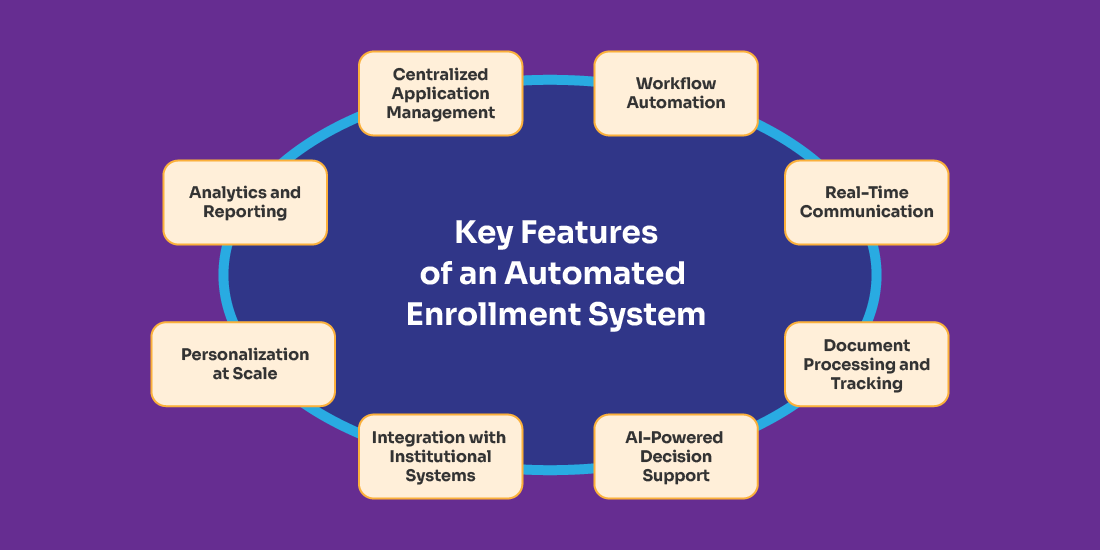
An automated enrollment system is a technology-driven platform designed to manage and streamline the student admissions and enrollment process through artificial intelligence, automation, and rule-based workflows. This system replaces manual and fragmented tasks with a unified solution that efficiently manages applications, communication, document processing, and decision support.
Centralized Application Management
Consolidates applicant data, documents, and interactions within a unified platform to facilitate efficient tracking and management.
Workflow Automation
Automates essential admissions processes, including application screening, follow-ups, document collection, and status updates.
Real-Time Communication
Facilitates immediate, automated communication with applicants via emails, notifications, and alerts throughout each stage of the process.
Document Processing and Tracking
Digitally collects, organizes, and monitors application documents to ensure completeness and minimize manual intervention.
AI-Powered Decision Support
Employs artificial intelligence to evaluate applications, identify high-intent candidates, and support admissions decisions.
Integration with Institutional Systems
Integrates with Student Information Systems (SIS), Customer Relationship Management (CRM) platforms, and other institutional systems to ensure consistent data flow across platforms.
Personalization at Scale
Provides personalized communication and engagement strategies based on applicant behavior, profile, and stage within the enrollment process.
Analytics and Reporting
Offers insights into application trends, conversion rates, and enrollment pipeline performance to inform strategic decision-making.
Benefits of Using an Enrollment Management System
An enrollment management system helps colleges and universities streamline the entire student recruitment and admissions lifecycle, from initial inquiry to enrollment.
By centralizing applicant data, automating repetitive tasks, improving communication, and providing real-time insights, these platforms enable institutions to operate more efficiently while delivering a better experience for prospective students. As enrollment challenges become increasingly complex, an enrollment management system empowers admissions teams to process applications faster, improve conversion rates, reduce administrative workload, and make data-driven decisions that support sustainable enrollment growth.
Accelerate Admissions Processing and Reduce Delays
The Problem
Many admissions teams still rely on manual processes to review applications, verify documents, and communicate decisions. During peak admissions cycles, this often leads to backlogs, delayed decisions, and frustrated applicants who may choose competing institutions with faster response times.
How an Enrollment Management System Helps
An enrollment management system automates application tracking, document collection, workflow routing, and status updates. This allows admissions teams to process applications more efficiently while maintaining consistency and compliance.
Use Case
A university receives 15,000 applications for a fall intake. Instead of staff manually checking transcripts and supporting documents, the system automatically validates submission requirements, flags incomplete applications, and routes qualified candidates to reviewers. As a result, application processing times are reduced significantly, helping the institution issue decisions faster.
Create a Frictionless and Student-Centric Enrollment Experience
The Problem
Prospective students often struggle with unclear application requirements, delayed responses, and limited visibility into their application status. This uncertainty can lead to disengagement and application abandonment.
How an Enrollment Management System Helps
The system centralizes communication, provides self-service portals, and delivers real-time updates throughout the enrollment journey. Students always know what steps they need to complete next.
Use Case
An international applicant uploads transcripts and submits an application. Through the student portal, they can instantly see missing requirements, receive automated reminders, and ask questions through an AI-powered assistant. This proactive support keeps the student engaged and reduces the likelihood of drop-off.
Improve Application-to-Enrollment Conversion Rates
The Problem
Many institutions invest heavily in recruitment but struggle to convert applicants into enrolled students. Without timely follow-up and personalized engagement, admitted students may lose interest or commit elsewhere.
How an Enrollment Management System Helps
Enrollment systems track student engagement and automate personalized outreach campaigns based on applicant behavior, helping institutions nurture prospects throughout the decision-making process.
Use Case
A student starts an application but does not complete it. The system automatically triggers reminder emails, sends relevant program information, and alerts an admissions counselor to follow up personally. These targeted interventions help recover applications that might otherwise have been lost.
Minimize Administrative Work and Increase Team Productivity
The Problem
Admissions staff often spend countless hours on repetitive tasks such as data entry, document sorting, application routing, and routine communications. This limits their ability to focus on strategic initiatives and student engagement.
How an Enrollment Management System Helps
Automation handles many of these routine processes, reducing manual effort and allowing staff to dedicate more time to high-value activities.
Use Case
Instead of manually assigning applications to reviewers, the system automatically routes applications based on program, applicant type, or geographic region. Staff can then focus on applicant counseling and recruitment efforts rather than administrative coordination.
Improve Data Quality and Eliminate Enrollment Errors
The Problem
Applicant data is often stored across spreadsheets, email threads, and disconnected systems. This fragmentation can result in duplicate records, missing information, and reporting inaccuracies that affect admissions decisions.
How an Enrollment Management System Helps
The platform creates a centralized database where all applicant information is stored, updated, and synchronized automatically across departments.
Use Case
A student updates their contact information after submitting an application. Rather than requiring multiple departments to update separate records, the change is automatically reflected across admissions, financial aid, and student services systems, ensuring consistency throughout the enrollment process.
Enable Better Collaboration Across Enrollment Teams
The Problem
Recruitment, admissions, financial aid, and academic departments often operate in silos, leading to communication gaps, duplicated efforts, and inconsistent interactions with students.
How an Enrollment Management System Helps
The system provides a shared platform where teams can access the same applicant records, communication history, and workflow updates in real time.
Use Case
An admissions counselor reviewing an application can immediately see previous conversations conducted by a recruiter and scholarship eligibility information provided by the financial aid team. This unified view allows departments to work together more effectively and provide a consistent student experience.
Make Smarter Enrollment Decisions with Real-Time Analytics
The Problem
Without access to reliable enrollment data, institutions often struggle to understand recruitment performance, identify bottlenecks, and forecast future enrollment outcomes accurately.
How an Enrollment Management System Helps
Advanced dashboards and reporting tools provide visibility into key enrollment metrics, allowing leaders to make informed strategic decisions.
Use Case
Enrollment leaders notice through system dashboards that applications from a particular region have increased by 30%, but conversion rates remain low. By analyzing student behavior data, they identify communication gaps and launch targeted outreach campaigns, resulting in improved yield rates and more effective recruitment spending.
Challenges Institutions Face Without an Enrollment Management System
As student expectations continue to rise and enrollment processes become more complex, managing admissions with spreadsheets, emails, and disconnected systems is becoming increasingly difficult. What may have worked a few years ago can quickly create bottlenecks when institutions are handling thousands of applications, documents, and student inquiries.
Admissions teams often find themselves spending more time on administrative tasks than meaningful student engagement, while applicants face delays, unclear communication, and a lack of visibility into their status.
Over time, these challenges can impact both operational efficiency and enrollment outcomes. Here are some of the most common obstacles institutions face when they don’t have a dedicated enrollment management system in place.
Costly Errors Caused by Manual Data Entry
Without a centralized enrollment system, admissions teams often rely on spreadsheets, emails, and manual data entry to manage applicant information. This increases the likelihood of duplicate records, missing documents, incorrect applicant details, and reporting inaccuracies. Even small errors can create delays in admissions decisions, negatively impact the student experience, and require significant time to correct.
Slow Application Processing and Admissions Delays
Managing applications manually can significantly slow down the admissions process, particularly during peak recruitment cycles. Staff must spend valuable time reviewing documents, updating records, tracking application statuses, and coordinating across departments. These delays can frustrate applicants and increase the risk of losing qualified students to institutions that offer faster admissions decisions.
Disconnected Systems Create Data Silos
Many institutions use separate platforms for recruitment, admissions, financial aid, student records, and communication. When these systems do not integrate effectively, information becomes fragmented across departments. Teams often struggle to access complete applicant records, resulting in duplicated work, inconsistent data, and limited visibility into the student journey.
Inefficient Student Communication and Follow-Up
Prospective students expect timely, personalized communication throughout the enrollment process. Without an enrollment system, institutions often rely on manual emails, phone calls, and spreadsheets to manage outreach efforts. This can lead to delayed responses, missed follow-ups, and inconsistent messaging, making it harder to keep students engaged and informed.
Limited Visibility into Enrollment Performance
Without centralized reporting and analytics, institutions often lack a clear understanding of how their enrollment processes are performing. Admissions leaders may struggle to track application volumes, conversion rates, recruitment campaign effectiveness, or enrollment trends. This lack of visibility makes it difficult to identify bottlenecks, optimize strategies, and make informed enrollment decisions.
Higher Applicant Drop-Off and Enrollment Melt
When students encounter lengthy processes, unclear requirements, or poor communication, they are more likely to abandon their applications or fail to enroll after being admitted. Without automated engagement tools and proactive follow-up workflows, institutions may miss critical opportunities to guide students through the enrollment journey, ultimately reducing conversion rates and overall enrollment outcomes.
Types of Enrollment Systems Used by Universities
Universities today use a range of enrollment systems depending on their size, structure, and digital maturity. These systems can range from traditional on-premise setups to modern cloud-based platforms, CRM-driven tools, and emerging AI-powered solutions.
Some institutions prefer standalone systems focused solely on admissions, while others adopt integrated platforms that manage the entire student lifecycle from inquiry to graduation. The choice often depends on factors like scalability needs, budget, IT infrastructure, and the level of personalization required in student engagement.
Cloud-Based Enrollment Systems
Cloud-based enrollment systems run on secure remote servers and are accessed online. This lets universities manage admissions from any location without needing a lot of on-site equipment. These systems are popular because they can grow with demand, are easy to update, and help admissions teams work together in real time.
Many schools use platforms like Slate by Technolutions or Ellucian’s cloud services to make application processing and communication smoother. Universities in the US, UK, and Australia use cloud-based systems to handle more international applicants efficiently.
On-Premise Enrollment Systems
On-premise enrollment systems are set up and managed on a university’s own servers. This gives schools full control over their data, customization, and security. These systems can be tailored to specific needs, but they often need a lot of IT support to keep running and up to date.
For example, many large public universities have used Oracle PeopleSoft for admissions and student records. Traditional universities, especially those with strict rules about data and compliance, still use on-premise systems.
AI-Powered Enrollment Platforms
AI-powered enrollment platforms use automation and machine learning to review applications, personalize messages, and predict which students are likely to enroll. These tools help admissions teams spot interested students, review documents automatically, and act quickly when needed.
Some universities are starting to use AI to work more efficiently and connect better with students, especially where competition for applicants is high. While these systems are still new, schools in places like the US and UK are testing AI to make admissions decisions smarter and cut down on manual work.
CRM-Based Enrollment Solutions
CRM-based enrollment solutions help universities manage relationships with prospective students at every stage, from inquiry to enrollment. These systems let schools track all communication, group applicants, and run targeted recruitment campaigns. For example, Arizona State University uses Salesforce Education Cloud to manage student engagement on a large scale.
CRM systems are especially helpful for schools that focus on personalized outreach and use many ways to communicate.
All-in-One Student Lifecycle Platforms
All-in-one student lifecycle platforms bring together admissions, enrollment, student records, and sometimes academic and alumni management in one system. This helps student data move smoothly from the first contact through graduation. Universities use solutions like Workday and Ellucian to modernize and connect their student systems. Large and multi-campus universities often choose these platforms to break down barriers between departments and work more efficiently.
How to Choose the Right Enrollment System
Choosing the right enrollment system involves aligning institutional needs with the platform’s capabilities, ensuring it supports efficiency, scalability, and a seamless student experience. It’s less about features alone and more about how well the system fits your admissions goals and workflows.
Define Institutional Goals and Enrollment Priorities
The selection of an appropriate enrollment system begins with a clear articulation of institutional objectives, such as increasing application volume, improving conversion rates, reducing processing time, or enhancing student engagement.
Without well-defined goals, institutions may implement robust systems that do not align with their specific requirements. For instance, a university experiencing low yield rates may benefit more from systems emphasizing communication and engagement features rather than solely focusing on application tracking.
Evaluate Automation and Workflow Capabilities
An effective enrollment system should substantially decrease manual workload by automating application processing, document verification, communication, and decision workflows. Institutions frequently encounter inefficiencies when staff dedicate significant time to repetitive tasks that could be automated.
For example, an optimal system would automatically route applications to reviewers, generate reminders for missing documents, and provide status updates without requiring manual input.
Assess Integration with Existing Campus Systems
Enrollment systems do not operate in isolation, so integration with tools like student information systems (SIS), learning management systems (LMS), CRM platforms, and finance tools is critical. Poor integration often leads to data silos and duplicate work across departments.
For example, when admissions data does not sync with financial aid or registrar systems, it creates delays and inconsistencies that affect both staff efficiency and student experience.
Review Scalability for Future Growth
Institutions should verify that the enrollment system can accommodate growth in application volumes, program offerings, and international recruitment initiatives. Universities often outgrow their systems when selections are based solely on present requirements rather than anticipated expansion.
A scalable system should manage seasonal increases in applications, support multiple campuses, and adapt to new workflows without compromising performance.
Analyze User Experience for Staff and Students
A system that is challenging to navigate may result in low staff adoption and student confusion. An effective enrollment platform should provide intuitive dashboards, straightforward application tracking, and a user-friendly interface for both institutional staff and applicants. For example, students should have the ability to check application status, upload documents, and receive updates independently, minimizing the need for manual support.
Ensure Strong Security and Compliance Standards
Enrollment systems process sensitive student data, such as academic records, identity documents, and financial information, which makes robust security and compliance measures imperative. Institutions should confirm that the system adheres to data protection regulations and implements best practices for encryption and access control. Insufficient safeguards may expose universities to data breaches, regulatory violations, and diminished applicant trust.
Evaluate Vendor Support and Implementation Training
Even the most advanced system may underperform without comprehensive onboarding, training, and continuous vendor support. Institutions should evaluate vendor responsiveness, the quality of implementation assistance, and the availability of training resources for staff.
For instance, universities frequently encounter challenges during peak admissions periods, which underscores the importance of timely and effective vendor support for uninterrupted operations.
Enrollment System Implementation: Best Practices
Implementing an enrollment system successfully requires clear planning, cross-functional collaboration, and a phased rollout approach. Institutions that focus on preparation, training, and continuous improvement tend to see faster adoption and better long-term outcomes.
Set Clear Enrollment KPIs from the Start
To implement a new system successfully, start by deciding what success means for your institution. Many schools bring in new tools without setting clear, measurable goals, which makes it hard to see if the changes work.
Tracking KPIs like how long it takes to process applications, conversion rates, student response times, and document completion rates helps you measure progress. For instance, if you want to speed up application turnaround, compare your current numbers to results after automation.
Engage Key Stakeholders Across Departments Early
Enrollment systems impact many teams, such as admissions, recruitment, financial aid, IT, and academic departments. If these groups are not included from the start, adoption may be low and workflows might not fit real needs.
Working together early helps the system match how people actually work and makes change easier. For example, bringing in admissions counselors during setup helps make sure workflows fit their review and decision-making process.
Plan Data Migration Carefully to Avoid Disruption
Moving data is a key part of setting up a new system, especially since schools often have lots of old applicant records in different places. If you do not plan this step well, you could lose data, create duplicates, or end up with errors. Taking a careful approach by cleaning, checking, and organizing data before moving it helps make the switch smoother. For example, many schools run both the old and new systems at the same time for a while to make sure everything is accurate before making the full change.
Provide Comprehensive Training for Admissions Teams
Even the most advanced system will fail if users are not properly trained. Admissions teams need to understand not just how to use the platform, but how it fits into their daily workflows. Training should include hands-on sessions, role-based guides, and ongoing support. For example, counselors should be trained on how to track applications, communicate with students, and use dashboards for decision-making.
Begin With Pilot Testing Before Full Rollout
Rolling out an enrollment system everywhere at once can be risky. Testing it first with a smaller department or program helps teams find problems early and improve how things work. This step-by-step approach makes sure the system is stable, and users are ready. For example, a university might start with one graduate program before using the system across the whole campus.
Continuously Monitor and Optimize Enrollment Workflows
Launching the system is just the beginning. To keep things running well, schools need to keep an eye on how the system works, listen to user feedback, and check enrollment numbers to spot ways to improve. For example, if you notice delays during document checks, you can adjust or automate those steps to work better.
Future Trends in Enrollment Systems
Enrollment systems are rapidly evolving as universities adopt more AI-driven, data-centric, and student-friendly technologies. The future will focus on automation, personalization, and accessibility, making the entire admissions journey faster, smarter, and more intuitive for both institutions and applicants.
AI-Powered Enrollment Assistants and Their Impact on Admissions Operations
AI-powered assistants are increasingly deployed to support admissions teams by automating repetitive tasks, including responding to queries, screening applications, and guiding students through requirements.
Many institutions encounter challenges related to the growing volume of inquiries and limited staff capacity to respond promptly. AI assistants address these issues by delivering instant, accurate responses and providing staff with actionable decision-making insights. For instance, these systems can summarize applications, identify incomplete submissions, and recommend subsequent actions for both students and counselors.
Predictive Enrollment Analytics for Smarter Decision-Making
Accurately forecasting enrollment outcomes remains a challenge for many institutions, often resulting in over- or under-enrollment in critical programs. Predictive analytics leverages historical data, applicant behavior, and engagement indicators to anticipate enrollment trends and identify high-probability applicants.
This enables admissions teams to prioritize outreach and allocate resources more efficiently. For example, universities can predict which applicants are most likely to enroll and concentrate personalized engagement efforts on those groups.
Conversational Admissions Experiences Across Channels
Traditional admissions communication is frequently fragmented across email, portals, and phone calls, which can create confusion for students. Conversational enrollment systems consolidate all interactions into a unified chat-based experience accessible via web, WhatsApp, SMS, and mobile applications.
This integration enables students to ask questions, submit documents, and receive updates in real time. For instance, a student can complete the entire application process through a single chat interface without the need to switch platforms.
Hyper-Personalized Student Enrollment Pathways
Generic communication no longer meets student expectations, especially in competitive global recruitment markets. Hyper-personalization uses AI and behavioral data to tailor messaging, program recommendations, and engagement strategies for each applicant.
This addresses the problem of low engagement caused by irrelevant or delayed communication. For example, a student interested in data science can receive customized reminders, scholarship alerts, and program content aligned specifically to their interests and profile.
Mobile-First Enrollment Platforms for On-the-Go Access
As students increasingly submit applications via mobile devices, institutions encounter challenges when enrollment systems are not optimized for mobile use. Mobile-first platforms facilitate seamless application submission, document uploads, and communication on smartphones. This approach reduces drop-off rates associated with complex, desktop-only processes. For instance, an international applicant can upload transcripts, monitor application status, and respond to queries entirely through a mobile application.
Voice and Multilingual Support for Global Accessibility
International institutions frequently encounter communication barriers resulting from language differences and limited accessibility options in traditional systems. Voice-enabled and multilingual enrollment platforms address these challenges by enabling students to interact in their preferred language and utilize voice commands. This enhances inclusivity and reduces obstacles in the application process. For example, a student can receive admission updates in their native language or complete application steps using voice assistance on mobile devices.
How EDMO Helps Universities Automate Enrollment
EDMO is an AI-powered enrollment platform that helps universities streamline and automate the entire admissions lifecycle. It reduces manual work, improves student engagement, and enables institutions to manage applications more efficiently through centralized workflows and real-time intelligence.
Centralized Enrollment Management
EDMO brings all enrollment activities into a single unified platform, eliminating the need to manage multiple disconnected tools. This helps universities avoid data fragmentation and ensures that admissions teams always work with accurate, real-time applicant information across the entire enrollment lifecycle.
AI-Powered Student Engagement
EDMO uses AI to help universities engage students more intelligently by responding to queries, guiding applications, and identifying intent signals. This reduces the burden on admissions teams while ensuring that students receive timely, relevant support throughout their journey.
Automated Communication Workflows
Instead of relying on manual emails and follow-ups, EDMO automates communication across channels like email, SMS, and WhatsApp. This ensures that students receive consistent updates, reminders, and guidance at every stage of the admissions process.
Real-Time Enrollment Tracking
EDMO provides admissions teams with real-time visibility into application progress, document status, and decision pipelines. This helps institutions quickly identify bottlenecks and take action to improve conversion rates and processing speed.
CRM and SIS Integrations
EDMO integrates seamlessly with existing CRM and Student Information Systems, ensuring smooth data flow across departments. This eliminates duplicate work, reduces errors, and enables a connected ecosystem for recruitment, admissions, and student services.
Personalized Student Journeys
EDMO enables institutions to deliver tailored experiences based on each student’s profile, behavior, and interests. This improves engagement and increases the likelihood of conversion by making every interaction more relevant and timely.
Conclusion
Modern enrollment challenges require more than manual processes and disconnected tools. As student expectations continue to rise, universities need smarter, faster, and more integrated systems to manage the entire admissions lifecycle. By adopting AI-powered enrollment platforms like EDMO, institutions can streamline operations, improve student engagement, and drive better enrollment outcomes while reducing administrative burden.
Frequently Asked Questions
Ques 1: What is an enrollment system?
Ques 2: What is an automated enrollment system?
Ques 3: How does an enrollment system work?
Written By






No comments yet. Be the first to comment!
Leave a Comment