

Table Of Contents
Introduction
Admissions teams at higher education institutions are now expected to carry out more duties than ever, such as handling increasing numbers of applications, responding to students through a variety of channels, monitoring recruitment efforts, co-ordinating the review of documents, and making timely decisions that have a direct effect on enrollment results. However, a large number of institutions still depend on separate systems, spreadsheets, their email inboxes, and manual follow-ups, all of which hinder the admissions process and result in excessive work for their staff.
A contemporary CRM has outgrown its status as simply a contact database and has now become the core of admissions operations. One that is suitably equipped enables colleges to consolidate applicant data, automate routine duties, enhance communication, and provides admissions staff with up-to-date visibility of each stage of the student’s journey. Since universities are competing for students and want to offer a more responsive experience to applicants, deciding on a CRM with the appropriate features is becoming an increasingly important strategic choice.
In this article we will examine the CRM features that admissions teams in higher education should focus on if they are to boost efficiency, aid better decision-making and provide a more seamless experience for prospective students.
What to Look for in a Higher Education CRM
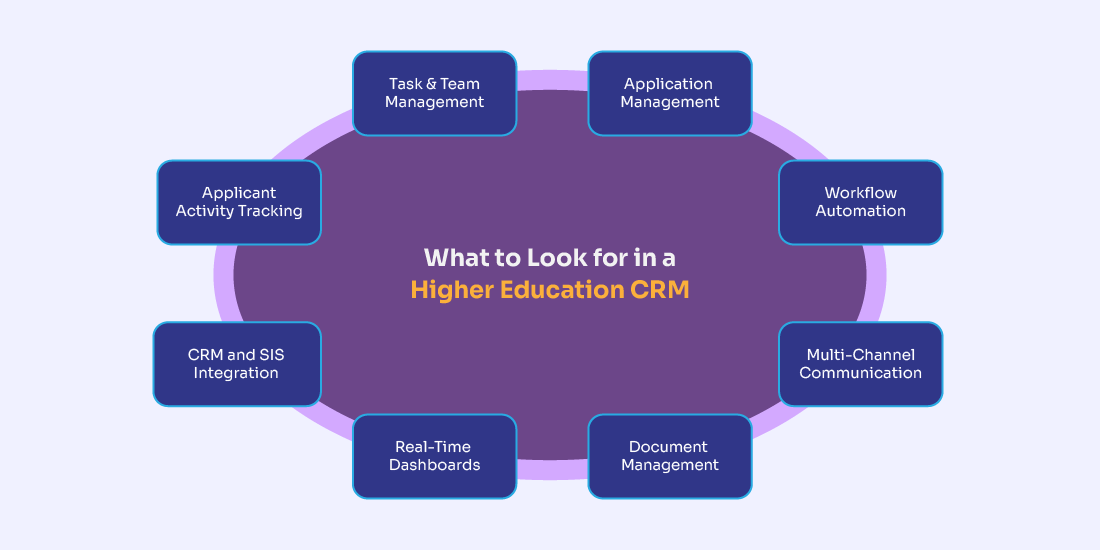
When evaluating a CRM for admissions, universities should look beyond basic contact management. A higher education CRM should support the full student enrollment lifecycle, from the first inquiry through application review, admission, and enrollment. It should help admissions teams work more efficiently, reduce manual administrative tasks, improve communication with students, and provide leadership with clear visibility into recruitment performance. The most effective CRMs are those that fit naturally into admissions workflows, integrate with existing campus systems, and continue to scale as application volumes grow.
Application and Inquiry Management
A strong higher education CRM should provide a centralized view of every prospective student from the moment they submit an inquiry. Admissions staff should see contact information, academic interests, recruitment source, communication history, application status, and next steps in one place. This eliminates switching between spreadsheets, email inboxes, and multiple databases and ensures no prospective student is overlooked during recruitment.
Workflow Automation
Admissions offices handle thousands of repetitive tasks, including sending reminders, requesting missing documents, assigning applications for review, and scheduling follow-ups. A CRM with workflow automation can trigger these actions automatically based on applicant behavior or application status. Automation reduces processing delays, improves consistency across the admissions team, and allows staff to spend more time advising students rather than managing administrative tasks.
Multi-Channel Communication
Today’s students expect timely responses across multiple communication channels. A modern CRM should support email, SMS, web chat, and other digital methods from a single platform. It should maintain a complete conversation history so any admissions officer can understand previous interactions and continue the conversation seamlessly. This creates a more personalized and responsive student experience.
Document Management
Document collection is often one of the most time-consuming parts of admissions operations. A higher education CRM should make it easy to receive, organize, classify, and track transcripts, test scores, recommendation letters, financial documents, and other application materials. Staff should quickly identify missing items, verify receipt dates, and access documents directly from the applicant record without searching shared drives or email attachments.
Real-Time Dashboards and Reporting
Admissions leaders need timely data to make informed decisions. The CRM should provide dashboards showing application volume, conversion rates, geographic distribution, counselor activity, and enrollment trends in real time. Instead of waiting for manually prepared reports, teams should monitor performance continuously and identify bottlenecks early in the recruitment cycle.
CRM and SIS Integration
A CRM should not operate in isolation. It should integrate smoothly with the institution’s student information system, application platform, financial aid system, and other campus technologies. Strong integration reduces duplicate data entry, improves data accuracy, and ensures that information flows automatically between systems throughout the student lifecycle.
Applicant Activity Tracking
Understanding student engagement is critical for effective recruitment. The CRM should track actions such as email opens, link clicks, event registrations, campus visit attendance, portal logins, and inquiry submissions. These signals help admissions teams identify highly interested students, prioritize outreach, and intervene when applicants become inactive.
Task Management and Team Collaboration
Admissions is rarely handled by one person. Counselors, evaluators, operations staff, and faculty reviewers often work on the same applicant record. A good CRM should support task assignment, shared notes, internal comments, and workflow ownership so teams can collaborate efficiently without relying on separate email chains or manual status updates.
Mobile Accessibility
Admissions officers frequently work outside their desks during recruitment travel, school visits, fairs, and events. Mobile access allows staff to review applicant records, update notes, respond to inquiries, and complete tasks from a phone or tablet. This improves responsiveness and keeps information current even when staff are traveling.
Security and Compliance
Student data is highly sensitive, so security should be a core requirement. A higher education CRM should provide role-based access controls, audit trails, encryption, secure authentication, and compliance capabilities aligned with regulations such as FERPA and relevant international privacy requirements. Institutions should be able to control who can view, edit, or export student information.
Scalability
Application volumes can increase significantly during peak admissions periods. The CRM should maintain performance during high-volume cycles and support future institutional growth, additional programs, new campuses, and expanding recruitment operations. Choosing a scalable platform helps avoid costly system replacements later.
AI and Analytics Capabilities
Increasingly, institutions are looking for CRMs that offer intelligent automation and predictive insights. AI-enabled capabilities can help identify applicants who are most likely to enroll, prioritize counselor outreach, summarize student interactions, detect incomplete applications, and surface trends that may otherwise go unnoticed. These features should enhance human decision-making rather than replace admissions professionals.
Ultimately, the best higher education CRM is one that simplifies daily admissions work, improves the student experience, and gives institutional leaders reliable data to guide enrollment strategy. Universities should evaluate CRM platforms not only on their feature lists but also on how effectively those features support real admissions operations.
Conclusion
Choosing the right CRM is no longer just a technology decision for higher education institutions; it is an enrollment strategy decision. Admissions teams need systems that help them manage growing inquiry volumes, communicate effectively with students, streamline application processing, and make faster, more informed decisions. The strongest higher education CRMs are those that reduce administrative burden while improving the student experience from first inquiry through enrollment.
When evaluating CRM platforms, institutions should focus on capabilities that support real admissions workflows: centralized student records, automation, multi-channel communication, document management, analytics, integrations, customization, and strong security controls. Features such as lead scoring and AI-driven insights can further help teams prioritize their efforts and engage students more effectively.
Ultimately, the best admissions CRM is the one that allows counselors to spend less time managing systems and more time building relationships with students. In an increasingly competitive enrollment environment, that shift from administrative work to meaningful student engagement can make a measurable difference in recruitment success, applicant satisfaction, and long-term institutional growth.
Frequently Asked Questions
Ques 1 What security and compliance features should a higher education CRM have?
Ques 2 Which CRM features are essential for managing student inquiries?
Ques 3 Why is lead scoring an important CRM feature for admissions teams?
Ques 4 What CRM integrations are important for higher education institutions?
Ques 5 What customization features should colleges look for in an admissions CRM?
Ques 6 Which CRM features help improve applicant engagement throughout the admissions journey?
Written By


You May Also Like
 AI in Education

 AI in Education
 AI in Education
No comments yet. Be the first to comment!
Leave a Comment