


Table Of Contents
Introduction
A student’s first experience with a college or university is usually through the admissions team, since this team answers their worried questions, looks at thousands of applications, arranges the necessary documents, meets the enrollment targets, and ensures that communication continues throughout the peak months of the year. However, successful admissions cycles are always the result of a team that is regularly working under tight deadlines, a high volume of applications, and constant pressure.
Managing an admissions team involves much more than just assigning tasks and keeping records. It is about setting up a situation in which counselors, coordinators, evaluators, and operations staff feel supported, motivated, and well-equipped so that they can carry out their best work; when morale is high, the team reacts more quickly, collaborates more effectively, communicates better with students, and keeps a higher level of accuracy over the entire admissions process.
The problem is that setting targets on their own is not enough to maintain motivation. Employees expect clarity, to be recognised, access to opportunities for growth, workloads that are manageable, and tools which cut down on repetitive tasks. Leaders who pay attention to these aspects regularly achieve better performance and experience less burnout, particularly during the peak times for recruitment and applications.
The following article looks at 11 proven methods for increasing motivation and performance among members of admissions teams. The strategies outlined are tailored to the higher education enrollment sector and can assist admissions leaders in creating a more engaged, resilient, and high-performing team at the same time as providing a better experience for prospective students.
Tips for Effectively Managing an Admissions Team
A well-managed admissions team can significantly impact enrollment outcomes and the student experience. During busy application seasons, staff often juggle inquiries, document reviews, interviews, and recruitment activities simultaneously. The following tips go beyond simple management advice and focus on practical ways to keep the team motivated, organized, and performing at a high level.
Set Clear Expectations
Admissions professionals work best when they know what is expected of them. Define responsibilities, turnaround times, communication standards, and enrollment goals clearly from the start. When expectations are transparent, team members can prioritize their work with confidence and avoid confusion.
Communicate Consistently
Regular communication keeps everyone aligned during fast-moving admissions cycles. Short weekly meetings, quick daily updates during peak periods, and open channels for questions prevent small issues from becoming major problems. Consistent communication also builds trust between managers and team members.
Recognize Good Work
Recognition is one of the simplest ways to improve morale. Thanking a counselor for excellent student support or acknowledging a staff member who cleared a document backlog shows that their effort is noticed. Frequent appreciation creates a positive culture where people feel valued for their contributions.
Invest in Training
Admissions processes, technology platforms, and compliance requirements continue to evolve. Provide training on CRM systems, communication skills, international admissions procedures, and new automation tools. Ongoing learning not only improves performance but also demonstrates that the institution is investing in its employees’ growth.
Encourage Team Collaboration
Admissions work is rarely successful when departments operate in isolation. Encourage counselors, evaluators, recruiters, and operations staff to share information and solve problems together. Collaborative teams are faster, more accurate, and better equipped to handle unusual applicant situations.
Use Data to Support Decisions
Tracking key metrics such as inquiry response time, application completion rates, and document-processing backlogs reveals where support is needed. Data helps managers allocate resources more effectively instead of relying on assumptions. It also lets teams see the impact of their efforts over time.
Reduce Manual Work
Repetitive administrative tasks can quickly drain energy from admissions staff. Automating document routing, reminders, status updates, and routine communications frees the team to focus on student conversations and relationship building. Technology should support staff, not add more complexity to their workload.
Support Well-Being During Peak Seasons
Application deadlines create intense pressure, especially when volumes surge unexpectedly. Monitor workloads, rotate responsibilities when possible, and encourage staff to take breaks. Managers who protect their team’s well-being are more likely to retain experienced admissions professionals and reduce burnout.
Create Growth Opportunities
High-performing staff want opportunities to develop new skills and advance their careers. Assign leadership projects, invite them to participate in strategic initiatives, or support attendance at professional conferences. Career development keeps talented employees engaged and strengthens the institution’s future leadership pipeline.
Keep Students at the Center
Every application represents a student making an important life decision. Reminding the team of this larger purpose helps maintain empathy and professionalism, even during stressful periods. A student-centered mindset often leads to better communication, stronger service, and a more meaningful admissions experience.
Effective admissions management is ultimately a balance of operational discipline and people leadership. When team members feel supported, recognized, and equipped with the right tools, they are far more likely to stay motivated and deliver exceptional results throughout the admissions cycle.
How to Keep Your Admissions Team Motivated
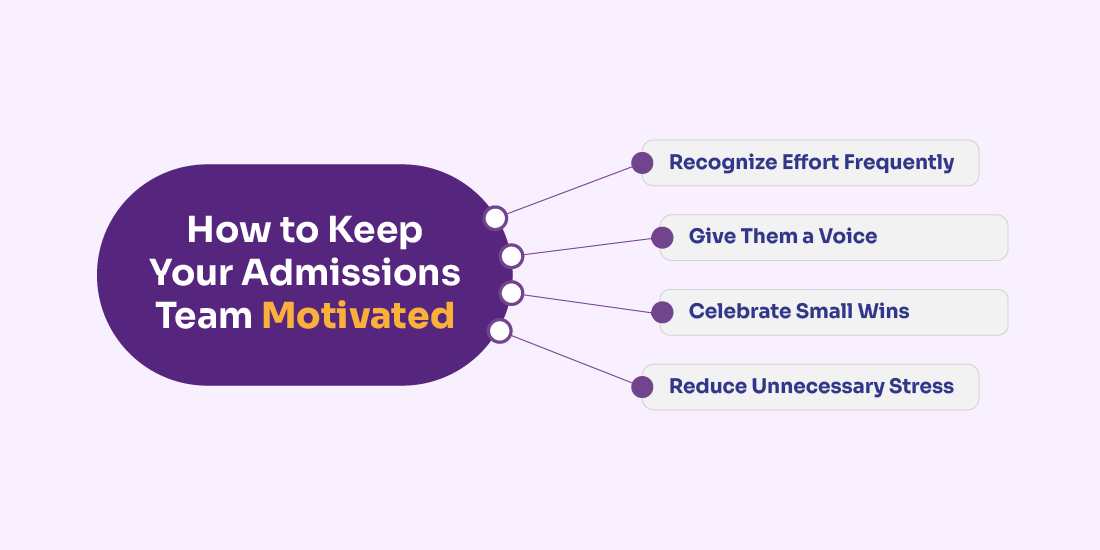
It takes more than just giving occasional praise or handing out rewards at the end of the year to keep an admissions team motivated. Since admissions professionals spend a great deal of their time meeting deadlines, responding to anxious questions from students, checking applications, and looking after large amounts of administrative work, their motivation remains high when they feel that their work has significance, when their efforts are acknowledged, and when their manager is interested in their success.
Connect Their Work to Student Success
Admissions staff tend to be motivated whenever they can see the actual effect of the work they do. Include stories of students’ successes, the enrollment results, and the feedback given by applicants and families. Once team members realise that the advice they provided helped a student to take the next step in life, the routine duties start to seem more meaningful.
Recognize Effort Frequently
Recognition needs to be both timely and specific; rather than giving a general “good job”, it is important to acknowledge precisely what was done well, for example, handling a difficult applicant situation professionally or reducing the application turnaround time. Frequently showing appreciation encourages positive behaviour and helps employees feel that their contributions are being noticed.
Give Them a Voice
People are more engaged if they are taken into account when decisions that concern their work are being made. Request input on recruitment strategies, communication templates, process improvements, and the adoption of new technology. Even if not all of the suggestions can be carried out, seriously listening to the team helps to build a sense of ownership and trust.
Celebrate Small Wins
The admissions cycles last a long time, and during the period when you’re waiting for the final enrollment figures it can seem as though no progress is being made. It’s a good idea to celebrate achievements such as finishing a major recruitment event, reducing the backlog of documents, or meeting an inquiry-response target. Celebrating small accomplishments helps to build momentum and maintains high energy levels right through the cycle.
Provide Opportunities to Grow
People are more motivated when they have a vision of their future within the organisation, and therefore you should provide training, mentorship, cross-functional projects, and opportunities for leadership. Since learning new skills makes the work more interesting and shows that the organisation places importance on long-term professional development.
Use AI Automation to Reduce Administrative Burden
One of the fastest ways to improve morale is to remove repetitive work from the admissions team’s day. AI automation tools can automatically extract information from transcripts and application documents, route files to the correct workflow, send status updates, answer routine student questions through chat or SMS, and surface applicants who need immediate attention. When counselors spend less time searching through PDFs or responding to the same inquiry repeatedly, they can focus on advising students, building relationships, and making thoughtful admissions decisions. Teams often experience less burnout and greater job satisfaction when technology handles the most repetitive tasks.
Reduce Unnecessary Stress
However great the motivation may be, it cannot compensate for chronic overload. You should regularly review the workflows and look for tasks which can be automated, simplified, or redistributed. Demonstrating adequate support during busy periods tells the team that management cares about both their performance and their well-being.
Encourage Peer Support
A supportive team atmosphere has a powerful motivating effect; it is important to get the staff to share their knowledge, assist each other when things are busy, and acknowledge one another’s achievements. Such strong relationships between peers usually make difficult work seem easier and more enjoyable.
Be Visible and Approachable
Managers who remain in touch with their team are able to keep morale high. They should walk around the premises, take part in team discussions, ask about any problems they may be having, and provide assistance when workloads get heavy. Employees are more likely to remain motivated if they feel that their leader is accessible and actually supportive.
Offer Flexibility When Possible
The admissions process usually involves times of high activity interspersed with more calm weeks. It is possible to improve staff work-life balance by offering flexible scheduling, allowing for occasional working from home, or by adjusting working hours during the non-peak times. Flexibility is generally seen as an indication of trust and respect.
Lead with Positivity
Members of the team usually pick up on the emotions of their manager. If the manager is calm, encouraging and focused on finding solutions, then he or she can help keep the team’s confidence up even when stressful admission periods are occurring. Being positive doesn’t mean ignoring the challenges; it means meeting them with optimism and by concentrating on what the team can achieve together.
Admissions teams that are motivated don’t just turn up by chance; instead, they are developed through regular recognition, effective communication, providing opportunities for development, and leadership that truly supports both performance and people. When strong people management is combined with AI automation tools which take over repetitive administrative tasks, universities will be able to create a more engaged admissions team, provide a better student experience, and reach stronger enrollment results.
The Role of the University’s Senior Leadership Team
The motivation and performance of an admissions team are shaped not only by admissions managers but also by the university’s senior leadership team. Presidents, vice presidents, provosts, deans, and enrollment leaders set the tone for how admissions is viewed across the institution. When senior leadership treats admissions as a strategic function instead of an administrative office, teams feel more valued and supported.
One of the most important responsibilities of senior leadership is to provide a clear enrollment vision. Admissions staff perform better when institutional goals are well defined, whether focused on growth, student quality, diversity, international recruitment, transfer enrollment, or retention. Clear priorities help teams make better decisions and align their daily work with the university’s broader mission.
Senior leaders also play a critical role in resource allocation. Adequate staffing, professional development budgets, modern CRM systems, and AI automation tools depend on leadership investment. Technologies like automated document processing, inquiry management, and student communication platforms can significantly reduce repetitive work and allow admissions professionals to focus on student engagement and relationship building.
Equally important is leadership visibility. Admissions teams are motivated when senior leaders acknowledge their efforts, attend recruitment events, share enrollment updates, and celebrate achievements publicly. Visible support sends a strong message that admissions work is essential to the institution’s success.
The senior leadership team should also foster collaboration across departments. Admissions outcomes are influenced by marketing, financial aid, academic departments, student services, and institutional research. Leadership can break down silos by encouraging shared goals, cross-functional planning, and regular communication among these units.
Finally, senior leaders are responsible for protecting team well-being during high-pressure enrollment periods. Monitoring workloads, supporting flexible practices when possible, and promoting a healthy workplace culture help prevent burnout and improve retention among experienced admissions professionals.
In short, a motivated admissions team is rarely created by frontline management alone. It results from senior leadership that provides strategic direction, invests in people and technology, recognizes contributions, encourages collaboration, and creates an environment where admissions professionals can succeed.
Conclusion
Managing an admissions team successfully requires a balance of strong leadership, clear processes, and the right technology. Admissions professionals are expected to deliver fast responses, accurate evaluations, personalized communication, and ambitious enrollment results, often during periods of intense workload. Universities that invest in communication, recognition, professional development, collaboration, and staff well-being are more likely to build motivated and high-performing teams. At the same time, AI automation tools can reduce repetitive administrative tasks such as document processing, inquiry handling, and application routing, allowing staff to focus on meaningful student interactions and strategic enrollment activities. When admissions leaders and senior university leadership work together to support people, processes, and technology, institutions can improve team morale, increase operational efficiency, and deliver a stronger experience for prospective students.
Frequently Asked Questions
Ques 1: How to Manage Admissions Office Staffing Challenges?
Ques 2: What are the biggest challenges in managing an admissions team?
Ques 3: How can universities improve admissions team performance?
Ques 4: How can technology help admissions teams work more efficiently?
Ques 5: How can AI improve admissions team productivity and decision-making?
Ques 6: What KPIs should admissions teams track?
Written By


You May Also Like
 AI in Education

 AI in Education
 AI in Education
No comments yet. Be the first to comment!
Leave a Comment