
Table Of Contents
- 1What is the Student Life Cycle?
- 2What Is Student Lifecycle Management?
- 3Student Lifecycle vs. Student Journey: What Is the Difference?
- 4The 6 Stages of the Student Lifecycle
- 5Student Lifecycle at a Glance
- 6How to Manage Key Stages of Student Lifecycle
- 7Importance of Student Lifecycle Management in Higher Education
- 8What Is Modern Student Lifecycle Management?
- 9How Does Technology Play a Role in Student Lifecycle Management?
- 10Platforms to Manage Student Life Cycle Stages
- 11How Can Data Analytics Be Used to Evaluate the Student Lifecycle?
- 12Student Lifecycle Management Software vs. CRM vs. SIS
- 13Benefits of Student Lifecycle Management
- 14Choose the Right Student Lifecycle Management Software
- 15How to Build a Student Lifecycle Management Strategy
- 16Where AI Fits in Student Lifecycle Management
- 17Summary
The student journey does not begin on the first day of class.
It starts when a prospective student first discovers an institution. It continues through application, enrollment, academics, student support, graduation, and even the alumni relationship.
Each stage creates different needs.
A prospective student may need help comparing programs. An applicant may need support completing documents. An enrolled student may need academic guidance. A graduating student may need career support.
For universities, managing these experiences across different departments and systems can become complex.
This is where student lifecycle management becomes important.
Student lifecycle management helps colleges and universities understand, manage, and improve every stage of the student journey. It brings together communication, student data, academic progress, support services, and technology so that students receive the right support at the right time.
The need for this connected approach remains clear. According to the National Student Clearinghouse Research Center, 85.8% of students who started college in fall 2024 were still enrolled in spring 2025. By fall 2025, that figure had fallen to 77.1%.
Technology also plays a growing role in the student experience. The 2026 EDUCAUSE Students and Technology research found that students want clearer guidance, more consistent digital tools, and fewer barriers when trying to get help or complete their work.
A strong lifecycle strategy helps institutions connect these experiences instead of managing them as separate events.
In this guide, we explain the stages of the student lifecycle, how universities can manage each stage, what data should be tracked, and how technology can create a more connected student experience.
What is the Student Life Cycle?
The Student Life Cycle refers to the complete journey a student undertakes with an educational institution from the very first point of contact (as a prospective student) through graduation and continuing as an alumnus. It helps institutions map out and manage every interaction with the student to optimise their experience, improve outcomes, and build long-term engagement.
This model is not only essential for admissions and enrollment offices but also for academic advisors, marketing teams, faculty, and alumni relations departments. When managed effectively, the student life cycle supports higher retention rates, increased student satisfaction, and stronger alumni networks.
With rising competition, shifting demographics, and student expectations evolving rapidly (especially in a post-COVID digital-first world), lifecycle management has become a strategic priority in higher education institutions worldwide.
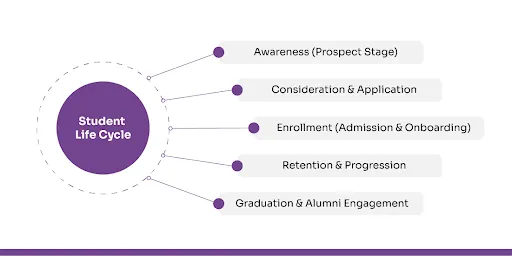
The student life cycle can be divided into 5 core stages, each with its own goals, tools, and outcomes. Let’s explore them step by step:
Awareness (Prospect Stage)
This is the first moment a potential student becomes aware of your institution. It could be through a digital ad, university ranking, social media reel, friend recommendation, or school fair.
University of Southern California uses targeted YouTube and Instagram ads to promote niche programs like Game Design, generating a 12% increase in international applications in 2023.
Consideration & Application
Now that students know your university, they start researching more. This is your chance to help them evaluate their fit and guide them toward applying.
University of Toronto improved application conversions by 18% after integrating personalised email campaigns and real-time chatbots on its admissions page.
Enrollment (Admission & Onboarding)
Once a student receives an offer, the goal is to officially enroll them and provide a seamless onboarding experience.
Georgia State University tracks over 800 risk indicators daily and sends alerts to advisors when students fall behind leading to a 32% increase in on-time graduations.
Retention & Progression
This stage ensures students don’t drop out mid-program and continue making academic progress.
Purdue University uses predictive analytics to anticipate student dropout risks and achieved a 91% first-year retention rate in 2024.
Graduation & Alumni Engagement
Once students graduate, institutions should maintain the relationship to foster loyalty, support, and continued engagement.
Harvard Business School uses an integrated alumni platform offering lifelong learning modules, networking, and regional chapters, leading to strong alumni participation and donation rates.
What Is Student Lifecycle Management?
Student lifecycle management, or SLM, is the structured approach universities use to manage and improve the student experience from first contact through graduation and alumni engagement.
It connects the people, processes, data, and technology involved at each stage.
Student lifecycle management may include:
- recruitment and lead nurturing
- admissions and application processing
- enrollment and onboarding
- academic advising
- student engagement
- financial and support services
- retention initiatives
- career preparation
- graduation
- alumni engagement
The goal is not simply to track students.
The goal is to understand what they need, identify where they may face friction, and make it easier for teams to provide timely support.
A strong lifecycle strategy also gives staff a more complete view of the student.
Instead of admissions, academic teams, advisors, and student services working with separate information, relevant data can move with the student throughout the journey.
Student Lifecycle vs. Student Journey: What Is the Difference?
The terms student lifecycle and student journey are often used in similar ways.
There is a small difference.
The student lifecycle describes the stages a student moves through during their relationship with an institution.
The student journey focuses more on the student’s actual experience within those stages.
For example, enrollment is one stage of the lifecycle.
The student journey within that stage may include receiving an admission offer, reviewing financial aid, submitting documents, paying a deposit, registering for courses, and attending orientation.
A lifecycle shows where the student is.
A journey map shows what the student is experiencing at that point.
Universities can use both together.
The lifecycle provides the structure. The journey map helps identify specific touchpoints, questions, delays, and opportunities for improvement.
The 6 Stages of the Student Lifecycle
Each stage of the student lifecycle has a different goal.
The information students need also changes as they move forward.
Awareness and Discovery
The lifecycle begins when a prospective student first learns about an institution.
This may happen through Google search, social media, college fairs, recommendations, university rankings, advertising, counselors, or alumni.
At this stage, students are usually asking broad questions.
They may want to know:
- Which programs are available?
- What does the university cost?
- What are the admission requirements?
- What is campus life like?
- What career opportunities are available?
- Is this institution right for me?
The institution’s goal is to make useful information easy to discover.
Clear program pages, student stories, search-friendly content, virtual events, and simple ways to request information can all support this stage.
The focus should be on helping students explore rather than pushing them immediately toward an application.
Consideration and Application
Once students become interested, they begin comparing institutions more seriously.
They may attend events, speak with counselors, review program details, calculate costs, and explore career outcomes.
Eventually, some students start an application.
This is where communication becomes more personal.
Students need clear information about:
- application requirements
- deadlines
- required documents
- scholarships
- financial aid
- program eligibility
- transfer credits
- international requirements
Institutions should make it easy for applicants to understand what they have completed and what still needs attention.
Long forms, unclear requirements, slow responses, and missing-document confusion can create unnecessary application drop-off.
Admission, Enrollment, and Onboarding
After an application is reviewed, admitted students move into one of the most important stages of the lifecycle.
An admission offer does not guarantee enrollment.
Students may still be comparing institutions, reviewing financial aid, discussing options with family, or waiting for answers about housing, credits, or costs.
Communication at this stage should focus on helping students make confident decisions.
Once students accept an offer, they may need to complete:
- deposits
- final transcripts
- identity verification
- financial arrangements
- housing forms
- course registration
- orientation
- academic advising
- student account setup
A clear onboarding experience reduces uncertainty and prepares students for the academic term.
Academic Experience and Engagement
Once students begin classes, the focus moves from recruitment to experience and success.
Students now interact with faculty, advisors, classmates, academic systems, student services, and campus communities.
Engagement can include:
- class participation
- LMS activity
- advising appointments
- student organizations
- campus events
- tutoring
- mentoring
- career services
- peer communities
Institutions need to make these resources easy to find.
Students should not have to understand the university’s internal structure before receiving support.
A connected student experience makes it easier to find the right person, resource, or next step.
Retention and Progression
Retention is not a single activity.
It is the result of what happens throughout the student’s academic experience.
A student may face academic, financial, personal, or administrative challenges at different points.
Institutions can use data to identify early signs that a student may need additional support.
Useful signals may include:
- declining grades
- missed classes
- low LMS activity
- incomplete registration
- missed advising appointments
- unpaid balances
- repeated course withdrawals
- lack of engagement with support services
These signals should not be treated as automatic proof that a student will leave.
They should help staff decide when outreach may be useful.
Georgia State University provides a well-known example. Its predictive advising system tracks around 800 risk factors for more than 40,000 students each day. Alerts have supported more than 250,000 one-to-one advising meetings since the program began.
The value of analytics comes from the action that follows.
Graduation and Alumni Engagement
The student lifecycle does not necessarily end when a degree is awarded.
Graduation creates a new relationship between the individual and the institution.
Before graduation, students may need:
- degree completion checks
- career guidance
- credential information
- job search support
- internship opportunities
- employer connections
After graduation, institutions may continue the relationship through:
- alumni communities
- networking
- mentoring
- career services
- lifelong learning
- events
- fundraising
- volunteer opportunities
Strong alumni relationships can also support future students through mentoring, recruitment, referrals, and career connections.
Student Lifecycle at a Glance
| Lifecycle Stage | Main Student Need | Institutional Priority | Useful Data |
|---|---|---|---|
| Awareness | Understand options | Attract right-fit prospects | Source, content engagement, inquiries |
| Consideration & Application | Make a confident choice | Improve application completion | Application activity, communication, missing requirements |
| Enrollment & Onboarding | Complete next steps | Improve yield and reduce melt | Deposits, documents, registration, onboarding tasks |
| Academic Engagement | Learn and stay connected | Support student experience | LMS activity, advising, events, support usage |
| Retention & Progression | Stay on track | Identify and support students early | Grades, attendance, credits, alerts, appointments |
| Graduation & Alumni | Complete the degree and move forward | Support outcomes and long-term relationships | Completion, career outcomes, alumni engagement |
How to Manage Key Stages of Student Lifecycle
Here are the key stages that require intervention and interactions from an institution during the student’s journey.
Awareness (Prospect Stage)
Maximise visibility, target right-fit students, and spark interest.
- Invest in SEO and Content Marketing: Blog posts, student testimonials, and YouTube videos showcasing campus life rank high on Google.
- Use Social Media Strategically: Platforms like Instagram, YouTube Shorts, and LinkedIn can effectively reach Gen Z.
- Personalise Ads & Outreach: Use geolocation and behavioural targeting for digital ads.
- Leverage Influencer & Alumni Marketing: Let alumni and current students share their stories.
Tool Suggestion: Google Ads, Meta Ads Manager, Unibuddy, Sprout Social
Consideration & Application
Help students explore, compare, and apply confidently.
- Simplify Application Processes: Minimise clicks, steps, and unnecessary document uploads.
- Offer Virtual Counsellors or Chatbots: Instant responses improve engagement and reduce dropout during the application.
- Host Webinars/Q&As with Faculty or Students: Builds trust and gives clarity.
- Showcase Outcomes: Highlight career placements, internship stats, and ROI.
Tool Suggestion: Intercom, LiveChat, Common App integrations, Element451
Enrollment & Onboarding
Ensure a smooth transition from admission to active student.
- Create a Digital Welcome Hub: Provide step-by-step onboarding with checklists, videos, and deadlines.
- Assign Peer Mentors or Advisors Early: Human connection reduces melt and builds belonging.
- Offer Pre-arrival Courses or Bootcamps: Especially useful for international or first-gen students.
- Use Mobile Notifications: Automate reminders about forms, housing, fees, and other important reminders.
Tool Suggestion: Comevo, Mongoose Cadence, Ellucian Banner, PeopleGrove
Retention & Progression
Keep students motivated, involved, and supported.
- Introduce Student Engagement Platforms: Use gamified tools for clubs, attendance, and activities.
- Early Alert Systems: Faculty flag students falling behind; advisors intervene fast.
- Feedback Culture: Use micro-surveys and real-time polls in classes.
- Mental Health & Well-being Resources: Normalise and promote counselling, peer support, and wellness activities.
Tool Suggestion: CampusGroups, Poll Everywhere, Starfish, Suitable
Retention & Progression
Prevent dropouts, ensure academic progress, and offer support.
- Use Predictive Analytics: Identify at-risk students before they disengage.
- Offer Flexible Learning Options: Hybrid classes, summer credits, and part-time options help retain non-traditional students.
- Create Personalised Pathways: Advisors help students track milestones and credits.
- Provide Emergency Financial Aid or Micro-grants: A major dropout trigger is sudden financial stress.
Tool Suggestion: Civitas Learning, EAB Navigate, DegreeWorks, Modo Campus
Graduation & Alumni Engagement
Maintain lifelong relationships and transform graduates into advocates.
- Build a Strong Alumni Portal: Offer job boards, lifelong learning courses, and social networking.
- Automate Post-Graduation Outreach: Celebrate their achievement and invite continued connection.
- Leverage Alumni as Mentors & Donors: Involve them in admissions, placements, and campaigns.
- Track Career Outcomes: Show future students how alumni succeed post-graduation.
Tool Suggestion: Graduway, EverTrue, Hivebrite, Salesforce Education Cloud
Importance of Student Lifecycle Management in Higher Education
In this section, we discuss why universities should invest in a comprehensive student lifecycle management strategy. This approach not only helps the institution gain a holistic view of student engagement but also enhances internal processes to foster a data-driven environment.
Improves Retention and Graduation Rates
SLM helps institutions keep students engaged and supported throughout their academic journey. By identifying when students are disengaging or at risk of dropping out, schools can provide targeted interventions like academic advising, tutoring, or financial aid. Consistent tracking of educational progress, attendance, and emotional well-being increases the chances of students staying enrolled and graduating on time.
- Georgia State University uses predictive analytics to track over 800 risk indicators daily. As a result, they added over 40,000 additional graduates per year and saw a significant increase in graduation rates, especially among low-income and first-gen students.
- Many institutions have witnessed increased retention: a case study using CRM identified 20% of first‑year students at risk, with 75% of those retaining into the next year after targeted intervention.
Enables Proactive, Data-Driven Interventions
SLM allows institutions to shift from reactive to proactive support. Using tools like predictive analytics and CRM systems, universities can identify struggling students before they fail or drop out. This means advisors can reach out early, offer resources, and monitor progress more accurately.
- Eastern Michigan University found that over 55% of undergraduates were failing to complete their degrees in 6 years. Using AI and data models, they began predicting which students were likely to struggle and offering early interventions.
Enhances Student Engagement and Experience
Engaged students are more likely to perform better, persist in their studies, and build meaningful connections. SLM helps institutions offer personalised experiences from welcome messages and student clubs to targeted mental health support and career mentoring.
According to the National Survey of Student Engagement (NSSE), students who participate in high-impact practices (e.g. internships, learning communities) show greater satisfaction and stronger academic outcomes.
Reduces Administrative Burden and Increases Efficiency
SLM systems, especially CRM platforms, automate repetitive tasks like application tracking, fee reminders, onboarding workflows, and academic alerts. This reduces staff workload and allows more time to support students directly.
Institutions using integrated CRM platforms report up to 40% reduction in administrative time, and 20–30% increase in conversion and retention rates due to timely outreach and automation.
Supports Strategic Enrollment and Long-Term Planning
SLM aligns with Strategic Enrollment Management (SEM)—a structured approach to attract, enroll, and retain students in line with institutional mission, capacity, and market needs. It allows long-term forecasting and targeted marketing.
Universities implementing SEM models have reported better alignment between enrollment goals and institutional growth, increasing student diversity and stabilising revenue streams.
What Is Modern Student Lifecycle Management?
Modern student lifecycle management is less about buying one large system and more about connecting the systems, data, and workflows that already shape the student experience.
A modern approach usually includes five elements.
Connected student data
Relevant data should move between CRM, SIS, LMS, advising, communication, and support systems.
Staff should not need to rebuild the student record at every stage.
A shared view of the student
Teams need enough context to understand the student’s history, current stage, and outstanding actions.
This does not mean every employee should see every piece of data.
Access should follow clear roles and privacy rules.
Workflow automation
Routine tasks such as reminders, document routing, status updates, and internal notifications can be automated.
This reduces delays and manual work.
Real-time analytics
Institutions need visibility into what is happening now, not only end-of-term reports.
Current data can help teams identify application bottlenecks, onboarding delays, or signs of student disengagement.
AI with clear oversight
AI can help answer questions, summarize information, process documents, identify patterns, and recommend next actions.
It should still operate with reliable institutional data, appropriate security, and clear human oversight.
Modern student lifecycle management is therefore not simply a new name for a CRM or SIS.
It is an operating model that connects systems around the student.
How Does Technology Play a Role in Student Lifecycle Management?
In the digital age, technology is no longer just a supporting tool it’s the backbone of effective Student Lifecycle Management. From the moment a student discovers a university to the day they become a lifelong alumnus, tech solutions play a critical role in ensuring a smooth, engaging, and data-driven experience.
Modern education institutions are increasingly using AI, predictive analytics, CRM systems, mobile apps, and learning platforms to personalise interactions, boost student success, and operate efficiently. A 2024 Educause report revealed that 74% of universities plan to increase investments in student experience platforms, with a focus on automation, analytics, and personalisation.
Let’s explore how technology enhances each phase of the student lifecycle:
Student Attraction & Awareness
- Digital marketing tools target the right audiences through SEO, social media, and behavioural analytics.
- Chatbots and virtual info sessions offer 24/7 answers and real-time engagement.
Tools: Google Ads, Meta Business Suite, Unibuddy, Mautic, ChatGPT-based bots
Application & Admission
- CRM platforms manage outreach, follow-ups, and application status updates.
- AI-driven tools analyse documents and automate eligibility decisions.
Tools: Slate CRM, Salesforce Education Cloud, Document Intelligence tools, Common App integrations
Enrollment & Onboarding
- Student portals and mobile apps guide admitted students through steps like fee payment, housing, visa support, and orientation.
- Automated reminders reduce summer melt.
Tools: Ellucian Banner, PeopleSoft Campus Solutions, Comevo, Mongoose Cadence
Academic Engagement & Learning
- Learning Management Systems (LMS) support hybrid learning, assignment tracking, and feedback loops.
- Gamified apps encourage participation in co-curriculars and student clubs.
Tools: Moodle, Canvas, Blackboard, Kahoot!, CampusGroups, Suitable
Retention & Student Support
- Predictive analytics flags at-risk students using GPA trends, attendance, and LMS activity.
- Early alert systems trigger academic and mental health interventions.
Tools: Civitas Learning, Starfish, EAB Navigate, Power BI
Graduation & Alumni Engagement
- Alumni platforms help manage networks, events, and fundraising.
- Credentialing software enables digital diplomas and career tracking.
Tools: Graduway, Hivebrite, EverTrue, Parchment
Platforms to Manage Student Life Cycle Stages
Each stage of the student lifecycle requires specific tools to streamline operations, enhance engagement, and improve outcomes. Below is a breakdown of recommended platforms by lifecycle stage:
Awareness & Attraction (Prospect Stage)
To reach and attract potential students.
Top Platforms:
- HubSpot / Salesforce Marketing Cloud – Lead nurturing, email campaigns, and performance tracking.
- Unibuddy – Enables peer-to-peer student conversations to influence decision-making.
- Mautic – Open-source marketing automation with personalised outreach tools.
- Google Ads / Meta Business Suite – Paid media campaigns to boost visibility.
Application & Admission
To manage inquiries, applications, and offer communications.
Top Platforms:
- Slate CRM – Widely used for application management and communications.
- Element451 – AI-powered admissions CRM with automation and personalisation.
- Common App Integration – Centralises student applications across institutions.
- Technolutions – Supports custom application workflows and analytics.
Enrollment & Onboarding
To guide admitted students through pre-arrival and initial setup.
Top Platforms:
- Ellucian Banner / Colleague – Student Information Systems (SIS) for enrollment and data records.
- PeopleSoft Campus Solutions – End-to-end enrollment, registration, and financial aid processing.
- Comevo – Online orientation and onboarding tool for new students.
- Mongoose Cadence – Text messaging platform for timely reminders and communication.
Academic Engagement & Experience
To manage coursework, learning, and student involvement.
Top Platforms:
- Canvas / Blackboard / Moodle – Learning Management Systems (LMS) for academic delivery.
- CampusGroups / Suitable – Gamified engagement tracking for co-curricular activities.
- Kahoot! / Poll Everywhere – In-class interactive tools for active learning.
- Zoom / MS Teams – For virtual classes, group work, and faculty collaboration.
Retention & Student Success
The goal is to identify at-risk students, monitor progress, and provide support.
Top Platforms:
- Civitas Learning – Uses predictive analytics to intervene early for struggling students.
- Starfish by Hobsons – Connects students with advisors and provides alert systems.
- EAB Navigate – Tracks academic progress and promotes intervention strategies.
- Watermark Insights – Supports outcomes assessment and engagement tracking.
Graduation & Alumni Engagement
To maintain alumni relationships and promote long-term engagement.
Top Platforms:
- Graduway / Hivebrite – Alumni platforms for networking, mentoring, and fundraising.
- EverTrue – CRM focused on donor engagement and alumni giving.
- Salesforce Alumni Experience – Tracks alumni lifecycle and event participation.
- Parchment / Credly – Manages digital diplomas, credentials, and verification.
How Can Data Analytics Be Used to Evaluate the Student Lifecycle?
Data analytics helps institutions understand how students move through each stage of the lifecycle.
Instead of looking only at final outcomes such as enrollment or graduation, universities can examine the steps that lead to those outcomes.
Useful lifecycle analytics include:
| Stage | Metrics to Track |
|---|---|
| Awareness | Website engagement, inquiry volume, inquiry source |
| Application | Application starts, completion rate, document completion, response time |
| Enrollment | Admit rate, yield rate, deposits, registration completion, summer melt |
| Academic Experience | LMS activity, advising appointments, campus engagement, support usage |
| Retention | Credit completion, GPA trends, attendance, re-enrollment |
| Graduation | Time to degree, completion rate, credential completion |
| Alumni | Career outcomes, alumni activity, mentoring, event participation |
The most useful analysis looks for patterns across stages.
For example, an institution may find that students who attend orientation are more likely to register on time.
Another institution may discover that applicants who wait longer for document review are less likely to complete the application.
Data can also help institutions identify differences across programs, student groups, campuses, or entry terms.
The goal is not to collect every possible metric.
The goal is to identify the data that helps teams make better decisions and take useful action.
Student Lifecycle Management Software vs. CRM vs. SIS
| System | Main Purpose | Typical Role in the Lifecycle |
|---|---|---|
| Student Lifecycle Management Software | Coordinate multiple lifecycle stages | Connect student experience, workflows, and data |
| CRM | Manage relationships and communication | Recruitment, admissions, outreach, advising |
| SIS | Maintain official student records | Enrollment, registration, academics, billing |
| LMS | Manage teaching and learning | Courses, assignments, grades, learning activity |
| Analytics Platform | Analyze data | Trends, risk indicators, performance |
| Student Engagement Platform | Improve student interaction | Communication, communities, events, support |
These systems often work together.
The key question is not which label is best.
The more useful question is whether data and workflows can move between the systems without creating unnecessary manual work.
Benefits of Student Lifecycle Management
In today’s data-driven and student-centric education environment, Student Lifecycle Management (SLM) has become an essential strategy for universities and colleges. It refers to the systematic coordination of every phase of the student journey from initial awareness and enrollment to graduation and alumni engagement.
By integrating tools, automating communication, and analysing student behaviours in real time, SLM enables institutions to not only operate more efficiently but also personalise student experiences, reduce dropouts, and foster lifelong engagement. It empowers institutions to make smarter decisions, increase student satisfaction, and build sustainable success.
Improved Student Retention and Graduation Rates
- Student Lifecycle Management systems monitor academic performance, attendance, and engagement data to detect early signs of student disengagement or risk.
- With this data, universities can proactively intervene through personalised academic advising, tutoring support, or financial aid helping more students stay enrolled and graduate on time.
Enhanced Student Engagement and Satisfaction
- SLM tools deliver personalised messages, event invites, and academic updates tailored to each student’s needs and interests.
- This level of targeted communication and access to support services increases a student’s connection to campus life, improving both satisfaction and overall success.
Streamlined Administrative Processes
- SLM platforms automate repetitive administrative tasks like document processing, follow-up emails, scheduling, and status tracking.
- This reduces manual workload for staff, minimises errors, and allows faculty and support teams to focus more on student-facing activities.
Data-Driven Decision Making
- Institutions collect real-time data on student behaviour, performance, and engagement through integrated SLM systems.
- These insights allow universities to make informed decisions on curriculum planning, resource allocation, and support strategies based on actual student needs.
Boosted Enrollment and Conversion Rates
- Marketing automation and CRM platforms nurture prospective students with timely, personalised communication across email, SMS, and social media.
- This leads to stronger applicant engagement, higher trust in the institution, and a higher conversion rate of inquiries into enrollments.
Seamless Student Experience Across the Journey
- From application to graduation, SLM ensures students receive consistent information and smooth access to services through unified portals or mobile apps.
- This seamless experience helps reduce confusion, builds trust, and ensures students feel supported at every stage of their academic journey.
Stronger Alumni Relations and Career Outcomes
- SLM platforms help maintain post-graduation relationships through alumni communities, event invitations, and mentorship opportunities.
- They also connect students with internships and jobs via employer networks, improving post-college outcomes and institutional reputation.
Choose the Right Student Lifecycle Management Software
Choosing the proper Student Lifecycle Management software is key to improving student engagement, retention, and institutional efficiency. The ideal platform should streamline the entire student journey from recruitment to alumni engagement while offering automation, real-time insights, and a user-friendly experience. Here are the top factors to consider when making your decision.
Understand Your Institution’s Needs
Identify your key challenges (e.g., low retention, poor engagement, complex admissions) and find a tool that directly addresses them.
Check Full Lifecycle Coverage
Ensure the platform covers all stages recruitment, admissions, academics, support, career services, and alumni engagement.
Look for Seamless Integration
The software should integrate easily with your existing LMS, CRM, SIS, and communication platforms to ensure data consistency.
Prioritise User Experience
Choose a platform with an intuitive interface for students, faculty, and staff ideally with mobile access and self-service options.
Evaluate Automation & Personalisation Features
Look for automation in emails, alerts, onboarding, and engagement workflows, plus personalised student journey options.
Analyse Analytics and Reporting Capabilities
Powerful data dashboards and predictive analytics help identify trends, improve decisions, and support at-risk students.
Ensure Security and Compliance
Check for compliance with local and global data privacy laws (like FERPA or GDPR) and strong security protocols.
Check Vendor Support and Training
A reliable vendor offers onboarding, continuous support, regular updates, and training resources for smooth adoption.
Review Scalability and Customisation
Your SLM platform should grow with your institution and allow customisation to match your workflows and branding.
Compare Costs vs Value (ROI)
Assess the licensing model, hidden costs, and expected ROI in terms of time savings, student success, and retention impact.
How to Build a Student Lifecycle Management Strategy
Technology should not be the first step.
Institutions should first understand the lifecycle they already have.
- Map the lifecycle
Document the major stages from first inquiry through graduation and alumni engagement.
Include important student actions and institutional handoffs.
- Identify friction
Look for delays, duplicate tasks, unclear ownership, and common student questions.
These are often the best places to begin improving the experience.
- Define ownership
Every major stage and workflow should have a clear owner.
If no team owns a handoff, it is more likely to fail.
- Identify the systems involved
Map the CRM, SIS, LMS, communication tools, portals, analytics platforms, and other systems involved at each stage.
This makes data gaps easier to see.
- Decide which data matters
Avoid collecting data without a clear purpose.
Choose indicators that can support decisions or action.
- Automate repetitive work
Start with tasks that are high-volume and predictable.
Examples include reminders, document routing, appointment notifications, and status updates.
- Create escalation paths
Not every situation should be automated.
Make it clear when a case should move to an advisor, admissions counselor, faculty member, or support team.
- Measure outcomes
Track whether the changes improve student progression, staff efficiency, response time, retention, or another defined goal.
- Improve continuously
The student lifecycle will change as student expectations, programs, policies, and technology change.
Review the journey regularly rather than treating lifecycle design as a one-time project.
Where AI Fits in Student Lifecycle Management
AI can support several stages of the student lifecycle, but the strongest use cases are usually specific.
During admissions, AI can help answer questions, guide applicants, process documents, and support application review.
During enrollment, it can provide reminders and help students understand next steps.
During the academic journey, AI can help surface information, summarize interactions, identify patterns, and support staff workflows.
Analytics can also help institutions identify students who may need additional support.
The goal should not be to remove people from the student experience.
AI is most useful when it handles repetitive or information-heavy tasks and gives staff more time for situations that require judgment, empathy, or deeper support.
Summary
Understanding and managing the student lifecycle from first awareness to alumni engagement is now critical for higher education success. Institutions that implement data-driven strategies and use technology like CRM systems and predictive analytics see higher retention, stronger engagement, and better outcomes. Georgia State University, for example, used such tools to significantly boost graduation rates. Student Lifecycle Management platforms streamline this journey, improve decision-making, and personalise support. Choosing the right software means ensuring full lifecycle coverage, seamless integration, and scalability. In a competitive landscape, SLM not only enhances student experience but also builds lasting institutional value.
Frequently Asked Questions
Question 1. How are technology and education related to each other?
Question 2. How Should a University Manage Its Data to Support Students?
Question 3. What is a Student Lifecycle or Student Journey Map?
Question 4. Why is Student Lifecycle Management important in higher education?
Question 5. What are the key stages of the student lifecycle?
Question 6. What tools help manage the student lifecycle effectively?
Question 7. How can predictive analytics improve student retention?
Written By


You May Also Like
 AI in Education

 AI in Education
 AI in Education
No comments yet. Be the first to comment!
Leave a Comment