

Table Of Contents
- 1Introduction
- 2AI’s Proven Impact on Enrollment Marketing in Higher Education
- 3How Higher Education Institutions Can Adopt AI in Enrollment Marketing
- 4Key Benefits of AI in Higher Education Enrollment Marketing
- 5Challenges and Risks of AI in Higher Education Enrollment Marketing
- 6The Biggest Enrollment Marketing Gaps in Higher Education Today
- 7Where Enrollment Leaders Are Seeing the Biggest Wins Today
- 8Conclusion
Introduction
The use of artificial intelligence (AI) in enrollment marketing involves applying machine learning, predictive analytics, natural language processing, and automation tools in order to help colleges and universities attract, engage with, and enroll students more effectively. Rather than depending mainly on generic email campaigns, one-size-fits-all outreach, and manual follow-up, AI allows institutions to analyze student behaviour, detect enrollment intent, provide personalized communication, and automate routine tasks throughout the recruitment and admissions process.
In higher education AI can be used to support a variety of enrollment marketing activities, such as recruiting students, scoring leads, managing inquiries, running email and SMS campaigns, carrying out conversations with chatbots, following up on applications, processing documents, evaluating transfer credits, verifying identities, and forecasting enrollment. It can also assist admissions teams in providing prospective students with timely and personalized information via web chat, text messaging, voice assistants, and CRM-based campaigns. By combining student data with real-time engagement insights, AI enables universities to expand their outreach, improve response times, decrease administrative workload, and offer a more personalized student experience from the first point of inquiry through to enrollment.
AI’s Proven Impact on Enrollment Marketing in Higher Education
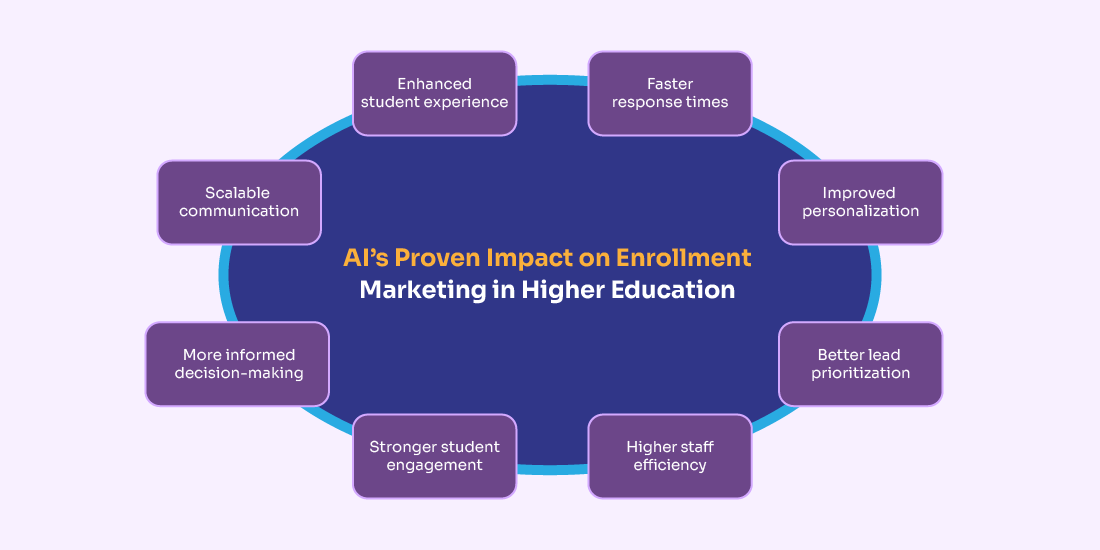
Colleges and universities are feeling more pressure to respond quickly to prospective students, personalize their communication, and improve enrollment results, all while working with limited staff. AI is helping enrollment and marketing teams meet these goals by taking over repetitive tasks, analyzing student engagement data, and making interactions more relevant throughout the recruitment process. These changes are starting to show measurable results in recruitment, admissions, and student engagement.
Faster response times
AI-powered chatbots, virtual assistants, and automated messaging can answer student questions right away, even after regular office hours. Prospective students do not have to wait for an admissions counselor to reply. This faster response keeps students interested during their decision-making process and makes it less likely they will give up or choose a school that replies sooner.
Improved personalization
AI looks at student interests, academic preferences, location, engagement history, and where they are in the enrollment process to personalize messages. Instead of getting generic emails, students receive information that matches their chosen program and stage in the process. This leads to a better student experience, stronger engagement, and a higher chance that students will finish their applications.
Better lead prioritization
Predictive analytics can spot prospective students who are more likely to enroll by looking at their behavior, interactions, and past patterns. Enrollment teams can then focus their efforts on students who are most likely to apply or enroll. This helps staff use their time and budgets more efficiently and improves conversion rates without needing to hire more people.
Higher staff efficiency
Enrollment offices often spend a lot of time on routine tasks like answering common questions, scheduling follow-ups, updating records, and handling paperwork. AI can take care of many of these jobs, so counselors and admissions officers have more time to advise students and build relationships. This leads to higher productivity, fewer delays, and more capacity during busy admissions seasons.
Stronger student engagement
AI helps schools figure out the best time, way, and message to reach prospective students. Personalized emails, text reminders, chatbot chats, and targeted web content encourage students to interact more often with the school. This leads to higher engagement throughout the recruitment process and can help more students finish their applications and enroll.
More informed decision-making
AI analytics give enrollment leaders real-time information about how campaigns are doing, trends in inquiries, applicant behavior, and recruitment results. Instead of only using old reports, schools can now track performance all the time and adjust their strategies quickly. This leads to better decisions and faster responses to changes in enrollment.
Scalable communication
As inquiry volumes grow, maintaining personalized communication becomes difficult for admissions staff. AI enables institutions to communicate with thousands of prospective students simultaneously while still tailoring content to individual interests and behaviors. The impact is the ability to scale recruitment efforts without proportionally increasing staffing costs, making growth more sustainable.
Enhanced student experience
From the first inquiry through enrollment, AI can provide timely reminders, application status updates, program information, financial aid guidance, and next-step instructions. Students receive consistent support throughout the enrollment process, reducing confusion and frustration. The impact is a smoother enrollment journey, greater student confidence in the institution, and a stronger first impression that can influence enrollment decisions.
For many schools, the main goal is not to replace enrollment staff but to help them focus on more valuable work like counseling, building relationships, managing yield, and planning recruitment strategies. AI is helping enrollment marketing move from simply reacting to situations to engaging students in a more proactive and data-driven way.
How Higher Education Institutions Can Adopt AI in Enrollment Marketing
There is no need for a full technological overhaul when introducing AI into enrollment marketing. The most successful institutions generally start by identifying a number of important applications, set up a system of governance, and then proceed gradually as both staff confidence and tangible results increase. Taking a step-by-step method allows universities to improve their recruitment outcomes while at the same time reducing operational risk.
Step 1: Start with high-volume enrollment workflows
Institutions ought to start by selecting tasks that take up a lot of staff time and which follow clear and predictable procedures; typical examples of such tasks are responding to inquiries, scheduling appointments, sending out application reminders, collecting documents, and providing answers to frequently asked questions. The reason for this is that these types of workflows lead to quick improvements in efficiency and enable the teams to enjoy the advantages of AI without interfering with the main admissions activities.
Effect: Students will receive faster service, there will be less administrative work, and the staff will adopt the new system more quickly.
Step 2: Centralize enrollment data before scaling AI
AI works at its most effective level when student information is linked together across CRM systems, SIS platforms, marketing platforms, and communication tools. Before launching AI projects, institutions must make certain that the data is accurate, easily accessible, and consistently governed.
Effect: It will lead to improved personalization, more dependable analytics, and stronger recruitment insights.
You should be careful since poor data quality can result in inaccurate recommendations, in duplicate outreach, and in an inconsistent experience for students.
Step 3: Introduce AI-powered student engagement
When the basic workflows have been made stable, organisations have the option of introducing conversational AI via web chat, SMS, and voice channels. These AI assistants are able to answer common questions, help students with the next steps, and offer support outside of office hours.
The result is higher engagement rates, better responsiveness, and increased accessibility for prospective students.
You should be careful since students must always have a straightforward way of getting in touch with a human counselor when their questions become complicated or sensitive.
Step 4: Expand personalization across campaigns
Email, text, and web content can be customized according to a person’s academic interests, geographic location, their engagement history, and the stage they are at in the enrollment process. Institutions ought to start off by focusing on a small number of segments and then slowly increase their personalization initiatives.
Effect: It leads to more pertinent communication, stronger links with students, and a better conversion of inquiry into application.
You should be careful not to go overboard with personalization since it might seem intrusive or could be based on data that the students did not voluntarily give.
Step 5: Add predictive enrollment analytics
Once reliable engagement data has been established, organisations will be able to use predictive models to spot students who have a stronger intention to enrol, to estimate yield, and to prioritise their outreach activities.
Effect: More efficient use of money spent on recruitment and a better distribution of counselors’ time.
You should be careful since predictive models should support rather than replace professional judgment. The historical data might include biases which influence the recommendations.
Key Benefits of AI in Higher Education Enrollment Marketing
The main benefit of AI does not consist in replacing enrollment teams since it enables them to devote more time to the sort of work which actually advances students towards enrollment. Most admissions offices are attempting to respond more quickly, offer more personalized communication, and deal with increasing numbers of inquiries all while having a limited number of staff members. This is the area in which AI is proving most useful.
Personalized outreach that feels relevant
Students ignore messages that appear to be sent to all members of the audience. By using AI, educational institutions are able to work out what a student is interested in and then send messages that seem more relevant to that particular student. Engagement generally increases when the communication aligns with a student’s intended field of study, their location, or the stage they are at in the application process. Since students nowadays have become used to highly personalised digital experiences, higher education cannot afford to come across as generic.
Less time on repetitive tasks
There is a long list of tasks in every admissions office which need to be carried out but do not call for the counselor’s expertise, such as sending follow-up emails, giving reminders, arranging appointments, providing status updates, and answering simple questions. When these kinds of interactions are automated, staff members get back the time needed for conversations that demand empathy, sound judgment, and the building of relationships. For educational institutions that are suffering from staffing shortages, this additional capacity is important.
Support that works on the student’s schedule
Most prospective students don’t restrict their search for colleges to just dropping in during office hours. A great deal of them study the various programs late at night, on weekends, or while in different time zones. Because of AI-powered chat and messaging tools, students are able to get immediate answers when they are actively seeking information, which in turn helps maintain the momentum of the recruitment process rather than causing a delay.
A small team can reach a much larger audience
A highly practical advantage is scalability. Institutes are able to communicate with tens of thousands of prospective students through email, text, and web channels without having to increase their staff at the same rate. This is particularly valuable for regional institutions and smaller enrolment teams which need to compete with bigger universities for attention.
Better decisions, not just more data
People in charge of enrollment already have a large number of reports, but what they usually don’t have is up-to-date insight. AI can be used to work out which campaigns are causing interest, where students are dropping out of the process, and which groups might require further outreach. Rather than waiting until the end-of-cycle analysis, the teams can make adjustments while the recruitment cycle is still going on.
A smoother experience from inquiry to enrollment
Students are much more likely to finish an application when they know exactly what their next step should be. Giving out timely reminders, offering personalised advice, and providing quick answers cuts down on confusion and help students to stay on track. The outcome is not only greater operational efficiency but also a better first impression of the institution.
The human touch becomes more valuable, not less
It is ironic that one of the major advantages of AI is that it provides more room for human interaction. Since technology takes over routine communication, counselors are then able to concentrate on mentoring students, talking over their academic goals, and dealing with complicated issues. The institutions which have achieved the best results are not having to choose between technology and people; instead they are using technology to make their human staff more effective.
Challenges and Risks of AI in Higher Education Enrollment Marketing
It is true that these technologies can greatly enhance enrollment marketing, but they by no means offer a “set it and forget it” answer. The majority of the actual difficulties are not technical; rather, they relate to data, processes, governance, and people. The institutions that achieve the best results generally proceed with care, keep students at the heart of their decisions, and ensure strong human supervision.
Student data deserves extra care
Since enrollment offices deal with personal information that is highly sensitive, privacy must always be given the highest importance. When considering any new technology it should be assessed in terms of data security, access controls, retention policies, and adherence to regulations such as FERPA and GDPR. Students are much more likely to place their trust in an institution that is open about how it collects and uses their information.
Old patterns can be repeated
Since predictive models are based on historical data and that data might include inequities, outreach recommendations could inadvertently give advantages to certain student groups if the patterns are not carefully examined. It is therefore essential to carry out regular auditing together with human review in order to ensure that recruitment practices stay fair.
Not every tool is built for higher education
Originally, many platforms were developed with retail or corporate marketing in mind. Higher education involves quite different workflows, such as the assessment of transfer credits, meeting residency requirements, adhering to financial aid timelines, and following the admission rules that are specific to each programme. Before adopting such a product, enrollment leaders should consider whether it actually understands these complexities.
Students still want real people
Automation is useful for handling routine inquiries, but when students are talking about financial aid, academic fit, immigration matters, or their personal situations, they usually prefer a human conversation. Technology should make it easier for students to get in touch with staff, not add another level between them and their counselors.
The upfront investment is real
It is possible to achieve long-term efficiency improvements, but this usually requires an initial outlay on software, integration, training, and continuous management. Instead, smaller institutions tend to find it more sustainable to begin with one or two high-impact applications rather than trying to carry out a comprehensive transformation right from the start.
Confident answers are not always correct
Generative systems sometimes give out information that is inaccurate or out of date even when they sound entirely certain. If they state a wrong deadline, scholarship requirement, or admissions policy it can cause confusion for students and add extra work for staff. Nevertheless, important messages regarding enrollment should still be checked over by people.
Staff adoption matters
New technology will only be adopted when the enrollment team are at ease with using it; although some staff members may be enthusiastic, others might be concerned about the changes to their roles. The extent of adoption can be greatly affected by clear communication, training, and involving the staff in the rollout process.
The biggest mistake is adopting technology without a goal
Gathering new tools is easy as long as they are on offer. The most effective implementations generally start with a particular enrollment challenge, such as slow response times when handling inquiries, low rates of application completion, or a heavy workload involving the processing of documents; measure the results and then expand step by step.
The best institutions are not having to decide between technology and people; instead, they use technology to deal with routine tasks so that the counselors can concentrate on advising, on building relationships, and on the conversations that are most important to students.
The Biggest Enrollment Marketing Gaps in Higher Education Today
One of the biggest enrollment marketing challenges facing colleges and universities today is that students are moving faster than many enrollment operations. A prospective student can order groceries, book travel, get banking support, and receive personalized recommendations online within seconds, so they naturally bring those expectations to the college search. When they encounter slow responses, generic emails, or complicated processes, the experience feels outdated. This is exactly why conversations about AI in enrollment marketing have become so important across higher education.
Response times are still slower than students expect
It is common for students to make an inquiry as they are carrying out research into colleges; if they don’t get a response soon after, then that initial enthusiasm may vanish. In a large number of admissions offices, enquiries are still sent through shared inboxes or handled by manual processes, and as a result a reply could take hours or even days. One of the most obvious areas for improvement is to provide faster, automated replies.
Communication still feels too generic
Students can tell when they are receiving the same message as everyone else. Many institutions continue to rely on broad email campaigns that do not reflect a student’s interests, intended program, or stage in the application process. One of the strongest use cases for AI in enrollment marketing in higher education is helping institutions deliver communication that feels more relevant and personal.
The student journey is often fragmented
Marketing has a certain view of the student, admissions another, and financial aid or advising yet another. Since these different systems are not always linked together, students may get repeated requests, inconsistent information, or outreach that is not in line with their current stage in the process. In the student’s eyes, the institution should come across as a single, cohesive organization.
Too much time is spent on administrative work
At many colleges and universities, activities such as reviewing transcripts, indexing documents, carrying out applications follow-up, assessing transfers, and entering data are still carried out manually. Staff have to spend a great deal of time transferring information from one place to another and as a result do not get the opportunity to interact with students. This is still one of the most ongoing problems relating to enrollment marketing and admissions workflows in higher education.
Support is not always available when students need it
Potential students don’t restrict their search for colleges to business hours. Many of them look into courses late at night, on weekends, or while in other countries. Parents may also look for alternatives after they have finished work. If assistance is only provided during office hours, then the institutions lose the chance to interact with students when they are most interested.
Decisions are often made after the fact
People in charge of enrollment often base their decisions on reports which outline what took place last month or last quarter. However, by the time a trend shows up in such a report, the recruitment cycle could have changed already. For schools that want to respond quickly to changes in student behaviour, having up-to-date enrollment information is becoming more and more important.
Transfer and adult learners encounter unnecessary friction
Transfer students and adult learners usually have the least tolerance for complicated procedures since they are juggling work, family, and other duties. The enrollment process can seem more difficult than it has to be due to frequent requests for documents, vague timelines for credit evaluation, and a number of handoffs.
Adoption is happening unevenly across campus
Certain departments are trying out conversational tools, analytics, or automation, whereas in others there is no definite strategy. This leads to an inconsistent student experience since a student might have a highly personalized interaction in one office and a completely manual one in another, making the institution seem fragmented.
Staff are being asked to use tools they were never trained on
New technology is usually introduced with the hope that the teams will work out how to use it as they proceed. If there is no training, no guidance, and no clear policies in place, staff members might become unsure about what is appropriate, what is effective, and what is compliant. Greater value is obtained from technology investments when institutions also make equal investments in preparing their workforce.
Policies have not always kept pace with innovation
Many colleges and universities are taking up new tools more quickly than they are establishing policies relating to data use, transparency, accountability, and ethical oversight. Although governance is generally not the most exciting aspect of innovation, it is what safeguards students, staff, and the institution as the adoption of these tools increases.
Where Enrollment Leaders Are Seeing the Biggest Wins Today
Conversations about AI in enrollment marketing have moved beyond theory. Enrollment leaders are increasingly using these technologies in practical ways to improve recruitment operations, support students more effectively, and reduce pressure on admissions staff. The most successful institutions are not trying to automate everything at once; they are focusing on areas where students expect faster service and where teams spend the most time on repetitive work. The encouraging news is that many colleges and universities are already seeing measurable benefits, while even larger opportunities remain ahead.
Student communication is becoming faster and more responsive
Many institutions are using conversational tools to answer common questions, send reminders, and keep prospective students engaged through web chat, text messaging, and email. Students receive information when they are actively researching programs rather than waiting for office hours, which helps maintain momentum during the recruitment process.
Recruitment efforts are becoming more focused
Engagement data and predictive insights are helping admissions teams identify which students are most likely to apply, complete an application, or enroll. Instead of treating every inquiry the same, counselors can prioritize outreach and spend more time with students who show stronger intent.
The biggest opportunity is improving the enrollment experience behind the scenes
Forward-looking institutions are exploring automated document processing, transfer credit evaluation, identity verification, enrollment forecasting, and advisor support tools that surface information in real time. These capabilities can shorten processing timelines, reduce administrative bottlenecks, and create a smoother journey from first inquiry to enrollment.
The institutions making the most progress tend to start with a specific enrollment challenge, measure the results, and expand gradually. The real opportunity is not simply adding new technology; it is creating an enrollment operation that is more responsive, informed, and student-centered at every stage of the journey.
Best AI Tools Higher Education Institutions Should Adopt
When enrollment leaders ask which tools they should adopt first, the answer is usually not “the most advanced platform.” The better question is, which tools solve the biggest operational bottlenecks today? For most colleges and universities, the strongest early investments are tools that improve student communication, automate document-heavy workflows, strengthen enrollment integrity, and give staff faster access to information. Institutions tend to see the quickest return when they start with practical use cases that directly affect response time, application processing, and student support.
A few examples of higher-ed-focused tools that address these areas include:
Student Copilot
This conversational assistant supports prospective and current students through web chat, SMS, and other communication channels. It can answer common questions, provide application guidance, send reminders, and keep students engaged outside business hours. The biggest advantage is that students receive timely support when they are actively researching programs rather than waiting for an admissions counselor to become available.
Transfer Credit Evaluator
Transfer evaluation is one of the most time-consuming workflows in admissions. Transfer Credit Evaluator automates transcript reading and credit mapping, allowing evaluators to review transfer coursework more efficiently. Institutions can reduce processing delays, improve consistency, and provide transfer students with decisions faster.
Email Doc Extractor
Admissions offices receive thousands of emailed documents each cycle. Email Doc Extractor monitors admissions inboxes, identifies attachments, classifies document types, and routes information into the institution’s CRM workflow. This reduces manual downloading, sorting, and data entry, giving staff more time to focus on student-facing work.
Student ID Verification
Enrollment fraud and identity verification have become growing concerns across higher education. Student ID Verification helps institutions confirm applicant identity through automated verification workflows, supporting enrollment integrity while minimizing friction for legitimate students.
These examples illustrate an important principle: the most valuable tools often quietly remove friction from everyday enrollment operations. Faster responses, quicker transfer decisions, cleaner document workflows, and stronger identity verification can impact student experience more than a complex system that is difficult for staff to adopt. Institutions that begin with targeted, high-impact workflows usually build confidence faster and create a stronger foundation for broader enrollment modernization.
The discussion about the use of AI in enrollment marketing has changed rapidly. What was originally seen as an experimental technology is now being adopted as a practical enrollment strategy by colleges and universities who want to react more quickly, communicate in a more personal way, and work more efficiently. The institutions that are achieving the greatest results aren’t necessarily those with the biggest budgets; rather, they are the ones who are willing to reconsider outdated work processes and concentrate on the student experience.
Conclusion
The key point is that technology by itself isn’t the objective; faster responses to inquiries, personalised outreach, automated processing of documents, improved enrolment integrity, and better enrolment insights are only important in so far as they help students feel supported at every stage of their experience. Human interaction still lies at the heart of recruitment and admissions, and the best results are achieved by combining technology with the knowledge and expertise of enrolment professionals.
For most organisations the following move doesn’t involve launching a large-scale transformation programme but instead consists of focusing on one or two key areas, for example, inquiry management, transfer evaluation, student communication, or identity verification, measuring the results and then expanding slowly. This method lowers the level of risk, helps to build staff confidence, and establishes a sustainable route to modernisation.
Since the competition for students is becoming increasingly fierce, AI is moving from being a future trend to becoming a strategic capability. Those institutions which make careful use of AI, have effective governance, and implement it with the student at the centre are likely to be in a better position to attract, engage and enroll students in the coming years.
Frequently Asked Questions
Ques 1. What measures can universities take to prevent bias in their AI-powered enrollment marketing?
Ques 2. How does AI in enrollment marketing differ from traditional enrollment marketing?
Ques 3, What is the time taken to implement AI into admissions and enrollment workflows?
Ques 4. Is it possible for AI to tailor its communication to prospective students?
Ques 5. How do you produce an enrollment marketing plan using AI?
Ques 6. In what way is artificial intelligence changing enrollment marketing in higher education?
Written By


You May Also Like
 AI in Education

 AI in Education
 AI in Education
No comments yet. Be the first to comment!
Leave a Comment