

Table Of Contents
- 1Introduction
- 2Student Copilot: Bringing AI-Powered Conversations to SMS
- 3What Is AI Texting?
- 4AI Texting vs. Traditional SMS: What’s the Difference?
- 5Why Universities Are Using AI Texting for Student Communication
- 6How AI Texting Works in Higher Education
- 7What does an AI texting conversation look like?
- 8AI Texting Across the Student Enrollment Journey
- 9How AI Texting Can Reduce Admissions Staff Workload
- 10AI Texting vs. Email, Chatbots, and Phone Calls
- 11How AI Texting Integrates With CRM and University Systems
- 12What Universities Should Look for in an AI Texting Platform
- 13How to Measure the Success of AI Texting
- 14Best Practices for AI Texting in Higher Education
- 15How EDMO Enables AI Texting Across the Enrollment Journey
- 16Conclusion
Introduction
Universities didn’t start using AI to write messages just because texting had become popular; instead, they adopted it because the conventional method of handling admissions communication was becoming harder to scale.
The admissions teams were already sending emails, taking calls and, in many cases, texting prospective and accepted students directly, but with the increasing number of applications, the number of routine inquiries, reminders and follow-ups also rose. Although the staff was able to tailor their communications, they could not realistically meet the speed at which the students expected replies.
AI texting was developed as a means of narrowing that gap. The initial aim was simple: to make timely and personalized communication available to a larger number of students without the need for the admissions teams to handle each conversation individually. Universities started to use AI-driven texting to answer ordinary questions, remind students of deadlines, identify the students who required extra support, and help applicants progress through the enrollment steps.
Georgia State University was among the first to take such action. In response to the increasing amount of summer melt, the university introduced an AI-powered texting assistant which was used for sending reminders, answering questions and assisting admitted students with completing their enrolment tasks. Other institutions then adopted similar methods, employing conversational texting to help with the completion of applications, with regard to financial aid, the submission of documents, orientation and other important stages.
The technology has now gone far beyond offering basic automated reminders. Currently, the various platforms use AI, two-way SMS, institutional knowledge bases and links to campus systems in order to provide more conversational student support. For instance, universities including Wayne State University and the University of Northern Colorado make use of AI-driven text conversations to answer questions, send forward-thinking reminders and refer students to staff when human involvement is required.
The guide examines that evolution by looking at why universities have adopted AI texting, what objectives they had, how it has affected communications regarding admissions and enrollment, which platforms are currently being used, and which universities have implemented them.
Student Copilot: Bringing AI-Powered Conversations to SMS
EDMO’s Student Copilot illustrates this shift toward conversational texting in higher education. Originally designed as an AI-powered enrollment assistant across web and voice, Student Copilot added two-way SMS, allowing prospective students to text questions about application deadlines, admission requirements, financial aid, transfer credits, and enrollment next steps and receive immediate, institution-specific responses.
The intent is not simply to automate text reminders. Student Copilot allows universities to use SMS as a two-way enrollment channel. Students can start a conversation, receive answers based on institution-approved knowledge, and be handed off to enrollment staff when a question requires human intervention. Staff retain the full conversation context rather than having to start the interaction over.
The tool also supports proactive communication. Admissions teams can send one-to-one messages for application updates, reminders, and follow-ups, or use one-to-many SMS campaigns for deadlines, events, announcements, and other time-sensitive communications. This creates a combination of automated conversations and outbound engagement within the same channel.
For enrollment teams, the value is primarily operational. Routine questions can be handled instantly, while counselors can spend more time on conversations that require judgment, empathy, or individualized guidance. Student Copilot is also designed to connect with university systems and use institution-approved information, helping maintain consistency across student interactions.
Today, Student Copilot supports an omnichannel student engagement model, connecting students through voice, SMS, WhatsApp, and web while providing application guidance, real-time updates, reminders, and next-step support. EDMO currently lists 350K+ students engaged and 2M+ queries resolved across the platform.
What Is AI Texting?
AI texting in higher education uses artificial intelligence to have two-way conversations with students through SMS. Unlike traditional text messaging, where universities send one-way reminders or campaign messages, AI texting allows students to ask questions and receive immediate, personalized responses. An AI texting platform can answer questions about applications, deadlines, admissions requirements, financial aid, and enrollment using information provided by the institution.
For college admissions and enrollment teams, AI texting provides a way to communicate with more students without adding the same workload for staff. Universities can use AI-powered text messaging to follow up with applicants, remind students about important tasks, answer common questions, and keep conversations moving outside regular office hours. When a question needs personal attention, the conversation can be handed off to an admissions counselor, keeping the interaction connected from AI support to human assistance.
Traditional SMS helps universities send timely reminders, updates, and announcements. AI texting takes that a step further by turning SMS into a two-way conversation. Students can ask questions, get immediate answers, receive follow-ups, and connect with staff when they need human help.
AI Texting vs. Traditional SMS: What’s the Difference?
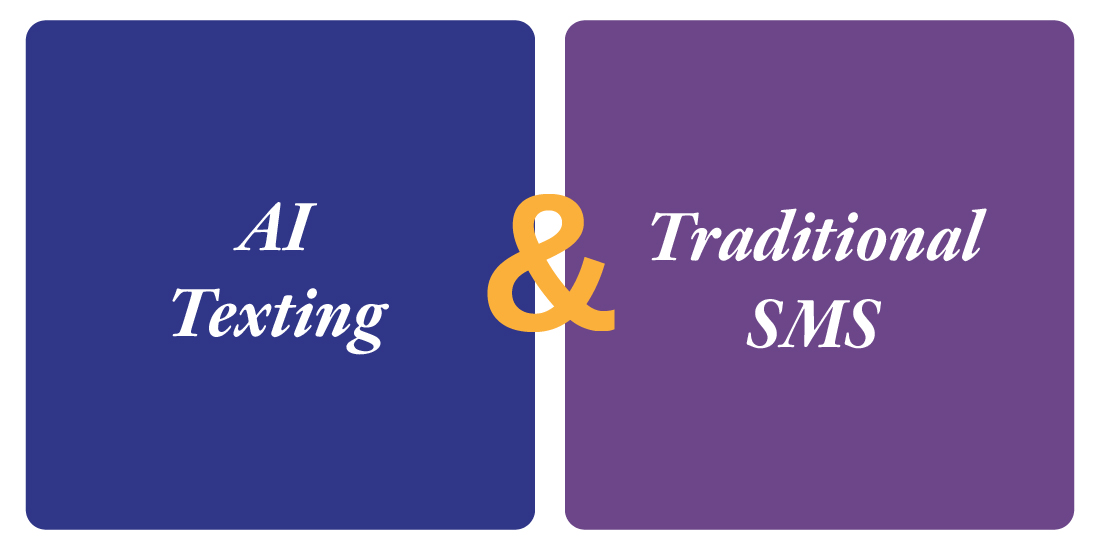
Traditional SMS helps universities send timely reminders, updates, and announcements. AI texting takes it a notch higher by turning SMS into a two-way conversation. Students can ask questions, get immediate answers, receive follow-ups, and connect with staff when they need human help.
| What are you comparing? | Traditional SMS | AI Texting |
| Can students get an immediate answer? | Usually no. They may need to wait for staff. | Yes. AI can answer common questions instantly. |
| Can students ask follow-up questions? | Yes, but staff typically need to respond. | Yes. AI can continue the conversation. |
| Can messages be personalized? | Mostly through templates and audience segments. | Responses can adapt to the student and conversation. |
| Who handles follow-ups? | Staff schedule and manage them. | AI can automate reminders and follow-ups. |
| Does it work after hours? | Usually depends on staff availability. | Yes. AI can provide 24/7 support. |
| What can universities use it for? | Reminders, alerts, and announcements. | Questions, applications, reminders, enrollment, and more. |
| What happens when human help is needed? | Staff typically handle the conversation. | AI can hand the conversation to staff with context. |
| How does it affect staff workload? | More conversations mean more manual work. | AI handles routine interactions at scale. |
Why Universities Are Using AI Texting for Student Communication
Students are already comfortable communicating by text. For universities, the bigger question has been how to make that channel useful beyond sending reminders. As application volumes grow and admissions teams juggle more conversations, AI texting is giving institutions a way to meet students where they are while handling more of the day-to-day communication that keeps enrollment moving.
Students are already on their phones
Email may still be the workhorse of admissions communication, but it is not always where students are most responsive. Texting puts the conversation in a familiar place and makes it easier for students to respond in the moment, whether they have a quick question about an application or need help with their next step.
Admissions teams spend a surprising amount of time answering the same questions
Application status, deadlines, required documents, financial aid, and enrollment steps come up again and again. AI texting can take care of these everyday questions, giving staff more room for conversations where their expertise and judgment really matter.
Enrollment is made up of dozens of small moments
A student rarely goes from application to enrollment in one smooth step. There are forms to complete, documents to submit, deadlines to remember, and decisions to make along the way. AI texting gives universities another way to stay present throughout those moments instead of relying on a single campaign or email sequence.
Students don’t always have a question when the admissions office is open
Some questions come late at night. Others appear over a weekend or just before a deadline. AI-powered texting can provide answers and guidance when staff are unavailable, giving students somewhere to turn instead of simply waiting.
Personalization becomes practical at scale
An admissions team can personalize messages for a small group of students. Doing that across thousands of applicants is another matter. AI texting makes it possible to respond to individual questions and circumstances without asking staff to manually write every response.
There is a useful middle ground between automation and a counselor
Not every student needs a phone call, but not every student can be served by a generic automated message either. AI texting sits between the two. It can handle straightforward conversations and bring in a staff member when the situation calls for human judgment.
The goal is not simply more texts. It is fewer students falling through the cracks
A missed document, unanswered question, or forgotten deadline can interrupt an otherwise promising enrollment journey. By keeping communication active and making it easier for students to get help, AI texting can support the small interactions that often make a difference between a student continuing or dropping off.
How AI Texting Works in Higher Education
For students, AI texting seems easy: you send a message, get a reply, and keep chatting. However, there is more going on behind the scenes. The university starts by giving the AI access to approved details like application requirements, program information, deadlines, financial aid, and enrollment policies. With this information, the AI can figure out what students are asking, find the right answers, and reply in a natural way.
The real benefit shows up after the first reply. Students can ask more questions, get reminders, or be connected with an admissions counselor if needed. Depending on the system, AI texting can also use student or application details to make conversations more personal. This way, texting supports students throughout the enrollment process instead of treating each message as a separate issue.
What does an AI texting conversation look like?
The university sets the ground rules
Before students start texting, the institution defines the information the AI can use, the types of questions it can answer, and when a conversation should be passed to staff. This helps keep responses aligned with university policies and approved information.
A student starts with a question
It could be as simple as, “When is the application deadline?” or “I’m transferring from another college. How do I submit my transcript?” The student does not need to know the right keyword or choose from a menu.
The AI figures out what they need
The AI interprets the question and responds using the university’s approved knowledge. If the student asks a follow-up question, the conversation can continue with the earlier context in mind.
The conversation can continue beyond one reply
A student might ask about a deadline, then ask what documents are required, then ask where to submit them. AI texting allows these questions to happen in one ongoing conversation instead of sending the student through different channels.
The university can reach out, too
AI texting is not limited to answering incoming questions. Universities can use it for proactive reminders and follow-ups, such as nudging an applicant to submit a missing document or reminding an admitted student about an upcoming enrollment deadline.
A person can take over when needed
Some questions are better handled by an admissions counselor. When that happens, the conversation can be handed off to staff, along with the context they need to continue the discussion without making the student repeat themselves.
At its best, AI texting creates a simple experience for the student while taking care of much of the communication work in the background. The student sees a text conversation. The university gets a scalable way to keep that conversation going.
AI Texting Across the Student Enrollment Journey
A student’s enrollment journey is made up of many small interactions, and each one can affect whether they move forward. A question left unanswered, a missing document, or a forgotten deadline can create friction. AI texting gives universities a way to stay connected across these moments, from the first expression of interest through enrollment, while giving students a familiar channel for getting information and taking action.
| Stage of the journey | How AI texting can help |
| Exploring programs | Answer questions about programs, tuition, admissions requirements, campus life, and other topics students are researching before they apply. |
| Starting an application | Help students understand the application process and clarify what they need to submit. |
| Completing the application | Follow up with students who have started but not completed an application and help them address common roadblocks. |
| Submitting documents | Remind students about missing documents and answer questions about what is required or how to submit it. |
| Waiting for a decision | Provide application updates and answer common questions while students wait for the next step. |
| Making an enrollment decision | Keep admitted students engaged with timely information about deadlines, financial aid, programs, and enrollment requirements. |
| Completing enrollment | Guide students through remaining tasks, from accepting an offer to completing required forms and other pre-enrollment steps. |
| Preparing to start | Send timely information about orientation, registration, important dates, and what students need to do before classes begin. |
The role of AI texting can change as the student moves forward. Early conversations may be about exploration and questions, while later interactions become more focused on completion, deadlines, and action. That makes texting useful throughout the journey, rather than just another channel for sending the same message to everyone.
How AI Texting Can Reduce Admissions Staff Workload
Admissions teams spend much of their day answering recurring questions, sending reminders, checking application progress, and following up with students. Much of that work is necessary, but it does not always require a staff member. AI texting can take on routine communication while keeping staff involved when a student needs guidance, judgment, or a personal conversation.
Handle the repeat questions
Deadlines, required documents, application status, and next steps come up every day. AI texting can answer many of these questions as they arrive, reducing the number of routine conversations staff needs to handle.
Keep follow-ups moving
Staff should not have to manually track every student who still needs to submit a document or complete an application. AI texting can manage timely reminders and follow-ups automatically.
Resolve simple issues early
A student looking for an application deadline does not necessarily need a counselor. An immediate answer over text can resolve the question before it becomes another email or phone call for staff.
Reserve staff for complex cases
Questions involving financial concerns, unusual application situations, or complicated transfer scenarios may need human judgment. AI can handle the straightforward conversations and bring staff in when their expertise is needed.
Support more students at once
During peak application and enrollment periods, message volumes can rise quickly. AI texting gives teams additional capacity without requiring staff to respond manually to every conversation.
Give counselors the full context
When a conversation is handed to staff, having the previous messages available means counselors can understand the student’s situation without asking them to repeat the conversation.
The goal is not to remove people from student communication. It is to take routine work off their plates so they have more time for the conversations where they can make a real difference.
AI Texting vs. Email, Chatbots, and Phone Calls
Universities usually do not depend on a single method of communication. Email is useful when it comes to giving detailed information, chatbots can assist website visitors, and phone calls provide a personal element. AI texting is in a middle position: it brings the convenience of messaging together with the possibility of carrying on a conversation. The appropriate option will vary according to what the student requires, but AI texting can help to address some of the gaps between simply sending information and offering one-to-one assistance.
Email is suitable for the kind of information that students need to keep
Email is the appropriate medium for admission letters, detailed instructions, forms, and other longer communications, while AI texting is more suitable for answering quick questions, sending out timely reminders, and handling conversations in which a response is important.
Website chat only helps when students are on the website
A chatbot is useful whenever a student is navigating a university website, since messaging stays with them and provides them with a direct way to contact it each time they have a question.
Phone calls offer personal support, but they take time
A counselor is able to have a worthwhile conversation over the phone, but it is difficult to keep up with calling thousands of students. With AI texting, staff can manage routine conversations at scale, leaving them free to support students who need a human touch.
AI texting sits between a broadcast and a conversation
Email and conventional SMS are usually employed as a means of sending information. Since phone calls are conversational by nature, AI texting combines both of these approaches so that universities are able to send out proactive messages as well as reply when students write back.
Students do not have to remember where to go for help
Rather than going to the website, opening a portal, looking for an email address, or waiting for a call, students can just text the university; for many common admissions questions, this can make it feel much more natural to get assistance.
The channels can work together
AI texting need not be used to replace email, chatbots, or phone calls. For example, a university could send out detailed information by email, give a quick answer through text messaging, and transfer a more complicated discussion to a counselor. The advantage is that each channel is used in the way it is most effective.
How AI Texting Integrates With CRM and University Systems
AI texting becomes more useful when it works with the systems a university already uses. By connecting with a CRM, SIS, or admissions system, AI can work with relevant student information and make each conversation more useful. For admissions teams, this means less manual work, more timely communication, and a clearer view of where students are in the enrollment process.
Know the student
AI can use details such as a student’s program or application status to make responses more relevant. Students get more useful answers, while staff spend less time looking up basic information.
Send timely reminders
A missing document or upcoming deadline can trigger a text at the right time. Staff do not have to manually track every student who needs a reminder.
Keep everything connected
Text conversations can work alongside information in the university’s existing systems. Staff get a better view of the student’s journey instead of piecing information together from different places.
Make handoffs easier
When a conversation needs a counselor, staff can see what has already been discussed. Students do not have to repeat their questions, and counselors can respond with context.
Reach more students
AI can handle routine conversations while the university’s existing systems continue to manage student records and workflows. Teams can support more students without every interaction becoming a manual task.
Keep the tools you already use
AI texting can connect with existing CRM and university systems rather than requiring teams to start from scratch. Universities can add a conversational texting layer without replacing the systems they already depend on.
Put simply, the integration brings three things together: student information, timely communication, and staff support. The systems provide the context, AI handles routine conversations, and staff can focus on the students and situations that need them most.
What Universities Should Look for in an AI Texting Platform
It’s not enough for universities simply to select an AI texting service that can send and receive SMS messages; they should consider how the platform will fit into the admissions process, what kind of information it will be able to provide, and the way it will function in conjunction with staff and the current systems. The platform should make it easier for students to communicate while at the same time decreasing the amount of routine work that members of the admissions team have to do.
Admissions-ready answers
The AI must be capable of answering the questions that students actually pose when they are going through the enrolment process. These questions can cover such areas as application deadlines, admission requirements, missing documents, financial aid, details of the program, the status of the application, and what to do next. It should base its responses on information that has been approved by the university so that students do not get general or out-of-date answers.
Real conversation
Students usually do not put forward a single question and then leave; instead, they might ask a further question, change the topic, or request clarification in light of the earlier response. A good AI texting system should realize the importance of context and allow the conversation to proceed in a natural way rather than treating each message as if it were the start of a new interaction.
Student context
Personalization ought not to amount to nothing more than including a student’s name in a message. If linked to the various university systems, AI-powered texting can make use of details like the student’s program, their position in the application process, or the requirements they still have to meet in order to make the communication more useful. As a result, students will get information that is relevant to their current stage in the enrolment process.
Proactive outreach
AI should not merely reply when a student sends a message; it can also be used by universities to check on students who have submitted incomplete applications, remind them of missing documents, warn them about deadlines that are approaching, or provide them with important enrollment information. This enables admissions teams to keep students progressing without having to carry out each follow-up manually.
Easy handoffs
There will always be certain kinds of conversations that need a human being involved. Students might have questions concerning odd situations, their financial affairs, possible transfers, or other matters that call for judgment. The platform should make it easy for members of staff to take control of the conversation while ensuring that the conversation history is retained, so that the students do not have to go over everything once more.
System integration
AI-assisted messaging becomes more useful if it is able to work with the tools that admissions teams currently rely on. By integrating with a CRM, an SIS, or the admissions system itself, the AI can gain access to the relevant information and ensure that the communication remains linked to the student’s file. It can also decrease the need for staff to switch between different systems or to manually check for information before replying.
Peak-period capacity
Admissions communication tends to change significantly near application deadlines, when decisions are announced, and during enrollment periods. The system should be capable of managing a large volume of conversations at the same time without imposing an additional workload on the staff. This is especially important for universities that want to support more students without increasing the number of staff members.
Useful reporting
The platform needs to allow admissions teams to see what is going on in their conversations. Useful reports should indicate which questions students ask most frequently, the number of conversations that are being managed by AI, when staff are being involved, and the areas where students may be having difficulty in completing the enrolment process.
Data protection
Since student communication may include personal and application information, universities must understand how this data is stored, who can access it, and how it is protected. Before incorporating a platform into the admissions process, pay attention to its security features, the permissions it grants, the compliance requirements it meets, and its data-handling practices.
How to Measure the Success of AI Texting
AI texting should not be measured simply by how many messages a university sends or how many conversations the AI handles. The more useful question is whether texting helps students move through the enrollment process while making communication more manageable for staff. Universities can track a mix of engagement, efficiency, and enrollment-related metrics to understand whether the platform is delivering value.
Response and engagement rates
Track how often students respond to texts, continue conversations, and engage with follow-up messages. Higher engagement can indicate that students find texting convenient and are willing to use it as a communication channel.
Response time
Measure how quickly students receive answers to their questions. Faster responses can reduce the waiting time that often causes students to lose momentum during the application and enrollment process.
Questions resolved by AI
Look at how many conversations the AI can resolve without staff involvement. This can show whether the platform is actually reducing repetitive work for admissions teams.
Staff time saved
Compare the amount of time teams spend answering routine questions and sending follow-ups before and after implementation. This helps universities understand whether AI texting is freeing staff to focus on more complex student conversations.
Application completion
Track whether students who receive AI-powered reminders and support are more likely to complete their applications and submit required documents.
Enrollment progression
Follow students beyond application completion to see whether texting helps them complete important steps such as accepting an offer, submitting final documents, registering, or enrolling.
Human handoff rates
Monitor how often conversations need staff intervention and which topics lead to handoffs. A high handoff rate may point to gaps in the AI’s knowledge or areas where students consistently need human support.
Student satisfaction
Gather feedback on whether students find the conversations helpful, easy to use, and timely. Engagement numbers alone do not show whether students are having a good experience.
Cost and operational impact
Compare the cost of the platform with measurable gains such as staff hours saved, increased application completion, and greater communication capacity. This gives leadership a clearer picture of the platform’s overall value.
Best Practices for AI Texting in Higher Education
AI texting works best when it feels like a helpful extension of the university, not another automated message channel. Admissions teams should set clear expectations for how the AI communicates, what it can handle, and when a person should step in. A few practical practices can make a big difference in how students experience the channel.
Start with the questions students ask most
Begin with common topics such as application deadlines, required documents, application status, financial aid, and enrollment steps. This gives the AI a focused role and helps teams identify where it can provide the most immediate value.
Keep messages natural and easy to read
Text messages should feel like texts, not shortened versions of formal emails. Use simple language, keep messages focused, and avoid sending students long blocks of information when a shorter response will do.
Give the AI reliable information
The quality of the conversation depends on the information behind it. Keep the AI connected to current, university-approved content and review important information regularly, especially deadlines, fees, requirements, and policies.
Use texting for timely moments
AI texting is particularly useful when timing matters. Reminders about incomplete applications, missing documents, upcoming deadlines, and enrollment steps can reach students when they are most likely to take action.
Know when to bring in a person
Not every student question should be automated. Set clear handoff rules for situations that require judgment, personal guidance, or sensitive discussion, and make sure staff receive the conversation history when they take over.
Personalize without overdoing it
Use relevant student information to make messages more useful, but avoid making every interaction feel overly automated or intrusive. The goal is to give students the right information based on where they are in the process.
Respect the student’s attention
More texting does not necessarily mean better communication. Give students clear reasons to respond, avoid unnecessary messages, and consider the timing and frequency of outreach.
Review conversations regularly
Teams should look at real conversations to understand what students are asking, where the AI struggles, and which responses need improvement. This creates an ongoing feedback loop that can make the experience better over time.
Connect texting to the larger enrollment strategy
AI texting should not operate as a standalone channel. Coordinate it with email, phone, web chat, and counselor outreach, so students receive a consistent experience regardless of how they choose to communicate.
How EDMO Enables AI Texting Across the Enrollment Journey
EDMO’s Student Copilot brings AI-powered texting into the enrollment journey, helping universities answer student questions, send timely follow-ups, and keep conversations moving across key admissions and enrollment steps. It supports two-way SMS, personalized responses, proactive outreach, and human handoffs when staff support is needed.
- Answer questions instantly: Provide responses on applications, deadlines, requirements, financial aid, transfer credits, and next steps.
- Follow up automatically: Send reminders for missing documents, incomplete applications, deadlines, and enrollment tasks.
- Keep conversations contextual: Use institution-approved information and relevant student details to make responses more useful.
- Bring staff in when needed: Hand conversations to admissions teams with the existing context intact.
- Support students across channels: Extend conversations beyond SMS through voice, web chat, and WhatsApp.
Conclusion
AI texting is becoming a practical way for universities to stay connected with students throughout the enrollment journey. From answering routine questions and sending timely reminders to supporting application completion and connecting students with staff, it can help admissions teams manage communication at a much larger scale. The key is to use AI where it adds value while keeping human support available when students need it.
Frequently Asked Questions
Ques 1: Can students opt out of AI text messages from a university?
Ques 2: Does AI texting require students to download an app?
Ques 3: Can AI texting understand informal student language and abbreviations?
Ques 4: Can universities send AI text messages to international students?
Ques 5: Can admissions counselors take over an AI text conversation?
Ques 6: Can AI texting communicate with thousands of prospective students at once?
Ques 7: Can universities use their existing phone number for AI texting?
Ques 8: How should universities handle student consent for AI-powered SMS communication?
Written By


You May Also Like
 AI in Education

 AI in Education
 AI in Education
No comments yet. Be the first to comment!
Leave a Comment