

Table Of Contents
- 1Introduction
- 2How Colleges Are Using AI in Higher Education Admissions
- 3Strategic Use of AI in Higher Education Admissions and Enrollment
- 4Key Benefits of Using AI in College Admissions
- 5Challenges and Ethical Considerations of AI in Admissions
- 6What Is the Future of AI in Education and University Admissions?
- 7Conclusion
Introduction
There is increasing pressure on colleges and universities to deal with applications more quickly, to communicate more effectively with prospective students, and to achieve better enrollment results all while having a limited number of staff members. Because of this, artificial intelligence is now quickly turning into a potent agent of higher education admissions rather than remaining a future possibility. By using machine learning, predictive analytics, natural language processing, and automation tools, AI in admissions supports activities such as recruitment, the processing of applications, communication with students, and enrollment operations, thereby allowing admissions teams to concentrate more on student engagement and making decisions.
Adoption is speeding up in many important areas. Organizations are employing conversational assistants for use in web chat and text messaging, using predictive analytics to spot students who have a stronger intention to enroll, applying document intelligence tools to handle transcripts and application documents, utilizing transfer credit evaluation systems in order to speed up the process of granting transfer admissions, and using identity verification tools to improve enrollment integrity. Furthermore, AI is assisting enrollment managers in forecasting trends in applications and in providing more personalized communication at every stage of the student journey, which in turn makes admissions operations quicker, more responsive, and more focused on the student.
How Colleges Are Using AI in Higher Education Admissions
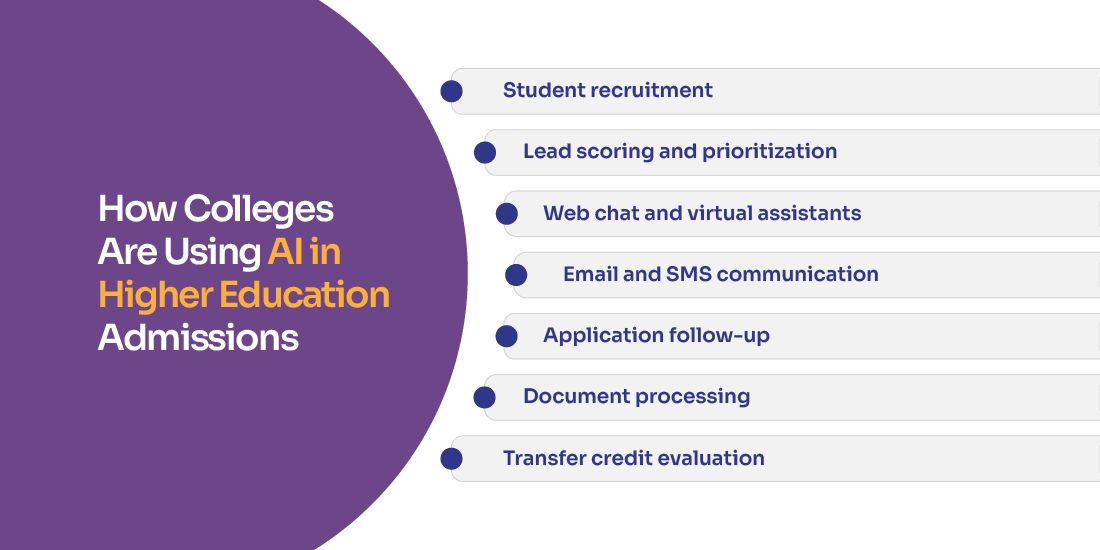
When people hear the phrase AI in higher education admissions, they often imagine a futuristic system making admissions decisions on its own. In reality, most colleges are using these tools in much more practical ways. The goal is usually simple: respond to students faster, reduce repetitive administrative work, and make the admissions experience feel less stressful. In many institutions, AI in admissions is working quietly behind the scenes while counselors continue to lead the conversations that matter most.
Student recruitment
Recruitment teams have always tried to figure out which students are genuinely interested in their institution. Today, they can look at patterns such as website visits, inquiry activity, event attendance, and email engagement to understand interest levels more clearly. That means counselors spend less time sending broad outreach and more time having meaningful conversations with students who are actively exploring their options.
Lead scoring and prioritization
Every admissions office has more inquiries than it can realistically call in a single day. Predictive tools help teams identify which students may need immediate follow-up and which students are still in the early research stage. Instead of working through a list in chronological order, counselors can focus their energy where it is most likely to help a student move forward.
Web chat and virtual assistants
Think about when many students search for colleges, often late at night, after school, or on weekends. Conversational assistants can answer common questions about deadlines, requirements, scholarships, or campus visits when staff members are not online. Students get quick guidance, and admissions teams avoid spending hours answering the same basic questions repeatedly.
Email and SMS communication
Students frequently miss deadlines not because they are uninterested, but because life gets busy. Automated email and text reminders can prompt them to submit transcripts, complete financial aid forms, or schedule a campus visit at the right moment. The communication feels more timely, and staff do not have to manually send every reminder.
Application follow-up
Almost every admissions office has a large group of partially completed applications. Intelligent workflows can spot when a student has stopped midway through the process and send a gentle nudge to help them continue. Sometimes a simple reminder is enough to move an application from incomplete to submitted.
Document processing
Anyone who has worked in admissions knows how much time can be spent downloading, renaming, sorting, and entering document information. Document intelligence tools can read transcripts and other application materials, pull out key details, and route them to the correct workflow. Staff still review important information, but the tedious administrative work is dramatically reduced.
Transfer credit evaluation
Transfer students often wait weeks for transcript evaluations, especially when they attended multiple institutions. Technology can help evaluators identify courses and suggest possible equivalencies much more quickly. Human reviewers still make the final decision, but students receive answers sooner and experience less uncertainty during the transfer process.
Identity verification and fraud detection
Colleges are paying much closer attention to enrollment fraud than they were a few years ago. Verification tools can help confirm applicant identity and flag unusual patterns without creating unnecessary barriers for legitimate students. The result is stronger enrollment integrity and a smoother verification experience for most applicants.
Enrollment forecasting
Admissions leaders constantly ask questions such as: Are applications up or down? Which programs are gaining interest? Are we on track for our target class size? Predictive analytics helps answer those questions earlier in the cycle, giving institutions more time to adjust outreach, staffing, or scholarship strategies before a problem becomes urgent.
Advisor and admissions support tools
During a conversation with a student, counselors often need quick access to deadlines, policies, program details, or application status information. Support tools can surface that information instantly, reducing the need to search through multiple systems. Students get faster answers, and counselors can stay focused on the conversation rather than the software.
Taken together, these examples show what AI in university admissions actually looks like in practice. It is less about replacing admissions professionals and more about removing friction from the enrollment journey. The institutions seeing the strongest results are using technology to handle repetitive tasks while their staff focus on guidance, relationships, and helping students make one of the most important decisions of their lives.
Strategic Use of AI in Higher Education Admissions and Enrollment
The most interesting change taking place in the field of admissions at present is that universities are no longer employing AI merely for the sake of efficiency. They are now using it in order to improve their enrollment decisions. Rather than asking themselves, “Can this task be automated?”, admission officers are asking, “Can this help us to recruit the right students, respond at the right moment, and eliminate unnecessary friction from the process?” It is for this reason that AI in higher education admissions can be considered a strategic capability rather than just another technology purchase.
Prioritizing students who are most likely to enroll
A large number of institutions get considerably more enquiries than the counselors are able to handle personally. In order to find students who are actively making up their minds, the enrollment teams look at engagement data, including students’ campus visit activity, their email interactions, how they behave when applying, and their level of interest in a program. The advantage of this strategy is not merely efficiency; it is that high-intent students get timely attention before they decide on another institution.
Reducing summer melt before students disappear
A major difficulty in terms of enrollment arises after a student has been admitted but before classes start. In order to detect admitted students who may be disengaging during the summer, universities make use of automated reminders and behavioural signals. It is possible to stop students quietly withdrawing from the process by providing them with early information regarding financial aid, housing, orientation, or registration.
Improving transfer enrollment decisions
Transfer students frequently have to wait for weeks while their transcripts are evaluated, and such lengthy delays may cause them to choose to enroll at other institutions. In order to reduce the time taken for evaluation and to offer quicker initial responses, universities are using transcript analysis and credit mapping tools in a strategic manner. Their aim is to achieve not just faster operations but also a more competitive approach to recruiting transfer students.
Responding to international students across time zones
It is not feasible for international recruitment teams to cover all time zones. In order to respond to questions from students who are researching abroad regarding applications, visas, scholarships, and programs, universities are making use of conversational support tools. This enables the institutions to stay engaged in markets in which delayed replies could have a significant effect on yield.
Protecting enrollment integrity as fraud risks increase
There is an increasing number of fraudulent applications, cases of identity misuse, and the use of synthetic students. In order to identify unusual patterns before the enrollment decisions are made, verification tools are being incorporated into the admissions processes. As a result, the institutions are able to safeguard their resources and lessen the downstream effects of fraudulent enrollments.
Forecasting enrollment gaps early enough to act
Instead of relying on the end-of-cycle reports, enrollment leaders are keeping a close eye on application and deposit trends as they happen, grouping the trends by program, location, and student group. If a program starts to underperform, the recruitment campaigns, scholarship strategies, or counselor outreach can then be modified while there is still time to affect the class.
Giving counselors faster answers during student conversations
In a phone call or when giving advice, counselors frequently need quick access to information such as deadlines, scholarship rules, transfer regulations, or the status of applications. By using advisor support tools, that information is made available instantly, so that counselors can concentrate on the student rather than having to search across various systems. The advantage of this approach is that it leads to a more consistent and responsive advising experience.
Connecting recruitment, admissions, and financial aid into one student journey
It is a frequent source of annoyance for students to get different information from various offices. By linking data together across the areas of recruitment, admissions, financial aid, and advising, top universities ensure that the communication sent to students matches their present situation. As a result, the enrollment process becomes more coordinated and the confusion which usually leads to students dropping out is reduced.
Key Benefits of Using AI in College Admissions
Colleges and universities are finding practical ways to use AI that make admissions faster, more personal, and easier for students. Instead of replacing the human side of admissions, these tools help schools respond quickly, stay in touch with students, and manage more applications smoothly. When used well, AI makes things easier for both students and admissions teams by removing obstacles and making the process more responsive.
Faster communication with students
Students often contact colleges while they are researching their options, and timing is important. Getting a quick response instead of waiting a day or two helps keep them interested. Fast communication helps colleges keep students engaged and makes a good first impression.
Communication that feels more personal
Students don’t want to feel like they’re just getting a generic email sent to everyone. AI can help personalize messages based on a student’s interests, major, location, or where they are in the admissions process. This makes the communication feel more relevant and personal.
Less time spent on repetitive tasks
Admissions staff spend a lot of time on reminders, entering data, tracking documents, and updating statuses. Automating these routine tasks gives them more time for counseling, outreach, and building relationships. Most admissions professionals prefer talking with students over managing spreadsheets.
More completed applications
Many students start an application but never finish it. Sometimes they are missing a document, forget a deadline, or get distracted by other things. Timely reminders can help students stay on track and complete their applications.
Better focus for admissions counselors
Not every student who asks for information is equally interested. Engagement data helps counselors see who is close to making a decision and who is still just researching. This lets them focus their outreach where it will be most effective.
Quicker processing of transcripts and documents
Anyone who has worked in admissions knows how much time can be spent downloading, sorting, and entering document information. Automated document processing can handle much of that administrative work in the background. Applications move through the system faster, and staff can focus on evaluation rather than paperwork.
A smoother experience for transfer students
Transfer students often worry about how their previous classes will count. Faster transcript reviews mean they get answers sooner and spend less time waiting. This can make the transfer process feel a lot less stressful.
Stronger protection against fraud
Colleges are dealing with more cases of identity fraud and fake applications than before. Verification tools can spot unusual activity early in the process. This helps protect the school’s resources and keeps things simple for real applicants.
Better visibility into enrollment trends
Enrollment leaders always want to know if applications are going up, down, or changing in certain programs. Real-time analytics can show these trends sooner, giving schools more time to adjust their recruitment, staffing, or scholarship plans. Getting this information earlier usually leads to better decisions.
More consistent support across every channel
Students may email, text, chat on the website, or call the admissions office. Consistent communication across those channels reduces confusion about deadlines, requirements, and next steps. From the student’s perspective, the institution feels more coordinated and responsive.
Easier growth without the same growth in staffing
As more students inquire and apply, it gets harder to keep up the same level of service. AI helps schools manage more communication and processing without having to hire as many new staff. This makes it easier to handle growth.
More time for the human side of admissions
One of the biggest benefits of AI is that it gives counselors more time for real conversations with students. When technology takes care of repetitive tasks, counselors can listen, talk about goals, and offer guidance. The best admissions experiences are still personal, and AI works best when it helps build those human connections instead of replacing them.
Challenges and Ethical Considerations of AI in Admissions
While AI can make admissions processes faster and more efficient, it also raises important ethical and operational questions. Universities need to think carefully about fairness, transparency, privacy, and human oversight as these tools become a more common part of enrollment operations. The strongest institutions are treating AI adoption not only as a technology initiative but also as a governance responsibility.
Data privacy and security
Admissions systems contain highly sensitive student information, including academic records, financial details, and personal identifiers. Institutions must ensure that this data is stored securely, accessed only by authorized users, and processed in compliance with regulations such as FERPA and GDPR. A single security lapse can affect thousands of applicants and damage institutional trust.
Bias in algorithms
AI models learn from historical data, and historical data may contain inequities from past recruitment or admissions practices. If those patterns are not reviewed carefully, the system may unintentionally favor some student groups over others. Regular auditing and human review are essential to identify and correct biased outcomes.
Lack of transparency
Some AI systems provide recommendations without clearly explaining how they reached those conclusions. When students and staff cannot understand why a student was prioritized or flagged, confidence in the process can decline. Universities need systems that provide interpretable insights rather than opaque decisions.
Over-reliance on automation
Admissions is still a relationship-driven process, and students often value personal interaction during important decisions. If too many interactions become automated, communication can start to feel transactional rather than supportive. Technology should assist counselors, not replace meaningful human engagement.
Inaccurate or outdated information
Generative AI tools can occasionally produce incorrect or outdated information about deadlines, scholarships, eligibility requirements, or institutional policies. Even a small error can create confusion for applicants and additional work for admissions staff. Human review remains important for high-stakes communications.
Unequal access to technology
Not all students have reliable internet access, appropriate devices, or the same level of digital literacy. Admissions processes that depend heavily on technology may unintentionally disadvantage students with fewer digital resources. Institutions should maintain alternative pathways for students who need additional support.
Staff readiness and training
Introducing new technology without adequate training can create uncertainty among admissions professionals. Staff need guidance on how to interpret AI-generated insights, recognize potential errors, and decide when human judgment should override automated recommendations. Successful adoption depends as much on people as it does on software.
Vendor dependence
Many institutions rely on third-party platforms for AI capabilities, which can create long-term dependency risks. Questions about data ownership, portability, integration, and future costs become increasingly important as these tools become embedded in admissions workflows. Universities should evaluate vendors with a long-term perspective.
Governance and accountability
Clear governance is essential when technology influences admissions operations. Institutions should define who is responsible for monitoring system performance, reviewing outcomes, handling appeals, correcting errors, and updating policies as practices evolve. Without accountability, small issues can become larger institutional problems.
Ethical use of student data
Students should understand what information is being collected, how it is being used, and whether it influences recruitment or admissions-related processes. Transparent communication about data practices helps build trust and supports informed consent. Ethical data use is a core part of responsible enrollment management.
Need for human oversight
Technology can support admissions teams, but final admissions decisions, scholarship determinations, and complex student cases should continue to involve experienced professionals. Human oversight provides context, empathy, and judgment that automated systems cannot fully replicate. The goal is augmentation, not replacement.
Reputation and institutional trust
Students and families are paying close attention to how universities use emerging technologies. If institutions appear careless, opaque, or overly automated, trust can erode quickly. Transparent policies, responsible implementation, and clear communication are essential for protecting institutional reputation and maintaining confidence in the admissions process.
What Is the Future of AI in Education and University Admissions?
The future of AI in university admissions will focus less on doing the same work faster and more on changing how institutions recruit, support, and enroll students. In the next few years, colleges are expected to use AI for operational efficiency as well as planning, student success, and institutional decision-making. Universities that gain the most value will use technology to remove friction while strengthening human relationships with students and families.
Admissions will become more predictive, not just reactive
Instead of waiting until applications are submitted, institutions will increasingly identify students who are likely to apply, enroll, or need additional support much earlier in the recruitment cycle.
International recruitment will become far more accessible
Multilingual conversational tools will help universities engage students across different countries and time zones without requiring admissions staff to be available around the clock.
Transfer admissions will become much faster
Automated transcript reading and credit-mapping technologies are expected to significantly reduce evaluation timelines, giving transfer students quicker answers and a smoother enrollment experience.
Fraud prevention will become a standard part of digital admissions
Identity verification, document authentication, and suspicious-activity detection will play a larger role as online applications continue to grow.
Enrollment planning will become more dynamic
Real-time analytics will allow leaders to monitor application trends, scholarship impact, and yield patterns continuously rather than relying mainly on end-of-cycle reports.
Admissions counselors will work with AI copilots
During student conversations, counselors will be able to access policies, deadlines, scholarship information, and application status instantly, reducing search time and improving consistency.
Student support will extend beyond admission
The same intelligence used during recruitment is likely to support onboarding, orientation, advising, and early retention efforts, creating a more connected student journey.
Ethics and governance will become a competitive differentiator
Institutions that are transparent about data use, fairness reviews, and human oversight are likely to earn greater trust from students, families, and regulators.
The human role will become more valuable, not less
As routine tasks become increasingly automated, admissions professionals will spend more time on advising, relationship-building, and helping students make confident enrollment decisions.
In the end, the future of AI in university admissions is not simply about smarter software. It is about creating an admissions experience that is more accessible, efficient, trustworthy, and supportive while preserving the human judgment that remains central to higher education.
Conclusion
The idea of AI in higher education admissions is no longer something that remains in the future. It is now being incorporated into day-to-day enrollment activities. Colleges and universities are employing it in order to get in touch with students more quickly, handle applications more efficiently, assess transfer credits more rapidly, improve enrollment integrity, and obtain earlier insights into enrollment trends. The institutions that are achieving the best results are not always the ones adopting the most technology; rather, it is those that use it in conjunction with a clear enrollment strategy and have strong human supervision.
The key point is that the admissions process remains one that is people-oriented. While students desire timely information, they also value empathy, guidance and the assurance that their application is being looked at fairly. AI performs at its best by eliminating administrative burdens and allowing counselors to spend more time on advising, building relationships and helping students make informed decisions.
In the growing race to attract students and as student expectations keep on increasing, those universities which integrate careful use of technology with transparency, good governance, and human judgment will be in a better position to attract, engage and enroll students in the years to come.
Frequently Asked Questions
Ques 1. Do colleges use AI to screen applications?
Ques 2. How does AI handle international student applications?
Ques 3. What’s the biggest mistake institutions make when adopting AI in enrollment?
Ques 4. How long does it take to implement AI for enrollment from start to finish?
Ques 5. Are there risks and governance issues that come with using AI for enrollment?
Written By


You May Also Like
 AI in Education

 AI in Education
 AI in Education
No comments yet. Be the first to comment!
Leave a Comment