


Table Of Contents
Introduction
During peak admissions season, even the most organized offices can feel overwhelmed by transcripts, spreadsheets, and constant GPA calculations. Each application often comes with its own grading scale, unique transcript format, or an education system that needs careful review. What looks like a straightforward task can quickly turn into a major bottleneck, taking up valuable time as more applications arrive. If institutions can verify GPAs more quickly without losing accuracy, they can move qualified students through the process faster and give applicants the timely decisions they expect.
What Is GPA Verification in Higher Education? Why It Matters More Than Ever
Imagine reviewing hundreds or even thousands of applications, only to discover that every transcript tells its own story. Some students have letter grades, others have percentages, and international applicants may follow entirely different grading systems. Before an admissions team can fairly compare applicants, they first need to ensure everyone’s academic performance is being measured on the same scale. That’s where GPA verification comes in.
GPA verification is the process of confirming that an applicant’s academic record has been accurately translated into a standardized GPA for evaluation. It involves validating transcripts, interpreting different grading systems, and ensuring that every applicant is assessed consistently and fairly. While it sounds straightforward, it can quickly become one of the most time-consuming parts of the admissions process, especially during peak application season. That’s why universities are increasingly looking for faster, smarter ways to verify GPAs without compromising accuracy
Why Is GPA Verification Important?
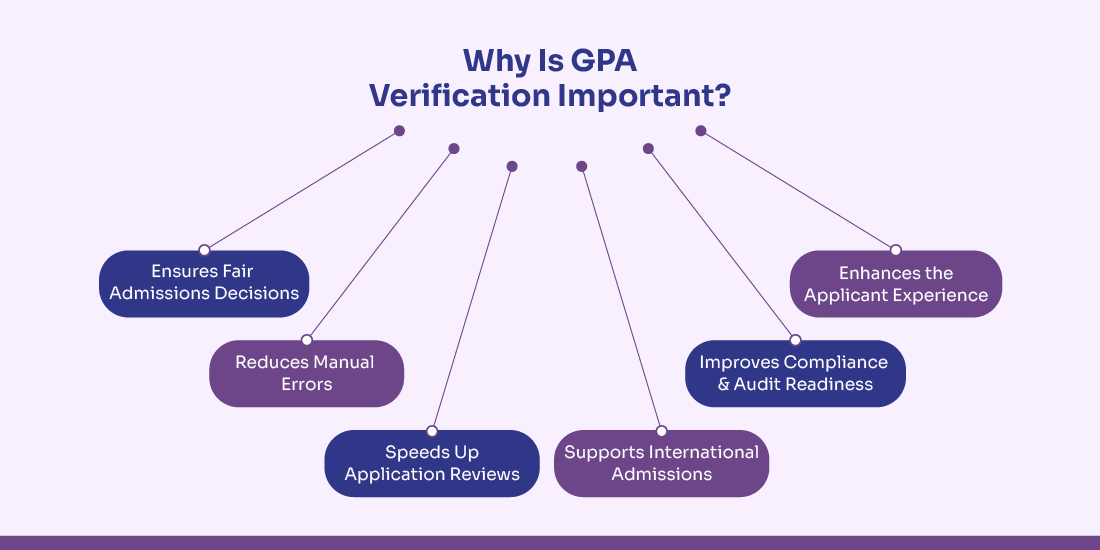
A student’s GPA is often one of the first things admissions teams consider, but that number only tells the full story when it has been verified correctly. With applicants coming from different schools, countries, and grading systems, comparing academic performance isn’t as simple as looking at a single score. GPA verification ensures every transcript is interpreted consistently, helping institutions make fair, accurate, and timely admissions decisions while reducing unnecessary administrative work.
Ensures Fair Admissions Decisions
Every applicant deserves to be evaluated on equal footing. GPA verification standardizes academic records from different institutions and grading systems, ensuring admissions officers compare like with like instead of relying on raw scores that may not be directly comparable.
Reduces Manual Errors
Manually calculating or converting GPAs leaves room for mistakes, especially when admissions teams are processing thousands of applications under tight deadlines. Verification helps minimize calculation errors, misinterpretations, and inconsistencies that could impact admissions outcomes.
Speeds Up Application Reviews
GPA verification is one of the most repetitive tasks in admissions. Streamlining this process allows applications to move through the review pipeline much faster, helping institutions shorten decision timelines without compromising accuracy.
Supports International Admissions
International applicants often submit transcripts based on grading systems that differ significantly from domestic standards. GPA verification helps admissions teams accurately interpret these credentials, making it easier to evaluate students from around the world fairly and consistently.
Improves Compliance and Audit Readiness
Admissions decisions should be backed by transparent and consistent evaluation processes. A standardized GPA verification workflow creates clear documentation, making it easier for institutions to demonstrate compliance with internal policies and accreditation requirements.
Enhances the Applicant Experience
Long waiting periods can leave prospective students anxious and uncertain about their future. Faster and more accurate GPA verification helps institutions provide quicker admissions decisions, creating a smoother and more positive experience for applicants.
Frees Admissions Teams to Focus on What Matters
Instead of spending hours deciphering transcripts and performing repetitive calculations, admissions professionals can devote more time to evaluating applicants holistically. This allows them to focus on essays, extracurricular achievements, recommendations, and other factors that contribute to selecting the right students.
At first glance, GPA verification may seem like a simple matter of checking a number on a transcript. In reality, it’s a multi-step process that requires admissions teams to validate academic records, interpret different grading systems, and ensure every applicant is evaluated consistently. Whether an institution receives applications from local students or across the globe, GPA verification plays a critical role in creating a fair and standardized admissions process. Here’s how it typically works.
How GPA Verification Works in Universities
At first glance, GPA verification may seem like a simple matter of checking a number on a transcript. In reality, it’s a multi-step process that requires admissions teams to validate academic records, interpret different grading systems, and ensure every applicant is evaluated consistently. Whether an institution receives applications from local students or across the globe, GPA verification plays a critical role in creating a fair and standardized admissions process. Here’s how it typically works.
Collecting Official Academic Records
The process begins when applicants submit their official transcripts and other academic documents. Admissions teams first verify that these records are complete, authentic, and issued by recognized educational institutions before moving forward.
Reviewing the Grading System
Not every transcript follows the same grading scale. Universities identify whether the applicant’s institution uses percentages, letter grades, CGPA, weighted GPAs, or another grading format to understand how academic performance has been measured.
Converting Grades to a Standardized GPA
If applicants come from different grading systems, admissions teams convert their academic scores into the institution’s preferred GPA scale. This ensures that every applicant can be evaluated using the same academic benchmark.
Validating Calculations
Once the GPA has been converted, admissions officers verify that the calculations are accurate and align with institutional policies. This step helps eliminate errors before the application moves to the next stage of review.
Applying Institutional Admissions Policies
Some universities have program-specific GPA requirements or prerequisites. The verified GPA is compared against these criteria to determine whether the applicant meets the academic eligibility requirements for admission.
Documenting the Verification Process
Every verification step is recorded to maintain transparency and consistency. Keeping a clear audit trail helps institutions demonstrate compliance with internal policies and accreditation standards whenever needed.
Moving the Application Forward
Once the GPA has been verified, the application proceeds to the broader admissions review process. At this stage, admissions officers can focus on evaluating the applicant holistically, considering essays, recommendations, extracurricular achievements, interviews, and other factors alongside verified academic performance.
How to Speed Up GPA Verification During Peak Admissions Season
When application volumes spike, GPA verification can quickly become one of the biggest bottlenecks in the admissions process. Admissions teams often spend countless hours reviewing transcripts, converting grading scales, and validating calculations before an application can move forward. The good news is that speeding up GPA verification doesn’t mean cutting corners. With the right processes and technology in place, universities can significantly reduce manual effort, improve accuracy, and keep applications moving without overwhelming their staff.
Automate Transcript Evaluation
Instead of manually reviewing every transcript, use automated transcript evaluation tools that can extract academic information, recognize grading systems, and calculate GPAs in minutes. This eliminates repetitive work and allows admissions teams to focus on reviewing applicants rather than performing calculations.
Standardize GPA Conversion Rules
One of the biggest causes of delays is inconsistent GPA conversion methods. Establishing standardized conversion policies for domestic and international applicants ensures every transcript is evaluated using the same criteria, reducing confusion and rework.
Digitize Academic Documents
Paper transcripts and scanned PDFs can slow down verification significantly. Encouraging digital transcript submissions and using document processing technology makes academic records easier to access, organize, and verify throughout the admissions cycle.
Leverage AI for Transcript Analysis
AI-powered admissions tools can identify grading scales, recognize coursework, flag missing information, and recommend GPA conversions with remarkable speed. Rather than replacing admissions professionals, AI helps them process applications faster while maintaining consistency and accuracy.
Prioritize Applications with Complete Documentation
Not every application is ready for verification on day one. Creating workflows that automatically identify complete applications allows admissions teams to verify GPAs immediately instead of wasting time following up for missing transcripts or supporting documents.
Integrate GPA Verification into Your Admissions Workflow
When GPA verification operates as a separate manual process, applications often sit in queues waiting for review. Integrating GPA verification directly into the admissions platform ensures academic records are validated as soon as documents are received, reducing delays and creating a smoother, end-to-end admissions workflow.
Conclusion
GPA verification may happen behind the scenes, but it has a direct impact on the speed, accuracy, and fairness of the admissions process. As application volumes continue to grow and institutions welcome students from increasingly diverse educational backgrounds, relying on manual verification alone is becoming harder to sustain. By combining standardized processes with automation and AI, universities can eliminate bottlenecks, reduce errors, and help admissions teams spend less time on repetitive calculations and more time evaluating the potential of every applicant. Faster GPA verification doesn’t just improve operational efficiency; it creates a better admissions experience for everyone involved.
Frequently Asked Questions
Ques 1. Do universities verify GPA?
Ques 2: Who is responsible for GPA verification?
Ques 3. How does AI improve GPA verification?
Ques 4: Does automated GPA verification replace human reviewers?
Ques 5. What are the biggest challenges in manual GPA verification?
Ques 6. What are the benefits of automating GPA verification?
Written By


You May Also Like
 AI in Education

 AI in Education
 AI in Education
No comments yet. Be the first to comment!
Leave a Comment