

Table Of Contents
Introduction
For many universities, Slate CRM has been a reliable platform for managing admissions and enrollment. But as the higher education landscape evolves, institutions are beginning to ask whether it still meets their growing needs. Today’s admissions teams aren’t just looking for a CRM. They need a platform that can automate routine tasks, deliver personalized student engagement at scale, provide real-time insights, and integrate seamlessly with the rest of their technology stack. That’s why many universities are exploring alternatives that offer greater flexibility, stronger AI capabilities, and a more modern approach to enrollment management. The best fit will depend on your institution’s goals, existing processes, and plans for future growth.
Slate CRM Overview
Slate CRM is an enrollment management platform developed for colleges and universities. Admissions and enrollment teams use it to manage the full student recruitment lifecycle, from prospect inquiries to application processing, admissions decisions, and enrollment. The platform offers flexibility, enabling institutions to customize workflows, automate communications, create application portals, and generate tailored reports. Its all-in-one design makes it a preferred solution for centralizing recruitment and admissions operations.
Why Universities Are Looking Beyond Traditional CRMs
Slate is still a solid admissions CRM for many schools, but universities now need more than what traditional CRMs were built to offer. Here are some of the new demands:
AI-Powered Student Engagement
Students want quick, personalized answers on any channel. Schools now look for AI tools and chatbots that can reply around the clock, help applicants through tricky steps, and reach out based on what students do.
Intelligent Document Processing
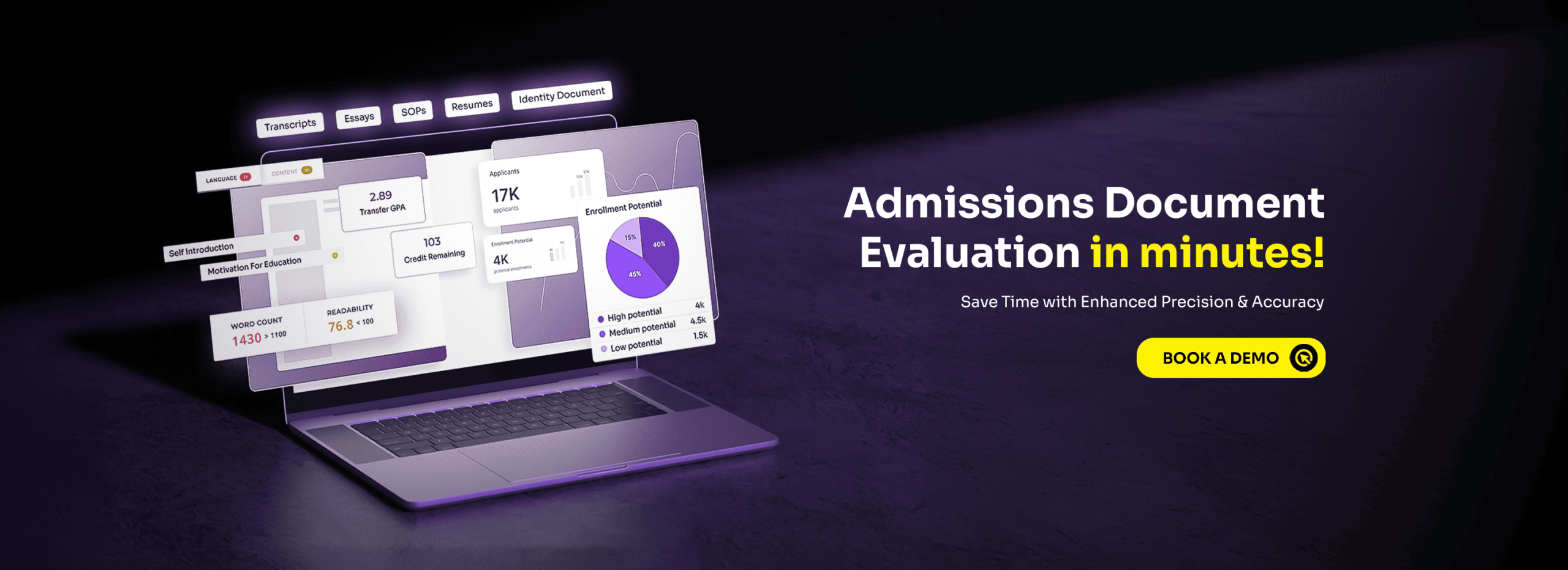
Admissions offices handle thousands of transcripts, recommendation letters, financial forms, and ID documents. Schools want AI to pull out, sort, check, and fill in this information automatically, instead of doing it all by hand.
Predictive Enrollment Intelligence
Instead of just tracking applicants, universities want AI to predict who will enroll, spot at-risk students, estimate yield, and suggest what admissions counselors should do next.
Real-Time Decision Support
Admissions leaders can’t wait for weekly or monthly reports anymore. They need real-time dashboards that show bottlenecks, trends, counselor results, and recruitment ROI as things happen.
Omnichannel Communication
Prospective students use email, SMS, WhatsApp, web chat, social media, and phone calls. Schools now want a single platform to handle all these channels, instead of juggling each one on its own.
Workflow Automation
Today’s admissions teams want routine tasks like application reviews, interview scheduling, document reminders, follow-ups, and status updates to run automatically, with little staff effort.
AI-Assisted Admissions Review
As application volumes continue to rise, institutions are looking for AI tools that summarize applicant profiles, analyze interview performance, highlight missing documents, and help reviewers make faster, more informed decisions.
Seamless Integration Across Campus Systems
Universities want admissions platforms that easily connect with Student Information Systems (SIS), Learning Management Systems (LMS), financial aid tools, ID verification, and analytics, without needing lots of custom work.
Personalized Student Journeys
Applicants today expect messages that match their academic interests, location, program choices, and where they are in the admissions process, not generic emails sent to everyone.
Operational Efficiency with Smaller Teams
Budget constraints and staffing shortages are forcing admissions offices to accomplish more with fewer people. Institutions are prioritizing platforms that reduce manual work through automation and AI rather than simply organizing applicant data.
These needs don’t mean Slate can’t handle any of these tasks. Many schools add features through integrations, custom work, or third-party tools. Still, universities are now looking for platforms that offer more AI and automation features right away, making setup and maintenance easier.
Essential Features to Look for in a Higher Education CRM
A higher education CRM should be more than a system of record. It should act as an intelligent enrollment platform that helps universities recruit, engage, and convert students more efficiently. With application volumes increasing and students expecting instant, personalized experiences, institutions need technology that automates routine work, surfaces actionable insights, and empowers admissions teams to focus on building meaningful relationships. The following features have become essential for universities looking to modernize their enrollment strategy.
Meet Students Where They Are, When They Need You
Imagine a prospective student from Brazil visiting your website at midnight with questions about visa requirements. Instead of waiting until the admissions office opens, an AI assistant answers their questions instantly, recommends relevant programs, and schedules a meeting with an admissions counselor. This keeps the student engaged when interest is highest.
Know Which Applicants Need Attention Before It’s Too Late
Not every admitted student will enroll. Predictive analytics can identify applicants who are showing strong enrollment intent based on their interactions, while flagging students who have stopped engaging. For example, if an admitted student hasn’t opened emails or completed financial aid forms, the CRM can alert counselors to reach out before the student drops off.
Turn Hours of Paperwork into Minutes
Admissions teams often spend countless hours reviewing transcripts, recommendation letters, and financial documents. AI can automatically extract GPA, course information, and other critical data from transcripts, verify required documents, and highlight missing information, significantly reducing manual effort.
Automate the Busywork, Focus on Students
Instead of manually sending reminder emails or assigning applications for review, the CRM can automate the entire process. For instance, once an applicant submits all required documents, the system automatically moves the application to the next reviewer, schedules an interview, and notifies the applicant of the next steps.
One Conversation Across Every Channel
Today’s students don’t rely on email alone. A modern CRM should support conversations across email, SMS, WhatsApp, live chat, and social media. For example, a student who begins an inquiry through live chat can later receive personalized application reminders via WhatsApp without losing the context of the conversation.
Help Reviewers Make Better Decisions, Faster
During peak admissions season, reviewers may need to assess hundreds of applications daily. AI can generate concise summaries of each applicant, highlight academic achievements, identify potential concerns, and even analyze interview transcripts, allowing admissions officers to make faster, more informed decisions.
Stop Looking at Yesterday’s Data
Suppose application submissions from international students suddenly decline after a website update. Rather than discovering the issue weeks later in a monthly report, real-time dashboards alert admissions leaders immediately, enabling them to investigate and resolve the problem before it affects enrollment targets.
Every Applicant Deserves a Personalized Experience
A student interested in Computer Science should receive different communications than one applying for an MBA. Modern CRMs personalize email campaigns, event invitations, scholarship information, and content recommendations based on each student’s interests, location, and stage in the admissions process.
Connect Every System Without the Headache
Admissions doesn’t operate in isolation. A CRM should connect with Student Information Systems (SIS), Learning Management Systems (LMS), financial aid platforms, identity verification tools, and virtual event software. For example, once a student accepts an admission offer, their information can automatically sync with the SIS without duplicate data entry.
Protect Student Data Without Slowing Down
Universities handle highly sensitive student information, from academic records to financial documents. A modern CRM should include role-based access controls, audit trails, encryption, and compliance with regulations such as FERPA and GDPR to protect institutional and student data.
Built for Application Season, Not Just Business as Usual
Application volumes often surge close to deadlines. Whether a university receives 5,000 applications or 100,000, the CRM should maintain fast performance, automate repetitive tasks, and ensure that students continue to receive timely responses without overwhelming admissions staff.
Turn Every Student Conversation into Actionable Insights
Every interaction with prospective students contains valuable insights. AI can analyze emails, chats, and interview conversations to identify common questions, measure applicant sentiment, and uncover recurring barriers in the admissions journey. For example, if many applicants express confusion about scholarship eligibility, the admissions team can proactively update website content and outreach campaigns to address those concerns before they become obstacles.
Top Slate CRM Alternatives for 2026
If you’re considering moving beyond Slate CRM, you’re in good company. Many universities are rethinking their CRM strategy as enrollment goals evolve and AI becomes central to admissions. While Slate remains a popular choice, several platforms now offer specialized capabilities in AI, automation, student engagement, and lifecycle management. Below are some of the leading alternatives for 2026, based on widely recognized higher education CRM platforms.
Salesforce Education Cloud
Overview
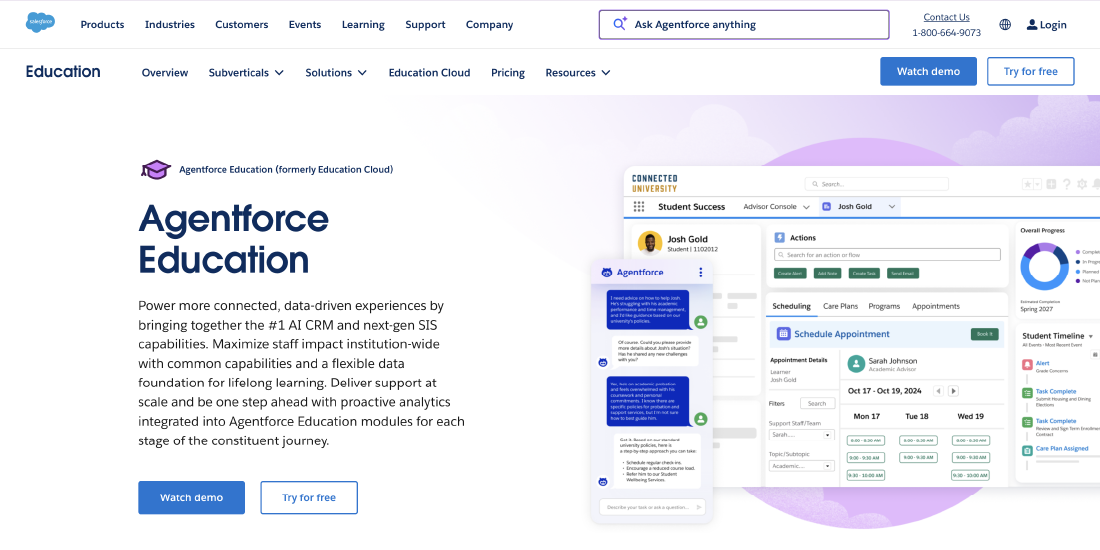
Salesforce Education Cloud adapts Salesforce’s enterprise CRM platform for higher education. It offers extensive customization, AI capabilities, automation, and integrations, making it suitable for institutions with complex technology environments.
Strengths
- Highly customizable
- Powerful automation and AI
- Extensive integration ecosystem
- Scales well for large institutions
Weaknesses
- Complex implementation
- Requires dedicated IT resources and ongoing administration
- Higher implementation and maintenance costs
Best For
Large universities and multi-campus institutions with experienced IT teams and complex operational requirements.
Navigate360
Overview
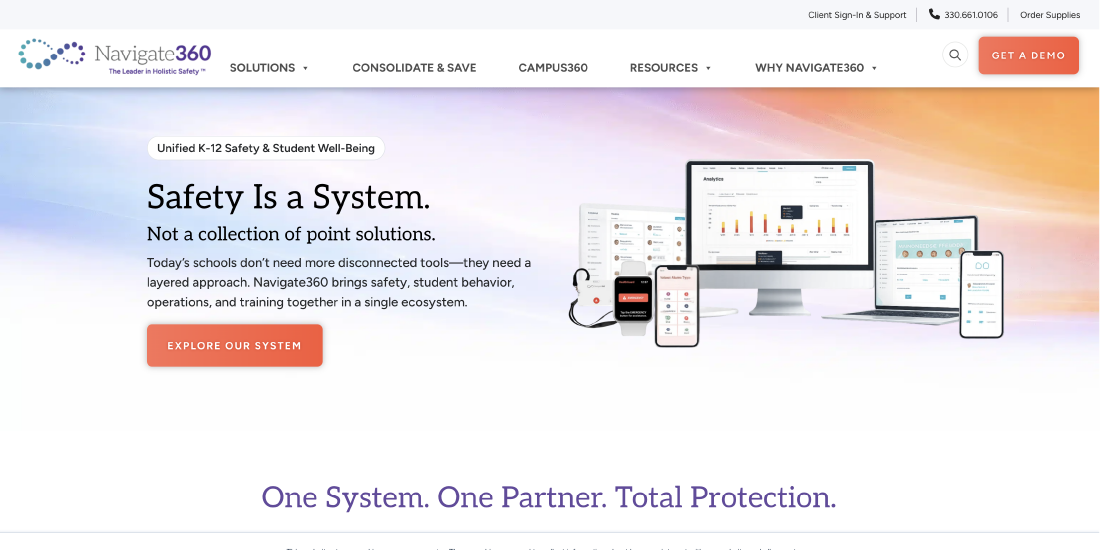
Navigate360 is designed to support the entire student lifecycle from recruitment and admissions to advising, retention, and alumni engagement. Instead of focusing only on enrollment, it connects multiple campus teams within one platform and includes embedded AI capabilities to improve staff productivity.
Strengths
- Covers enrollment, student success, and advancement
- Strong advising and retention capabilities
- Built specifically for higher education
- Shared student data across departments
Weaknesses
- Broader lifecycle focus may be more than institutions need if they’re only replacing an admissions CRM.
- Can require significant organizational adoption across departments.
Best For
Universities looking for a unified platform that supports students from recruitment through graduation.
Element451
Overview
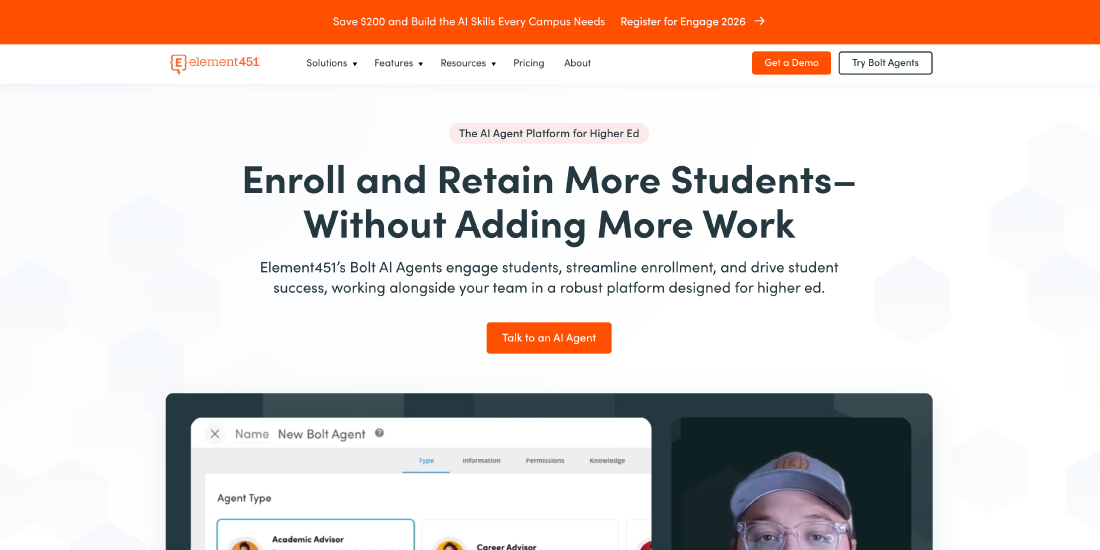
Element451 focuses on recruitment, enrollment marketing, and AI-driven student engagement. The platform emphasizes conversational AI, personalized communication, and marketing automation to help institutions convert more applicants.
Strengths
- Strong AI-powered student communication
- Excellent marketing automation
- Personalized recruitment campaigns
- User-friendly interface
Weaknesses
- Primarily focused on enrollment rather than the complete student lifecycle.
- May require additional systems for advising and student success.
Best For
Institutions focused on improving recruitment, lead nurturing, and applicant conversion.
Ellucian CRM
Overview
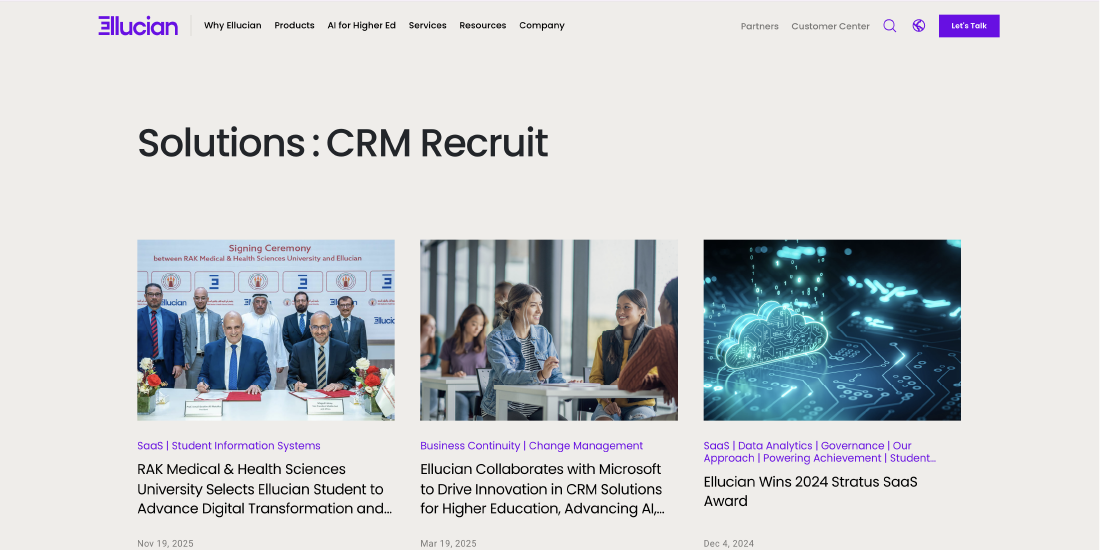
Ellucian offers CRM solutions for recruitment, admissions, student success, and advancement. It is particularly attractive for institutions already using Ellucian’s Student Information Systems, such as Banner or Colleague.
Strengths
- Native integration with Ellucian SIS
- Supports the complete student lifecycle
- Strong enrollment and advising capabilities
- Well-established higher education ecosystem
Weaknesses
- Best value for existing Ellucian customers.
- Less flexibility for institutions using other enterprise systems.
Best For
Universities already invested in the Ellucian ecosystem.
TargetX
Overview
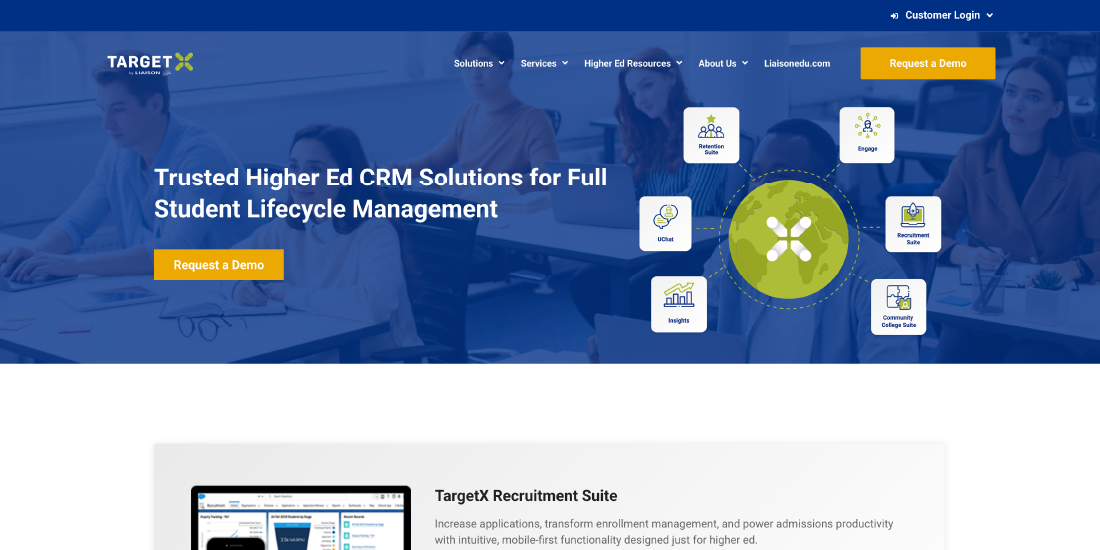
TargetX, part of Liaison, is built on Salesforce and supports undergraduate recruitment, admissions workflows, and student engagement. It has a long history in higher education and offers configurable communications throughout the enrollment journey.
Strengths
- Designed specifically for higher education
- Flexible recruitment workflows
- Built on Salesforce
- Strong communication management
Weaknesses
- Inherits some of Salesforce’s implementation complexity.
- Customization can become resource-intensive.
Best For
Colleges and universities seeking a Salesforce-based admissions CRM with higher education-specific workflows.
Conclusion
Choosing a higher education CRM is about more than replacing your current system. It is about finding a platform that helps your admissions team work smarter, engage students more effectively, and achieve long-term enrollment goals.
While Slate CRM remains a trusted choice for many institutions, the expectations of today’s universities have changed. Admissions teams need AI-powered automation, personalized communication, real-time insights, and intelligent workflows that reduce manual work and help applicants move through the enrollment process more smoothly.
The right CRM will depend on your institution’s priorities. Some universities need a highly customizable platform, while others are looking for AI-first solutions that simplify admissions and improve the student experience from day one. Taking the time to evaluate your current challenges, future growth plans, and technology needs will help you choose a platform that delivers value well beyond admissions.
Frequently Asked Questions
Ques 1. What are universities using CRM for?
Ques 2. What is the best CRM for universities?
Ques 3. Is Salesforce good for higher education?
Ques 4. What should universities look for in a CRM?
Written By






No comments yet. Be the first to comment!
Leave a Comment