


Table Of Contents
- 1What is a Transcript?
- 2What is Transcript Evaluation?
- 3What’s in a transcript evaluation?
- 4Who requires a Transcript evaluation?
- 5What is Automated Transcript Evaluation?
- 6Key Steps in Automated Transcript Evaluation
- 7EDMO’s Application Evaluator- Automated transcript processing
- 8Why Institutions Automate Transcript Evaluation
- 9Benefits of AI and automation in Transcript Evaluation
- 10How to Automate Transcript Evaluation
- 11Challenges of Automated Transcript Evaluation
- 12Application Intake and Centralization
- 13Conclusion
- 14FAQs
Transcript evaluation means reviewing and processing students’ academic records to check if they meet eligibility requirements, transfer credits, prerequisites, and other admissions criteria. Although this might seem simple, it is actually quite complicated. Universities and admissions teams receive transcripts in many formats, languages, grading systems, and credit structures from different countries and education boards. Evaluators have to manually gather course details, understand grading standards, confirm academic history, match courses to the institution’s requirements, and follow policies. Because of this, transcript evaluation takes a lot of time and is prone to mistakes, which can delay application decisions, create workflow problems, and make it harder for institutions to provide quick, personalized admissions experiences.
What is a Transcript?
A transcript is an official academic record documenting a student’s educational history and performance over a specific study period. Generally, it includes courses completed, grades earned, credit hours, cumulative GPA or marks, academic terms attended, degree or qualification pursued, and the name of the institution awarding the record.
In higher education admissions, transcripts are indispensable student records used to evaluate academic preparedness, determine eligibility, award transfer credits, verify prerequisites, and support enrollment decisions. Because transcript formats, grading systems, and course structures vary widely across institutions and countries, interpreting transcripts accurately is not child’s play and requires careful review and evaluation.
What is Transcript Evaluation?
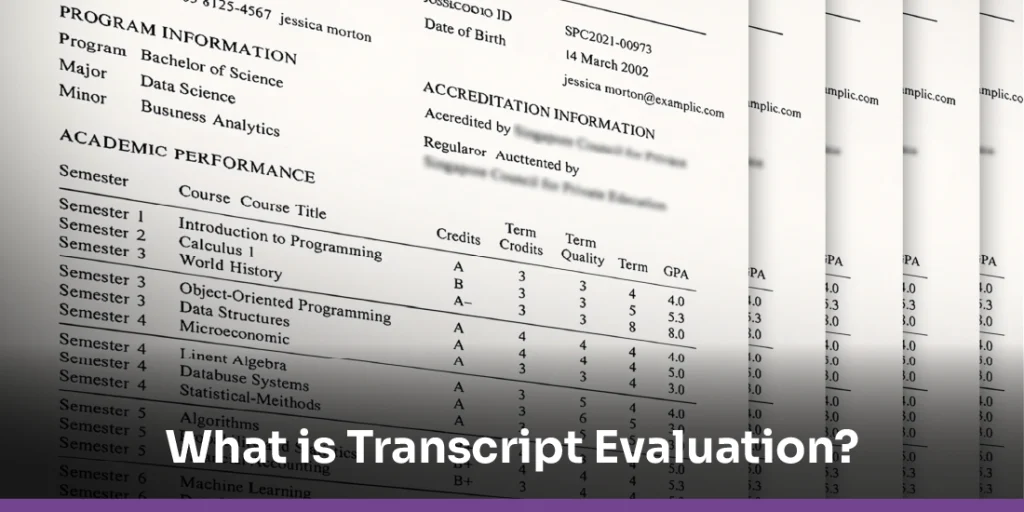
Transcript evaluation is the process of reviewing, interpreting, and assessing a student’s academic transcript to determine how their previous education aligns with an institution’s admissions, transfer, or academic requirements. It helps universities and educational institutions understand a student’s academic background beyond the raw grades and course list presented in the document.
What’s in a transcript evaluation?
A transcript evaluation typically consists of a structured, multi-step review of a student’s academic record to translate prior education into a format that can be fairly assessed against an institution’s requirements. It breaks down raw academic data into standardized, comparable, and decision-ready insights used for admissions, credit transfer, and placement.
Document Intake and Verification
Transcripts are collected, authenticated, and verified for completeness. This process includes reviewing the issuing institution, official seals, document formats, and supporting academic records to confirm legitimacy.
Data Extraction and Standardization
Essential academic information, including course titles, grades, credit hours, and grading scales, is extracted from the transcript and converted into a standardized format. This step is particularly critical for international transcripts that may have diverse structures and terminology.
Grade Interpretation and GPA Conversion
Various grading systems are analyzed and converted into a unified grading scale. This enables institutions to equitably compare applicants from diverse academic backgrounds and educational systems.
Course-by-Course Analysis
Each subject is assessed individually to determine its academic level, content relevance, and equivalency to the receiving institution’s courses or program prerequisites.
Credit Evaluation and Transfer Mapping
Eligible courses are assigned credit values and mapped against specific degree requirements, helping determine how much of a student’s prior learning can be transferred or recognized.
Final Review and Decision Making
All evaluated components are consolidated into a comprehensive assessment that informs admissions decisions, placement recommendations, or transfer approvals.
Purpose of Transcript Evaluations
Transcript evaluations help educational institutions fairly and accurately interpret students’ academic histories from diverse education systems. Their main purpose is to standardize transcripts to support admissions, credit transfers, and program placements. This allows institutions to make consistent and equitable decisions despite differences in grading systems, curricula, or international education structures.
Ensure Fair Academic Comparison
They standardize grading systems and academic structures, allowing students from various institutions and countries to be evaluated on a common scale.
Support Admissions Decisions
Evaluations enable universities to assess whether applicants meet program eligibility criteria and academic prerequisites.
Determine Transfer Credits
They identify which previously completed courses can be accepted for credit toward a new degree program, reducing repetition of coursework.
Verify Academic Credentials
Transcript evaluations verify the authenticity and legitimacy of applicants’ academic records.
Enable Proper Course Placement
They assist in placing students in suitable course levels based on prior learning and subject proficiency.
Improve Decision Speed and Consistency
Standardized evaluations reduce interpretation errors and enable admissions teams to make faster, more consistent decisions.
Who requires a Transcript evaluation?

Transcript evaluations are required by various stakeholders in higher education and professional pathways to understand and standardize a student’s prior academic record. Since transcripts come from different institutions, countries, and grading systems, evaluations convert them into a consistent format for decision-making.
Universities and Colleges
Higher education institutions require transcript evaluations to assess admissions eligibility, verify academic qualifications, and determine credit transfers or course placements.
International Students
Students applying to study abroad often need transcript evaluations to have their foreign academic records understood and compared against the destination country’s education standards.
Admission and Recruitment Teams
Admissions offices and enrollment teams use transcripts to screen applicants, validate credentials, and ensure candidates meet program requirements.
Credential Evaluation Agencies
Third-party evaluation bodies evaluate academic records on behalf of institutions, employers, or licensing authorities to ensure standardization and authenticity.
Licensing and Certification Boards
Professional licensing authorities ask for academic transcripts to verify academic qualifications for fields such as engineering, healthcare, teaching, and law.
Employers (in a few exceptions)
Some employers deem it compulsory for employees to submit their transcripts to verify their educational backgrounds for roles that require verified academic credentials or international degrees.
What is Automated Transcript Evaluation?
Automated transcript evaluation employs artificial intelligence, machine learning, and rule-based systems to digitize and streamline the review of academic transcripts, converting them into standardized, decision-ready evaluations. Rather than relying on manual interpretation of grades, course structures, credit systems, and institutional policies, automated systems extract, analyze, and map academic data more efficiently, consistently, and at scale.
Key Steps in Automated Transcript Evaluation
Automated transcript evaluation follows a structured AI-driven workflow that transforms raw academic records into standardized, decision-ready outputs for admissions and credit assessment. Instead of manually reviewing each transcript, the system uses OCR, data processing, and rule-based evaluation to extract, normalize, and analyze academic information at scale. These steps ensure faster processing, consistent interpretation across diverse grading systems, and improved accuracy in admissions decisions while allowing human oversight for exceptions.
Document Upload and Ingestion
Transcripts are uploaded to the system in multiple formats, including PDFs, scanned copies, and digital records. The system then ingests and organizes these documents for subsequent processing.
Optical Character Recognition (OCR) and Data Extraction
AI-powered optical character recognition (OCR) processes the transcript and extracts essential academic details, including course names, grades, credit hours, semesters, and institutional information.
Data Cleaning and Standardization
The extracted data is organized into a standardized format, addressing inconsistencies in formatting, terminology, and transcript layouts across institutions and countries.
Grade Normalization and Conversion
Various grading systems are automatically converted to a standardized scale, such as grade point average (GPA) equivalents, to facilitate equitable comparison among applicants.
Course Mapping and Rule Application
Courses are matched against institutional databases and predefined academic rules to determine equivalency, prerequisites, and program relevance.
Credit Evaluation and Calculation
Eligible courses are assigned credit values and counted toward degree or program requirements in accordance with institutional policies.
AI-Assisted Review and Validation
The system identifies anomalies, exceptions, or uncertain matches for human review to ensure accuracy and compliance.
Final Evaluation Output
A structured evaluation report is generated that summarizes grade point average (GPA), transferable credits, course mappings, and eligibility outcomes for admissions or placement decisions.
EDMO’s Application Evaluator- Automated transcript processing
EDMO’s Application Evaluator helps automate and simplify the entire process of reviewing student applications. It pays special attention to interpreting transcripts and mapping academic eligibility.
It allows admissions and enrollment teams to shift from manual, paper-based reviews to a more organized, AI-supported workflow. Academic records are turned into clear, standardized insights that are ready for decision-making.
The tool works by taking in application documents, including transcripts, and pulling out key academic details like courses, grades, credits, and grading systems. It then puts this information into a consistent format and checks academic performance against set rules, such as GPA minimums, required courses, and program-specific criteria.
In addition to extracting data, the Application Evaluator helps schools understand and map courses. This makes it easier to see course equivalencies, transfer credit options, and academic readiness. If there are exceptions or missing details, the system flags them for a person to review, so admissions teams stay in control while saving time.
Why Institutions Automate Transcript Evaluation
Higher education institutions are increasingly adopting automation for transcript evaluation to handle growing application volumes, reduce manual workload, and improve the speed and consistency of admissions decisions. Traditional evaluation processes are often slow, labor-intensive, and prone to inconsistency due to variations in global grading systems, transcript formats, and institutional policies. Automation helps standardize these inputs, enabling admissions teams to quickly convert complex academic records into accurate, comparable, and decision-ready insights while maintaining compliance and reducing human error.
Faster Application Processing
Automation significantly reduces the time required to review transcripts, enabling institutions to process larger volumes of applications without delays.
Improved Accuracy and Consistency
AI-driven systems standardize grading scales, credit systems, and course interpretations, minimizing inconsistencies across evaluators.
Reduced Manual Workload
Admissions teams are freed from repetitive data extraction and conversion tasks, allowing them to focus on higher-value decision-making.
Better Handling of International Applications
Automation efficiently manages diverse transcript formats, languages, and grading systems from global applicants.
Scalable Admissions Operations
Institutions can handle seasonal spikes in applications without needing proportional increases in staffing.
Enhanced Decision Support
Automated systems provide structured, standardized evaluations that help admissions officers make faster and more informed decisions.
Benefits of AI and automation in Transcript Evaluation
AI and automation are transforming transcript evaluation in higher education by making workflows faster, more accurate, and scalable. Rather than relying on manual review, AI-powered systems extract, standardize, and analyze academic data in real time. This enables admissions teams to make quicker, more informed decisions while reducing operational burden and errors.
Faster Evaluation Turnaround
AI reduces transcript processing time from days to minutes, accelerating admissions and enrollment cycles.
Higher Accuracy and Reduced Errors
Automation minimizes errors in data entry, GPA conversion, and credit mapping by applying consistent rules and models.
Standardization Across Global Systems
It standardizes diverse grading scales, course structures, and transcript formats into a unified evaluation framework.
Lower Operational Workload
Admissions teams spend less time on repetitive tasks and more time on strategic decision-making and applicant engagement.
Scalable Processing of Applications
Institutions can efficiently manage peak application volumes without increasing staff.
Improved Decision Consistency
AI ensures similar academic profiles are evaluated using the same criteria, reducing subjectivity in admissions decisions.
Better Support for International Students
Automation processes multilingual and non-standard transcripts, making global admissions more inclusive and efficient.
How to Automate Transcript Evaluation
To automate transcript evaluation, use AI, OCR, and rule-based systems to pull academic data from transcripts, standardize it, and match it to your institution’s requirements. This approach replaces manual review with a faster, more accurate, and consistent process for admissions decisions.
Digitize and Ingest Transcripts
Gather transcripts in different formats like PDFs, scanned images, or digital uploads, and store them in one system that can handle many files at once.
Apply OCR and Data Extraction
Apply OCR and AI tools to pull out important academic details, including courses, grades, credits, semesters, and school information.
Clean and Standardize Data
Clean up the extracted data by fixing formatting issues, making course structures consistent, and matching terms from different education systems.
Normalize Grades and GPA Conversion
Change different grading systems into a common scale, like GPA or percentages, so you can compare all applicants fairly.
Apply Evaluation Rules and Logic
Set up your institution’s rules to check if applicants meet requirements like prerequisites, minimum GPA, credit limits, and program-specific needs.
Map Courses to Equivalencies
Compare the courses you’ve extracted with your institution’s database or catalog to see if credits can transfer and if courses are equivalent.
Flag Exceptions for Human Review
Identify incomplete, ambiguous, or unusual records and route them to admissions officers for manual validation.
Generate Evaluation Reports
Create clear reports that sum up GPA, credit transfer options, course matches, and how ready each applicant is for admission. These reports help with final decisions.
Challenges of Automated Transcript Evaluation
Automation makes transcript evaluation much faster and more efficient, but it is not a simple process you can set up and forget. To make it work well, you need experienced admissions and academic operations teams. These teams must set up institutional rules, manage exceptions, and make sure AI results match real academic policies and the variety of global education systems.
Need for Experienced Academic and Operations Teams
Automating transcript evaluation relies on clear rules for grading, credit transfer, and course equivalency. Experienced teams are needed to set up these systems, understand complex academic structures, and keep improving the evaluation process so it stays accurate and fair for all types of transcripts.
Handling Complex and Exceptional Academic Cases
Even the best systems have trouble with unusual cases like interdisciplinary courses, non-standard grading, incomplete records, or special institutional policies. Skilled admissions staff need to review these flagged cases, check the AI’s results, and make decisions when automation is not enough.
Best Foot Forward: Transcript Evaluation Within the Admissions AI Team
Transcript evaluation within an Admissions AI team constitutes a collaborative workflow in which automation and human expertise jointly convert complex academic records into structured, decision-ready insights. Instead of functioning as an isolated manual process, evaluation is integrated into a comprehensive AI-powered admissions ecosystem that emphasizes speed, accuracy, and scalability, while preserving institutional judgment and oversight.
Application Intake and Centralization
All student applications and transcripts are aggregated within a unified admissions system, ensuring that data from multiple sources is consolidated for efficient processing.
AI-Based Data Extraction
AI and optical character recognition (OCR) technologies automatically process transcripts and extract essential academic details, including courses, grades, credits, and grading systems, from a variety of formats.
Standardization and Structuring
The extracted data is cleaned and standardized into a consistent format, facilitating uniform interpretation across countries, institutions, and educational boards.
Automated Academic Evaluation
The system applies predefined institutional rules to evaluate grade point average (GPA) equivalency, course relevance, prerequisite fulfillment, and credit eligibility at scale.
Exception Detection and Flagging
Applications with missing data, unusual grading structures, or ambiguous course mappings are flagged by the system for further human review.
Human-in-the-Loop Review
Experienced admissions officers and evaluation specialists review flagged cases, validate AI outputs, and apply contextual academic judgment where required.
Decision Support and Ranking
The finalized evaluation data is used to support admissions decisions, prioritize high-fit candidates, and streamline enrollment workflows.
Continuous Model and Rule Refinement
Feedback from admissions teams is used to continuously improve AI accuracy, update evaluation rules, and enhance future transcript processing performance.
Conclusion
To sum up, transcript evaluation is central to today’s admissions process. It helps schools understand and compare different academic backgrounds so they can make fair decisions. With more applications and students moving across borders, manual review is no longer practical. Using AI and automation speeds up the process, improves accuracy, and makes academic comparisons more consistent. Still, the best results come from a mix of technology and human judgment. Automation can handle large amounts of data, while admissions teams focus on special cases and context. This approach leads to faster, more reliable, and fairer admissions decisions.
FAQs
Who can complete a transcript evaluation?
Transcript evaluations are typically completed by admissions officers, credential evaluators, or trained academic staff. Many institutions also use AI-powered systems to assist or automate the process.
How much does a transcript evaluation cost?
Costs vary widely. In traditional setups, third-party evaluations can range from $100–$300 per transcript, while in-house automated systems primarily reduce operational costs rather than per-evaluation fees.
How long does it take to receive a transcript evaluation?
Manual evaluations can take several days to weeks, while automated systems can process transcripts in minutes to hours, depending on complexity and review requirements.
Why does transcript evaluation break down at scale?
At scale, manual evaluation becomes slow, inconsistent, and resource-heavy due to diverse global formats, grading systems, and increasing application volumes, leading to bottlenecks and delays.
What types of transcripts does the Transcript Evaluation AI support?
It supports domestic and international transcripts across formats, including scanned PDFs, digital transcripts, multilingual documents, and varied grading systems.
How does the Transcript Evaluation AI tool handle different grading scales?
It automatically normalizes grading systems by converting them into a standardized scale, such as GPA or percentage equivalents, using predefined institutional rules.
How is transcript data used in application review and decisioning?
Evaluated transcript data is used to assess eligibility, calculate GPA equivalency, determine credit transfer, and support admissions or placement decisions.
Can admissions staff review or adjust transcript data?
Yes. Admissions teams can review, validate, and override AI-generated evaluations, ensuring human oversight for edge cases and institutional compliance.
Written By






No comments yet. Be the first to comment!
Leave a Comment