


Table Of Contents
- 1Introduction
- 2What Is International Student Application Management?
- 3Key Aspects of Managing International Applications
- 4Common Challenges in Managing International Student Applications
- 5Key Indicators of Potential Identity Fraud in Applications
- 6How Universities Authenticate International Applications
- 7Role of AI and Automation in International Admissions
- 8Best Practices for Managing International Student Applications
- 9How EDMO Helps Universities Manage International Student Applications
- 10Future Trends in International Student Admissions
- 11Conclusion
Introduction
Handling international student applications is now one of the most important and challenging parts of university admissions. As schools compete for students from around the world, admissions teams do much more than process paperwork. They work with different academic systems, documentation standards, time zones, languages, and changing visa rules. Every application is more than just a candidate; it comes with unique details that need careful review and understanding on a large scale.
International recruitment is no longer just about numbers. Now, universities focus on finding students who are the right fit and likely to enroll. Schools need to reply quickly, tailor their messages for different regions, and keep their evaluations fair, even as applications increase. To do this well, they need strong systems, clear processes, and good use of data. Managing international applications effectively is now key for both running admissions smoothly and building a diverse, successful student body.
What Is International Student Application Management?
International student application management refers to the comprehensive process of supporting foreign applicants from initial inquiry through to enrollment. This process includes tracking academic documentation, verifying language proficiency, and addressing complex visa requirements. Educational institutions and agencies employ specialized software to optimize these administrative procedures.
The management of international student applications encompasses several critical operational stages and incorporates specific technological solutions.
Core Lifecycle Stages
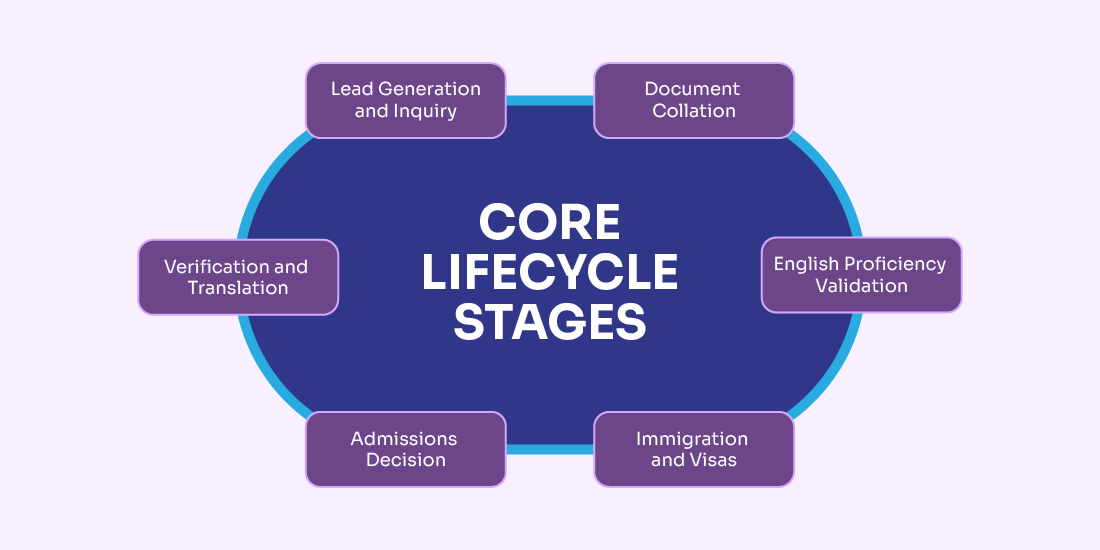
The process covers a series of predefined milestones tailored specifically to overseas applicants:
- Lead Generation and Inquiry: Monitoring prospective students as they request information about academic programs, scholarships, or campus life.
- Document Collation: Collecting transcripts, degree certificates, and identification documents, such as passports.
- Verification and Translation: Confirming that credentials meet local standards and authenticating notarized translations.
- English Proficiency Validation: Obtaining standardized test scores, such as IELTS, TOEFL, or PTE.
- Admissions Decision: Evaluating application files and issuing either conditional or unconditional offer letters.
- Immigration and Visas: Assisting students in preparing required financial documentation, such as bank statements, and obtaining necessary student visas, including the F-1 visa in the United States or the Study Visa in the United Kingdom.
Key Aspects of Managing International Applications
Universities face a unique set of challenges when managing international student applications. They need to balance efficiency, consistency, and a personal touch while working with different academic systems, document standards, and regulations from around the world. Compared to domestic admissions, international applications are more complicated and often need to be processed quickly. They also involve more people, extra verification steps, and communication across different time zones. By following a clear process, admissions teams can review applicants fairly, stay compliant, improve results, and make the experience smoother for students.
Credential evaluation and academic equivalency
Admissions teams need to understand different grading systems, degrees, and academic formats to compare them fairly with their own standards. They often use evaluation frameworks or get help from outside agencies to do this.
Document verification and compliance management
Teams must check transcripts, test scores, financial documents, and identity records, making sure everything meets visa and regulatory rules.
Efficient application processing workflows
It is important to create review processes that are efficient, reduce delays, and make evaluations consistent. This helps teams handle many applications without losing accuracy.
Communication and applicant engagement
Admissions teams should communicate clearly and on time with applicants, using different channels and considering time zone differences. This helps guide students through every step.
Data-driven admissions decision-making
Using centralized systems and data analysis helps teams track applications, spot trends, focus on the most interested candidates, and increase the number of students who enroll.
Common Challenges in Managing International Student Applications
Managing international student applications is complex, as universities must assess candidates from varied educational backgrounds while ensuring fairness, efficiency, and compliance. Admissions teams often experience operational strain from high application volumes, inconsistent documentation, and changing regulatory requirements. These issues are compounded by communication gaps, time zone differences, and the need to deliver a seamless applicant experience while maintaining accurate evaluations and decisions.
Managing International Student Applications: Challenges & Troubles
- Variation in academic systems and grading standards
Comparing qualifications across countries is challenging because of differences in curricula, grading scales, and credential structures. - Incomplete or inconsistent documentation
Missing transcripts, unclear academic records, and inconsistent document formats slow verification and evaluation. - Credential evaluation complexity
Accurately mapping international qualifications to domestic equivalents often requires specialized expertise or external services. - Regulatory and visa compliance requirements
Admissions teams must navigate country-specific immigration rules, financial documentation standards, and institutional compliance requirements. - Communication barriers and time zone differences
Delays in responses and misunderstandings due to language differences, regional expectations, and asynchronous communication cycles. - High application volumes and processing delays
High application volumes can create bottlenecks, slow turnaround times, and risk losing highly motivated candidates. - Limited visibility across the application lifecycle
Fragmented systems make it difficult to track applicant progress, identify drop-offs, and optimize yield strategies.
Universities must now assess student applications holistically, considering both academic records and the integrity of the entire submission. As digital applications and cross-border mobility increase, admissions teams need to identify genuine applicants and detect potential fraud early in the review process. Enhancing this scrutiny is vital to protect institutional credibility and ensure fair opportunities for all qualified students.
Key Indicators of Potential Identity Fraud in Applications
Managing student applications today requires universities to look beyond academic scores and focus on the integrity of the entire application. With increasing digital submissions and cross-border mobility, admissions teams must be able to distinguish between genuine applicants and potentially fraudulent profiles early in the review process. Strengthening this layer of scrutiny is essential not only for protecting institutional credibility but also for ensuring fair opportunities for authentic students.
Red Flags in Student Applications That Signal Identity Fraud
- Inconsistent personal information across submitted documents
Names, dates of birth, or spellings that do not match across passports, transcripts, and application forms. - Suspicious or poor-quality document uploads
Blurry scans, altered PDFs, or documents showing signs of tampering, such as inconsistent fonts or mismatched seals. - Unverifiable academic credentials
Degrees or transcripts from institutions that cannot be validated through official channels or recognized databases. - Unusual gaps or overlaps in academic timelines
Chronological inconsistencies in education history that do not align with standard academic progression. - Multiple applications with similar profiles
Repeated submissions from different accounts with overlapping personal details, photos, or contact information. - Email and contact inconsistencies
Use of temporary, generic, or mismatched contact details that do not align with institutional or country-specific norms. - IP or location anomalies during application submission
Applications submitted from locations that do not match declared residence or education history. - Pressure tactics or urgency in communication
Applicants repeatedly pushing for expedited decisions without reasonable cause or documentation clarity.
How Universities Authenticate International Applications
Universities get international applications from many different education systems, so verifying documents is an important part of admissions. Making sure each applicant’s identity, academic background, and records are real helps keep the process fair and protects academic standards. As fraud becomes more advanced, verification now uses both technology and human checks in a careful, step-by-step process.
- Primary document authentication
Staff check official transcripts, degree certificates, and mark sheets to make sure the information is consistent, the format is correct, and the documents come from the right authority. - Third-party credential evaluation services
Universities use trusted agencies to compare international qualifications to local standards and to confirm that the issuing institutions are legitimate. - Direct institutional verification
They contact the original schools or universities to check enrollment records, graduation status, and academic performance directly. - Digital verification tools and databases
Universities use secure online platforms and national or international databases to check degrees, test scores, and whether institutions are accredited. - Identity verification checks
They compare passports, government IDs, and application details to make sure all the information matches across the documents. - Fraud detection and document forensics
Staff review documents with special tools to spot any changes, unusual metadata, or formatting issues. - Cross-referencing application data
They check that academic history, timelines, and supporting documents all make sense together throughout the application. - Interview or video verification (when required)
Sometimes, universities hold live or recorded interviews to confirm who the applicant is and to clear up any questions about their documents.
Role of AI and Automation in International Admissions
Universities are increasingly implementing artificial intelligence (AI) and automation to address the growing complexity of international admissions. As application volumes rise and documentation formats diversify, manual processing has become insufficient. AI-enabled systems streamline verification, enhance decision consistency, and provide faster responses while maintaining accuracy and regulatory compliance across global applicant pools.
Automated Document Processing and Data Extraction
AI tools extract and structure data from transcripts, passports, and certificates, thereby reducing manual data entry and minimizing errors.
Intelligent Credential Evaluation Support
AI systems map international qualifications to institutional standards by referencing historical data and established global education frameworks.
Fraud Detection and Anomaly Identification
Machine learning models identify inconsistencies in documents, identity information, and academic timelines for further review.
Application Triage and Prioritization
Automation sorts and ranks applications according to completeness, eligibility, and institutional criteria.
Workflow Automation Across Admissions Stages
Routine tasks, including status updates, reminders, and checklist tracking, are automated to enhance operational efficiency.
AI-Driven Communication and Applicant Support
Chatbots and virtual assistants deliver real-time responses to applicant inquiries across multiple time zones and languages.
Predictive Analytics for Yield and Enrollment
AI models analyze applicant behavior and historical data to forecast the likelihood of acceptance and subsequent enrollment.
Integration with Admissions Systems and Customer Relationship Management (CRM) Platforms
Automation ensures seamless data flow among application platforms, CRM tools, and internal review systems.
Best Practices for Managing International Student Applications
Admitting international students is more complicated now, as universities work with applicants from many backgrounds, regions, and documentation standards. To handle this well, schools need clear systems that help keep things accurate, consistent, and responsive at every step. Good processes and teamwork are essential for growing international recruitment while maintaining quality and fairness.
- Standardize evaluation criteria across regions
Set clear standards for reviewing academic credentials from different countries so that every application is evaluated fairly. - Implement centralized application systems
Manage applications, documents, and communications in one unified system to make coordination and tracking easier. - Strengthen document verification processes
Use both manual checks and digital tools, along with third-party validation, to confirm documents are real and lower the risk of errors. - Adopt automation for routine workflows
Automate routine tasks like data entry, status updates, and first-round screening to work faster and make fewer mistakes. - Improve clarity and consistency in communication
Keep applicants informed with timely updates that are clear and tailored to their region throughout the admissions process. - Use analytics to guide admissions decisions
Use data on application trends, conversion rates, and enrollment patterns to adjust your strategies and get better results. - Upskill admissions teams on global education systems
Help your team learn about international grading systems, qualifications, and how schools differ so they can review applications more accurately. - Stay aligned with evolving compliance requirements
Keep up with changes in visa policies, school regulations, and country requirements to make sure the admissions process goes smoothly.
How EDMO Helps Universities Manage International Student Applications
EDMO enables universities to streamline and modernize international student admissions by integrating AI-driven automation, document intelligence, and conversation intelligence within a unified workflow. This approach reduces manual effort in application review, verification, and applicant engagement, allowing institutions to process larger volumes of international applications with increased speed, accuracy, and consistency, while enhancing the overall student experience.
- AI-Powered Document Intelligence
Automatically extracts and structures data from transcripts, passports, and supporting documents to minimize manual data entry and reduce processing delays. EDMO’s Document Intelligence uses AI to extract, structure, and verify information from academic and identity documents such as transcripts, passports, and certificates, helping universities reduce manual effort and improve accuracy in admissions. Its tools include automated data extraction, document classification, fraud and anomaly detection, and real-time validation support, enabling faster processing and more reliable international application review. - Automated Credential Processing and Evaluation Support
Enables admissions teams to standardize the interpretation of international qualifications and streamline equivalency mapping. - Fraud Detection and Risk Flagging
Detects inconsistencies across identity documents, academic records, and application data to facilitate early risk identification. - Conversation Intelligence for Applicant Engagement
Supports real-time tracking of applicant interactions, provides next-best-action recommendations, and helps teams respond faster and more effectively. - AI admissions copilot for teams
Provides admissions officers with summaries, application insights, and decision support to enhance consistency and decrease review time. EDMO’s Advisor Copilot and Student Copilot work together to make international admissions more connected and responsive. The Advisor Copilot supports admissions teams with application summaries, next-best-action recommendations, risk signals, and workflow insights to improve decision-making and efficiency. The Student Copilot helps applicants by providing real-time guidance, answering queries, and offering personalized updates throughout the application journey, ensuring a smoother and more transparent admissions experience. - Workflow Automation Across Admissions Stages
Automates repetitive tasks, including status updates, reminders, and checklist tracking, to enhance operational efficiency. - Integration with Existing Systems
Integrates with platforms such as Customer Relationship Management (CRM) and Student Information System (SIS) tools to ensure seamless data flow across admissions ecosystems. - Enhanced Yield and Conversion Insights
Utilizes analytics to identify high-intent applicants and support improved enrollment forecasting and decision-making.
Future Trends in International Student Admissions
International student admissions are changing quickly as universities adapt to new student mobility trends, digital tools, and greater competition for talent. The process, which used to be mostly manual and paperwork-heavy, is now shifting toward data-driven, automated, and student-centered approaches. Soon, schools will use smarter systems that speed up application processing, predict results, personalize communication, and improve enrollment strategies.
- AI-first admissions workflows
More universities will use AI to handle document review, check eligibility, and sort applications more efficiently. - Shift toward predictive admissions models
Data analytics will become more important for predicting which applicants are likely to succeed, enroll, and how they might behave during the admissions process. - Greater emphasis on real-time applicant engagement
Schools will start to engage with applicants in ongoing, two-way conversations instead of just sending occasional emails. - Stronger focus on fraud detection and identity verification
More advanced verification tools will become common to help manage the growing risks of digital applications. - Integration of admissions ecosystems
Application platforms, CRMs, and student information systems will work together more closely to make data sharing easier. - Personalized applicant journeys at scale
AI-driven segmentation will enable tailored communication based on geography, intent, and academic profile. - Rise of skills and competency-based evaluation
Admissions teams will start to look at more than just grades, considering other signs of a student’s skills and readiness. - Increased automation in decision support
AI tools will help admissions staff by providing summaries, making recommendations, and speeding up decisions.
Conclusion
Managing international student applications is no longer just an administrative function. It is a strategic capability that directly influences a university’s global reach, diversity, and enrollment outcomes. As institutions face increasing complexity in academic systems, documentation standards, and applicant expectations, success depends on building structured, technology-enabled processes that ensure accuracy, speed, and fairness at scale. Universities that invest in stronger verification systems, streamlined workflows, and intelligent automation are better positioned to attract and enroll high-quality international talent.
Ultimately, the future of international admissions will be defined by how effectively institutions combine human judgment with AI-driven insights. Those that adapt early will improve operational efficiency and deliver a more transparent, responsive, and student-centric admissions experience.
Frequently Asked Questions
Ques 1 What is international student application management?
Ques 2 What are the key aspects of managing international applications?
Ques 3 How do universities verify international student applications?
Ques 4 What are common red flags in student applications?
Ques 5 How can universities prevent identity fraud in admissions?
Ques 6 How does AI help international admissions teams?
Ques 7 What challenges do universities face in international admissions?
Ques 8 What tools are used for international student application management?
Written By





No comments yet. Be the first to comment!
Leave a Comment