

Table Of Contents
- 1Introduction
- 2What is an admissions chatbot?
- 3Top Advantages of Using Admissions Chatbots for College Admissions Guidance
- 4Admissions Chatbot vs. Admissions Counselor
- 5How Admissions Chatbots Can Help Address the High School Counselor Shortage
- 6Can Admissions Chatbots Replace a College Counselor?
- 7Conclusion
Introduction
For potential students today, the process of applying to universities generally starts well before they have a conversation with a member of the university staff. They look at courses late at night, check on tuition fees using their phones, and expect replies within minutes rather than after days. Because of this change in the way students behave, colleges and universities have been forced to reconsider the way in which they offer admissions assistance. Nowadays, admissions chatbots powered by AI are able to give immediate answers to standard questions, help applicants complete the forms, send them reminders, and be available around the clock. At the same time, admissions counselors still play a vital role in assisting students with making complicated decisions that relate to finance, academic suitability, career objectives, and their personal situations.
The issue is not whether to use a chatbot or a counselor. The real question is which types of interaction should be automated and which need a human element. If all aspects are automated there is a risk of providing an impersonal service, whereas if they depend completely on their staff they may have difficulties with delayed responses, spikes in the number of applications during certain seasons, and a growing volume of enquiries. The most successful admissions offices combine the use of AI automation with human expertise, applying each one where it is most valuable.
The article looks at the advantages and limitations of admissions chatbots and admissions counselors, determines which tasks are most appropriate for automation, points out the situations in which human assistance always performs better than technology, and explains how universities can design a hybrid admissions system that enhances both the student experience and operational efficiency.
What is an admissions chatbot?
An admissions chatbot is a virtual assistant that uses AI to help prospective students and applicants find information and complete admissions tasks. Students can interact with the chatbot through a website chat, SMS, voice, or messaging app. The chatbot answers common questions and guides students through each step of the enrollment process, so staff do not have to reply to every inquiry themselves.
For example, a student might ask about deadlines, required documents, tuition, scholarships, transfer credits, campus visits, or their application status. The chatbot can give quick answers, share helpful links, collect contact details, and send more complicated questions to an admissions counselor if needed.
Today’s admissions chatbots often connect to university systems like a CRM or student information system. This helps them personalize conversations based on a student’s interests, application stage, or past questions. Some advanced chatbots can also send reminders, set up appointments, summarize chats for staff, and spot students who might need extra help.
The biggest advantage of an admissions chatbot is speed and availability. Unlike a traditional office that operates during business hours, a chatbot can respond 24/7, helping institutions manage high inquiry volumes during peak admissions periods while reducing repetitive workload for admissions teams. However, chatbots are most effective for routine, information-based interactions; they do not replace the empathy, judgment, and relationship-building skills of an admissions counselor.
Top Advantages of Using Admissions Chatbots for College Admissions Guidance
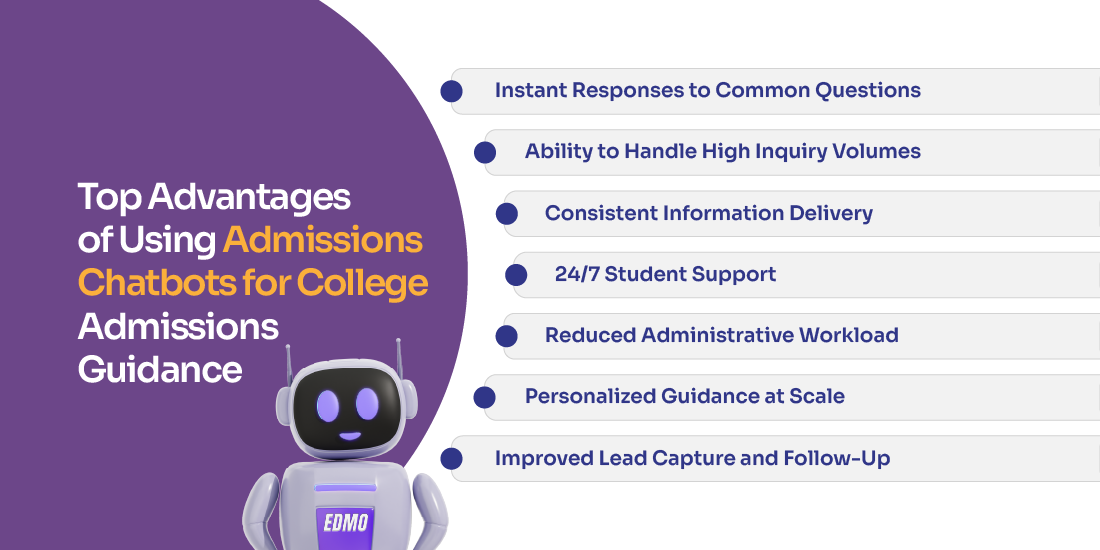
Admissions chatbots are transforming how colleges and universities interact with prospective students. Instead of waiting for office hours or email replies, students can receive instant support throughout their enrollment journey. Below are the major advantages of using admissions chatbots, explained in a more conversational and practical way.
24/7 Student Support
One of the biggest advantages of an admissions chatbot is that it never closes. Students often research colleges late at night, on weekends, or from different time zones. A chatbot can answer questions at any hour, ensuring students receive timely support whenever they are ready to engage with the institution.
Instant Responses to Common Questions
Students expect quick answers, especially when comparing multiple colleges. An admissions chatbot can immediately respond to questions about application deadlines, required documents, tuition fees, scholarships, and campus visits. This instant communication reduces frustration and keeps students engaged with the university.
Ability to Handle High Inquiry Volumes
During peak admissions seasons, universities may receive thousands of inquiries in a short period. Human teams can become overwhelmed, leading to delays. A chatbot can manage many conversations simultaneously, helping institutions maintain fast response times even during application deadlines and recruitment campaigns.
Consistent Information Delivery
Different staff members may sometimes explain policies in different ways. A chatbot provides standardized responses based on approved institutional information. This consistency helps ensure every prospective student receives accurate guidance about admissions requirements, procedures, and timelines.
Reduced Administrative Workload
Admissions counselors spend significant time answering repetitive questions. By automating routine inquiries, chatbots free staff to focus on higher-value activities such as application review, student counseling, recruitment strategy, and relationship building with prospective applicants.
Personalized Guidance at Scale
Modern AI chatbots can tailor conversations based on a student’s program of interest, academic level, location, or stage in the admissions process. For example, an international applicant may receive different guidance than a transfer student. This personalization improves the student experience without requiring additional staff effort.
Improved Lead Capture and Follow-Up
A chatbot can collect names, email addresses, phone numbers, academic interests, and other inquiry details during the conversation. These details can be sent automatically to the university CRM, allowing admissions teams to continue personalized outreach and nurture prospective students more effectively.
Automated Reminders and Nudges
Many applicants miss deadlines because they forget a step in the process. Admissions chatbots can send reminders about incomplete applications, missing documents, interview schedules, financial aid forms, or upcoming campus events. These timely nudges help students stay on track and improve application completion rates.
Faster Inquiry-to-Application Conversion
When a student receives immediate assistance, they are more likely to continue exploring the institution rather than leave the website. Chatbots can guide students directly to the application portal, provide step-by-step instructions, and encourage them to begin the application process while their interest is still high.
Better Support for International Students
International applicants often face challenges such as visa questions, credential requirements, English-language proficiency policies, and time-zone differences. A chatbot can provide round-the-clock support and often communicate in multiple languages, making the admissions process more accessible for global students.
Valuable Admissions Insights and Analytics
Every chatbot conversation generates data about student concerns and behavior. Universities can analyze these interactions to identify frequently asked questions, confusing application steps, and common barriers to enrollment. These insights help admissions leaders improve communication and streamline processes.
Cost-Effective Scalability
Hiring additional admissions staff for every increase in inquiry volume can be expensive. Chatbots allow institutions to scale student support more efficiently by automating many routine interactions. This makes them a cost-effective solution for growing enrollment operations.
Stronger Mobile and Text-Based Engagement
Today’s students are highly comfortable with messaging and mobile communication. Chatbots work well on smartphones and can engage students through chat interfaces that feel familiar and convenient. This improves response rates and encourages ongoing interaction with the institution.
Seamless Escalation to Human Counselors
The best admissions chatbots do not replace counselors; they support them. When a conversation becomes complex or sensitive, the chatbot can transfer the student to a human admissions counselor along with the conversation history. This creates a smoother handoff and prevents students from having to repeat their questions.
Admissions Chatbot vs. Admissions Counselor
As universities modernize their enrollment operations, a common question arises: Should student support be handled by an admissions chatbot or by an admissions counselor?
The answer is not one or the other. Admissions chatbots excel at speed, scale, and routine communication, while admissions counselors provide empathy, judgment, and personalized guidance for complex decisions. Institutions that understand the strengths of each can create a more efficient admissions process and a better student experience.
Admissions Chatbot
An admissions chatbot is best suited for high-volume, repetitive interactions that require quick answers and consistent information.
- Available 24/7 for student inquiries.
- Provides instant answers to common admissions questions.
- Handles thousands of conversations simultaneously.
- Delivers consistent, approved information.
- Sends automated reminders and follow-ups.
- Captures leads directly into the CRM.
- Reduces repetitive workload for admissions staff.
- Works well across web chat, SMS, and messaging platforms.
Admissions Counselor
An admissions counselor is most effective when students need nuanced advice, reassurance, or help making an important educational decision.
- Provides personalized academic and career guidance.
- Understands student goals and circumstances.
- Handles complex or unusual application cases.
- Supports financial aid and scholarship discussions.
- Builds trust and long-term relationships.
- Offers empathy during stressful decision periods.
- Exercises professional judgment and discretion.
- Represents the institution’s culture and values in a human way.
Comparison Table
| Area | Admissions Chatbot | Admissions Counselor |
| Availability | 24/7 | Business hours |
| Response speed | Instant | Minutes to days |
| Inquiry volume | Very high | Limited by staffing |
| Consistency | Highly consistent | May vary slightly by counselor |
| Personalization | Rule- or AI-based personalization | Deep human personalization |
| Emotional support | Limited | Strong |
| Complex case handling | Escalates to human | Excellent |
| Relationship building | Minimal | Excellent |
| Cost per interaction | Low | Higher |
| Financial aid discussions | Basic information only | Detailed guidance |
| Transfer or international cases | Basic guidance and routing | Detailed evaluation support |
| Decision support | Limited | Strong |
| Scalability | Excellent | Moderate |
What should be the takeaway?
Use an admissions chatbot for routine questions, application reminders, lead capture, and first-line support. Use an admissions counselor for complex applications, financial aid conversations, transfer evaluations, international student concerns, and final enrollment decisions. The strongest admissions strategy combines both: AI automation for efficiency and human expertise for the moments that matter most to students.
Where Admissions Counselors Still Lead in Helping Students Apply to College
Even though there has been rapid growth in the use of AI-powered admissions chatbots, admissions counselors are still essential to the college application process. Applying to college is not merely an administrative matter; it is a significant life decision that takes into account academic objectives, financial considerations, career ambitions, family expectations, and one’s own level of confidence. Although chatbots are able to give quick answers to standard questions, it is the admissions counselors who offer the human insight and support that students frequently need when facing important choices. Because they can listen, understand individual circumstances, and establish trust, they remain one of the most valuable resources in the field of higher education admissions.
Personalized College and Program Guidance
Admissions counselors assist students in finding colleges and academic programmes that truly suit their interests, strengths, and long-term objectives. Instead of just giving a list of the programmes available, they are able to talk about career prospects, the atmosphere of the campus, different kinds of learning styles, and the various opportunities that might be more appropriate for a specific student.
Support for Complex Application Situations
Students who have obtained credit through transfer studies, have gaps in their academic record, hold international qualifications, come from nontraditional educational backgrounds, or have other unusual circumstances usually need personal guidance. Admissions counselors are in a position to examine these cases thoroughly, clarify the institution’s policies, and assist students in presenting their applications in the best possible light.
Financial Aid and Affordability Conversations
Questions concerning scholarships, grants, tuition fees, payment arrangements, and eligibility for financial aid are generally complex and very personal. Admissions counselors are able to go over the various options with students, explain the confusing requirements, and assist families in making well-informed financial decisions regarding attending college.
Emotional Support During a Stressful Process
Filling out college applications can cause anxiety, uncertainty, and self-doubt. Throughout the process, admissions counselors give their encouragement, reassurance, and practical advice. Because of their empathetic attitude and the fact that they interact personally with students, they can help them feel supported and confident as they go through a major life change.
Building Trust and Long-Term Relationships
By having many conversations with a student, along with making campus visits, conducting interviews, and carrying out follow-ups, a counselor is able to build up a continuous relationship with them. This kind of relationship causes students to feel a sense of connection with the institution and frequently influences their final decision regarding enrollment, a point on which automated systems are unable to replicate effectively.
How Admissions Chatbots Can Help Address the High School Counselor Shortage
High school counselors play an important role in helping students explore colleges, understand admission requirements, complete applications, and make informed enrollment decisions. However, counselor shortages and growing student caseloads can make it difficult for every student to receive timely, personalized guidance. Admissions chatbots can help bridge this gap by providing students with immediate access to basic college admissions information and support, while allowing counselors to focus their limited time on conversations that require deeper guidance and personal attention.
How Admissions Chatbots Can Help
- Provide 24/7 access to admissions information: Students can ask questions about application deadlines, eligibility requirements, programs, financial aid, and required documents outside regular counseling hours.
- Reduce the burden of repetitive questions: Chatbots can handle frequently asked questions that consume significant counselor time, allowing human counselors to concentrate on more complex student needs.
- Support more students simultaneously: A chatbot can interact with multiple students at once, making it easier to provide basic admissions guidance even when counselors are managing large caseloads.
- Help students navigate the application process: Chatbots can walk students through application steps, explain what documents they need, and remind them about upcoming deadlines or incomplete requirements.
- Give students faster answers: Instead of waiting for an appointment or email response, students can receive immediate answers to common admissions questions, helping them keep their college search moving forward.
- Extend support to students who may not seek counseling: Some students may hesitate to approach a counselor with basic questions. A conversational chatbot provides a low-pressure way to ask questions and explore college options.
- Personalize guidance based on student needs: When connected to relevant institutional information, AI-powered chatbots can tailor responses based on factors such as a student’s program interest, application stage, or questions.
- Identify when human support is needed: Chatbots should not replace counselors. They can recognize more complicated questions or situations and direct students to a counselor when human judgment, empathy, or personalized advice is required.
- Keep students engaged between counselor interactions: Automated reminders, follow-ups, and informational messages can help students stay on track when counselors do not have the capacity for frequent one-on-one communication.
- Give counselors more time for high-value conversations: By taking care of routine information requests, chatbots can help counselors spend more time on activities where human support matters most, such as discussing academic goals, financial concerns, college fit, and individual circumstances.
Can Admissions Chatbots Replace a College Counselor?
No, admissions chatbots cannot fully replace college counselors. They can automate routine interactions and provide students with fast, accessible information, but cannot replicate the empathy, judgment, context, and personal connection counselors bring to the college decision-making process. The most effective approach is to use chatbots and counselors together, letting technology handle repetitive tasks while professionals focus on situations requiring personalized guidance.
- Chatbots are best for routine questions: They can quickly answer questions about application deadlines, required documents, programs, tuition, scholarships, and admission requirements.
- Counselors provide personalized guidance: Choosing a college involves more than finding information. Students may need help evaluating academic interests, career goals, financial circumstances, family considerations, and personal priorities.
- Human support matters for complex situations: Unusual academic histories, special circumstances, financial concerns, or questions involving multiple factors often require human judgment rather than an automated response.
- Chatbots can support, not replace, relationships: Students may appreciate the convenience of an AI assistant, but meaningful conversations with counselors can build trust and give students confidence when making important decisions.
- AI can make counselors more effective: By handling repetitive inquiries, collecting preliminary information, and answering basic questions, chatbots can give counselors more time for high-value student conversations.
- The strongest model is human + AI: Rather than asking whether a chatbot should replace a counselor, institutions should consider where automation can complement human expertise. Chatbots can provide immediate first-line support, while counselors step in when students need deeper guidance.
Conclusion
Chatbots cannot take the place of counselors, but they can serve as a useful extension of the admissions support team. They are able to deal with routine inquiries, offer assistance around the clock, lead students through the various application steps, and manage large numbers of questions, thereby reducing the workload for both college admissions staff and high school counselors. As a result, human counselors have more time to concentrate on complicated questions, the personal situations of students, and the kind of relationship-building that students still appreciate. The best approach is not to choose between AI and human support, but rather to adopt a balanced system in which AI automation looks after repetitive tasks and humans intervene when empathy, judgment, and personal guidance are important.
Frequently Asked Questions
Ques 1. Does the use of an admissions chatbot eliminate the need for personal essays and interviews?
Ques 2: How does an admissions chatbot keep up with changes to admissions?
Ques 3. What level of security does an AI college counselling service provide with regard to a student's personal information?
Ques 4. What kinds of questions is an admissions chatbot able to answer?
Ques 5. At what point should an admissions chatbot pass a student on to a counselor?
Ques 6. Can admissions chatbots help reduce counselor workload?
Written By


You May Also Like
 AI in Education

 AI in Education
 AI in Education
No comments yet. Be the first to comment!
Leave a Comment