


Table Of Contents
- 1Introduction
- 2Examples of Administrative Benchmarking in Higher Education
- 3Why Administrative Benchmarking Matters in Higher Education
- 4What needs to change in order that benchmarking may work better in higher education?
- 5How Does Smarter Benchmarking Allow Institutions to Thrive in the Face of Market Disruptions?
- 6What Are Universities Benchmarking Today?
- 7Types of Administrative Benchmarking for Universities
- 8How to Conduct Administrative Benchmarking at Your University
- 9Internal vs. External Administrative Benchmarking
- 10The Role of AI and Automation in Improving Administrative Performance
- 11The Future of Institutional Benchmarking
- 12Conclusion
Introduction
Administrative benchmarking in higher education is growing in importance as a means for universities to improve their operational efficiency, keep costs under control, and provide better services to students. In the past, higher education benchmarking relied on annual reports, comparisons with other institutions, surveys, and historical performance data. Nowadays, universities can use real-time operational data, analytics platforms, and automation technologies to benchmark their administrative performance more continuously and accurately.
Today’s administrative benchmarking does not stop at comparing the costs or staffing levels of one university with those of other similar institutions. Instead, universities benchmark individual processes and outcomes in areas such as admissions, enrollment, registrar operations, financial services, student support, and other administrative functions. Metrics including application processing time, transcript evaluation turnaround, staff productivity, response times, error rates, cost per transaction, and automation rates can give a better indication of how efficiently administrative teams are operating.
The process usually begins by determining the administrative function that is to be assessed and setting up appropriate performance indicators. Universities gather data from a range of systems, including their CRM, student information system (SIS), admissions platforms, and other operational tools. This data may then be compared with past internal performance figures, the institution’s own targets, or available comparisons with other similar institutions. The aim is not merely to find out if a university is above or below a benchmark, but to discover why there are differences in performance and to identify where changes could have the most significant effect.
Technology has likewise altered the way in which administrative benchmarking is carried out. Rather than having to wait for periodic reviews, senior figures in higher education can make use of analytics and automation to keep a close eye on operational metrics in near real time. As a result, it becomes easier to detect bottlenecks, assess the impact of changes to processes, evaluate technology investments, and continually improve administrative workflows.
For universities that are dealing with a growing number of applications, have a limited amount of staff, and are under pressure to give students faster service, administrative benchmarking offers a systematic means of linking operational performance with the institution’s overall objectives. This guide looks at the way higher education benchmarking functions at the present time, the main administrative indicators that universities should monitor, the various benchmarking approaches, and the role that technology can play in enabling institutions to turn benchmarking data into tangible improvements.
Administrative benchmarking means measuring and comparing how a university performs in its administrative work against different standards.
- Defined standards: Established benchmarks for operational performance, cost, quality, or service.
- Internal targets: Performance goals established by the institution for specific administrative functions.
- Historical results: Previous institutional performance used to identify progress, trends, or areas of decline.
- Peer institutions: Data from comparable universities used to understand how an institution performs relative to similar organizations.
- Operational outcomes: Measures such as processing time, staffing levels, cost, accuracy, productivity, and service quality.
In colleges and universities, administrative benchmarking can be used in many areas, such as admissions, enrollment, registrar work, financial aid, student financial services, human resources, finance, IT, and facilities. The benchmarks depend on the area. For example, admissions might track how quickly they process applications and how productive their staff are. Student financial services might look at payment processing, refunds, staffing, and costs.
Examples of Administrative Benchmarking in Higher Education
Many universities and higher education groups already use benchmarking to check how well their administration works. For example, Georgia Tech has compared its staffing levels with those of other schools to assess how much it spends on labor. These results help with budget planning, staffing decisions, and changes to the administration’s organization.
The University of Wisconsin–Madison also uses benchmarking and operational analysis in its finance and administration work. Its strategic initiatives team works on improving operations, service quality, and administration across the campus.
The University of California system uses campus-level benchmarking to compare the efficiency of its campuses. This includes looking at areas such as purchasing operations and transaction volume.
In addition to what individual schools do, groups like NACUBO offer benchmarking programs. These let colleges and universities compare their administrative and financial performance with similar schools. For example, the Student Financial Services Benchmarking Report examines staffing, budgets, payment methods, refunds, and student account operations.
These examples show that administrative benchmarking is not just for one department or one measure. Universities can use it to review specific processes, compare how the institution as a whole is doing, decide how to allocate resources, and set clear standards for improvement.
Why Administrative Benchmarking Matters in Higher Education
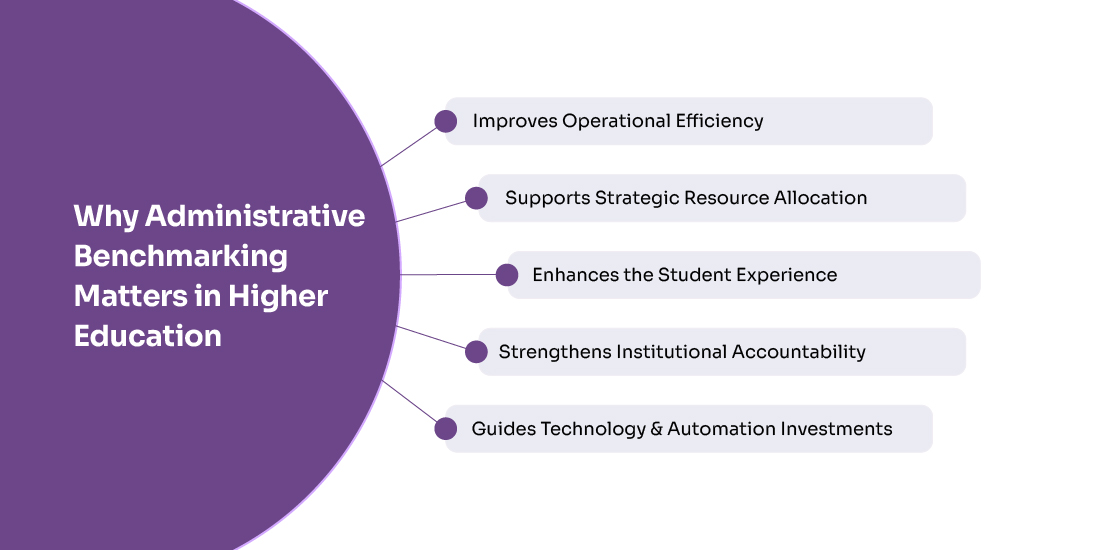
The way in which administration is managed has a direct bearing on a university’s capacity to control its costs, to support its students, and to reach its institutional objectives. Since higher education institutions are now experiencing reduced budgets, pressure on staffing, and increasing operational requirements, it has become more important than ever to understand where administrative resources are being used effectively. Administrative benchmarking provides university leaders with a systematic method of assessing performance and making informed decisions regarding the improvement of institutional operations.
Improves Operational Efficiency
Benchmarking allows universities to identify areas in which their administrative operations might be unnecessarily complicated or inefficient. By comparing performance among different functions, it is possible to spot opportunities for simplifying work processes, getting rid of redundant steps, and improving the way work is transferred between departments.
Supports Strategic Resource Allocation
University leaders have to constantly strike a balance between the competing demands for funding, staff, and technology. By using administrative benchmarking, they are able to obtain evidence to back their decisions and thus allow the institutions to allocate their resources to the areas which have the greatest operational or strategic impact.
Enhances the Student Experience
Administrative procedures form part of the student’s experience, covering such areas as applying, transferring credits, registering for courses, and obtaining financial services. If the speed and consistency of these procedures can be improved, then the administrative difficulties can be reduced, and it will be easier for students to obtain the support they need.
Strengthens Institutional Accountability
Having clear benchmarks provides departments and university leadership with a common basis for assessing administrative performance. Instead of depending on individual judgments as to what success means, institutions can set measurable objectives and then evaluate their progress based on these objectives.
Guides Technology and Automation Investments
Benchmarking can help universities to decide where technology might be used to deal with particular operational problems. If an organization is able to spot a process which continually demands a lot of time or manual work, then it has better grounds for assessing whether automation or other technology investments are justified.
Enables Continuous Performance Improvement
Administrative benchmarking is most useful when incorporated into a continuous improvement strategy, as universities can then use existing benchmarks to assess whether changes to their processes are having the desired effect, refine their methods, and sustain improvements as their institutional needs evolve.
Helps Build More Scalable University Operations
Administrative workloads can change greatly as enrollment figures, the range of programs offered, and the number of students increase. By using benchmarking, universities can determine whether their current way of operating can meet changing demand and identify where capacity must expand to ensure their operations remain sustainable.
Why Traditional Administrative Benchmarking Falls Short
Traditional administrative benchmarking has enabled universities to find out how their operations stack up against those of other institutions, but traditional methods are becoming less effective in a higher education setting that changes rapidly. Although many organizations still rely on annual surveys, fixed reports, and general comparisons with other similar institutions which do provide some useful background information but only a limited view of what is taking place in individual administrative processes. It is difficult for managers to detect problems early, work out their underlying causes, or assess the effect of operational changes.
Uses Data That Does Not Update Often
Traditional benchmarking usually relies on annual or periodic reporting cycles. When the results are available, staffing levels, enrollment numbers, or administrative workloads may have changed by then. As a result, there is a delay between the occurrence of an operational problem and when leadership can respond to it.
Concentrates on high-level comparisons
Things like the amount spent on administration per student or the ratio of staff to students can show how an institution stacks up against others, but they don’t explain what is causing the differences. Two universities may have the same general figures yet adopt entirely different processes, technologies, and staffing models.
Offers only limited visibility into the process level
Traditional benchmarking usually places more importance on the end results than on the various workflows that lead to them. This means that managers might realize a department is underperforming but won’t be able to identify which specific step, handover, or administrative task is to blame.
It makes it difficult to interpret comparisons between peers.
There is a great deal of variation among universities in terms of their size, purpose, the backgrounds of their students, the academic programs they offer, their organizational arrangements, and the technology they use. If universities are compared without taking these differences into account, the benchmarks obtained may be hard to apply or might result in misleading conclusions.
Relies Heavily on Manual Data Collection
Gathering benchmarking data using spreadsheets, surveys, and manual reporting can involve a great deal of administrative work. Since manual methods can cause inconsistencies, it becomes more difficult to keep reliable comparisons between departments or over different reporting periods.
It does not always take into account the student’s point of view
Operational benchmarks can show universities how fast or how cheaply a process is carried out without indicating the way in which that process affects students; in this way, a department might achieve an internal efficiency target even though students still have to face delays, poor communication, or unnecessary administrative friction.
It is possible to turn benchmarking into a compliance exercise
If benchmarking is regarded mainly as a matter of having to report, then teams will tend to concentrate on producing the figures rather than using them to improve their operations. As a result, the value of benchmarking as a management tool is reduced and institutions may fail to link their administrative performance with their wider institutional priorities.
Difficulties in Keeping Up With Technology-Driven Operations
Administrative procedures are becoming more and more influenced by automation, artificial intelligence, integrated systems, and digital student services. Since traditional standards do not take into account variations in the degree of automation or in workflows that are enabled by technology, universities find it more difficult to assess the real efficiency of their current administrative operations.
What needs to change in order that benchmarking may work better in higher education?
The focus ought to change from static comparisons to active performance management. Universities should have benchmarks that show how administrative work is really carried out, take into account the different characteristics of each institution, and provide leaders with sufficient context so that they can take action on the results. The improved approach should also link operational performance with student outcomes, cost efficiency, and the institution’s overall priorities.
Switch from annual reporting to continuous benchmarking.
Universities ought to go beyond the kind of benchmarking that takes place only at the time of annual planning or reporting. By carrying out more frequent evaluations of their performance, managers will be able to detect earlier any changes in workload, capacity, and service levels and take action before minor operational problems turn into bigger ones.
Benchmark Processes, Not Just Departments
Rather than comparing whole departments, universities should look at the individual processes that constitute administrative work; by examining activities such as the review of applications, the processing of transcripts, registration, or handling of student inquiries, they can gain more useful insights into areas that require improvement.
Use More Relevant Peer Groups
A useful benchmark should account for institutional characteristics such as enrollment size, public or private status, program mix, student population, and operating model. Comparing universities with genuinely similar characteristics makes benchmarking results more meaningful and easier to apply.
Combine Efficiency With Quality
Administrative performance should not be judged solely on speed and cost. Universities should combine efficiency measures with considerations of accuracy, service quality, student satisfaction, compliance, and other relevant outcomes so as not to improve one measure while deteriorating another.
Connect Data Across Administrative Systems
Administrative performance is usually distributed among a number of different systems, such as CRMs, SIS platforms, admissions applications, and service-management tools. When these various data sources are combined, senior members of the institution are able to obtain a more comprehensive understanding of how the processes perform from beginning to end.
Establish Clear Baselines and Targets
Benchmarking is more useful if universities know their starting point and what an improvement entails. By determining their baseline performance and setting realistic targets, teams are able to measure their progress and assess whether the operational initiatives are producing significant results.
Make Benchmarking Action-Oriented
Benchmarking ought to result in decisions, not just in the production of reports. Universities should make use of the results of benchmarking to spot specific improvements in their processes, decide which investments to make, revise their staffing arrangements, and assess whether the changes are having the desired effects.
Incorporate Technology and Automation Into Benchmarks
When universities take up the use of AI, automation and digital workflows, benchmarking must take into account the way that technology affects administrative capacity. In assessing modern administrative operations, institutions should look at measures including the rate of automation, the amount of manual work, the level of processing accuracy and the amount of staff time that is saved.
Give Departments Ownership of Improvement
Central leadership can establish institutional benchmarks, but individual departments need the context and authority to act on the results. Giving administrative teams access to relevant performance information can encourage accountability while allowing improvements to be tailored to the needs of each function.
How Does Smarter Benchmarking Allow Institutions to Thrive in the Face of Market Disruptions?
Market disruptions can quickly reveal weaknesses in how a university operates. Shifts in enrollment, workforce, technology, funding, and student expectations all put more pressure on administrative teams. Smarter benchmarking helps schools go beyond just tracking performance to see if their systems can adapt to change. Many universities are already using benchmarking, operational analysis, and performance data to become more adaptable.
Anticipates Capacity Problems Before They Become Critical
Benchmarking helps universities spot when their administrative capacity is falling behind what the institution needs. Rather than waiting for service delays or staff shortages to become serious, leaders can watch for changes in workload and capacity to predict where problems might arise.
University example: University of Iowa
The University of Iowa uses benchmarking to compare staffing levels within its departments and with other schools. Its HR benchmarking tools help leaders see if their teams match up with peers and follow the university’s strategy. This approach gives them a better way to respond to changing workforce needs instead of just relying on past staffing numbers.
Makes Universities More Responsive to Enrollment Volatility
Enrollment changes can quickly affect administrative workloads, often without much warning. By benchmarking enrollment operations, universities can see how their staffing, structures, and resources match their enrollment goals and the current market.
University example: Cornell College and Duquesne University
Enrollment leaders at Cornell College and Duquesne University joined a national benchmarking project that looked at admissions staffing, budgets, and structures at schools of different sizes and selectivity. This kind of benchmarking helps enrollment teams decide if their current models still fit as recruitment needs change.
Provides Evidence for Difficult Strategic Decisions
When universities face financial or enrollment challenges, they often have to make tough decisions about staffing, organization, and spending. Benchmarking gives leaders an outside perspective, helping them see where to invest and where changes might be needed.
University example: Mills College
When Mills College compared its administrative spending to similar-sized schools, it found much higher costs and more non instructional staff. The analysis showed that using benchmarking data earlier could have helped the college spot financial and enrollment issues sooner and possibly fix them before they became serious.
Helps Institutions Build More Flexible Operating Models
Disruption often reveals that different departments are performing the same work in different ways. Benchmarking processes can expose unnecessary variation and create an evidence base for standardizing or redesigning administrative operations where appropriate.
University example: University of Washington
The University of Washington’s Operational Excellence program found that too much variation in processes made administration more complicated. Because the university is decentralized, there were many ways to do the same tasks. Now, the university is working to simplify administrative work and cut down on unnecessary complexity.
Links Administrative Performance to Institutional Resilience
The most useful benchmarks extend beyond cost and staffing to examine whether administrative operations can continue supporting the university’s mission under changing conditions. This means considering service quality, capacity, process complexity, and the ability to scale operations without proportionally increasing administrative burden.
University example: University of Virginia
The University of Virginia did a benchmarking study of its Finance, HR, IT, Procurement, Student Services, and Research Administration departments. It compared its performance to other universities and organizations, then used what it learned to guide improvements that support its teaching, research, and public service goals.
Turns Disruption Into an Opportunity for Operational Redesign
Benchmarking can show that the real issue is not just a lack of resources, but old ways of working. By combining benchmarking with process analysis, institutions can redesign their administrative operations to fit new needs instead of just adding more resources to old processes.
University example: a major public research university
A public research university used operational analysis to fix slow hiring and inefficient procurement. After redesigning these processes, non faculty hiring time dropped by 46% and unnecessary procurement vouchers fell by 57%. This shows how performance analysis can lead to real improvements, not just small changes.
What Are Universities Benchmarking Today?
Universities are expanding administrative benchmarking beyond basic measures such as staffing levels and operating costs. Leading institutions are examining the performance of specific services, the consistency of processes, technology utilization, and the experience those processes create for students and staff. For example, the University of Virginia has benchmarked Finance, HR, IT, Procurement, Student Services, and Research Administration against other higher education and non-higher-education organizations.
Admissions and Enrollment Performance
Universities are benchmarking the resources and outcomes associated with recruitment, admissions, and enrollment operations. This can include admissions staffing, organizational structures, budgets, application volumes, and enrollment outcomes.
EAB’s 2024 national benchmarking study, for example, surveyed more than 180 institutions on enrollment-office operations, including organizational structure, budget and staffing, and enrollment objectives. This gives institutions a reference point for assessing whether their enrollment operations are appropriately structured for their goals.
Student Service Delivery
Student services are increasingly being evaluated based on how effectively institutions deliver support across the student lifecycle. Universities can benchmark service volumes, response times, workload distribution, and the consistency of support across different channels.
The University of Virginia included Student Services in its administrative benchmarking study, examining the function’s structure, costs, and performance across central offices and individual schools and units.
Administrative Cost and Workforce Efficiency
Staffing and administrative costs remain important benchmarking areas, particularly as universities look for ways to manage expenses without compromising service quality. Institutions can compare staffing ratios, compensation costs, workload distribution, and the cost of delivering specific services.
The University of Iowa, for example, uses HR benchmarking to compare staffing levels across internal units and with outside institutions. Its benchmarking resources specifically describe using these comparisons to determine whether staffing levels align with peers and strategic direction.
Process Speed and Administrative Workload
Universities are also looking more closely at how long administrative work takes and how much effort it requires. Rather than looking only at departmental headcount, this approach examines the workload behind specific processes, such as hiring, procurement, registration, admissions, or records management.
The University of Washington’s Operational Excellence initiative identified extensive variation in how administrative tasks were performed, including at least 31 different approaches to processing a vendor invoice. The university is using process standardization and workload alignment to simplify administrative operations.
Technology, Automation, and Digital Operations
Technology benchmarking is becoming increasingly important as universities adopt automation, AI, integrated platforms, and digital student services. Institutions can assess technology spending, staffing, system utilization, automation levels, and the amount of manual work required to deliver administrative services.
EDUCAUSE’s benchmarking services allow institutions to compare IT staffing, budgets, services, and technology environments against selected peer groups. Its benchmarking resources are also being expanded to support budgeting, staffing, service, and technology planning.
The University of Melbourne provides an example of how institutions are moving from measuring technology investment to measuring its operational impact. Research on its automation initiatives reports 22 automated processes and approximately 10,000 hours of annual labor savings.
Student Experience and Service Quality
Administrative benchmarking is increasingly moving beyond “How much does this process cost?” to “What experience does this process create for students?” Universities can therefore benchmark service accessibility, response times, satisfaction, communication, and other indicators alongside operational efficiency.
The University of Leicester’s recent student-services transformation illustrates this shift. Its implementation of Dynamics 365 and AI-supported services was designed to improve administrative efficiency, staff productivity, response times, and student engagement, with one templating process estimated to save 312 hours annually.
Administrative Process Standardization
Another emerging benchmarking area is process consistency. When different departments perform similar tasks in substantially different ways, universities can benchmark those variations to determine whether standardization or shared services could improve efficiency.
UC Berkeley’s operational excellence diagnostic, for example, identified highly distributed administrative staffing and benchmarked productivity measures such as HR staffing ratios against higher education norms. The analysis identified opportunities around standardization, automation, specialization, and shared services.
This broader approach gives universities a more complete picture of administrative performance. Instead of benchmarking a single number such as cost per student, institutions can examine capacity, cost, speed, quality, technology, and student experience together to understand how well an administrative function is actually performing.
Types of Administrative Benchmarking for Universities
Administrative benchmarking can take several forms depending on what a university wants to evaluate and what it wants to compare. Using more than one benchmarking approach can give higher education leaders a clearer understanding of institutional performance without relying on a single measure.
- Internal Benchmarking: Compares performance between departments, campuses, programs, or administrative units within the same university. This helps institutions identify differences in processes and share practices that are producing better results.
- External or Peer Benchmarking: Compares a university’s performance with similar institutions. Peer groups may be selected based on enrollment size, institutional type, geographic region, or other characteristics to make comparisons more meaningful.
- Competitive Benchmarking: Focuses on how a university’s administrative performance compares with institutions competing for the same students, faculty, or resources. It can help leaders understand where operational performance may affect institutional competitiveness.
- Process Benchmarking: Examines how a specific administrative process is performed rather than evaluating an entire department. Universities can compare workflows such as admissions processing, transcript evaluation, registration, procurement, or student support to identify more effective approaches.
- Performance Benchmarking: Measures specific outcomes against established targets or standards. Common measures include turnaround time, accuracy, service levels, productivity, operating costs, and workload capacity.
- Functional Benchmarking: Compares a particular administrative function with the same function at other organizations, even when those organizations are not direct university peers. For example, a university may compare its customer service operations with service organizations outside higher education to identify alternative practices.
- Strategic Benchmarking: Connects administrative performance with broader institutional priorities. Instead of focusing only on operational efficiency, universities evaluate whether administrative capabilities support goals such as enrollment growth, student retention, financial sustainability, or digital transformation.
- Technology and Automation Benchmarking: Evaluates how effectively administrative technology is being used. This can include system adoption, automation levels, processing capacity, manual effort, and the operational impact of AI and other digital tools.
The most effective approach is rarely a single type of benchmarking. Universities can combine internal, peer, process, performance, and technology benchmarking to understand not only where they stand, but also which operational changes are most likely to improve institutional performance.
How to Conduct Administrative Benchmarking at Your University
Administrative benchmarking works best as a structured improvement exercise rather than a one-time comparison. Universities can follow a practical sequence that moves from selecting a specific area for review to validating findings and turning them into measurable actions.
Select the Process for Review
Choose one administrative process where better performance could have a meaningful institutional impact. Starting with a defined process keeps the exercise manageable and makes the findings easier to act on.
Map the Existing Workflow
Document how the process currently operates, including key activities, handoffs, decision points, systems involved, and responsible teams. This creates a clear picture of the current operating model before comparisons are made.
Determine the Data Requirements
Identify the information needed to evaluate the process accurately. Define where the data will come from, who owns it, the period it should cover, and how frequently it should be updated.
Validate Data Quality
Check the data for missing records, inconsistent definitions, duplicate entries, and differences in how departments record the same activity. Reliable benchmarking depends on comparable and trustworthy data.
Normalize for Institutional Differences
Account for factors that can distort comparisons, such as enrollment size, student population, academic structure, geographic location, or organizational complexity. This prevents universities from treating fundamentally different operating environments as equivalent.
Compare Performance Against the Selected Reference Point
Analyze the university’s results against the appropriate benchmark. Look for meaningful differences rather than focusing solely on whether a result is higher or lower.
Investigate the Reasons Behind Variations
Examine why performance differs. The cause may involve workflow design, staffing models, system limitations, policy requirements, training, or differences in how work is distributed.
Prioritize the Most Significant Opportunities
Not every performance gap requires immediate action. Rank opportunities based on factors such as institutional impact, effort required, cost, risk, and potential benefit to students or staff.
Implement Targeted Changes
Put selected improvements into practice and assign clear ownership. Depending on the findings, changes may involve redesigning a workflow, removing unnecessary steps, changing responsibilities, or modifying supporting systems.
Evaluate the Impact
After implementation, assess whether the change produced the intended result. Compare post-change performance with the original baseline and document both improvements and unintended effects.
Establish a Repeatable Benchmarking Cycle
Once the approach has been validated, incorporate it into regular operational reviews. This allows universities to apply the same methodology to other administrative processes and build benchmarking into their broader improvement strategy.
Internal vs. External Administrative Benchmarking
Internal administrative benchmarking involves comparing performance among different departments, campuses, programs, or time periods that are part of the same university. It enables institutions to spot the differences in the way similar functions are carried out and to decide where practices can be standardized or modified. For instance, a university might compare admissions processing performance among its various colleges or assess how its registrar operations have changed over a number of academic years.
External administrative benchmarking involves comparing a university’s performance with that of other institutions or with appropriate industry standards. When selecting peer universities, decisions are generally based on criteria such as enrollment numbers, the type of institution, its mission, or its mode of operation in order to ensure that the comparisons are more meaningful. Through external benchmarking, leaders are able to gain a wider view of their institution’s performance, and it can show them practices or operating models that might not become apparent when relying only on internal comparisons.
The Role of AI and Automation in Improving Administrative Performance
AI and automation are becoming part of a broader shift in how universities design and manage administrative operations. Rather than simply replacing manual tasks, these technologies can change how information moves through an institution, how decisions are supported, and how teams respond to operational demand.
- Connects Disconnected Administrative Workflows: AI can help move information between systems and processes, reducing the gaps that occur when admissions, registrar, enrollment, and student service teams work with separate workflows.
- Turns Administrative Data Into Actionable Insights: AI can analyze large volumes of operational data to identify patterns, anomalies, and emerging issues that may be difficult to detect through conventional reporting.
- Enables More Adaptive Operations: AI-powered workflows can respond to changing conditions, such as fluctuations in application volume or different types of student requests, without requiring administrators to manually redesign processes each time.
- Supports Human Decision-Making: AI can organize relevant information, surface potential issues, and provide recommendations while keeping institutional staff involved in decisions that require context, judgment, or policy interpretation.
The Future of Institutional Benchmarking
Institutional benchmarking is becoming more connected and flexible. As universities get better operational data, benchmarking will shift from occasional comparisons to ongoing analysis that helps leaders track changes in performance. In the future, we can expect more relevant benchmarks, increased use of AI, and closer links between administrative work and overall institutional results.
- Real-Time Performance Benchmarking: Universities will start tracking performance as operations change, instead of waiting for yearly reports. This approach gives leaders a more up-to-date view of new trends and shifts in performance.
- AI-Powered Benchmarking: AI will help universities analyze large and complex data, spot unusual patterns, and find links between different parts of performance. This shift means benchmarking will not just report past results but also help leaders see what needs attention.
- More Contextual Peer Comparisons: Benchmarking will go beyond basic comparisons between schools. Future benchmarks will consider things like a university’s mission, enrollment, programs, student backgrounds, and how the school is run to make comparisons more useful.
- Benchmarking Across the Student Lifecycle: Instead of evaluating administrative functions in isolation, institutions will increasingly examine how connected processes perform across the student journey, from recruitment and admission through enrollment, progression, and graduation.
- Predictive Institutional Benchmarking: As data improves, universities may use benchmarking to predict possible outcomes in different situations, like changes in enrollment, staffing, or student demand.
- Benchmarking as a Continuous Improvement System: Over time, benchmarking will become a regular part of managing universities. Schools can use what they learn to test changes, check results, and keep improving how their operations support their main goals.
Conclusion
Administrative benchmarking is becoming an important part of how universities evaluate and improve institutional performance. The most effective approach is not simply to compare one institution with another, but to understand the factors behind performance and use those insights to guide operational decisions. By combining relevant benchmarks, reliable data, appropriate peer comparisons, and ongoing evaluation, universities can build a clearer picture of where their administrative operations stand and where improvement can create the greatest value.
As higher education continues to face changing enrollment patterns, financial pressures, staffing challenges, and evolving student expectations, benchmarking can help institutions make more informed decisions about their operating models. With AI, automation, and integrated analytics becoming more common, universities also have an opportunity to make benchmarking more timely, contextual, and actionable.
Frequently Asked Questions
Ques 1: Where can universities find reliable administrative benchmarking data?
Ques 2: How often should universities update their administrative benchmarks?
Ques 3: How can universities compare performance with peer institutions?
Ques 4: What is a good benchmark for administrative costs in higher education?
Ques 5: How can universities benchmark staff workload and productivity?
Ques 6: How should universities select peer institutions for benchmarking?
Ques 7: What tools can universities use for administrative benchmarking?
Written By






No comments yet. Be the first to comment!
Leave a Comment