


Table Of Contents
- 1Introduction
- 2What is a Transfer Evaluation System?
- 3What Does a Transfer Evaluation System Do?
- 4Transfer Evaluation System vs. Manual Transfer Credit Evaluation
- 5Why Most Transfer Evaluation Systems Are Broken?
- 6How a Transfer Evaluation System Can Improve College Admissions
- 7Key Features of an Effective Transfer Evaluation System
- 8How EDMO Redefines the Transfer Evaluation System
- 9How Colleges Can Implement a Transfer Evaluation System
- 10Conclusion
Introduction
Transfer students are becoming an increasingly important part of the total number of students enrolled in higher education, but reviewing their previous coursework can be one of the most time-consuming and complicated tasks for admissions and registrar staff. They have to review transcripts, identify courses already taken, establish equivalencies, calculate the relevant credit amounts, and ensure that the evaluations comply with the institution’s policies, all while providing students with timely information about the value of their credits.
If the process involves a great deal of manual inspection, it may result in delays, increase staff workload and make the transfer experience harder for students. Students’ decisions regarding enrollment can be affected by uncertainty about how many credits will transfer and how those credits will count toward a degree.
A transfer evaluation system would allow colleges to simplify the process by automating repetitive evaluation tasks, setting standards for credit decisions, and providing staff with better visibility into evaluation results. If the appropriate technology is used, institutions will be able to reduce administrative work while providing transfer students with quicker, clearer information about their academic progress.
This article will examine what a transfer evaluation system is, how it functions, the benefits it offers to both colleges and students, and how institutions can make their transfer credit evaluation more efficient, thereby boosting enrollment.
What is a Transfer Evaluation System?
A transfer evaluation system is software that helps colleges and universities review, organize, and use academic credits students earned at other schools. Rather than relying solely on manual transcript reviews, these systems can automate parts of the process, such as pulling course details, identifying potential course matches, and determining how credits count toward a student’s program.
A typical transfer evaluation system can support admissions or registrar teams in several ways:
- Process transcripts: Pull courses, grades, credits, and other important academic details from submitted transcripts.
- Identify course equivalencies: Match completed courses with your school’s transfer rules, course catalog, or existing equivalency lists.
- Calculate transferable credits: Figure out which credits can be accepted and how they count toward a student’s degree requirements.
- Standardize evaluations: Use the same rules and steps for all transfer-credit reviews.
- Support staff review: Provide evaluators with an initial review they can check, adjust, or approve as needed.
- Provide faster answers to students: Help schools share transfer-credit decisions more quickly, so students know sooner how their credits fit into their academic plans.
The goal goes beyond just automating transcript reviews. A good system links transfer-credit evaluation to the whole enrollment process, making things easier for staff and giving students a clearer idea of how their past coursework will count.
For colleges handling more transfer students, this can change transfer evaluation from a slow, manual task to a faster, more consistent, and student-friendly process.
What Does a Transfer Evaluation System Do?
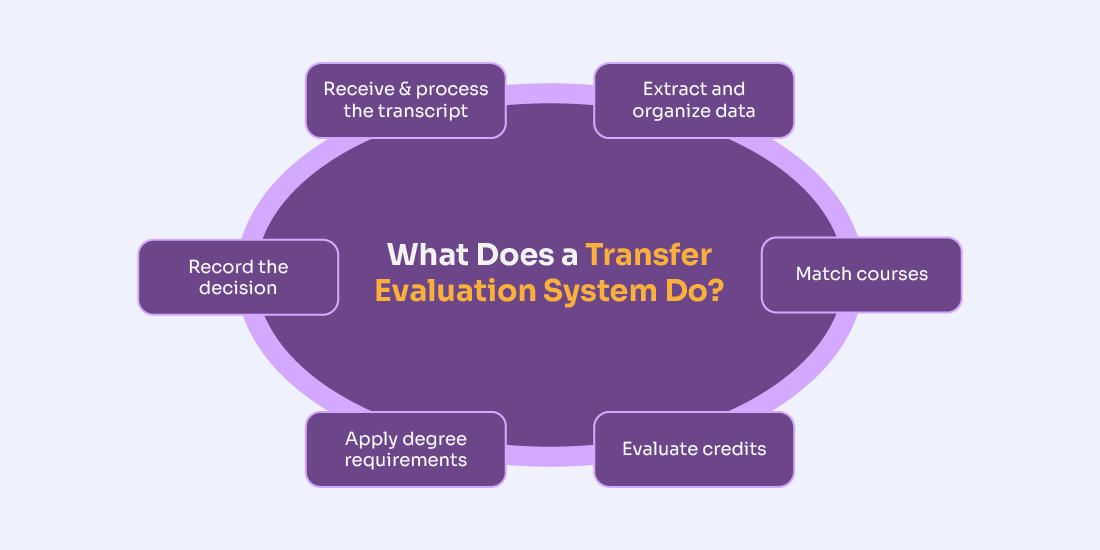
A transfer evaluation system streamlines the process of determining which credits a student has earned elsewhere and how those credits can apply toward a program. The process generally involves several steps, from receiving and processing the transcript to reviewing the evaluation and recording the final transfer credit decision.
Receive and process the transcript
The process begins when a student submits an academic transcript from a previous institution. Once it’s received by the admissions counselor, the official uploads the transcript and prepares it for evaluation, reducing the need for staff to manually enter information.
Extract and organize data
The software tool extracts relevant information, including course names, course codes, grades, credits, and academic terms. This information is organized in a structured format to make it easier for evaluators to review the student’s academic history.
Match courses
The tool compares the student’s completed courses against the institution’s existing course equivalencies and transfer rules. This helps identify courses that may have an established equivalent at the receiving institution.
Evaluate credits
Once potential matches are identified, the transfer credit evaluation tool determines which courses and credits may be eligible for transfer based on institutional policies, grades, course requirements, and other criteria.
Apply degree requirements
Transferable credits can then be evaluated against the student’s intended program. This helps determine whether credits satisfy specific degree requirements, count as electives, or may not apply toward the program.
Review and verify
Staff can then oversee and review the tool’s evaluation and verify the recommended outcomes. Evaluators can make corrections or adjustments when a course requires additional review or does not fit an existing equivalency.
Record the decision
Once the evaluation is approved, the final transfer-credit decisions can be recorded in the student’s academic record. Systems integrated with an institution’s SIS can help reduce duplicate data entry and streamline this step.
Communicate results
The completed evaluation gives students a clearer picture of which credits will transfer, how those credits apply to their degree, and what coursework they still need to complete. This can help students make more informed enrollment and academic decisions.
Transfer Evaluation System vs. Manual Transfer Credit Evaluation
A transfer evaluation system can make the credit evaluation process faster and easier by reducing repetitive manual work. Manual evaluation gives staff full control but can take more time, especially when colleges receive a large number of transfer applications. A transfer evaluation system helps staff work more efficiently while still allowing them to review and approve decisions.
| Factor | Transfer Evaluation System | Manual Evaluation |
| Transcript review | Automatically reads and organizes transcript data | Staff review transcripts manually |
| Course matching | Suggests matching courses | Staff research and match courses |
| Processing time | Faster | Takes more time |
| Staff work | Reduces repetitive tasks | Requires more manual work |
| Consistency | Uses the same rules across evaluations | Decisions can vary between staff |
| Large volumes | Can handle more transcripts | More students mean more staff time |
| Errors | Reduces manual data-entry errors | More chance of data-entry mistakes |
| Complex cases | Flags cases for staff review | Staff review every case manually |
| Record keeping | Keeps evaluation information organized | Records may be spread across different systems |
| Student response | Can provide decisions faster | Students may wait longer |
| System integration | Can connect with SIS and CRM systems | Often requires manual data entry |
| Staff role | Staff review and approve results | Staff perform most of the evaluation work |
Why Most Transfer Evaluation Systems Are Broken?
Various transfer evaluation systems were designed to handle just one part of the transfer process rather than the entire workflow. As a result, colleges may still rely on spreadsheets, manual research, separate systems, and staff intervention to complete evaluations. The result is a process that remains slow, inconsistent, and difficult to scale.
Too Much Work Behind the Scenes
Staff still have to review transcripts, enter course details, research course equivalencies, and check results. This takes time away from more complex evaluations and student support.
Automation Gaps
Moving a manual process into software does not always make it automated. If staff still have to move data between systems or review every course manually, the process remains time-consuming.
Poor Connections Between Systems
Transfer evaluation tools may not connect well with the institution’s SIS, CRM, or degree audit system. This can lead to duplicate data entry and disconnected workflows.
Challenges in Course Matching
Courses are not always easy to match. Differences in course names, descriptions, credit hours, and academic content can make it difficult to identify the right equivalency.
Outdated Course Information
Transfer decisions depend on accurate and current course equivalencies. If this information is outdated, staff may need to research courses manually or rely on old information.
Not Built for Complex Cases
Some courses require additional review, such as international coursework, unusual courses, missing information, or courses affected by curriculum changes. Many systems do not handle these cases well, leaving staff to do the work manually.
Limited Visibility
Staff and students may not always understand why a course was accepted, rejected, or matched to a particular course. This makes decisions harder to review and explain.
Capacity Becomes a Challenge
A system may work well with a small number of transfer students but become harder to manage as application and transcript volumes grow. More students often means more staff time.
Students Wait Too Long
When evaluations take days or weeks, students may have to wait to understand how their previous credits apply to their new program. This uncertainty can make the transfer process frustrating and may affect enrollment decisions.
How a Transfer Evaluation System Can Improve College Admissions
A transfer evaluation system can enable admissions teams to get transfer students through the enrolment process more quickly and with less manual effort. Since it automates routine tasks, arranges transfer credit information, and links the evaluation process to the existing admissions systems, it allows admissions officers to spend less time on administrative duties and more time assisting students in making informed enrollment decisions.
Process More Transcripts in Less Time
A transfer evaluation system can quickly extract and organize information from transcripts, reducing the time admissions officers spend reviewing documents manually. This allows teams to process more applications without increasing staff workload.
Give Students Faster Credit Decisions
By identifying potential course matches and applying established transfer rules, the system can help admissions officers make credit decisions faster. Students can then get quicker answers about how their previous coursework will count toward their program.
Reduce Repetitive Admissions Work
Automating tasks such as data entry, course matching, and credit calculations reduces the amount of routine work admissions officers need to handle. This gives staff more time to focus on cases that require professional judgment and expertise.
Apply Transfer Rules Consistently
A transfer evaluation system can apply the same institutional rules and processes across evaluations. This helps reduce inconsistencies that can occur when different staff members manually evaluate similar coursework.
Handle Transfer Volume Without Adding Staff
As the number of transfer applications grows, admissions teams can use automation to process more transcripts without relying entirely on additional staff. This is especially valuable during busy enrollment periods when application volumes increase.
Give Students Clearer Answers About Their Credits
Faster evaluations give admissions officers more timely and accurate information to share with students. Students can better understand which credits will transfer and how those credits may apply to their chosen program.
Track Evaluations From One Place
A centralized system can give admissions teams visibility into completed evaluations, pending reviews, exceptions, and outstanding work. This makes it easier to identify delays and keep evaluations moving.
Let Staff Focus on Cases That Need Human Judgment
Instead of spending most of their time on routine evaluations, admissions officers can focus on unusual courses, complex transcripts, and cases that require additional research. The technology handles repetitive work while staff remain responsible for reviewing and approving decisions.
Connect Transfer Evaluation With the Admissions Workflow
When the evaluation system connects with admissions and student information systems, data can move more smoothly from application to enrollment. This reduces duplicate data entry and creates a more connected transfer admissions process.
Key Features of an Effective Transfer Evaluation System
A good transfer evaluation system does more than just put transcript reviews online. It reduces manual work, helps staff make fair credit decisions, integrates with college systems, and gives students quicker, clearer answers about their transfer credits. Here are some important features:
- Automated Transcript Processing: Pulls course names, grades, credits, and other important details from transcripts to cut down on manual data entry.
- Course Equivalency Matching: Checks completed courses against existing equivalencies and finds possible matches for staff to review.
- Transfer Credit Rules: Uses school policies and transfer rules to figure out which courses and credits can be accepted.
- Automated Credit Calculations: Figures out how many credits can transfer and how they count toward a student’s degree.
- Human Review and Approval: Lets staff review, fix, and approve evaluations from the system, especially when a course or transcript needs extra attention.
- Support for Complex Evaluations: Deals with special cases like unusual courses, international transcripts, missing details, or courses that do not have an existing match.
- SIS and CRM Integration: Links with student information, admissions, and CRM systems so staff do not have to enter the same information more than once.
- Centralized Evaluation Records: Keeps course matches, transfer decisions, staff reviews, and evaluation history organized in one place.
- Real-Time Status Tracking: Shows which evaluations are done, waiting, or need staff attention, so teams can spot and fix delays.
- Clear Student-Facing Results: Explains transfer-credit decisions so students know which credits transfer and how they count toward their program.
- Reporting and Analytics: Gives insights into how many evaluations are done, how long they take, common course matches, and other trends to help admissions and registrar teams improve their work.
How EDMO Redefines the Transfer Evaluation System
Most traditional tools for assessing transfers tend to concentrate on keeping records of equivalencies and aiding with manual evaluations. EDMO instead adopts a more automated and interconnected method by employing AI to look after the repetitive aspects of both transcript and credit evaluation, while still keeping admissions and registrar staff in charge of making the final decisions. The Transfer Credit Evaluator offered by EDMO can assist colleges in shifting from manual transcript reviews to a quicker workflow that includes document processing, course matching, credit evaluation, and a human review.
- AI-Powered Transcript Processing: EDMO can pull important details from student transcripts. It collects information like courses, grades, credits, and other academic facts. This cuts down on the need to type in data by hand.
- Automated Course Evaluation: Instead of requiring staff to research every course manually, EDMO can evaluate coursework and identify potential course equivalencies based on available academic information and institutional rules.
- Human-in-the-Loop Review: Staff remain part of the decision-making process. They can review AI-generated evaluations, make corrections when needed, and approve the final transfer-credit outcome.
- Faster Transfer Evaluations: By automating time-consuming steps, EDMO can help admissions and registrar teams complete evaluations faster and provide students with earlier answers about their transferable credits.
- Handles Complex Transcripts: EDMO can support evaluations involving different transcript formats, course structures, and academic histories, while allowing cases that need additional expertise to be reviewed by staff.
- Works With Existing Systems: EDMO is designed to fit into existing institutional workflows and can connect transfer evaluation with systems such as the SIS and CRM, reducing duplicate data entry.
- Built for High-Volume Processing: Automation allows teams to process larger numbers of transcripts without increasing manual workload at the same rate, helping institutions manage periods of high transfer activity.
- Creates a More Connected Enrollment Workflow: Transfer evaluation does not have to operate as a separate process. By connecting evaluation with the broader admissions workflow, EDMO can help move students from transcript submission to credit decision and enrollment more efficiently.
How Colleges Can Implement a Transfer Evaluation System
Setting up a transfer evaluation system involves more than just buying new software. Colleges need a solution that works with their current admissions and registrar processes, connects to existing systems, and helps staff through each step. A third-party provider can review your current process, set up the technology, link it to your systems, and help automate routine tasks over time without interrupting daily work.
- Assess the Current Transfer Evaluation Process: Begin by finding out which tasks take up most of your staff’s time, like reviewing transcripts, matching courses, calculating credits, entering data, or handling exceptions. This will show you which steps could benefit most from automation.
- Define Institutional Transfer Rules: Before you set up the system, make sure to write down your transfer-credit policies, course equivalencies, grading standards, credit limits, and rules for different types of coursework. These guidelines are key for making accurate evaluations.
- Choose a System That Fits Existing Workflows: Look for a system that supports your current evaluation process, so staff do not have to change how they work. The system should also be flexible enough to adapt as your transfer policies and programs evolve.
- Connect With Existing College Systems: Your vendor should be able to link the transfer evaluation system with tools like your SIS, CRM, degree audit, and admissions platforms. This way, information can move between systems without staff having to enter the same data more than once.
- Start With High-Volume Tasks: Begin by automating repetitive tasks like pulling transcript data, matching courses, and calculating credits. Focusing on these areas first can quickly improve efficiency and help staff get used to the new system.
- Keep Staff Involved in Final Decisions: Automation should help evaluators, not replace them. Staff need to review AI recommendations, handle exceptions, make corrections, and approve final transfer-credit decisions.
- Test Before Full Implementation: Work with your vendor to test the system using real evaluation cases and compare automated results to staff decisions. This helps spot any gaps, improve accuracy, and build trust before rolling out the system more widely.
- Train Admissions and Registrar Teams: Make sure staff know how the system works, how to review its recommendations, manage exceptions, and when to step in. Good training helps the technology fit smoothly into daily work instead of becoming just another tool to work around.
- Monitor Results and Improve Over Time: Once the system is running, track things like processing time, number of evaluations, staff workload, correction rates, and how quickly students get responses. Vendors can use this information to find bottlenecks and keep improving the process.
- Scale as Transfer Volume Grows: A good system should handle more transfer applications without needing a lot more manual work from staff. This lets colleges grow their transfer operations while keeping the evaluation process consistent.
Conclusion
A transfer evaluation system can help colleges move beyond slow, manual credit evaluation and create a more efficient transfer admissions process. By automating transcript processing, course matching, credit calculations, and other repetitive tasks, these systems can reduce staff workload while helping students receive faster and clearer transfer-credit decisions. The most effective solutions also integrate with existing college systems and keep staff involved in reviewing complex cases. As transfer enrollment grows, investing in the right technology can help institutions improve efficiency, support staff, and create a better experience for transfer students.
Frequently Asked Questions
Ques 1: Can a transfer evaluation system integrate with a college CRM?
Ques 2: Can transfer credit evaluation be automated?
Ques 3: How does a transfer evaluation system handle different transcript formats?
Ques 4: Can a transfer evaluation system reduce manual work for admissions teams?
Ques 5: How can colleges measure the performance of a transfer evaluation system?
Written By






No comments yet. Be the first to comment!
Leave a Comment