

Table Of Contents
- 1Introduction
- 2Stages of the Student Experience in Higher Education
- 3Why Enrollment Student Experience Wins Students
- 4Understanding the Student Experience in Higher Education
- 5How Institutions Measure Student Experience
- 6The Growing Importance of Enrollment Experience in Student Success
- 7Challenges Driving Institutions to Rethink Student Engagement
- 8Building Better Student Experiences: Strategies for Modern Institutions
Introduction
In higher education, the student experience covers every part of a learner’s journey with a university. It does not just emphasize a student’s academic learning; it includes every interaction, from researching the school to enrolling, attending classes, joining campus life, and staying connected after graduation. Today, quality academic education is not the only yardstick on which a university is judged, but also on how smooth, supportive, and personal the whole student experience is, starting from awareness to student onboarding.
A positive student experience builds and solidifies trust, keeps students enrolled, and cements the university’s reputation. Of all the stages, the enrollment experience is often the most important and can be the deciding factor when students choose between universities with equal stature and prestige.
Stages of the Student Experience in Higher Education
Awareness Stage
Students first discover the institution through digital ads, rankings, social media, events, or referrals.
Consideration Stage
They research programs, compare universities, explore websites, attend webinars, and engage with admissions teams.
Application Stage
Students submit applications, documents, and test scores while interacting with admissions systems and counselors.
Enrollment Decision Stage (Most Decisive)
Students evaluate offers, financial aid, communication quality, and responsiveness before confirming admission.
Onboarding Stage
Includes acceptance, orientation, course registration, and integration into academic systems and campus life.
Academic Experience Stage
Covers classroom learning, faculty engagement, peer collaboration, assessments, and academic support services.
Support & Engagement Stage
Includes counseling, career services, internships, extracurricular activities, and student well-being support.
Graduation & Alumni Stage
Focuses on degree completion, placement outcomes, and long-term alumni engagement with the institution.
Why Enrollment Student Experience Wins Students
Think of enrollment as the moment when interest turns into commitment. Students have likely spent weeks or even months researching institutions, comparing options, and weighing their choices. At this stage, they expect a process that is simple, transparent, and responsive. When universities make enrollment easy and personalized, students are far more likely to move forward with confidence. When they encounter confusion, delays, or poor communication, they may look elsewhere. That’s why the enrollment experience often plays a bigger role in enrollment decisions than institutions realize.
- This is the first important interaction where students start to judge whether they can trust the institution.
- At this point, students are comparing different universities directly.
- Quick and clear communication helps students feel less uncertain and anxious.
- When students get advice tailored to them, they feel more confident about making their decision.
- If there are delays in processing documents or responding to questions, students may decide not to continue with their application.
- A smooth process shows that the university is efficient and trustworthy.
- Clear information about financial aid at this stage has a big impact on which school students choose.
- A good enrollment experience helps students feel connected to the university.
Understanding the Student Experience in Higher Education
The student experience comprises all interactions a student has with a college or university, beginning before enrollment and continuing throughout their studies. Each interaction, from exploring programs and submitting applications to attending classes, seeking support, and joining campus activities, influences students’ perceptions of the institution.
For example, consider a student who has applied to a university but is missing a transcript and a Letter of Recommendation (LOR). Rather than waiting for the student to identify the issue, an AI chatbot sends a friendly reminder, details what is missing, shares the submission deadline, and provides a direct upload link. A week later, the chatbot reminds the student that their Statement of Purpose (SOP) is still pending and offers tips for completion. This approach ensures students receive timely guidance without searching through emails or contacting the admissions office.
These experiences, though seemingly minor, significantly reduce stress, save time, and help students feel supported. Student experience extends beyond academics to include every touchpoint that keeps students informed, valued, and confident throughout their time at the institution.
How Institutions Measure Student Experience
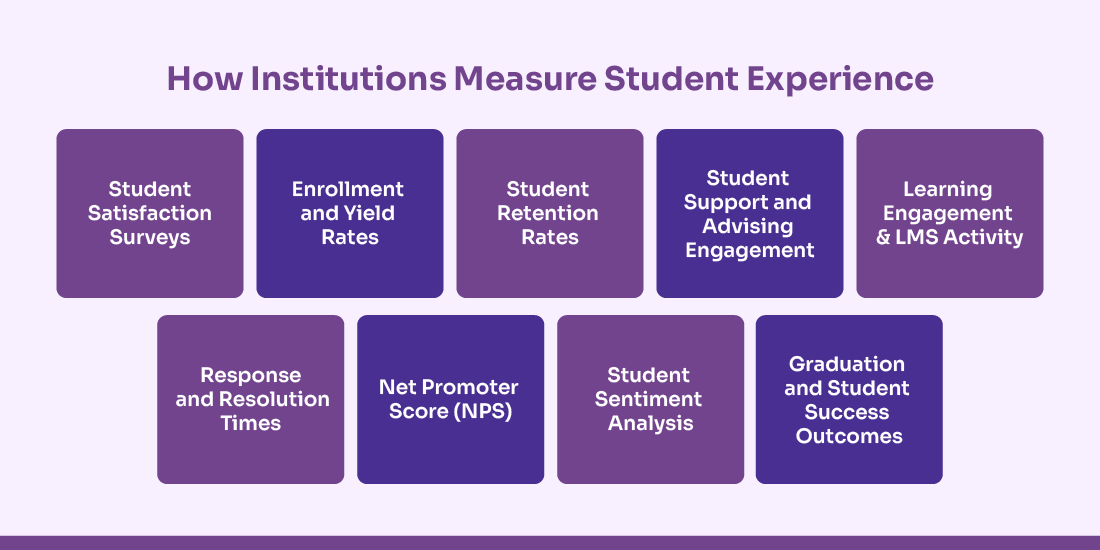
Student experience can feel subjective, but institutions increasingly use data and feedback to understand how students perceive their journey. To measure it effectively, universities break it down into stages and touchpoints, from enrollment and onboarding to academics, support services, and graduation. By tracking student feedback and behavioral data, institutions identify what’s working, uncover friction points, and make informed decisions to improve engagement, satisfaction, and success.
Student Satisfaction Surveys
One common way institutions measure student experience is by asking students directly. Surveys help universities understand how students feel about admissions, academics, support services, campus life, and overall satisfaction. For example, a university may discover through survey responses that students find the financial aid process confusing, prompting it to simplify communications and provide better guidance.
Enrollment and Yield Rates
The enrollment process reveals much about student experience. Institutions track how many applicants start and complete applications, receive offers, and enroll. If many admitted students choose another institution, it may indicate issues with communication, responsiveness, or the enrollment journey.
Student Retention Rates
Retention measures how many students return for the next semester or academic year. When students leave before completing their studies, it signals challenges with academic support, engagement, affordability, or belonging. For instance, if first-year retention drops, institutions may investigate whether students receive adequate onboarding and advising support.
Student Support and Advising Engagement
Universities monitor how students interact with advisors, counselors, tutoring centers, and other support services. Low engagement can sometimes indicate that students are unaware of available resources. Conversely, frequent support requests around the same issue may highlight a process that needs improvement.
Learning Engagement and LMS Activity
Student participation within learning platforms provides valuable insights into engagement. Institutions can track attendance, assignment submissions, discussion participation, and course activity. For example, if students consistently stop engaging with a particular course after a few weeks, faculty may need to review course design or student support mechanisms.
Response and Resolution Times
Students increasingly expect quick answers, especially during admissions and enrollment. Institutions often measure how long it takes to respond to student questions and resolve requests. Imagine a student who is missing a transcript, SOP, or Letter of Recommendation. An AI chatbot can instantly notify them about the missing document, explain how to submit it, and send reminders before the deadline. Tracking how quickly such issues are resolved helps institutions evaluate the quality of their student support experience.
Net Promoter Score (NPS)
Many institutions ask a simple but powerful question: “How likely are you to recommend this institution to a friend or colleague?” The answer provides insight into overall student sentiment and loyalty. A high NPS often reflects positive experiences across multiple areas of the student journey.
Student Sentiment Analysis
Beyond surveys, institutions increasingly analyze feedback from emails, chatbot conversations, social media, and student communities. For example, if students frequently mention long wait times for admissions decisions, universities can identify the issue early and take corrective action before it affects enrollment outcomes.
Graduation and Student Success Outcomes
Ultimately, student experience is reflected in student success. Graduation rates, academic performance, and career outcomes help institutions assess whether students are receiving the support they need to achieve their goals. Strong outcomes often indicate that students felt engaged, supported, and connected throughout their educational journey.
By looking at these metrics together, institutions move beyond assumptions and gain a clearer understanding of what students are experiencing at every stage of their journey.
The Growing Importance of Enrollment Experience in Student Success
Students today look for the same convenience, personalization, and quick responses from universities as they do from banks or online services. They expect fast answers, smooth processes, and support whenever they need it. Meanwhile, universities face more competition for students, higher expectations, and pressure to improve retention and results. Because of this, student experience is now a key priority that affects enrollment, retention, student success, and a university’s reputation.
It Influences Enrollment Decisions
Students start judging universities by their experience even before classes begin. Schools that respond quickly, offer clear guidance, and communicate personally are more likely to turn applicants into enrolled students.
It Shapes First Impressions
For many students, the admissions and enrollment process is their first real contact with a university. Good experiences build trust and confidence, but delays or confusion can lead students to choose another school.
It Improves Student Retention
When students feel supported and connected, they are more likely to stay in school. Good advising, clear communication, and easy-to-access support help students solve problems before they become reasons to drop out.
It Drives Student Success
When students can easily access academic resources, support services, and guidance, they are better positioned to achieve their educational goals and complete their programs.
It Strengthens Institutional Reputation
Students often talk about their experiences with friends, family, and online. Good experiences lead to more positive word-of-mouth and help build the university’s reputation.
It Meets Rising Digital Expectations
Today’s students expect smooth digital experiences. They want to submit documents online, get instant updates, find information when they need it, and connect with universities in different ways.
It Creates a Competitive Advantage
Since academic programs are often similar at different schools, the student experience can set a university apart. Students are more likely to pick schools that make things easier and offer more support.
Challenges Driving Institutions to Rethink Student Engagement
Many schools are finding that old ways of engaging students are not working anymore. Delays in responses, poor communication, and disconnected systems make the student experience harder, so universities are rethinking how they connect with students at every step.
Prospective Students Are Dropping Off Before Applying
Many students stop researching schools if they cannot quickly find answers about programs, costs, deadlines, or admissions requirements.
Application Completion Rates Are Declining
Students often begin applications but do not finish them because forms are complicated, documents are missing, instructions are unclear, or there is not enough follow-up support.
Students Miss Critical Enrollment Deadlines
Key requirements like transcripts, Statements of Purpose (SOPs), Letters of Recommendation (LORs), and financial aid documents are often delayed because students do not get reminders or guidance on time.
Admissions Teams Are Struggling to Keep Up with Inquiries
As more applications come in, staff have trouble answering every student question quickly. This slows down engagement and leads to missed chances.
Students Feel Disconnected During Onboarding
After being admitted, many students feel unsure about registration, orientation, housing, and choosing courses. This can lower their engagement before classes start.
At-Risk Students Are Identified Too Late
Schools often cannot see early warning signs, so it is hard to step in before students lose interest in academics or social life.
Communication Is Often Fragmented Across Departments
Students sometimes get different information from admissions, financial aid, advising, and academic departments. This can cause confusion and frustration.
Support Services Are Underutilized
Many students do not know about resources like tutoring, advising, counseling, or career services until they face big problems.
Students Expect Immediate Responses
Students today expect quick replies. If they have to wait days for an email, they may think less of the school and be less willing to engage.
Institutions Are Facing Greater Pressure to Improve Retention and Outcomes
As enrollment pressures grow and student expectations change, universities are turning to new technologies and engagement strategies to offer more personal, proactive, and connected experiences.
Building Better Student Experiences: Strategies for Modern Institutions
Universities are starting to see that improving student experience takes more than just a few separate efforts. Students today want schools to understand their needs, communicate clearly, and make every step easy. Meanwhile, admissions teams are handling more questions, advisors are helping more students, and schools are working hard to boost retention and results.
Because of this, many universities are taking a closer look at the whole student journey to find out where students face delays, confusion, or lack of support. The aim is not just to fix problems as they come up, but to spot student needs early and offer help before frustration builds.
Send Personalized Messages, Not Generic Ones
Students want to know that their school understands their goals and situation. If every student gets the same email, they are less likely to pay attention because the message might not matter to them.
For example, a student looking at a Master’s in Data Science does not need reminders about undergraduate deadlines. They would rather get details about program outcomes, faculty, scholarships, and application steps that match their interests. When messages are personalized, students feel valued and can find what they need faster.
Offer Support Whenever Students Need It
Students often have questions outside of office hours. Someone applying might be working on their application late at night, and a current student could need help signing up for classes on the weekend.
This is why many institutions are introducing AI-powered chatbots and virtual assistants that can answer common questions instantly. For example, if a student wants to know whether their transcript has been received or what documents are still pending, they can get an answer immediately instead of waiting for an email response from the admissions office.
Simplify Admissions and Enrollment Processes
Many students abandon applications because the process feels overwhelming. Multiple forms, unclear requirements, and repeated requests for information can create unnecessary friction.
Universities are increasingly streamlining these processes by automating document collection, application tracking, and status updates. Instead of wondering where they stand, students can see exactly which documents have been received and what steps remain before their application is complete.
Use Proactive Reminders to Keep Students on Track
Students often miss deadlines because they are handling many things at once. Application steps, financial aid forms, transcripts, SOPs, and LORs can pile up and feel overwhelming.
Instead of waiting for students to realize they missed something, schools are sending reminders and helpful nudges. For example, a chatbot can let a student know their SOP is due in five days, remind them about a missing LOR, and give direct links to finish the rest. These small steps can really help more students finish their applications and enroll.
Build a Smooth Digital Experience
Students use many different systems during their time at university, like admissions portals, learning platforms, and advising tools. If these systems are not connected, it can be frustrating for students to find what they need.
Top universities are building connected systems so students can get information, finish tasks, and find support all in one place. When students spend less time figuring out systems, they have more time to learn and reach their goals.
Make Academic Advising More Proactive
Traditionally, advising has often been reactive, with students seeking help only after encountering academic challenges. By that point, it may already be difficult to recover.
Now, schools use student data to spot problems early. For example, if a student stops going to class, misses assignments, or seems less engaged, advisors can reach out and offer help before things get worse.
Respond to Student Feedback Faster
It’s important to collect student feedback, but real change happens when schools act on it. Students get frustrated if they keep sharing concerns and nothing improves.
Many institutions are moving beyond annual surveys and collecting feedback continuously throughout the student journey. If multiple students report confusion about financial aid communications, for example, the institution can revise its messaging immediately rather than waiting until the following academic year.
Identify At-Risk Students Before They Disengage
Students rarely leave an institution without warning signs. Often, there are indicators such as declining attendance, reduced engagement, missed assignments, or repeated requests for support.
By analyzing these signals, universities can identify students who may be at risk and intervene early. A simple outreach from an advisor or support team at the right moment can often make the difference between a student persisting and dropping out.
Make Onboarding Better for Students
The time between getting admitted and starting classes is often overlooked. Students are excited but usually have questions about registration, housing, orientation, financial aid, and what to expect academically. A good onboarding process gives clear guidance and keeps students involved before classes start. When students feel supported during this time, they are more likely to start their studies with confidence.
Help Students Find Support Services Easily
Many schools have great support resources, but students can’t use them if they don’t know they exist.
Whether it’s tutoring, mental health counseling, career help, financial aid, or academic coaching, schools should make these resources easy to find and use. Adding support services to student portals, apps, and chat tools helps students get help right when they need it.
What Didn’t Work vs. What Will Work
| What Didn’t Work | What Will Work |
| Waiting for students to reach out when they need help | Proactively identifying needs and engaging students before issues arise |
| Generic mass emails sent to all students | Personalized communications based on student interests, behavior, and journey stage |
| Business-hours-only support | 24/7 AI-powered support and self-service assistance |
| Manual tracking of applications and documents | Automated workflows with real-time status updates |
| Separate systems for admissions, academics, and support | Integrated platforms that provide a unified student experience |
| Reactive advising after students struggle academically | Predictive advising that identifies risks early |
| One-time surveys conducted annually | Continuous feedback collection and real-time sentiment monitoring |
| Students searching multiple portals for information | Centralized student portals and conversational assistants |
| Delayed responses to inquiries and support requests | Instant answers and rapid issue resolution |
| Measuring success solely through enrollment numbers | Measuring engagement, satisfaction, retention, and student outcomes across the entire lifecycle |
Frequently Asked Questions
Ques 1. In what ways do these essential automations contribute to creating a more student-centric enrollment experience?
Ques 2. How does student enrollment software enhance the student experience?
Ques 3. Why is student experience important in higher education?
Written By





No comments yet. Be the first to comment!
Leave a Comment