

Table Of Contents
- 1Introduction
- 2What Is a Recruitment Ecosystem in Higher Education?
- 3Why Universities Need a Connected Recruitment Ecosystem
- 4How the Recruitment Ecosystem Connects the Student Journey
- 5Common Gaps in a University’s Recruitment Ecosystem
- 6How AI Is Changing the Higher Education Recruitment Ecosystem
- 7How to Measure the Performance of Your Recruitment Ecosystem
- 8Building an AI-Powered Recruitment Ecosystem With EDMO
- 9Conclusion
Introduction
Nowadays, student recruitment is more complicated than it was a few years ago, as students expect rapid replies, tailored communication and a seamless application process at every point of contact. Yet at the same time, the enrollment teams are dealing with a greater number of inquiries, coping with several systems and facing limited staffing resources.
That is why many colleges and universities are focusing on developing a more effective recruitment ecosystem rather than relying on a single tool or campaign. An ecosystem for recruitment links people, processes, data, and technology to ensure a consistent experience for a student from the very first inquiry through enrollment.
Today’s recruitment strategies do not stop at email campaigns and campus visits. They also involve the use of AI for communication, automated workflows, data-driven decision-making, integration with CRM systems, and engaging students personally at scale. Once these strategies are combined, institutions can reduce manual tasks, respond more quickly, and improve conversion rates at every stage of the enrollment process.
This article will examine what is meant by a higher education recruitment ecosystem, why it is important, and the strategies enrollment teams can adopt to develop a more efficient, student-focused recruitment process.
What Is a Recruitment Ecosystem in Higher Education?
In higher education, a recruitment ecosystem is a network of people, processes, technology, data, and communication channels that all work together to attract, engage, and enroll new students. This system covers every step of the recruitment journey, from first contact and answering questions to reviewing applications, making admissions decisions, and enrolling students.
In the past, student recruitment focused on email campaigns, college fairs, campus visits, and manual follow-ups. Now, things have changed a lot. Students want personalized experiences, quick replies, digital-first interactions, and steady communication across channels like email, text messages, live chat, social media, and school websites.
Because of these changes, today’s enrollment teams are moving away from separate recruitment activities. Instead, they are building connected recruitment ecosystems that link important systems like Customer Relationship Management (CRM) platforms, Student Information Systems (SIS), marketing automation tools, application management systems, and student engagement platforms.
A strong recruitment ecosystem helps colleges and universities to:
- Improve student engagement by using personalized communication
- Make admissions and enrollment processes more efficient
- Bring student data together from different systems
- Automate tasks that are repeated during recruitment
- Get up-to-date insights into how recruitment is performing
- Increase the number of applications, accepted students, and enrollments
The recruitment ecosystem is also changing due to advances in artificial intelligence (AI), automation, predictive analytics, and conversational technologies. Enrollment teams can now identify high-intent prospects, automate follow-up communications, provide 24/7 student support, and make data-driven recruitment decisions at scale.
Today, with so much competition for students, having a connected recruitment ecosystem is not just an advantage. It is now essential. Schools need this approach to improve recruitment outcomes, provide a better student experience, and meet their enrollment goals.
Why Universities Need a Connected Recruitment Ecosystem
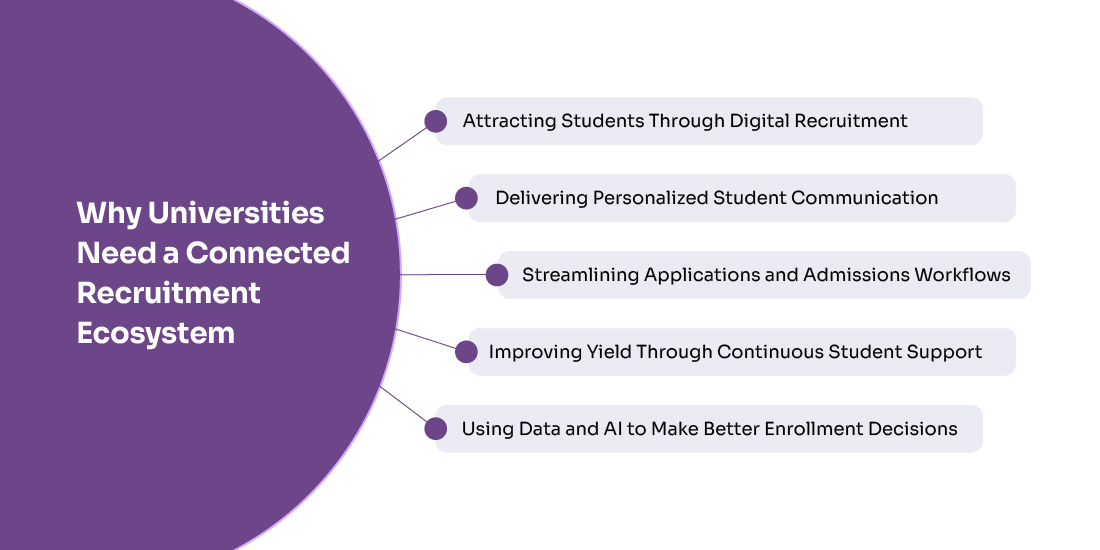
A student recruitment system that is successful is based on coordinated strategies rather than on separate tasks. Today’s enrollment offices achieve a more seamless experience for prospective students by combining digital outreach, personal communication, automation, and decisions guided by data. The main elements that make today’s recruitment ecosystem more effective are as follows.
Attracting Students Through Digital Recruitment
Students begin their college discovery process well in advance of making a campus visit. They find information about colleges by using search engines, social media, YouTube, online reviews, and virtual events. To connect with students where they are already active, enrollment teams are investing in search engine optimization, paid advertising, content marketing, webinars, and student ambassador programs. Rather than using just one method of recruitment, schools set up a number of digital contact points to get students to ask questions and remain connected as they make their decision.
Delivering Personalized Student Communication
Students expect to receive quick and pertinent communication at every stage of the enrolment process. Instead of sending the same message to all applicants, enrolment offices are making use of CRM systems, AI-driven chat, SMS, and automated email workflows to provide personalized updates according to a student’s interests and the stage of their application.
Many organizations also offer 24-hour support via virtual assistants that handle routine admissions questions, allowing advisers to focus on more complex conversations.
Streamlining Applications and Admissions Workflows
Improving efficiency has made application processing a key concern for enrollment teams. Rather than handling documents by hand, many institutions are now using automation to gather transcripts, verify student details, calculate GPAs, and organize application materials.
Admissions staff will be able to spend more time reviewing applications, providing support to students, and making admissions decisions in a timely manner if repetitive administrative tasks are reduced.
Improving Yield Through Continuous Student Support
Sending an admission offer is not the end of the recruitment process; modern enrollment offices keep in touch with accepted students through personalized outreach, financial aid reminders, orientation information, and enrollment checklists.
A number of institutions use automated reminders alongside proactive communication from their advisors to reduce student dropout and to assist them in completing the final steps before classes start.
Using Data and AI to Make Better Enrollment Decisions
Data has become one of the most valuable elements in a recruitment ecosystem, with enrollment leaders tracking where inquiries come from, application trends, communication performance, and conversion rates to determine what is effective and where students drop off.
AI and analytics tools enable teams to detect recruitment bottlenecks, predict enrollment trends, and enhance their recruitment strategies through real-time insights. Rather than making decisions based on assumptions, enrollment offices can continuously improve their recruitment processes by using measurable data.
How the Recruitment Ecosystem Connects the Student Journey
A modern recruitment ecosystem connects all stages of the student journey rather than treating recruitment, admissions, and enrollment as separate processes. When communication, data, and technology work together, students receive a smoother experience from their first inquiry to their first day on campus. Enrollment teams also benefit from fewer manual tasks, faster response times, and better visibility into each student’s progress.
Here’s how today’s recruitment ecosystem supports students at every step, and how tools like EDMO help institutions deliver that experience.
Students get instant answers with AI-powered support
Students often have questions outside office hours. Many institutions use AI assistants to provide 24/7 support for admissions, financial aid, deadlines, and campus life. EDMO’s Student Copilot helps answer these questions through web chat and SMS, keeping students engaged without making them wait for a staff response.
Personalized communication keeps students engaged
Modern enrollment offices move beyond one-size-fits-all emails by using CRM integrations, automation, and conversational AI to send relevant messages based on a student’s interests and application stage. EDMO’s Conversation Intelligence helps institutions deliver personalized conversations while working alongside existing CRM systems.
Application processing becomes faster and more accurate
A connected recruitment ecosystem reduces manual work during admissions. Instead of sorting documents by hand, institutions can automate transcript processing, GPA calculations, and document classification. EDMO’s Transfer Credit Evaluator, GPA Calculator, and Email Document Extractor help admissions teams process application materials more efficiently.
Identity verification builds trust in the admissions process
As online applications grow, enrollment offices are adding stronger verification steps to reduce fraud while keeping the process simple for legitimate applicants. EDMO’s Student ID Verification helps institutions verify government-issued IDs and confirm applicant identity during admissions.
Advisors get better context for student conversations
Recruitment works best when advisors have the right information before speaking with a student. Instead of switching between multiple systems, modern enrollment offices use AI tools that surface conversation history and student context in one place. EDMO’s Advisor Copilot gives advisors quick access to relevant information, helping them provide more informed support.
Data helps enrollment teams improve recruitment outcomes
Modern recruitment ecosystems use analytics to track inquiry sources, application progress, communication performance, and conversion rates. EDMO’s Analytics Studio gives admissions leaders real-time visibility into recruitment and admissions performance, helping them identify bottlenecks and make data-driven enrollment decisions.
When these capabilities work together, the recruitment ecosystem becomes more than a collection of software. It creates a connected student journey where students receive timely support, advisors work more efficiently, and enrollment teams can improve recruitment outcomes with data and AI.
Common Gaps in a University’s Recruitment Ecosystem
Even universities with strong admissions and enrollment processes can still have gaps in their recruitment systems. These gaps often arise when teams, systems, and processes evolve independently over time. This can lead to a disjointed student experience, less insight for enrollment leaders, and missed chances to connect with students when it matters most. Spotting these gaps is the first step to creating a more unified and effective recruitment strategy.
Disconnected Recruitment and Admissions Systems
Many universities rely on separate platforms for marketing, recruitment, admissions, student records, and communication. If these systems do not share information well, staff often have to move data by hand or switch between several tools. This makes it hard to see the full student journey and can cause teams to have different or outdated information.
Limited Personalization at Scale
Enrollment teams understand that students prefer messages that feel personal, but it is hard to customize every interaction by hand. As more students inquire and apply, teams often rely on mass emails and standard follow-ups. This leads to a gap between what students expect from a modern digital experience and what schools can actually provide with limited staff.
Slow Response to Student Inquiries
If students do not get quick answers, they may look at other schools. Still, many enrollment offices rely on staff being available to answer routine questions. Not having enough support after hours, handling lots of inquiries, and doing follow-ups by hand can all cause delays when students are making important choices.
Too Much Manual Administrative Work
Recruitment teams often spend a lot of time on tasks that are not directly related to recruiting students. Sorting documents, checking transcripts, calculating GPAs, updating records, and entering data into different systems all take up valuable staff time. Doing these tasks by hand can also lead to mistakes and slow down the admissions process.
Recruitment Decisions Without Real-Time Data
Some enrollment teams still use spreadsheets, occasional reports, or data from different systems to track how recruitment is going. This makes it harder to notice changes in student behavior, find problems, or react quickly if a campaign is not working well. Without up-to-date data, enrollment leaders may have to make big decisions without all the facts.
Weak Engagement After the Application or Admission
Another common gap happens after a student applies or gets an admission offer. Communication often drops off or only covers deadlines and paperwork. Students still need help at this stage, especially with financial aid, enrollment steps, orientation, and what to do next. If schools do not stay in touch, they risk losing admitted students and missing out on enrollments.
Difficulty Connecting Human Support With Automation
Automation can take care of many routine tasks, but students still need to talk to advisors and admissions staff for more complicated questions. Problems can arise when automated systems and human teams do not work together. A better recruitment system makes it easy for students to move from automated help to real people, so they get the support they need without repeating themselves.
How AI Is Changing the Higher Education Recruitment Ecosystem
The way AI is affecting recruitment in higher education is turning it from a series of separate tasks into a more connected and adaptable process. Previous recruitment methods usually relied on fixed campaigns, pre-set workflows, and staff having to decide manually what should be done next. With the help of AI, enrollment teams can now respond to changes in student behaviour, spot opportunities earlier, and coordinate their recruitment activities more intelligently.
Some of the biggest changes include:
Predictive Recruitment Helps Teams Identify Enrollment Opportunities
By using AI, it’s possible to analyze historical enrollment data and students’ current activity to detect patterns that would be hard to identify manually. Enrollment teams can then use these insights to identify which prospects are more likely to apply, which applicants might need extra support, or where new enrollment opportunities may be emerging.
It changes recruitment so that, instead of just responding to what students do, it involves making more informed decisions about where staff attention should have the greatest impact.
AI Supports More Adaptive Recruitment Strategies
Traditional recruitment campaigns are usually planned months in advance and proceed in a set order. With the use of AI, teams will be able to alter their strategies in response to what is actually happening. When engagement levels change within a specific student group, program, or recruitment channel, the teams can adjust their outreach and follow-up approaches rather than waiting until the campaign has finished.
As a result, the recruitment process becomes more responsive to the real behavior of students.
AI Helps Connect Information Across the Enrollment Ecosystem
The information generated during a student’s recruitment process can be found on several platforms, including the CRM, the admissions system, the communication tools, the website, and the student information system. AI can assist in making sense of this information and in bringing the relevant signals together.
This allows enrollment leaders to obtain a more comprehensive view of recruitment activity rather than having them interpret separate reports from different systems.
AI Changes How Enrollment Teams Allocate Staff Time
AI is having a similar effect on the work of enrollment professionals: instead of spending a lot of their time on routine tasks, they can concentrate on cases that call for judgment, relationship building, and intervention.
For instance, an AI system could identify a student who has demonstrated a great deal of interest but whose progress has then halted, enabling an advisor to judge if it is worthwhile to make a personal contact. This in turn leads to a more targeted form of human intervention.
AI Makes Recruitment Workflows More Intelligent
Earlier types of automation generally operated on the basis of rules like ‘if this occurs, send that message’. AI on the other hand provides more flexibility by interpreting the information and assisting in deciding which action might be appropriate.
The way EDMO’s System Intelligence approach addresses this change is by combining AI capabilities with the systems enrolment teams currently use. Instead of forcing institutions to replace their present CRM or SIS, AI can function as an intelligence layer that enables the teams to get more value from their existing enrolment infrastructure.
AI Creates a More Continuous Recruitment Experience
The biggest change could well be the shift from having separate recruitment stages. With the aid of AI, it’s possible to link together prospect engagement, application activity, admissions operations, advising, and enrollment decisions into a more continuous process.
This implies that universities can make their recruitment system more responsive over time; rather than just guiding students through a fixed funnel, enrollment teams can use AI to understand what is happening at each stage and decide where intervention, automation, or additional support is needed.
How to Measure the Performance of Your Recruitment Ecosystem
When evaluating your recruitment ecosystem, it’s important to look beyond just the number of inquiries or applications. Enrollment teams should focus on how smoothly students move through each stage of the recruitment process and identify where potential students might drop off. By tracking student engagement, application conversion, enrollment results, operational efficiency, and technology performance together, institutions can better see what’s working and where they can improve.
Here are some important benchmarks to keep an eye on:
- Inquiry-to-Application Rate: This shows how well your recruitment efforts turn interested students into actual applicants. If this rate drops, it could mean there are issues with your messaging, follow-up, program details, or the application process.
- Application-to-Admission Rate: This tells you how many applications lead to an admission decision or offer. Looking at this rate by program, student group, or recruitment source can highlight differences in applicant quality.
- Admission-to-Enrollment Yield: This measures what percentage of admitted students actually enroll. It’s a key benchmark because it shows how well your institution turns offers into enrollments.
- Time to First Response: This tracks how quickly your team replies after a student asks for information. Responding faster can help you connect with students while they’re still interested.
- Student Engagement Rate: Track how often students interact with your emails, texts, web chats, events, and other channels. Checking engagement by student group can show which methods get the best response.
- Application Processing Time: This measures how long it takes to process an application or document from start to finish. If it takes longer than expected, it might mean your team is dealing with manual steps, not enough staff, or systems that don’t work well together.
- Staff Time per Application: Track how much time your staff spends helping each applicant. This helps leaders see if automation and better workflows are really making things easier.
- Recruitment Source Conversion: Compare how many applications and enrollments come from different channels like search, ads, email, events, referrals, or social media. This helps your team focus on the channels that work best.
- Admitted Student Melt: This measures what percentage of admitted students don’t end up enrolling. Watching this by student type, program, or stage can help you spot where students might need more support before they enroll.
- Cost per Enrolled Student: Compare your total recruitment spending to the number of students who actually enroll. This gives you a better sense of efficiency than just counting leads.
- Automation Rate: Track how many recruitment and admissions tasks are done automatically instead of by hand. This shows if your technology is really making a difference.
- Student Satisfaction: Recruitment results should also reflect how students feel about their experience. Surveys, feedback, response quality, and satisfaction scores can show if your recruitment process is making things easier for students.
The goal isn’t to maximize each metric on its own. Instead, enrollment leaders should look at all these benchmarks together to see where students are progressing, where they’re getting stuck, and which parts of the recruitment process have the greatest impact.
Building an AI-Powered Recruitment Ecosystem With EDMO
An AI-powered recruitment ecosystem should not be another collection of disconnected tools. The real value comes from connecting the systems, workflows, and intelligence an enrollment office already relies on. EDMO takes this approach by working alongside an institution’s existing enrollment infrastructure and adding an intelligence layer across the student journey.
For universities looking to modernize their recruitment ecosystem, the focus should be on connecting what already exists, identifying where intelligence can add value, and gradually expanding automation.
- Start with the existing enrollment infrastructure. Universities do not need to replace their CRM, SIS, or admissions technology to introduce AI. EDMO is designed to work with existing systems, allowing institutions to modernize their recruitment operations without taking on a complete technology replacement.
- Identify the highest-impact gaps first. Every enrollment office has different challenges. One may struggle with application volume, while another may need better student engagement or stronger visibility into recruitment performance. Institutions can start by addressing the areas creating the most friction rather than attempting to automate everything at once.
- Connect intelligence across workflows. The next step is moving away from isolated automation. When AI capabilities can work with information from the broader enrollment ecosystem, actions taken in one part of the student journey can inform what happens next. This creates a more coordinated recruitment process.
- Keep people in the loop. AI should handle appropriate repetitive work while enrollment professionals remain responsible for decisions, relationships, and situations that require judgment. EDMO’s approach allows institutions to combine automated processes with human oversight rather than treating AI as a replacement for staff.
- Measure the impact as the ecosystem grows. Universities should evaluate AI investments based on measurable outcomes such as processing time, staff workload, student response rates, application progression, and enrollment conversion. EDMO’s Analytics Studio can help leaders monitor operational performance and identify where further improvements are needed.
- Build incrementally instead of all at once. An effective recruitment ecosystem can evolve over time. Institutions can begin with one workflow, measure its impact, and then extend AI to other parts of recruitment and enrollment. This makes adoption more manageable while allowing teams to build on what they learn.
Ultimately, building an AI-powered recruitment ecosystem is less about adding more technology and more about making the technology a university already has work better together. EDMO’s role is to provide the intelligence layer that helps enrollment teams connect processes, reduce friction, and create a more coordinated approach to recruitment.
Conclusion
The next phase of student recruitment will be defined by how well universities can adapt to changing student behavior and enrollment demands. Instead of adding more campaigns, platforms, or processes, enrollment leaders need to look at where students experience friction and where their teams lose valuable time.
A stronger recruitment ecosystem starts with those gaps. Universities can improve it step by step by connecting existing systems, introducing intelligence where it can have the most impact, and continuously measuring what improves the student experience and enrollment outcomes. The institutions that take this approach will be better positioned to respond to changing recruitment demands without complicating their operations.
Frequently Asked Questions
Ques 1: Who should own the recruitment ecosystem within a university?
Ques 2: What technologies are needed to support a modern recruitment ecosystem?
Ques 3: How can universities connect recruitment data across different systems?
Ques 4: How can universities personalize recruitment without increasing staff workload?
Ques 5: How often should enrollment teams evaluate their recruitment ecosystem?
Ques 6: Can universities improve recruitment without replacing their existing CRM or SIS?
Written By





No comments yet. Be the first to comment!
Leave a Comment