

Table Of Contents
- 1Introduction
- 2Why Universities Are Using WhatsApp for Student Admissions
- 3How Universities Can Use WhatsApp Across the Student Enrollment Journey
- 4How WhatsApp Chatbots Help Increase Student Enrollments
- 5WhatsApp for Education Implementation Checklist
- 6Best Practices for Using WhatsApp in University Admissions
- 7Conclusion
Introduction
For today’s students, communication with a university doesn’t stop at the website or application portal. They expect quick, convenient answers on the channels they already use, which is why WhatsApp is becoming an increasingly useful tool for admissions teams. Instead of relying entirely on emails that can sit unread, universities can use WhatsApp to answer questions, follow up with prospective students, share important deadlines, send application updates, and keep conversations moving in real time.
The benefit goes both ways. Admissions teams get a faster, more direct way to engage students, reduce repetitive inquiries, and keep applicants moving through the enrollment journey. Students, meanwhile, get a simpler way to ask questions, receive timely updates, clarify application requirements, and stay connected with the university without having to navigate multiple systems. Used thoughtfully, WhatsApp can make the admissions experience feel less like a series of forms and emails and more like an ongoing conversation.
Why Universities Are Using WhatsApp for Student Admissions
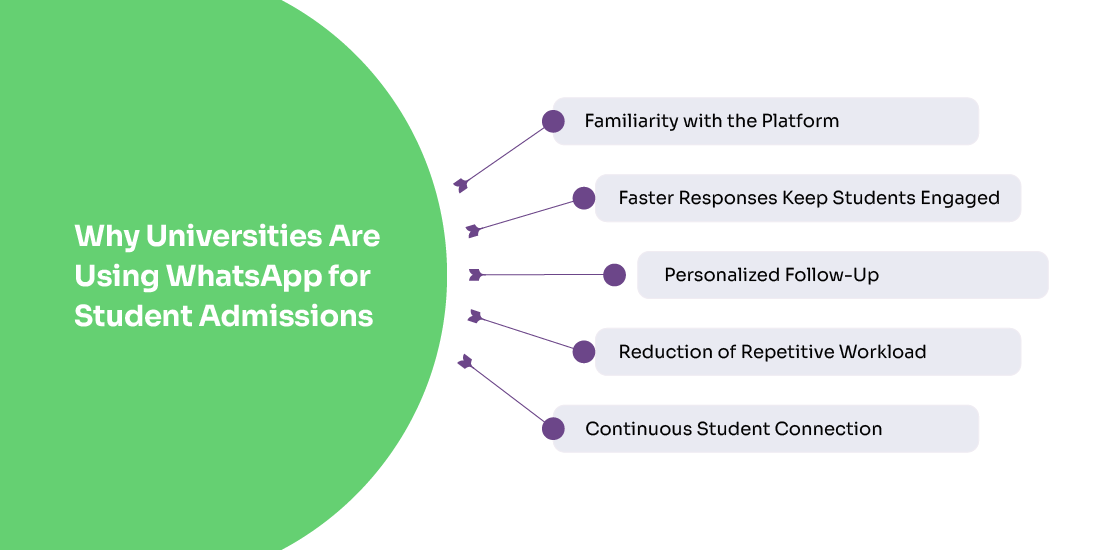
University admissions have become increasingly communication-intensive. Students often have questions at every stage, from selecting a program and understanding eligibility requirements to submitting documents and deciding whether to enroll. WhatsApp provides admissions teams with a familiar, direct channel for handling these interactions, allowing students to obtain information without repeatedly checking email or navigating various university systems. For institutions, WhatsApp can facilitate consistent follow-ups and help teams stay connected with prospective students throughout the enrollment journey.
Familiarity with the Platform
Many students are already comfortable using WhatsApp, which allows universities to engage prospective applicants on a platform they already understand, rather than requiring them to learn a new communication system. When powered by Student Copilot, WhatsApp becomes more than a messaging app, and it can provide instant answers to admissions questions, guide students through application requirements, and offer personalized support while keeping conversations seamless and familiar.
Faster Responses Keep Students Engaged
Admissions questions often arise with a sense of urgency. Quick responses regarding deadlines, required documents, programs, or application status can help maintain student momentum and reduce the likelihood of them seeking answers elsewhere.
Personalized Follow-Up
Admissions teams can use WhatsApp to send relevant reminders and updates tailored to where each student is in the enrollment process. This approach fosters a more conversational experience compared to sending the same generic email to every applicant.
Reduction of Repetitive Workload
Many admissions teams spend significant time answering recurring questions about application requirements, deadlines, fees, programs, and next steps. Using WhatsApp can help organize these conversations, and when paired with automation, it can address routine inquiries, allowing staff to focus on more complex student needs.
Continuous Student Connection
The use of WhatsApp doesn’t need to stop once a student submits an application. Universities can utilize it for reminders, document requests, interview information, decision notifications, enrollment deadlines, and other important communication points, creating a more seamless admissions experience.
How Universities Can Use WhatsApp Across the Student Enrollment Journey
The student enrollment journey rarely follows a straight path. A prospective student might discover a university through a campaign, ask questions weeks later, submit documents over several months, and require reminders before making a final enrollment decision. WhatsApp enables admissions teams to stay connected at each of these touchpoints through timely, personalized conversations rather than relying on disconnected emails and phone calls. When integrated with a university’s CRM and supported by tools like Student Copilot, WhatsApp can help create a more consistent experience from the first inquiry to enrollment.
Prospect Discovery and Lead Generation
Universities can use WhatsApp as an entry point for prospective students who learn about the institution from websites, social media campaigns, virtual events, or QR codes. Instead of making students wait for an email response, admissions teams can initiate conversations immediately, answer initial questions, and capture inquiry details for future follow-up.
Program Exploration and Personalized Guidance
Choosing the right program is often one of the biggest challenges for applicants. Through WhatsApp, admissions teams can assist students in comparing programs, explaining eligibility requirements, discussing tuition and scholarships, and recommending relevant resources. Student Copilot can also provide instant responses to common program-related questions while directing more complex inquiries to admissions counselors when necessary.
Application Support
Many applicants need help understanding application requirements or completing forms correctly. Universities can utilize WhatsApp to guide students through the application steps, explain document requirements, address questions about deadlines, and offer real-time assistance whenever students encounter issues during the application process.
Document Collection and Verification
Missing or incomplete documents frequently result in application delays. WhatsApp can help admissions teams request outstanding documents, remind students about verification requirements, confirm when documents have been received, and keep applicants informed about what still needs attention.
Interview and Event Coordination
For programs that require interviews or admissions events, WhatsApp provides an easy way to manage logistics. Teams can send interview invitations, share event details, provide joining instructions for virtual sessions, and remind students before scheduled appointments, reducing the likelihood of missed opportunities.
Application Status Updates
One of the biggest frustrations for applicants is waiting without knowing what comes next. Universities can use WhatsApp to share application milestones, notify students when reviews are complete, communicate admission decisions, and explain the next steps after an offer is made.
Enrollment and Deposit Reminders
Receiving an admission offer is just part of the journey. Students still need to accept offers, pay deposits, complete enrollment forms, and meet additional deadlines. WhatsApp can help universities send timely reminders, address last-minute enrollment questions, and keep admitted students engaged until they officially join the institution.
Pre-Arrival and Orientation Communication
The relationship should not end once a student enrolls. Universities can continue using WhatsApp to share orientation schedules, campus resources, housing information, registration guidance, and other important updates that facilitate a smooth transition into university life.
By supporting students throughout each stage of the enrollment journey, WhatsApp becomes more than just a communication channel. It transforms into a continuous engagement tool that helps admissions teams respond more quickly, reduce manual follow-ups, and create a more connected experience for every applicant.
How WhatsApp Chatbots Help Increase Student Enrollments
Speed and consistency play a crucial role in whether prospective students complete their applications or drop out during the process. Many applicants have questions outside of business hours, miss important emails, or lose momentum when faced with long wait times for responses. WhatsApp chatbots can address these issues by providing instant, personalized support throughout the enrollment journey. When integrated with a university’s CRM and powered by AI tools like Student Copilot, these chatbots can handle routine inquiries at scale while ensuring that admissions teams can step in when human assistance is required.
Provide Instant Answers 24/7
Students often research universities during evenings and weekends when admissions offices are closed. A WhatsApp chatbot can immediately respond to common questions about programs, eligibility, application requirements, scholarships, and deadlines, helping students move forward without having to wait for office hours.
Reduce Application Drop-Offs
Many prospective students abandon their applications when they encounter obstacles or miss essential steps. Chatbots can guide applicants through the process, explain what documents are needed, and send timely reminders that encourage students to complete their applications.
Deliver Personalized Conversations at Scale
Instead of sending the same generic message to every applicant, AI-powered chatbots can personalize conversations based on a student’s program of interest, application stage, or previous interactions. This makes communication more relevant and allows admissions teams to support thousands of students simultaneously.
Automate Follow-Ups and Reminders
Manually following up with every applicant is time-consuming for admissions teams. Chatbots can automatically send reminders about missing documents, interview schedules, deposit deadlines, and other enrollment tasks, ensuring students stay informed throughout the process.
Qualify and Route Prospective Students
Not every inquiry requires a counselor’s attention. Chatbots can gather basic information, identify a student’s interests, and route more complex questions to the appropriate admissions advisor. This helps teams prioritize conversations that need human expertise.
Support International Applicants
International students often have additional questions regarding visas, English language requirements, transcript evaluations, and time zone differences. WhatsApp chatbots can provide immediate guidance regardless of location, making universities more accessible to global applicants.
Provide Admissions Teams with Actionable Insights
Every conversation can reveal what students are asking most frequently, where applicants are facing challenges, and which follow-ups generate the most engagement. These insights help admissions teams refine their recruitment strategies and enhance the overall enrollment experience.
WhatsApp for Education Implementation Checklist
It is most effective to launch WhatsApp as part of the university’s enrolment strategy rather than just incorporating it as another messaging channel. In order to achieve a successful implementation, the appropriate technical arrangement, well-defined communication policies, integration with the CRM system, and a plan for balancing automation with human assistance are all necessary. The checklist provided can assist admissions teams in creating a WhatsApp experience that is structured, compliant, and aimed at enhancing student engagement.
Set up an official WhatsApp Business account
So that students will be able to easily identify the university and feel confident that they are talking to an official admissions office, it is necessary to use a verified business account.
Integrate WhatsApp with your CRM
Link WhatsApp to systems such as Slate, Salesforce, or other enrollment platforms so that conversations, student records, and application updates all remain in one place.
Deploy an AI-powered Student Copilot
Student Copilot can be used to answer commonly asked questions, assist applicants with the admissions process, and have the ability to transfer complex conversations to admissions counselors when necessary.
Create automated conversation flows
Create workflows for common admissions situations such as responding to inquiries, providing application advice, sending reminders about required documents, scheduling interviews, and carrying out follow-ups after enrollment.
Define escalation rules
Make the decision about when conversations should shift from automated service to that of a human admissions advisor so that students get the appropriate level of support.
Organize message templates
Create approved templates for confirming applications, reminding about deadlines, inviting people to events, making admission decisions, and providing enrollment instructions so that all communication remains consistent.
Obtain student consent
Make sure that students agree to receive WhatsApp messages and comply with the relevant privacy and messaging regulations before sending out the notifications.
Train the admissions team
Provide the staff with clear guidelines regarding response times, appropriate behaviour during conversations, the procedures to follow when escalating an issue, and how to use WhatsApp in connection with the current recruitment processes.
Track performance metrics
Keep an eye on response times, engagement rates, the number of applications completed, document submission rates, and enrollment conversion rates in order to assess the impact of your WhatsApp strategy.
Continuously optimize the experience
Keep regularly reviewing the conversation data in order to spot frequently asked questions by students, improve the chatbot’s responses, refine the various workflows, and thus enhance the entire enrollment process.
Best Practices for Using WhatsApp in University Admissions
WhatsApp is most effective when it supports your university’s current admissions process rather than taking its place. Students want quick, helpful, and personalized replies, as well as accuracy, privacy, and the chance to talk to a real person if needed. By following some best practices, admissions teams can offer a professional experience and get the most out of the platform.
Keep conversations student-focused
Make sure each message has a clear reason, like answering a question, helping a student with their next step, or sharing an important update. Try not to send too many messages or anything that feels too promotional.
Respond quickly and consistently
Quick replies are important during admissions. Let students know when they can expect a response, and use automation for common questions so they get help even after hours.
Personalize communication whenever possible
Use students’ names and adjust your messages based on their program, where they are in the application process, or past conversations. Personal touches make your messages feel more meaningful than general updates.
AI tools such as Student Copilot can answer routine questions, but students should always have the option to talk to an admissions counselor when they need more personal help with complicated issues.
Use approved message templates
Set up standard templates for things like application confirmations, document reminders, interview invites, and enrollment updates. This keeps your team’s communication style consistent.
Protect student data and privacy
Always get permission before sending messages on WhatsApp, and make sure your conversations follow your institution’s privacy rules and any laws like FERPA and GDPR that apply.
Integrate WhatsApp with your enrollment systems
Link WhatsApp to your CRM so all chats, application updates, and student records are in one place. This gives your admissions team the full picture during every conversation.
Monitor performance and improve continuously
Keep an eye on things like how fast you reply, how engaged students are, how many finish their applications, and how many enroll. Looking at these insights often helps you spot common questions and find ways to make the admissions process better.
Conclusion
WhatsApp is no longer just a messaging app. It has become a coherent enrollment channel for universities that want to communicate faster and more effectively with prospective students. From answering first-time inquiries to sending application reminders and enrollment updates, it helps admissions teams create a more connected and responsive student experience. When combined with AI tools like Student Copilot and integrated with a university’s CRM, WhatsApp can reduce manual workload while supporting more personalized conversations at scale. The result is a smoother enrollment journey that benefits both admissions teams and the students they serve.
Frequently Asked Questions
Ques 1. Should a university use the WhatsApp Business App or WhatsApp Business Platform?
Ques 2. Does a university need consent to message prospective students on WhatsApp?
Ques 3. Can universities send mass WhatsApp messages?
Ques 4. Can a WhatsApp chatbot answer admissions questions?
Ques 5. 5. How should universities measure WhatsApp recruitment performance?
Ques 6. Can WhatsApp integrate with a university CRM?
Ques 7. How can universities automate application reminders on WhatsApp?
Written By


You May Also Like
 AI in Education

 AI in Education
 AI in Education
No comments yet. Be the first to comment!
Leave a Comment