


Table Of Contents
Introduction
For university admissions staff, the process of assessing an applicant’s academic eligibility goes well beyond simply verifying that their GPA meets the minimum requirement. The admissions officers have to decide whether the applicant’s academic record meets the institution’s policies, the program’s specific requirements, the transfer rules, and, where relevant, the standards associated with accreditation and professional licensing.
When the applications are submitted by different institutions, using different grading systems, belonging to various academic programs and coming from different countries, the situation becomes more complicated. In such cases, the student’s GPA may have to be recalculated, put into context or be assessed in relation to the specific requirements of individual courses.
Moreover, the admissions teams might need to make a distinction between cumulative and institutional GPA, take into account any repeated courses, evaluate the transfer credits and check prerequisites before reaching a decision on admission.
The importance of these requirements extends well beyond the first review of an application; incorrect calculations of GPA or an inconsistent application of academic standards may influence eligibility decisions, academic placement, transfer evaluations, and an institution’s ability to show that it is complying with the relevant standards.
For admissions offices that are having to deal with increasing numbers of applications, the problem is to keep the same standard of accuracy without requiring that each application be subject to a lengthy manual examination. It has therefore become an essential element of efficient university admissions operations to know which accreditation and GPA requirements apply and to establish reliable procedures for tracking and assessing them.
Key Accreditation Requirements
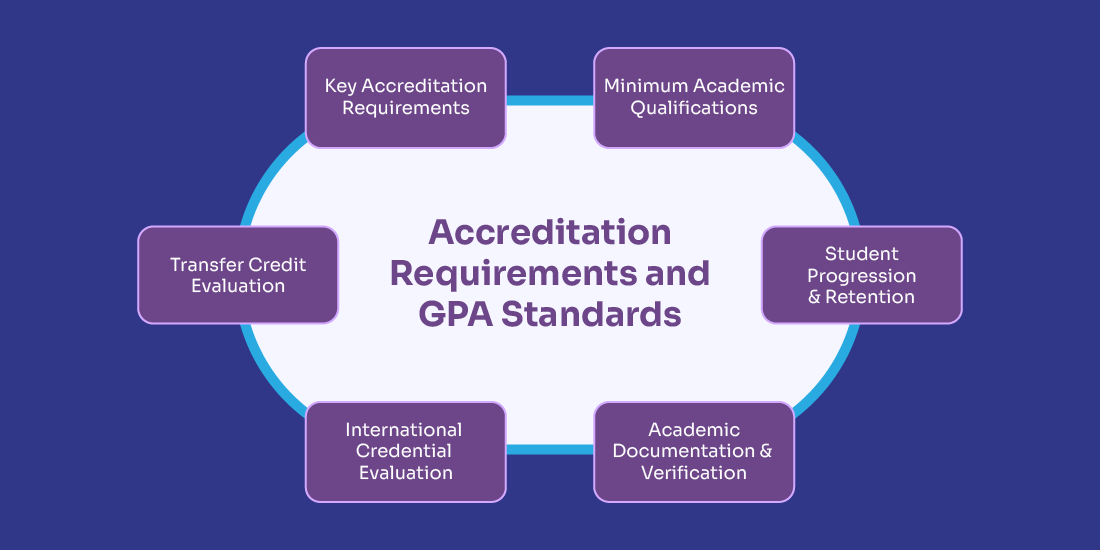
For university admissions staff, accreditation requirements affect how institutions determine academic eligibility, assess qualifications, and record admission decisions. Although requirements vary by accrediting body, institution, and program, admissions teams must identify the criteria for each applicant and apply them consistently during evaluation.
Minimum Academic Qualifications
Admissions teams must verify that applicants meet the minimum academic standards set by the institution or program. These may include a minimum GPA, required degree level, prerequisite courses, standardized test scores, or other measures of academic readiness.
Program-Specific Admission Standards
Certain programs may have academic requirements stricter than the university’s general admission criteria. Admissions teams may need to verify minimum GPAs in specific subjects, completion of prerequisite courses, or other requirements before admitting an applicant to a program.
Transfer Credit Evaluation
When applicants transfer from another institution, teams must determine if previously earned credits come from recognized institutions and meet standards for acceptance, equivalency, and application toward the new program.
International Credential Evaluation
International applicants often require extra review to determine how foreign qualifications, grading scales, and academic credentials compare with U.S. or institutional standards. This involves evaluating degree equivalencies, converting grades, and verifying the authenticity of academic records.
GPA Calculation and Consistency
Admissions teams need clearly defined methods for calculating and interpreting GPAs, particularly when applicants have coursework from multiple institutions, repeated courses, different grading scales, or weighted and unweighted grading systems.
Academic Documentation and Verification
Transcripts, certificates, test scores, and other academic records must be collected and verified to ensure admission decisions are based on accurate and complete information. Institutions may also need to keep documentation showing how eligibility decisions were made.
Student Progression and Retention Standards
Accreditation requirements can extend beyond admission. Programs may set minimum GPA or academic progression standards students must maintain after enrollment. Accurate initial evaluation is important to set appropriate academic expectations.
Compliance and Policy Alignment
Admissions practices should stay consistent with accreditation standards, state and federal requirements, and the university’s published policies. Changes to these requirements must be reflected in admissions workflows to avoid applying outdated criteria.
University GPA Standards
The GPA standards are one of the most widely used academic criteria by university admissions offices when deciding if applicants satisfy the eligibility conditions set by the institution and at the program level. Yet there is no single GPA standard applied throughout higher education; the requirements can differ from one institution to another, depending on the degree level, the academic program, the category of applicant, and even the kind of courses the applicant has taken. Because of this, admissions offices must have well-defined procedures for calculating, interpreting, and verifying GPAs instead of depending on a single numerical cutoff.
Minimum GPA Requirements
Universities can set a minimum cumulative GPA for admission, while individual colleges or programs may establish higher limits on the basis of academic competitiveness or the requirements of the program.
Program-Specific GPA Thresholds
Professional and specialized courses may require applicants to have a minimum overall GPA as well as separate GPA requirements for the prerequisite or major-related subjects.
Cumulative vs. Program GPA
The admissions teams could be required to tell the difference between an applicant’s total cumulative GPA and the GPA that they obtained in their particular major, subject area, or in a set of prerequisite courses.
Different Grading Scales
Applicants can use the 4.0, 5.0, percentage-based, letter-grade, or other grading systems when submitting their records. The teams have to decide on how these grades should be interpreted or converted in accordance with institutional policies.
Weighted and Unweighted GPAs
Applicants have the option of reporting their GPAs in a way that takes into consideration the difficulty of their courses. In order to understand if the GPA that an applicant reports is a weighted one, an unweighted one, or one calculated by some other method used by the institution, the admissions teams must do so.
Repeated Coursework
When students take the same courses, different universities have various policies regarding which grades are included in the GPA for admission, such as replacing an earlier grade, averaging the different grades, or taking into account all the grades.
Transfer Coursework
The calculation of a GPA can get more complicated in the case where an applicant has taken courses at a number of different institutions. The admissions teams might then have to decide which of the grades and credits should be included in the GPA used for institutional admission.
International GPA Evaluation
Since international applicants have academic records which employ different grading scales and methods of assessment, the admissions teams should adhere to the established institutional or credential-evaluation procedures rather than comparing the foreign grades directly with domestic GPAs.
Conditional Admission Standards
Certain institutions will admit students who do not meet the standard GPA criteria provided that they complete their prerequisite courses, take part in academic support schemes, or satisfy certain performance requirements once they have enrolled.
Documentation and Auditability
GPA decisions must be based on the relevant academic records and employ a consistent method of calculation so that institutions can explain how they have decided on an applicant’s eligibility and can apply their standards in a consistent way to all applicants.
Why Accreditation Matters
It is important because it offers an external basis by which it can be determined whether a university or academic program meets the required standards in terms of the quality of education, governance, academic standards, and student outcomes. For admissions teams, though, accreditation is more than just a credential of the institution; it can affect the way applicants are assessed, which academic qualifications are recognized, and what kind of documentation has to be kept. Admissions decisions that are not in line with the relevant accreditation and institutional standards may result in compliance risks, inconsistencies in the decisions regarding eligibility, and problems for students as they progress in their studies.
Ensures Academic Standards Are Applied Consistently
Accreditation sets out standards which allow academic policies and admissions practices to be assessed against them. It enables admissions teams to apply their eligibility criteria in a consistent manner instead of having to depend on personal judgment.
Supports Accurate Admissions Decisions
Clear academic and program requirements enable teams to decide if applicants have the necessary preparation to succeed in the programs they have chosen.
Protects Transfer and Credit Recognition
The accreditation status may influence whether or not coursework and qualifications from another institution are regarded as acceptable for transfer or for further academic evaluation.
Supports Financial Aid Eligibility
Institutional accreditation is important for an institution if it is to be eligible to take part in federal financial aid programs, which shows that accreditation is relevant to both the way in which the institution operates and to students’ access to aid.
Reduces Compliance Risk
Keeping the admission criteria and records accurate helps organizations show that their procedures conform to the relevant accreditation standards and to the institution’s own policies when they are undergoing reviews or audits.
Improves Transparency for Students
Since the academic and GPA requirements are clearly defined, applicants will have a better understanding of what is expected of them before applying and will experience less uncertainty regarding their eligibility.
Strengthens Institutional Credibility
The fact that an institution or program has been subject to an external review against established standards is what accreditation indicates, and this can affect the way students, employers, other institutions and stakeholders view the quality of the programs offered.
Requires Ongoing Monitoring
Accreditation standards and the policies of the institution may change with time, so admissions teams must have procedures for keeping up with the updates and for making sure that the published requirements, the evaluation workflows, and the criteria for decisions are up to date.
Conclusion
Accreditation requirements and GPA standards are not simply compliance considerations for universities. They are part of the foundation on which accurate and defensible admissions decisions are built. As institutions evaluate applicants from increasingly diverse academic backgrounds, admissions teams must be able to interpret different grading systems, verify credentials, apply program-specific requirements, and maintain consistency across thousands of applications. A clearly defined framework for tracking accreditation requirements and GPA standards can help institutions reduce errors, improve the consistency of evaluations, and give admissions teams greater confidence in their decisions. The goal is not only to meet accreditation expectations, but to build an admissions process that is accurate, transparent, and scalable.
Written By


You May Also Like
 AI in Education

 AI in Education
 AI in Education


No comments yet. Be the first to comment!
Leave a Comment