

Table Of Contents
- 1Introduction
- 2The Growing Importance of Data Analytics in Universities
- 3Why Data Analytics is Essential for Modern Higher Education Administration
- 4Key Advantages of Data Analytics in Higher Education
- 5Key Data Analytics Trends Transforming Higher Education Administration
- 6How Universities Use Predictive Analytics
- 7Challenges of Data Analytics in Higher Education
- 8Best Practices for Implementing Data Analytics in Universities
- 9How EDMO Supports Data-Driven Higher Education Administration
- 10Future of Data Analytics in Higher Education
- 11Conclusion
Introduction
Colleges and universities are collecting more data than ever. They track everything from student applications and enrollment trends to academic performance, engagement, finances, and alumni outcomes. With so much information available at every stage of the student journey, schools are under pressure to boost student success, use resources wisely, show results, and stay competitive. Data analytics is now a key strategic tool, not just a way to report numbers. By turning raw data into useful insights, universities can make better decisions, spot opportunities and risks sooner, offer more personalized support, and run their operations more efficiently.
For example, during admissions, a university might see that many students from one region start applications but do not finish them. Another group might finish their applications, but then turn down admission offers. These might look like separate problems, but data analysis can uncover deeper issues. Delays in follow-up, confusion about financial aid, or unclear program value could be affecting both groups.
With this information, admissions and enrollment teams can take more targeted actions instead of using the same approach for everyone. They might run outreach campaigns for certain regions, send personalized emails based on where students are in the application process, or quickly share financial aid details with students who seem very interested. Over time, these data-driven steps can help more students finish their applications and accept offers, leading to better enrollment results.
The Growing Importance of Data Analytics in Universities
Data analytics is the process of collecting, organizing, and analyzing large data sets to uncover patterns, trends, and insights that support better decision-making. In higher education, it combines information from across the institution, student applications, academic performance, LMS activity, financial aid data, campus engagement, and alumni outcomes to create a fuller picture of how the university functions and how students progress.
In recent years, data analytics has become more important for universities as the scale and complexity of institutional data have grown. Universities no longer operate in silos where each department makes decisions independently with limited visibility into the broader student journey. They are expected to demonstrate outcomes, improve student success, manage resources efficiently, and deliver personalized experiences. Data analytics enables this shift by turning fragmented information into actionable insights. It helps institutions move from intuition-based decisions to evidence-driven strategies that directly impact enrollment, retention, and overall performance.
Why Data Analytics is Essential for Modern Higher Education Administration
Managing a university today is more complex than ever, with schools handling huge amounts of data in admissions, academics, finance, student services, and alumni relations. Data analytics is no longer just a tool for reporting; it now plays a key role in shaping strategy. By connecting information from different departments, analytics helps universities spot important trends and make quicker, better decisions that improve student success and how the institution runs.
Here’s why data analytics matters in every department:
Admissions & Enrollment
- Improves application tracking and yield prediction
- Identifies high-performing recruitment channels
- Enables data-driven outreach and conversion strategies
Academic Affairs
- Tracks student performance and learning outcomes
- Identifies curriculum gaps and improvement areas
- Supports program evaluation and academic planning
Student Success & Retention
- Detects at-risk students early using predictive insights
- Monitors engagement and attendance trends
- Enables timely interventions to improve retention
Finance & Administration
- Supports accurate budgeting and financial forecasting
- Tracks resource utilization and operational efficiency
- Helps optimize spending and cost management
Student Services & Campus Operations
- Improves service delivery through usage insights
- Tracks student satisfaction and engagement patterns
- Enhances resource allocation across services
Advancement & Alumni Relations
- Identifies donor and alumni engagement patterns
- Improves fundraising campaign targeting
- Strengthens long-term relationship management
When schools use analytics in all these areas, they become more connected, efficient, and able to make decisions based on real evidence.
Key Advantages of Data Analytics in Higher Education
Data analytics in higher education has moved beyond just dashboards and reports. Now, it helps universities truly understand what is happening throughout the student journey and respond quickly. By spotting patterns in admissions, academics, and student services, institutions can make faster decisions that improve results, cut down on inefficiencies, and create a better experience for students. The main change is that decisions are now based on real-time evidence instead of guesswork.
Higher enrollment conversions through smarter targeting
Universities no longer have to treat every applicant the same way. They can now see who is most likely to enroll and why some students lose interest. For example, if data shows that students from a certain area finish applications but stop responding after getting fee information, the university can offer clearer financial advice or follow up personally. These small changes can lead to better enrollment results.
Early intervention that improves student retention
Analytics helps schools spot early warning signs that might be missed otherwise. For example, if a first-year student stops logging into the learning system, misses assignments, and participates less in discussions, the system can alert staff. Advisors can then reach out, offer help, or connect the student with a mentor before they think about leaving.
Faster admissions and document processing with fewer errors
Admissions teams often deal with thousands of emails and documents. With AI-powered analytics and OCR, transcripts and supporting documents can be read and structured instantly. For example, instead of manually entering grades from multiple formats, the system can extract GPA, subjects, and marks in seconds, allowing teams to focus on reviewing candidates rather than data entry.
Better academic outcomes through curriculum insights
Universities can spot where students often have trouble and take steps to help. For example, if several groups of students do poorly in a certain math class, teachers can change how they teach, add extra sessions, or update course materials to help students do better.
More efficient use of institutional resources
Data analytics shows universities where resources are used too much or too little. For example, if support centers are very busy at the start of the semester but quiet later, staff schedules can be changed to match. This gives better service without raising costs.
More personalized and responsive student experience
Instead of sending the same messages to every student, universities can tailor communication based on behavior and needs. For example, a student struggling academically might automatically receive study resources and tutoring options, while a high-performing student might be guided toward internships or research opportunities. This makes support feel more relevant and timely.
Smarter financial planning and aid allocation
Universities can identify students who may be at risk of dropping out due to financial pressure. For example, if a student’s engagement is strong but financial aid gaps exist, the institution can proactively offer targeted scholarships or payment flexibility. This helps retain students who might otherwise discontinue.
Stronger alumni engagement and fundraising outcomes
Instead of broad outreach, analytics helps institutions understand which alumni are most engaged. For example, if certain alumni regularly attend webinars or interact with newsletters, advancement teams can prioritize them for fundraising campaigns. This makes outreach more focused and increases the likelihood of contributions.
Key Data Analytics Trends Transforming Higher Education Administration
Higher education administration is now much more data-driven than before. Rather than depending on occasional reports or separate spreadsheets, universities use real-time insights to see what’s happening in admissions, academics, finance, and student support as events unfold. This change matters because today’s institutions face more complexity, so decisions must be quicker, better coordinated, and based on evidence instead of guesswork.
Real-time decision-making across the student lifecycle
Universities do not wait until the end of an admissions cycle or semester to see how things are going. For example, if they notice many applicants are leaving at the fee payment stage, the admissions team can quickly make instructions clearer or offer live help, rather than losing those students by the end of the cycle.
Predictive analytics for student success and retention
Rather than waiting until a student fails or withdraws, institutions are starting to act sooner. For example, if a student’s attendance drops, their activity in the learning system goes down, and they submit fewer assignments in the first weeks, predictive tools can flag them as “at risk.” This lets advisors offer counseling or academic help before things get worse.
AI-powered document processing and intelligent OCR
Admissions teams used to spend hours reviewing transcripts and documents by hand, but AI is changing this process. For example, when thousands of applications come in, intelligent OCR can quickly pull out grades, subjects, and GPAs from different transcript formats and put them into a standard format. This saves a lot of time and cuts down on mistakes.
Hyper-personalized student engagement strategies
Universities are now personalizing messages based on each student’s behavior and needs, rather than sending the same message to everyone. For example, a student having trouble in their first semester might get emails about tutoring, while a top student could be encouraged to look into research or internships.
Integrated data systems across departments
In the past, admissions, academics, and finance teams often worked separately. Now, universities are linking these systems to see the full picture of student success. For example, if a student is doing well in class but having trouble with financial aid, the system can flag this so support teams can help sooner.
Operational analytics for smarter resource use
Universities also use data to make daily operations better. For example, if analytics show that some lecture halls are often empty while others are too crowded, they can adjust schedules to use space more efficiently without spending more on new buildings.
Outcome-based reporting and accountability
The focus is moving from only counting enrollments to measuring real results. For example, instead of just reporting how many students joined a program, universities now track how many graduates get jobs in their field within six months. This helps them judge how effective their programs are.
How Universities Use Predictive Analytics
Predictive analytics is helping universities shift from reacting to problems to spotting them before they start. By looking at both past and current data from admissions, academics, and student behavior, schools can find patterns that point to future outcomes like enrollment chances, academic success, or dropout risk. This means universities can step in sooner with better support, helping students succeed and making the institution run more smoothly, instead of waiting for problems to become serious.
Improving enrollment forecasting and planning
Universities use predictive models to guess how many admitted students will actually enroll. For instance, if past data shows that students from certain areas or with specific financial backgrounds are less likely to accept offers, schools can change their outreach, scholarships, or follow-up efforts to get more accurate results.
Identifying students at risk of dropping out early
Rather than waiting for bad grades at the end of the semester, predictive analytics checks early signs like attendance, online activity, late assignments, and how engaged students are. For example, if a student stops logging into the online system in the first month, the system can alert advisors so they can offer help right away.
Enhancing academic performance and support
Universities can figure out which students might have trouble in certain courses by looking at their past grades and current participation. For example, if data shows that students with weaker math skills often struggle in first-year statistics, the school can offer extra help or prep classes ahead of time.
Optimizing student advising and interventions
Advisors can focus on students who need help the most, instead of only reacting to problems. For example, a dashboard might show students who are doing well in class but starting to lose interest, so advisors can check in with them before things get worse.
Improving financial aid allocation and student retention
Predictive models can spot students who are doing well in their studies but might be struggling with money. For example, if a student has good grades but is falling behind on payments, the university can offer financial aid or flexible payment options to help them stay enrolled.
Supporting resource planning and course demand prediction
Universities can predict which courses will be more popular. For example, if data shows more students signing up for data science electives over several semesters, schools can plan for more teachers and bigger classes.
Strengthening graduation and completion rate tracking
Predictive analytics helps figure out which students are likely to graduate on time and which ones might be delayed. For example, if a student is missing important courses or not earning enough credits, the system can alert advisors early so they can help the student get back on track.
Challenges of Data Analytics in Higher Education
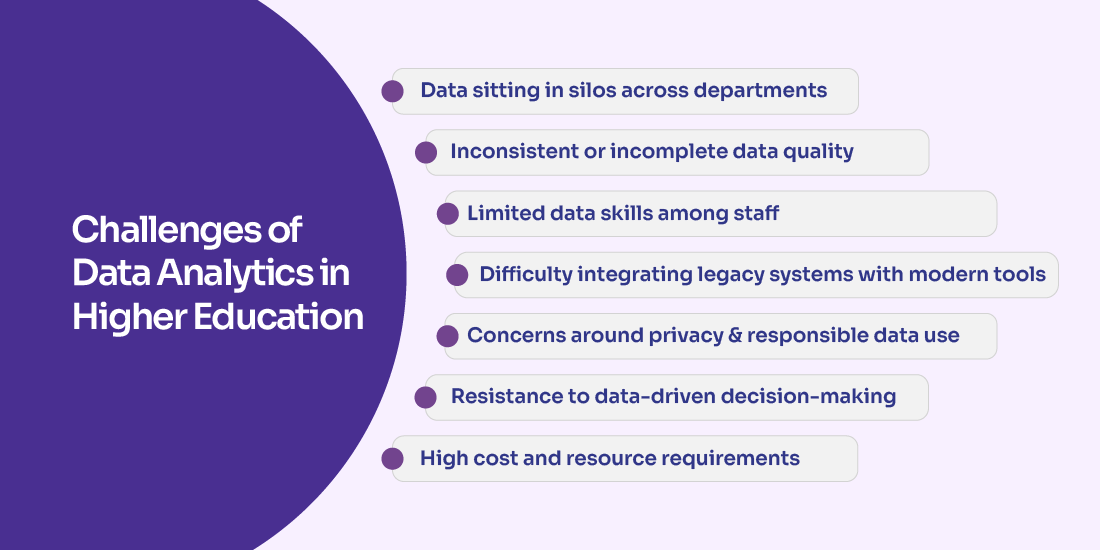
Data analytics has huge potential in higher education, but putting it into practice is often more complicated than it looks. Many universities are still working with disconnected systems, uneven data quality, and limited technical capacity, which makes it difficult to fully use the insights they generate. On top of that, concerns around privacy, cost, and institutional readiness often slow down adoption. As a result, even when data is available, turning it into meaningful, consistent action can be a real challenge.
Data sitting in silos across departments
In many universities, different teams manage their own systems. Admissions might have one dataset, academics another, and finance another. For example, an advisor may not immediately see that a student who is performing well academically is actually struggling with fee payments, simply because that data lives in a separate system.
Inconsistent or incomplete data quality
Analytics is only as good as the data behind it. But in reality, student records are often incomplete or updated at different times across systems. For instance, a course completion record might be updated in the LMS but not yet reflected in the central student database, leading to confusion or inaccurate reporting.
Limited data skills among staff
Even when dashboards are available, not everyone feels confident using them. For example, an administrator might see a retention dashboard showing at-risk students but may not be sure what action to take next, which limits the real impact of the insight.
Difficulty integrating legacy systems with modern tools
Many universities still rely on older systems that were not designed for today’s analytics needs. For example, connecting a decades-old student information system with a modern AI-driven analytics platform often requires significant time, cost, and technical effort.
Concerns around privacy and responsible data use
Student data is highly sensitive, and universities need to be extremely careful about how it is used. For instance, while predictive models can identify at-risk students, institutions must ensure that this information is handled ethically and does not lead to unintended bias or misuse.
Resistance to data-driven decision-making
In some cases, decisions are still driven more by experience than by data. For example, a faculty member might rely on past teaching experience rather than adjusting a course based on analytics showing students are struggling with a specific module.
High cost and resource requirements
Building a strong analytics ecosystem takes investment in tools, infrastructure, and skilled people. For example, smaller institutions may struggle to implement advanced analytics platforms while also managing day-to-day operational priorities.
Best Practices for Implementing Data Analytics in Universities
Bringing data analytics into universities goes beyond adding new tools or dashboards. It means building a culture where data guides decisions in admissions, academics, student services, and administration. When analytics is done right, it becomes part of daily work instead of just a reporting task. To get real value, universities should focus on strong foundations like data quality, integration, user adoption, and governance.
Start with clear, high-impact use cases
Rather than analyzing everything at once, universities should start with areas that have a direct impact. Many schools begin with enrollment funnel analysis or tracking student retention, since changes here can be measured right away and make a real difference.
Break down data silos early
Analytics works best when data from different departments is connected. For example, if admissions data is not linked to academic performance and financial aid, it is hard to see why a student might be at risk. Bringing systems together early helps build a full picture of each student.
Focus on data quality before advanced analytics
Clean, consistent data is more valuable than complex models built on poor inputs. For instance, if student records are duplicated or outdated across systems, even the best predictive model will produce unreliable insights.
Make insights easy to understand and use
Dashboards should not be overwhelming or overly technical. For example, instead of showing raw numbers alone, a retention dashboard should clearly highlight “students at risk this week” so advisors can take immediate action without needing data expertise.
Train staff to act on insights, not just view them
Adoption improves when people understand how to use data in their daily roles. For example, an academic advisor should not only see a risk score but also know what steps to take next, such as scheduling outreach or recommending support services.
Embed analytics into everyday workflow
Analytics should fit naturally into daily routines. For example, if faculty already use an LMS, adding performance insights right into that system lets them use data without having to switch to another platforms.
Prioritize data privacy and governance from the start
Universities need to make sure student data is handled responsibly. For example, access to sensitive predictive insights should depend on staff roles, so only the right people can see certain student information.
Continuously refine models and strategies
Analytics is not a one-time setup. For example, if a predictive model for student retention is not accurately identifying at-risk students, it should be regularly reviewed and adjusted based on real outcomes and feedback.
How EDMO Supports Data-Driven Higher Education Administration
As universities continue to embrace data-driven decision-making, they need systems that can not only collect information but also structure, process, and activate it in real time. EDMO supports this shift by bringing together AI-powered automation, intelligent document processing, and academic data standardization into a unified workflow. Instead of relying on manual effort and disconnected systems, institutions can streamline how student data flows across admissions and academic operations, enabling faster and more consistent decision-making.
EDMO’s suite of tools helps universities operationalize data at scale. Its AI-powered document extraction and intelligent OCR can instantly pull information from emails, transcripts, and application documents, while the GPA Calculator standardizes academic performance across different grading systems for fair evaluation. At the same time, admissions teams gain better visibility into enrollment data, reviewers can validate and adjust records within institutional rules, and workflows become significantly faster and more accurate. Together, these capabilities reduce processing time, improve data consistency, and empower institutions to make more informed, data-driven decisions across the student lifecycle.
Future of Data Analytics in Higher Education
Higher education is becoming increasingly data-driven, with decisions in admissions, academics, student support, and administration shaped by real-time insights and intelligent systems. As universities face greater complexity, evolving student expectations, and increased accountability, data analytics will become central to daily operations. The focus will move from understanding past events to actively influencing future outcomes.
From reporting to real-time decision-making
Universities will use continuously updated live dashboards instead of waiting for periodic reports. For example, admissions teams can monitor application drop-offs in real time and promptly adjust communication or support rather than responding after the cycle ends.
Stronger use of predictive and prescriptive analytics
Institutions will predict outcomes such as student dropout risk and receive actionable recommendations. For example, if a student is identified as at risk, systems may suggest targeted tutoring, financial support, or advisor outreach based on previous cases.
AI-driven automation of administrative workflows
Routine tasks such as document verification, transcript processing, and data entry will become fully automated. For example, instead of manually reviewing thousands of applications, AI systems will extract, structure, and validate data instantly, allowing staff to focus more on decision-making than processing.
Hyper-personalized student experiences at scale
Universities will use analytics to tailor the entire student journey. For example, two students in the same program may receive completely different support paths based on their engagement patterns, academic performance, and career interests.
Fully integrated data ecosystems across campus systems
Data from admissions, learning management systems, finance, and student services will become more unified. For example, if a student struggles academically and has pending fee issues, both signals will be visible in one place, enabling faster, coordinated intervention.
Ethical and responsible use of student data
As analytics becomes more powerful, universities will place greater emphasis on transparency, fairness, and privacy. For example, institutions will need clear guidelines on how predictive risk scores are used so that students are supported rather than unfairly labeled.
Outcome-focused institutional intelligence
The emphasis will shift from tracking inputs like enrollment numbers to outcomes such as graduation rates, employability, and long-term student success. For example, programs will increasingly be evaluated based on career outcomes rather than just admissions volume.
Conclusion
Data analytics is no longer a supporting function in higher education, it has become central to how universities operate, plan, and improve outcomes. From improving enrollment efficiency to strengthening student success and optimizing institutional resources, analytics enables leaders to make faster, smarter, and more evidence-based decisions. As universities continue to evolve, those that effectively embed data into everyday decision-making will be better positioned to deliver stronger student outcomes and long-term institutional growth.
Frequently Asked Questions
Ques 1 What is data analytics in higher education?
Ques 2 Why is data analytics important in higher education administration?
Ques 3 What are the benefits of data analytics in universities?
Ques 4 How do universities use predictive analytics?
Ques 5 How does analytics improve student retention?
Ques 6 What tools are used for higher education analytics?
Ques 7 What are the biggest challenges in university analytics?
Ques 8 How is AI transforming higher education analytics?
Written By




No comments yet. Be the first to comment!
Leave a Comment