
Table Of Contents
- 1Introduction
- 2What Is Unified Enrollment in Higher Education?
- 3Why Are Universities Moving Toward Unified Enrollment?
- 4What Are the Key Components of a Unified Enrollment System?
- 5How Does a Unified Enrollment System Work?
- 6How to Build a Unified Enrollment System in Higher Education
- 7What Are the Benefits of Unified Enrollment for Universities?
- 8How AI and System Integrations Enable Unified Enrollment
- 9What KPIs Should Universities Track to Measure Unified Enrollment Success?
- 10Conclusion
Introduction
Imagine a prospective student who has submitted an application, uploaded the required transcripts, and contacted the admissions office for an update. The admissions counselor checks the CRM, but the transcript status hasn’t been updated. The registrar’s office has already received the document, but the admissions team hasn’t received that information. Meanwhile, the student continues receiving automated reminders to submit the same transcript.
This is what happens when enrollment systems operate in silos.
For universities managing thousands of applicants, disconnected CRM platforms, Student Information Systems (SIS), document management tools, and communication channels can create significant operational challenges. Admissions teams spend valuable time switching between platforms, manually updating records, and coordinating with other departments. Without a shared view of student information, institutions risk delayed admissions decisions, inconsistent communication, and losing prospective students along the way.
Unified enrollment management offers a way to connect these fragmented processes. By bringing student data, enrollment workflows, and institutional systems together, universities can create a more coordinated admissions experience without necessarily replacing their existing technology.
In this guide, we explore what unified enrollment means in higher education, how a connected enrollment system works, and how universities can build one to improve operational efficiency and the student experience.
What Is Unified Enrollment in Higher Education?
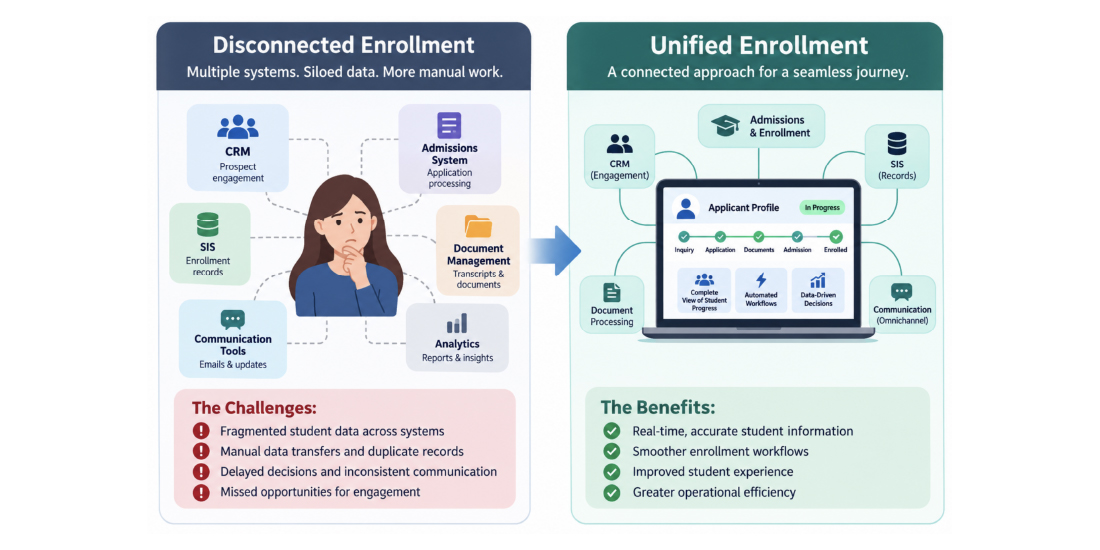
Unified enrollment in higher education is an approach to managing the entire student enrollment journey through connected institutional systems, shared student data, and coordinated workflows. It brings together admissions, recruitment, student communication, application processing, and enrollment operations so that departments can access consistent, up-to-date information about prospective students.
In a traditional enrollment environment, universities often rely on separate platforms for different activities. A CRM manages prospective student interactions, an admissions system processes applications, a Student Information System (SIS) maintains academic and enrollment records, and other tools handle document verification and student communication. When these systems are not integrated, information must be transferred manually, creating delays, duplicate records, and gaps in visibility.
A unified enrollment system connects these platforms so that information can move between them as students progress through the enrollment process. For example, when an applicant submits a missing transcript, the document status can be updated in the admissions system and made available to the counselor through the CRM. This allows the counselor to follow up on the next requirement instead of requesting a document that has already been received.
Importantly, unified enrollment does not require universities to replace their existing CRM, SIS, or admissions platforms with a single solution. Institutions can build a connected enrollment ecosystem by integrating their current systems, automating data exchange, and establishing consistent workflows across departments.
The goal is to provide enrollment teams with a reliable view of each applicant’s progress while creating a smoother, more coordinated experience for students.
Why Are Universities Moving Toward Unified Enrollment?
Universities are investing in enrollment technologies to manage growing operational demands, but adding more platforms does not always translate into better coordination. When systems operate independently, enrollment teams often face challenges that affect both administrative efficiency and the student experience.
Here are some of the key reasons universities are moving toward a unified enrollment approach.
Fragmented Student Data Across Multiple Systems
Student information is often distributed across CRM platforms, Student Information Systems (SIS), application portals, and document management tools. Each system may contain different information about the same applicant, making it difficult for enrollment teams to establish a complete and accurate student profile.
For example, an admissions counselor may see an incomplete application in the CRM even though the missing documents have already been processed in another system. Without reliable data synchronization, staff must manually reconcile records before taking action.
Disconnected Admissions and Enrollment Workflows
The enrollment journey involves multiple departments, including recruitment, admissions, financial aid, and the registrar’s office. When their systems are not connected, tasks that should trigger the next step in the process may require manual intervention.
An admission decision recorded in one platform, for instance, may not automatically update the student’s enrollment status or initiate the next set of requirements. These gaps can delay application processing and create unnecessary administrative work.
Inconsistent Student Communication Across Channels
Prospective students interact with universities through websites, emails, SMS, phone calls, and application portals. When these communication channels operate independently, admissions teams may lack visibility into previous conversations and student inquiries.
As a result, applicants may receive duplicate reminders, conflicting information, or follow-ups that do not reflect their current application status. A unified enrollment approach helps institutions coordinate communication using consistent student information across channels.
Manual Data Entry and Repetitive Administrative Tasks
Disconnected systems often require staff to transfer applicant information, update document statuses, and reconcile records manually. These repetitive activities consume time that admissions teams could otherwise spend engaging prospective students and resolving complex application issues.
Manual processes also increase the likelihood of duplicate records, data entry errors, and outdated information. Connecting institutional systems can reduce these tasks by enabling automated data exchange and workflow updates.
Limited Visibility into Enrollment Performance
Enrollment leaders need reliable data to monitor application volumes, conversion rates, admission decisions, and enrollment yield. However, when information is spread across multiple platforms, generating a comprehensive enrollment report can require significant manual consolidation.
Disconnected reporting can also make it difficult to identify where applicants are dropping out of the enrollment funnel or which recruitment activities are contributing to enrollment outcomes.
By connecting data across the enrollment lifecycle, universities can improve reporting consistency and make more informed decisions about recruitment, admissions operations, and enrollment planning.
What Are the Key Components of a Unified Enrollment System?
A unified enrollment system brings together the technologies, data, and workflows universities use throughout the student enrollment journey. Solutions such as EDMO’s System Intelligence help institutions connect existing platforms, including CRM, Student Information Systems (SIS), and other enrollment technologies, enabling data to flow between systems without requiring universities to replace their current infrastructure.
However, system integration alone is not enough. Building a unified enrollment ecosystem also requires centralized access to student information, coordinated communication, automated workflows, enrollment analytics, and secure data management.
Here are the seven key components of a unified enrollment system in higher education.
Centralized Student Data and Unified Applicant Profiles
A unified enrollment system should provide admissions teams with a consolidated view of each prospective student’s information, including contact details, inquiry history, application status, submitted documents, and enrollment progress.
This does not necessarily mean storing all student information in one database. Instead, connected systems can exchange relevant information to maintain a consistent applicant profile across departments.
For example, an admissions counselor should be able to view a student’s latest application status, outstanding requirements, and previous interactions without switching between multiple platforms.
CRM and Student Information System (SIS) Integration
CRM and SIS integration is a critical component of unified enrollment. While CRM platforms such as Salesforce Education Cloud and Slate help institutions manage recruitment and admissions activities, SIS platforms such as Ellucian Banner, PeopleSoft, and Workday Student maintain academic, enrollment, and student records.
Connecting these systems enables institutions to synchronize relevant student information, application updates, admission decisions, and enrollment statuses.
For instance, when an admitted applicant confirms enrollment, the appropriate information can be transferred to the SIS without requiring admissions staff to manually re-enter the student’s details.
Connected Admissions and Document Management
Universities process large volumes of academic transcripts, recommendation letters, identification documents, and other application materials. A connected document management system helps admissions teams receive, classify, review, and associate these documents with the correct applicant records.
Integrating document processing with CRM and admissions platforms allows document statuses and review outcomes to be reflected in the enrollment workflow.
For example, when a transcript is received and processed, the applicant’s checklist can be updated automatically, allowing the admissions team to proceed with the next review stage.
Omnichannel Student Communication and Engagement
A unified enrollment system should connect student communication across email, SMS, voice, web chat, and other supported channels.This allows admissions teams to access relevant conversation history and provide responses based on the student’s current enrollment status.
For instance, a student who has already submitted an application should receive information about outstanding requirements or next steps rather than generic reminders to apply. Coordinated communication also supports timely follow-ups and reduces the likelihood of duplicate or conflicting messages.
Automated Enrollment Workflows
Workflow automation connects activities across different stages of the enrollment journey. Universities can configure automated actions based on student behavior, application milestones, and changes in enrollment status.
These workflows may include assigning new inquiries to admissions counselors, sending reminders for missing documents, initiating application reviews, updating student records, or triggering enrollment confirmation communications.
By reducing repetitive administrative tasks, automation allows enrollment teams to focus on activities that require human judgment and personalized student support.
Enrollment Analytics and Reporting
A unified enrollment system should provide visibility into enrollment performance across recruitment, admissions, and enrollment stages.
By combining relevant data from connected systems, universities can monitor metrics such as inquiry-to-application conversion, application completion rates, processing times, admission yield, and enrollment trends.
Enrollment leaders can use these insights to identify bottlenecks, evaluate recruitment effectiveness, and make more informed decisions about resource allocation and enrollment planning.
Data Governance, Security, and Access Controls
Connecting multiple institutional systems requires clear policies governing how student information is accessed, shared, and maintained.
Universities should establish data ownership, role-based permissions, secure integrations, audit trails, and procedures for maintaining data accuracy across platforms.
For U.S. institutions, enrollment data management must also account for applicable FERPA requirements, particularly when student education records are shared between departments or third-party technology providers.
Strong data governance helps ensure that information remains reliable and accessible to authorized users without compromising student privacy.
Together, these components enable universities to create a connected enrollment environment where student information, communication, and operational workflows remain coordinated throughout the enrollment lifecycle.
How Does a Unified Enrollment System Work?
A unified enrollment system connects every stage of the student journey, from the first inquiry to enrollment confirmation and onboarding. By integrating CRM, Student Information Systems (SIS), document management platforms, and communication tools, universities can automate workflows and maintain consistent student information across departments.
Solutions such as EDMO bring together Conversation Intelligence, Document Intelligence, and System Intelligence to support these connected workflows. Here’s how unified enrollment works across six key stages.
Student Inquiry and Lead Capture
The enrollment journey begins when a prospective student expresses interest through a university website, recruitment campaign, event, phone call, or other communication channel.
A unified enrollment system captures these inquiries and creates or updates student profiles in the institution’s CRM. Admissions teams can then access the student’s contact information, program interests, and inquiry history without manually transferring data between platforms.
For example, EDMO’s Student Copilot can engage prospective students, answer questions about programs and admission requirements, and capture relevant inquiry information. Through EDMO’s System Intelligence integrations, this information can be synchronized with platforms such as Salesforce Education Cloud or Slate, depending on the institution’s configuration.
Lead Qualification and Nurturing
Once an inquiry is captured, the next step is identifying prospective students who are likely to apply and keeping them engaged throughout the admissions process.
A connected enrollment system uses student interests, engagement history, and application progress to coordinate personalized follow-ups across communication channels.
EDMO’s AI Lead Nurture supports this process through automated lead management, qualification, and personalized outreach across email, SMS, and voice. Meanwhile, Advisor Copilot helps admissions counselors prioritize prospective students, access conversation summaries, and identify appropriate follow-up actions.
As student interactions are recorded in connected CRM systems, counselors can continue conversations with relevant context rather than starting from scratch.
Application Submission and Document Processing
When students submit their applications, universities must collect and review transcripts, recommendation letters, identification documents, and other required materials.
In a unified enrollment system, submitted documents are associated with the appropriate applicant records, and their processing status can be shared across connected platforms.
EDMO’s Document Intelligence supports this stage through tools such as the Email Doc Extractor, GPA Calculator, ID Verification, and Transfer Credit Evaluator. These tools help extract information from academic records, calculate GPAs, verify applicant identities, and assess transferable credits.
For example, when a transcript is received, EDMO’s document processing capabilities can extract relevant academic information and return the results to the connected admissions platform for review. This reduces manual data entry and helps admissions teams move applications through the review process.
Application Review and Admission Decisions
Once the required documents are available, admissions teams evaluate applicants against institutional admission criteria. This may involve reviewing academic performance, personal statements, recommendation letters, transfer credits, and program-specific requirements.
A unified enrollment system makes relevant application information available within the review workflow, reducing the need to retrieve records from multiple platforms.
EDMO’s Application Evaluator supports admissions reviewers by analyzing application materials against institution-defined rubrics and generating structured evaluations. Its GPA Calculator and Transfer Credit Evaluator can provide additional academic insights to support eligibility assessments.
Authorized admissions officers remain responsible for reviewing the findings and making final decisions. Once a decision is recorded, connected systems can update the applicant’s status and initiate the appropriate communication workflows.
Enrollment Confirmation and SIS Synchronization
After receiving an admission offer, students must complete enrollment requirements such as accepting the offer, submitting outstanding documents, and confirming their intent to enroll.
A unified enrollment system connects these activities with the institution’s CRM and SIS, helping departments maintain accurate enrollment records.
EDMO’s System Intelligence supports data exchange between institutional platforms such as Salesforce, Slate, Ellucian Banner, PeopleSoft, and Workday Student. Depending on the integration and institutional workflows, relevant applicant information and enrollment status updates can be synchronized across systems.
At the same time, Student Copilot can help admitted students understand outstanding requirements and upcoming deadlines, while Advisor Copilot can assist counselors in identifying students who need additional support.
Student Onboarding and Transition
The enrollment journey continues after a student accepts an admission offer. Universities must coordinate orientation, advising, account activation, and other onboarding activities to help students transition successfully.
A connected enrollment system allows relevant student information and completed enrollment requirements to be made available to authorized departments and onboarding platforms.
Through EDMO’s System Intelligence, universities can connect enrollment data with supported SIS and learning management systems. Student Copilot can continue answering questions about onboarding requirements, while Advisor Copilot can help staff review student information and prepare follow-up communications where these workflows are configured.
This continuity helps institutions reduce repeated information requests and maintain a consistent student experience as applicants become enrolled students.
Ultimately, unified enrollment is not about introducing another standalone platform. It is about ensuring that student information, admissions activities, and communication remain connected throughout the enrollment lifecycle. By combining system integrations with AI-powered engagement and document processing, universities can reduce manual handoffs and build a more coordinated enrollment experience.
How to Build a Unified Enrollment System in Higher Education
Building a unified enrollment system does not necessarily require universities to replace their existing technology infrastructure. Instead, institutions can connect their CRM, Student Information System (SIS), admissions platforms, and communication tools to create coordinated workflows across the enrollment journey.
However, successful implementation requires more than connecting software. Universities must align their enrollment processes, establish consistent data standards, and ensure that different departments can access accurate information when needed.
Here are eight steps to building a unified enrollment system.
Audit Existing Enrollment Systems and Identify Data Silos
Start by evaluating the platforms used across recruitment, admissions, financial aid, registrar operations, and student onboarding. Identify where student information is stored, how it moves between systems, and which activities require manual intervention.
For example, an institution may use Salesforce for recruitment, Slate for admissions, and Ellucian Banner for student records. Mapping these systems can reveal duplicate data entry, delayed updates, and disconnected workflows that need attention.
Map the Complete Student Enrollment Journey
Document every stage of the student journey, from initial inquiry and application submission to admission decisions, enrollment confirmation, and onboarding.
Identify the departments, technologies, and data involved at each stage. Pay particular attention to handoffs where student information must move between teams.
This helps institutions determine which processes should be connected and where automation can reduce delays.
Establish a Unified Student Data Framework
Define how student information will be organized, maintained, and shared across institutional platforms. Universities should establish consistent data fields, unique student identifiers, record-matching rules, and clear ownership of information. They should also determine which system serves as the authoritative source for each type of data.
For example, the CRM may manage prospect engagement history, while the SIS maintains official enrollment records. A unified data framework ensures that relevant information remains consistent without unnecessary duplication.
Integrate CRM, SIS, and Admissions Platforms
Once the data framework is established, connect the systems responsible for recruitment, application processing, enrollment records, and student communication.
Universities can use APIs, integration platforms, or purpose-built solutions such as EDMO’s System Intelligence to enable data exchange between existing technologies.
For example, institutions using Salesforce Education Cloud, Slate, Ellucian Banner, PeopleSoft, or Workday Student can configure integrations to synchronize relevant student information and enrollment updates.
Prioritize integrations that eliminate high-volume manual tasks and improve visibility across departments.
Automate Repetitive Enrollment Workflows
Identify administrative activities that follow predictable rules and can be automated without removing necessary human oversight.
Common opportunities include lead assignment, application status updates, missing-document reminders, transcript processing, and enrollment confirmation communications.
Tools such as EDMO’s Document Intelligence can support automated extraction and processing of application materials, while AI Lead Nurture can coordinate prospective student follow-ups.
Start with a limited set of workflows, measure their effectiveness, and expand automation gradually.
Introduce AI-Powered Student Engagement and Decision Support
Once student data and enrollment workflows are connected, universities can introduce AI capabilities to improve responsiveness and support admissions staff.
For example, AI-powered student assistants can answer routine questions, provide application updates, and guide applicants through outstanding requirements. Advisor-facing tools can summarize interactions, identify pending tasks, and suggest follow-up actions.
EDMO’s Student Copilot and Advisor Copilot support these activities by helping students and admissions counselors access relevant information and manage enrollment interactions.
AI responses and recommendations should remain grounded in authorized institutional data, with escalation procedures for complex or sensitive cases.
Establish Data Governance and Cross-Departmental Ownership
Define responsibilities for maintaining data accuracy, managing system access, and overseeing enrollment workflows.
Admissions, registrar, IT, financial aid, and other relevant departments should agree on data ownership, synchronization rules, security requirements, and procedures for resolving discrepancies.
Universities should also implement role-based access controls, audit trails, and appropriate safeguards for student education records under applicable FERPA requirements.
Clear governance prevents connected systems from creating new inconsistencies or exposing information to unauthorized users.
Monitor Performance and Continuously Improve
After implementation, evaluate whether the unified enrollment system is improving institutional operations and the student experience.
Track metrics such as application processing time, inquiry response time, application completion rate, enrollment yield, manual intervention rates, and data synchronization errors.
Regularly review these results with enrollment and IT teams to identify bottlenecks, refine workflows, and prioritize future integrations.
Building a unified enrollment system is an ongoing process. Institutions can begin by connecting their most critical systems and gradually expand toward a more coordinated, data-driven enrollment environment.
What Are the Benefits of Unified Enrollment for Universities?
A unified enrollment system helps universities move beyond disconnected administrative processes toward a more coordinated, student-centered enrollment experience. By connecting institutional data, communication channels, and workflows, universities can improve operational efficiency while giving enrollment teams greater visibility and control over the admissions process.
Here are six key benefits of unified enrollment in higher education.
Improved Student Experience Across the Enrollment Journey
Prospective students expect timely responses, accurate information, and clear guidance throughout admissions. A unified enrollment system allows universities to provide consistent communication based on each student’s application status, interests, and previous interactions.
For example, a student who has already submitted a transcript can receive information about the next admission requirement instead of another reminder to upload the same document. This reduces confusion and helps applicants navigate the enrollment process more confidently.
Faster Application Processing and Admissions Decisions
When admissions platforms, document management systems, and student records are connected, application information can move between departments without unnecessary manual handoffs. Automated document processing, application status updates, and review workflows can help admissions teams identify completed applications sooner and reduce administrative delays. This allows admissions officers to spend more time evaluating applications and less time collecting information from multiple systems.
Better Collaboration Between Enrollment Departments
Recruitment, admissions, financial aid, and registrar teams often contribute to different stages of the enrollment journey. Unified enrollment gives authorized staff access to relevant student information and workflow updates across these departments. For instance, when an applicant accepts an admission offer, the registrar and onboarding teams can receive the information needed to initiate their respective processes. This improves coordination, reduces repeated requests for information, and helps departments work toward shared enrollment goals.
Improved Lead-to-Enrollment Conversion Opportunities
Disconnected communication and delayed follow-ups can cause prospective students to lose interest or abandon their applications. A unified enrollment system helps universities identify applicants who need assistance, coordinate timely outreach, and personalize communication based on enrollment activity. For example, admissions counselors can prioritize students with incomplete applications, while automated reminders can encourage applicants to complete outstanding requirements. These capabilities create opportunities to improve application completion and enrollment yield, although actual results depend on institutional processes and implementation.
Reduced Administrative Workload and Operational Costs
Manual data entry, duplicate record management, and repetitive document reviews consume significant staff time. By connecting systems and automating routine activities, universities can reduce the effort required to maintain applicant records, process documents, and coordinate enrollment tasks. This allows admissions teams to allocate more time to personalized student engagement, complex application reviews, and other activities requiring human judgment.
More Accurate Enrollment Forecasting and Decision-Making
Enrollment leaders rely on accurate information to forecast incoming classes, evaluate recruitment performance, and allocate institutional resources. A unified enrollment system brings together relevant data from recruitment, admissions, and enrollment platforms, making it easier to monitor application volumes, conversion rates, admission yield, and enrollment trends. With more consistent reporting, institutions can identify potential enrollment gaps earlier, evaluate the effectiveness of recruitment initiatives, and make informed adjustments to their enrollment strategies. Ultimately, the value of unified enrollment extends beyond technology integration. It helps universities improve the way departments collaborate, how enrollment decisions are made, and how prospective students experience the admissions journey.
How AI and System Integrations Enable Unified Enrollment
Connecting institutional systems creates the foundation for unified enrollment, but AI helps universities make better use of the information flowing between them. While system integrations enable data exchange, AI can analyze student information, automate routine activities, and support timely engagement throughout the enrollment journey.
For example, EDMO combines System Intelligence, Conversation Intelligence, and Document Intelligence to connect existing university technologies with AI-powered enrollment workflows. This allows institutions to introduce automation and intelligent assistance without necessarily replacing their CRM, Student Information System (SIS), or admissions platforms.
AI-Powered Lead Management and Student Nurturing
A connected enrollment system can use student engagement history, program interests, and application activity to support personalized outreach.
EDMO’s Virtual Enrollment Copilot helps universities manage prospective student inquiries, qualify leads, and automate follow-up communication. By connecting these activities with institutional CRM data, admissions teams can identify students requiring attention and coordinate outreach across supported channels.
This helps institutions maintain consistent engagement from initial inquiry through application submission.
Automated Application and Document Processing
Admissions teams often spend considerable time reviewing transcripts, calculating GPAs, evaluating transfer credits, and organizing application materials.
EDMO’s Document Intelligence suite supports these activities through tools such as the GPA Calculator, Transfer Credit Evaluator, Email Doc Extractor, and Application Evaluator.
These tools extract and structure information from submitted documents, apply institution-defined evaluation rules, and return relevant results to connected admissions workflows. Human reviewers can examine flagged cases and make final decisions where required.
AI-Powered Student and Advisor Support
Students frequently contact universities for information about application requirements, document statuses, deadlines, and next steps. EDMO’s Student Copilot Web and Voice can answer routine questions using authorized institutional information and escalate conversations to admissions counselors when needed. Meanwhile, Advisor Copilot helps enrollment staff review student records, summarize interactions, identify missing requirements, and prepare follow-up communications. Together, these capabilities support more consistent student engagement while reducing repetitive work for admissions teams.
Connecting Existing Systems Through System Intelligence
AI-powered enrollment tools are most effective when they can access accurate information from the systems universities already use. EDMO’s System Intelligence serves as an integration layer connecting supported institutional platforms, including Salesforce Education Cloud, Slate, Ellucian Banner, PeopleSoft, Workday Student, and learning management systems. Depending on the integration, institutions can configure data synchronization and automated workflows to keep relevant student records, document statuses, and enrollment information aligned across platforms. For example, when a transcript is processed through Document Intelligence, the extracted information and review status can be delivered to the connected admissions platform. Advisor Copilot can then use available student information to help counselors identify the next appropriate action.
By combining AI capabilities with connected institutional systems, universities can move from isolated automation toward coordinated enrollment operations. The objective is not simply to introduce more technology, but to ensure that existing platforms and AI tools work together to support students and enrollment teams.
What KPIs Should Universities Track to Measure Unified Enrollment Success?
Implementing a unified enrollment system is only the first step. Universities must also measure whether connected systems and automated workflows are improving enrollment outcomes, administrative efficiency, and the student experience.
Tracking the right key performance indicators (KPIs) helps enrollment leaders identify bottlenecks, evaluate system performance, and make data-driven improvements.
Here are six important KPIs universities should monitor.
Inquiry-to-Application Conversion Rate
This metric measures the percentage of prospective students who submit an application after expressing interest in the institution.
Formula: (Number of applicants ÷ Number of inquiries) × 100
A unified enrollment system helps universities track prospective students across recruitment channels, monitor engagement, and identify where students disengage before applying.
Application Completion Rate
Application completion rate measures the percentage of started applications that are successfully submitted with the required information.
Formula: (Completed applications ÷ Started applications) × 100
Universities can use this metric to evaluate whether automated reminders, document processing, and coordinated communication are helping students complete their applications.
Enrollment Yield Rate
Enrollment yield measures the percentage of admitted students who ultimately enroll at the institution.
Formula: (Enrolled students ÷ Admitted students) × 100
By tracking admission decisions, student engagement, and enrollment confirmations across connected systems, universities can identify where admitted students need additional support.
Average Application Processing Time
This KPI measures the time required to process an application, from submission to an admission decision.
Universities can monitor processing time by program, application type, or document requirement to identify operational delays.
A reduction in processing time may indicate that system integrations, automated document processing, and coordinated review workflows are improving efficiency.
Student Inquiry Response Time
Student inquiry response time measures how quickly prospective students receive an initial response after contacting the university.
Institutions should monitor response times across email, web chat, SMS, and phone, distinguishing automated acknowledgments from substantive responses where appropriate.
This helps enrollment teams assess whether AI-powered communication and counselor workflows are improving responsiveness.
Manual Processing and Data Synchronization Rates
Unified enrollment should reduce repetitive administrative work while improving the consistency of information across institutional platforms.
Universities can measure the percentage of enrollment tasks requiring manual intervention, the number of duplicate student records, and the frequency of data synchronization errors.
For example, tracking how many transcripts require manual data entry or how often CRM and SIS records need reconciliation can help institutions evaluate the effectiveness of their integrations and automation.
To measure unified enrollment success accurately, universities should establish baseline performance before implementation and review these KPIs regularly. Comparing results over time helps institutions determine which improvements are working and where additional workflow optimization is needed.
Conclusion
Unified enrollment helps universities bring disconnected systems, student information, and admissions workflows into a more coordinated enrollment process. By integrating CRM platforms, Student Information Systems (SIS), document management tools, and communication channels, institutions can reduce administrative complexity and provide a more consistent experience for prospective students.
However, building a unified enrollment ecosystem is not simply about connecting technologies. It also requires universities to establish reliable data practices, automate repetitive tasks, and ensure that enrollment teams have access to accurate information throughout the student journey.
EDMO helps universities move toward unified enrollment through its System Intelligence, Conversation Intelligence, and Document Intelligence capabilities. By connecting existing institutional platforms and introducing AI-powered student engagement, document processing, and advisor support, EDMO enables universities to modernize enrollment operations without necessarily replacing their current systems.
For institutions looking to improve enrollment efficiency and student engagement, the next step is to identify disconnected workflows, prioritize critical integrations, and gradually build a more connected, data-driven enrollment environment.
Frequently Asked Questions
Ques 1. What is a unified enrollment management system?
Ques 2. What is the difference between unified enrollment and traditional enrollment management?
Ques 3. How does unified enrollment improve student enrollment?
Ques 4. Can universities implement unified enrollment without replacing their existing CRM or SIS?
Ques 5. What role does AI play in unified enrollment management?
Ques 6. How can universities integrate admissions and student information systems?
Written By






No comments yet. Be the first to comment!
Leave a Comment