

Table Of Contents
- 1Introduction
- 2Who Are Multilingual Students in Higher Education?
- 3Types of Multilingual Students in U.S. Higher Education
- 4Using AI Tools to Support Multilingual Learners in Higher Education
- 5Key AI Tools and Applications for Multilingual Student Support
- 6Choosing the Right AI Tools for Multilingual Student Support
- 7Benefits and Limitations of AI for Multilingual Student Support
- 8Conclusion
Introduction
The United States continues to attract students from across the world, making multilingual communication an increasingly important part of higher education. According to the Open Doors 2025 Report by the Institute of International Education (IIE), 1,177,766 international students studied at U.S. colleges and universities during the 2024–25 academic year, accounting for approximately 6% of the country’s higher education population.
With students arriving from different countries and linguistic backgrounds, universities face a growing need to provide accessible and consistent support across multiple languages. For international students and non-native English speakers, understanding admission requirements, application deadlines, financial aid, visa-related procedures, and enrollment instructions can be challenging when information is primarily available in English.
At the same time, admissions and student support teams may struggle to respond to inquiries in multiple languages, particularly outside regular office hours. Hiring multilingual staff for every language represented in the student population is not always practical, especially for institutions managing thousands of student interactions.
AI-powered multilingual student support offers universities a scalable way to bridge these communication gaps. Through multilingual AI chatbots, voice assistants, and automated communication tools, institutions can help students access information, ask questions, and receive guidance in their preferred languages without relying entirely on human translation or language-specific support teams.
In this guide, we’ll explore how AI improves multilingual student support in higher education, its key applications and benefits, and how universities can implement AI-powered communication while maintaining accuracy, accessibility, and human oversight.
Who Are Multilingual Students in Higher Education?
Multilingual students are individuals who speak, understand, or use more than one language in their academic, personal, or professional lives. In higher education, this includes students who have learned English as an additional language, students who grew up in multilingual households, and students who use different languages for everyday communication and academic activities.
In the United States, multilingual students are not limited to international applicants. They also include domestic students from immigrant families, bilingual communities, and households where English is not the primary language.
For universities, understanding these different student populations is important because their communication needs vary. Some students may be comfortable studying in English but prefer their native language when discussing complex admission requirements, financial matters, or enrollment procedures.
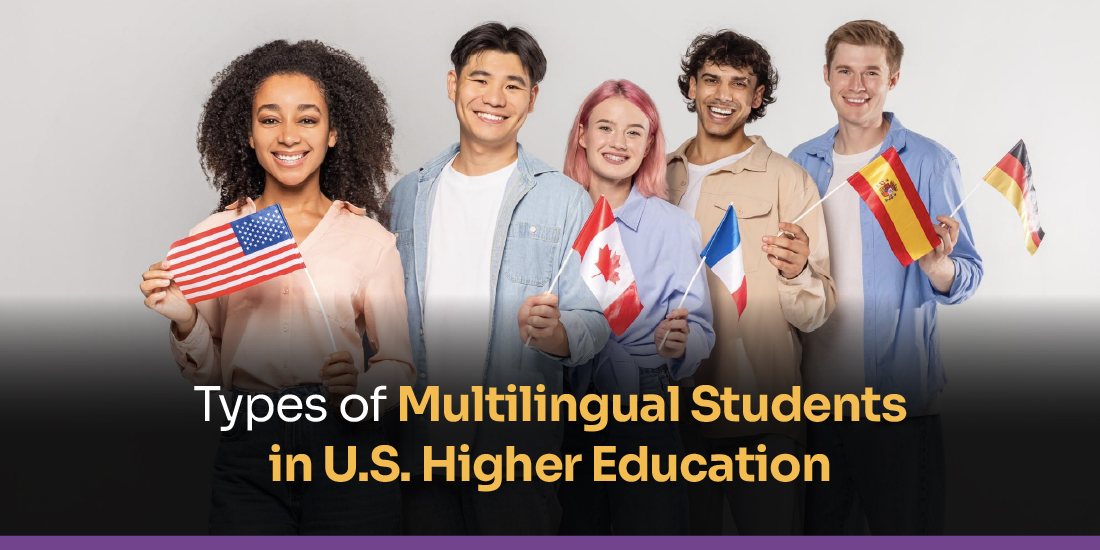
Types of Multilingual Students in U.S. Higher Education
International Degree-Seeking Students
These are students who travel to the United States to pursue undergraduate, graduate, or doctoral degrees. Many come from countries where English is not the primary language, including China, India, South Korea, Vietnam, and Brazil.
Although students may meet university English-language proficiency requirements, they can still benefit from multilingual assistance when navigating unfamiliar administrative processes, academic terminology, or enrollment requirements.
International Exchange and Short-Term Students
Exchange students, visiting students, and participants in short-term academic programs may study at U.S. institutions for a semester, academic year, or shorter period.
Because they have limited time to become familiar with university procedures, accessible multilingual guidance can help them understand course registration, housing, orientation, and campus services.
English as a Second Language (ESL) and Pathway Program Students
Some students enter the U.S. higher education system through English-language training, intensive English programs, or academic pathway programs designed to prepare them for degree-level study.
These students may need additional language support while learning about university admission criteria, academic expectations, and the transition into undergraduate or graduate programs.
Immigrant and First-Generation Students
Students from immigrant families may grow up speaking one language at home and English at school. Some are first-generation college students who must navigate university processes without extensive family experience of U.S. higher education.
Multilingual support can be particularly helpful when communicating with families about application requirements, tuition, financial aid, and enrollment deadlines.
Heritage Language Speakers and Bilingual Domestic Students
Many U.S.-born students grow up in bilingual or multilingual households, speaking languages such as Spanish, Chinese, Vietnamese, Arabic, or Korean alongside English.
While these students may be fluent in academic English, providing information in additional languages can improve accessibility for family members involved in important educational decisions.
These categories can overlap. A first-generation student may also be bilingual, while an international student may speak several languages fluently. Universities should therefore offer language preferences and accessible support options rather than assuming students’ needs based on nationality or background.
Using AI Tools to Support Multilingual Learners in Higher Education
Supporting multilingual learners requires more than translating university websites or admission materials into different languages. Students need to understand academic requirements, communicate with university staff, complete enrollment procedures, and access support services throughout their educational journey.
AI-powered tools can help universities address these needs by providing multilingual communication, personalized guidance, and faster access to institutional information. When integrated with existing university systems, these tools can support students in their preferred languages while reducing repetitive administrative work for admissions and student support teams.
Here are six ways universities can use AI tools to support multilingual learners.
Multilingual AI Chatbots for Student Inquiries
AI-powered chatbots allow students to ask questions and receive responses in supported languages without waiting for a multilingual staff member.
For example, a student from Brazil may ask about application requirements in Portuguese, while a student from South Korea may prefer Korean when discussing transcript submission or enrollment deadlines.
EDMO’s Student Copilot helps universities provide AI-powered student assistance through website chat. With multilingual capabilities configured, students can access institution-specific information about admission requirements, application procedures, and next steps.
This makes student support more accessible while allowing admissions teams to focus on inquiries requiring human assistance.
AI Voice Assistants for Multilingual Phone Support
Phone conversations can be challenging for students who are less comfortable discussing complex university procedures in English. Language barriers may lead to misunderstandings, repeated calls, or incomplete information.
Multilingual AI voice assistants can help students communicate verbally in supported languages, ask questions, and receive guidance without navigating complicated phone menus.
For example, an international applicant calling about missing documents could receive an explanation of the requirements in their preferred language.
EDMO’s Student Copilot supports AI-powered phone interactions and can transfer conversations to human advisors when students request assistance or the inquiry falls outside the AI’s supported knowledge.
AI-Powered Translation of Enrollment Communications
Universities regularly send emails, application instructions, deadline reminders, and enrollment updates to prospective students.
AI translation tools can help institutions adapt these communications into multiple languages, making important information easier to understand.
For example, an admitted student may receive an enrollment checklist in their preferred language, helping them understand which documents to submit and which deadlines to follow.
Universities should establish translation review procedures for sensitive communications, particularly those involving immigration, financial aid, legal obligations, or official admission decisions.
Personalized Multilingual Student Engagement
Multilingual students may have different communication preferences depending on their language proficiency, program interests, and stage in the enrollment journey.
AI-powered engagement tools can help universities personalize outreach using available student information and communication preferences.
For example, a prospective student who begins an application but does not complete it may receive a reminder explaining the next steps in their selected language.
EDMO’s AI Lead Nurture supports automated lead management and personalized follow-up workflows. When combined with institution-approved multilingual content and connected CRM data, these workflows can help universities coordinate relevant outreach across supported communication channels.
AI-Assisted Academic and Administrative Guidance
Multilingual learners may understand conversational English but find university terminology difficult, especially when navigating transfer credits, academic policies, registration requirements, or financial procedures.
AI-powered assistants can explain complex information in simpler language, provide step-by-step instructions, and help students locate relevant institutional resources.
For example, a transfer student may ask what a course equivalency means or how transferred credits will appear in their academic record.
AI tools can explain the general process using institution-approved information, while referring students to academic advisors or registrar staff for decisions specific to their records.
AI-Powered Language Support for Learning and Accessibility
Beyond admissions and enrollment, AI tools can support multilingual students in their academic activities.
AI-powered captioning, transcription, translation, and writing assistance can help students understand lectures, review course materials, and communicate more confidently.
For example, a multilingual student may use AI-generated lecture transcripts to revisit unfamiliar terminology or use language assistance tools to improve the clarity of an academic draft.
However, universities should establish clear policies governing AI use in coursework, academic integrity, accessibility, and student data privacy.
Why Human Oversight Still Matters
Although AI can improve multilingual student support, universities should not rely on automated responses for every situation. Translation errors, cultural differences, and inaccurate interpretations can affect how students understand important institutional information.
Institutions should regularly evaluate AI responses across supported languages, maintain updated knowledge sources, and provide clear escalation paths to qualified staff.
The goal is not to replace multilingual student support teams, but to make accurate information and assistance more accessible. By combining AI-powered communication with human expertise, universities can create a more inclusive and responsive support experience for students from diverse linguistic backgrounds.
Key AI Tools and Applications for Multilingual Student Support
Universities can use different AI technologies to support multilingual students across admissions, enrollment, academic learning, and campus services. While some tools focus on translating information, others help students communicate with university staff, understand complex requirements, or access personalized assistance.
Choosing the right tools depends on the institution’s student population, language requirements, existing technology infrastructure, and support needs.
AI Translation and Language Assistance Tools
AI-powered translation tools help universities make written information accessible in multiple languages. They can translate admission instructions, orientation materials, student communications, and general university information.
Tools such as Google Translate, DeepL, and Microsoft Translator can support multilingual communication, while generative AI tools can help simplify complex academic language and explain unfamiliar terminology.
For example, an international student reviewing an enrollment checklist may use AI translation to understand the required documents and submission deadlines.
Universities should use approved tools and review translations of official or sensitive information before sharing them with students.
Multilingual AI Chatbots and Virtual Assistants
Multilingual AI chatbots provide conversational support by allowing students to ask questions in their preferred languages and receive responses based on university-approved information.
These assistants can support common inquiries related to admission eligibility, application requirements, tuition, deadlines, and campus services.
EDMO’s Student Copilot Web is an example of an AI-powered student assistant that universities can integrate into their websites and enrollment workflows. With supported language capabilities and appropriate configuration, it can help institutions provide multilingual guidance and direct students to human advisors when necessary.
Unlike standalone translation tools, institution-connected chatbots can use relevant university knowledge to provide context-specific responses.
AI Speech Recognition and Voice Translation Tools
AI-powered speech recognition converts spoken language into text, while speech translation technologies help people communicate across language barriers.
Technologies such as Microsoft Azure AI Speech and Google Cloud Speech-to-Text can support multilingual voice applications, including transcription and speech-based assistance.
For universities, these capabilities can help students communicate through phone support systems or access spoken information in supported languages.
EDMO’s Student Copilot Voice provides AI-powered phone assistance for student inquiries. Where multilingual speech capabilities are supported and configured, voice-based workflows can help students receive guidance and connect with human advisors when required.
AI Writing and Communication Assistants
AI writing assistants help multilingual students improve the clarity, grammar, and structure of written communication.
Tools such as Grammarly, ChatGPT, and Microsoft Copilot can help students understand unfamiliar expressions, draft emails to university departments, and refine academic writing.
For example, a student may use an AI writing assistant to draft an email requesting clarification about an admission requirement.
These tools can also help university staff prepare clearer, more accessible communications for students with different levels of English proficiency.
Institutions should provide guidance on appropriate AI use, especially for graded assignments and communications containing sensitive student information.
AI Transcription, Captioning, and Lecture Support Tools
Multilingual students may find it easier to understand complex academic content when spoken information is accompanied by written transcripts or captions.
AI-powered transcription and captioning tools can convert lectures, webinars, orientation sessions, and recorded presentations into searchable text.
Solutions such as Microsoft Teams transcription, Zoom AI Companion, and Otter.ai offer speech-to-text capabilities that can support review and comprehension.
For example, an international student attending an online orientation session may use captions or a transcript to revisit important instructions.
Universities should evaluate language accuracy, accessibility requirements, and data privacy before deploying these tools.
AI-Powered Student Engagement and CRM-Connected Tools
Translation and conversational assistance become more useful when they are connected to the student’s actual enrollment journey.
CRM-connected AI tools can use authorized student information, application status, and communication preferences to support personalized engagement.
For example, a university may configure automated outreach to send application reminders in a student’s selected language or direct a student to the appropriate support team.
EDMO’s AI Lead Nurture and Advisor Copilot can support lead management, follow-up workflows, and counselor assistance. Through EDMO’s System Intelligence integrations, relevant information can be exchanged with supported institutional platforms such as Salesforce Education Cloud and Slate.
This approach helps universities move beyond isolated multilingual interactions toward more coordinated student support.
Choosing the Right AI Tools for Multilingual Student Support
No single AI tool addresses every multilingual support requirement. Universities may need a combination of translation services, conversational AI, speech technologies, academic assistance tools, and CRM-connected enrollment solutions.
Teaching Strategies for Integrating AI into Multilingual Classrooms
AI-powered tools are not limited to admissions and student support. They can also help faculty create more inclusive learning environments for students with different language backgrounds and levels of English proficiency.
In multilingual classrooms, students may understand academic concepts but struggle with unfamiliar terminology, fast-paced lectures, or expressing complex ideas in English. By integrating AI into teaching practices, educators can reduce language-related barriers without compromising academic expectations.
Here are six practical strategies for using AI in multilingual higher education classrooms.
Provide AI-Generated Captions and Lecture Transcripts
Students who are learning in an additional language may need more time to process spoken information, especially during lectures involving technical terminology.
Faculty can use AI-powered transcription and captioning tools to provide written versions of lectures, discussions, and recorded lessons.
For example, a student studying engineering may review a lecture transcript to better understand unfamiliar technical terms before an assessment.
Teaching strategy: Enable captions during lectures, share reviewed transcripts where appropriate, and encourage students to revisit difficult sections while studying.
Simplify Complex Academic Content Without Changing Its Meaning
Academic readings often contain specialized vocabulary, long sentences, and unfamiliar expressions that can make comprehension difficult for multilingual learners.
Generative AI tools can help educators create plain-language explanations, vocabulary lists, and summaries that make challenging material easier to understand.
For example, a professor teaching economics could provide an AI-assisted glossary explaining terms such as inflation, monetary policy, and opportunity cost.
Teaching strategy: Use AI to develop supplementary explanations alongside original course materials, ensuring that simplified content preserves the intended academic meaning.
Encourage AI-Assisted Language Practice
Some multilingual students may hesitate to participate in classroom discussions because they are concerned about pronunciation, grammar, or communicating ideas clearly.
AI conversational tools can provide opportunities to practice academic English through simulated discussions, presentations, and question-and-answer exercises.
For example, a student preparing for a business presentation could practice explaining a concept to an AI assistant and receive feedback on clarity and word choice.
Teaching strategy: Introduce optional AI-based practice activities before presentations or discussions, while ensuring that students continue developing independent communication skills.
Use AI to Support Personalized Learning
Students in multilingual classrooms often have different levels of language proficiency and familiarity with academic terminology.
AI tools can help educators develop supplementary learning resources tailored to different comprehension needs.
For example, an instructor may create introductory explanations, practice questions, and advanced exercises covering the same subject.
Teaching strategy: Provide multiple ways to engage with course material, including AI-assisted summaries, vocabulary exercises, and self-assessment activities, without lowering learning objectives.
Incorporate Multilingual Resources into Classroom Activities
Allowing students to connect new concepts with languages they already know can support comprehension and classroom participation.
AI translation tools can help students compare terminology across languages, understand unfamiliar instructions, and prepare for discussions.
For example, a student studying healthcare administration may compare English medical terminology with equivalent terms in their first language to strengthen understanding.
Teaching strategy: Encourage students to use AI translation as a learning aid while verifying important terminology against reliable academic sources.
Establish Clear Guidelines for Responsible AI Use
AI can support multilingual learning, but students need to understand when its use is appropriate and when independent work is expected.
Universities should establish clear expectations for AI-assisted writing, translation, research, and assessments.
Faculty can explain which activities permit AI assistance, how students should acknowledge AI use, and why generated information must be verified.
Teaching strategy: Include an AI-use policy in course instructions and design assessments that evaluate students’ understanding rather than their ability to reproduce AI-generated answers.
Balancing AI Assistance with Human Teaching
AI can help multilingual students access learning materials, practice communication, and understand unfamiliar concepts. However, it cannot replace the cultural awareness, academic guidance, and individualized feedback provided by educators.
Faculty should review AI-generated learning resources for accuracy, evaluate whether tools meet accessibility requirements, and ensure that students are not required to disclose sensitive information to unapproved platforms.
The goal is to use AI to remove unnecessary language barriers while preserving academic rigor and meaningful interaction between students and educators.
Benefits and Limitations of AI for Multilingual Student Support
AI-powered multilingual support can help universities communicate with students from different linguistic backgrounds, improve access to institutional information, and reduce the workload on admissions and student support teams. However, the effectiveness of these tools depends on language accuracy, system integration, data security, and appropriate human oversight.
Understanding both the benefits and limitations allows universities to implement AI responsibly while maintaining the quality of student support.
Key Benefits of AI for Multilingual Student Support
24/7 Student Assistance Across Multiple Languages
International students often communicate with universities from different time zones, making it difficult to access support during regular office hours. AI-powered chatbots and voice assistants can provide round-the-clock assistance in supported languages, helping students find information about admissions, enrollment, and university services without waiting for staff availability.
Improved Accessibility and Student Inclusion
Students who are less comfortable communicating in English may hesitate to ask questions or seek clarification. Multilingual AI tools can reduce these barriers by allowing students to interact in their preferred languages. This can make university information more accessible and help students participate more confidently in academic and administrative activities.
Faster Responses and Reduced Administrative Workload
Admissions and student support teams frequently receive repetitive questions about deadlines, required documents, application statuses, and enrollment procedures. AI assistants can handle many routine inquiries, allowing staff to focus on complex cases that require personalized assistance. This can improve response times while reducing repetitive administrative work.
More Personalized Student Communication
AI tools connected to institutional systems can use authorized student information, language preferences, and enrollment progress to support relevant communication. For example, a university can send an application reminder in a student’s preferred language based on outstanding requirements. This helps institutions deliver more consistent guidance throughout the student journey.
Scalable Support for Diverse Student Populations
Universities may serve students who speak dozens of different languages. Maintaining dedicated support teams for every language can be difficult and expensive. AI-powered multilingual tools allow institutions to expand language coverage without increasing staffing at the same rate, although human support and quality assurance remain essential.
Limitations of AI for Multilingual Student Support
Translation Accuracy and Language Nuances
AI translation tools may struggle with regional dialects, cultural expressions, specialized academic terminology, and complex instructions. An inaccurate translation of admission requirements or financial aid information could create confusion for students. Universities should regularly test language accuracy and review sensitive communications before distribution.
Limited Understanding of Cultural Context
Effective multilingual support involves more than translating words. Cultural expectations can influence how students ask questions, interpret instructions, and communicate with university staff. AI systems may not consistently recognize these differences, making human intervention important for sensitive or complex conversations.
Risk of Incorrect or Misleading Information
Generative AI tools can sometimes produce inaccurate answers, particularly when institutional information is outdated, incomplete, or unavailable. Universities should connect AI assistants to approved knowledge sources, establish response boundaries, and provide escalation options when the system cannot answer confidently.
Student Data Privacy and Security Concerns
Multilingual support tools may process personal information, academic records, and application details. Institutions must evaluate how vendors collect, store, and process this information and implement appropriate safeguards. For U.S. universities, this includes considering applicable FERPA requirements, access controls, and institutional data protection policies.
Uneven Performance Across Languages
AI systems do not necessarily provide the same level of accuracy or fluency in every language. Performance may be weaker for less commonly supported languages, regional dialects, or speech with unfamiliar accents. Universities should evaluate tools using the languages and communication scenarios relevant to their student populations rather than relying solely on advertised language coverage.
Finding the Right Balance Between AI and Human Support
AI is most effective when it complements existing student support services rather than replacing them entirely. Universities can use AI to handle routine multilingual inquiries, provide translated guidance, and assist students outside business hours while directing complex or sensitive matters to qualified staff.
Solutions such as EDMO’s Student Copilot can support AI-powered student interactions, while human escalation workflows help institutions maintain oversight when additional assistance is required.
By combining AI capabilities with accurate institutional knowledge, regular performance reviews, and accessible human support, universities can create multilingual services that are both scalable and reliable.
Conclusion
As U.S. universities welcome students from diverse linguistic and cultural backgrounds, providing accessible multilingual support has become an important part of the student experience. Language barriers can affect how students understand admission requirements, communicate with university staff, and participate in academic activities.
AI-powered tools offer institutions a scalable way to address these challenges. From multilingual chatbots and voice assistants to translation, transcription, and writing assistance, AI can help students access information in their preferred languages while reducing repetitive tasks for university staff.
EDMO supports this approach through its AI-powered Student Copilot, which helps universities provide timely student assistance, answer enrollment-related questions, and connect students with human advisors when needed. Combined with institutional system integrations, these capabilities can help universities create more accessible and coordinated student support experiences.
However, successful implementation requires accurate institutional information, responsible data practices, and human oversight. By combining AI capabilities with inclusive teaching strategies and personalized support, universities can reduce language barriers and create a more welcoming environment for multilingual learners.
Frequently Asked Questions
Ques 1. What advancements in AI have been made to help non-English language learners?
Ques 2. How can you demystify the use of AI in your classroom?
Ques 3. How can AI help multilingual students improve their academic English and writing skills?
Ques 4. What are the best AI tools for supporting multilingual learners in higher education?
Written By






No comments yet. Be the first to comment!
Leave a Comment