

Table Of Contents
Introduction
Choosing the right admissions platform is one of the most important technology decisions a university can make. The platform your institution selects will influence everything from how prospective students are engaged and applications are managed to how efficiently admissions teams operate throughout the enrollment cycle. With growing application volumes and rising expectations for personalized communication, institutions need technology that can scale alongside their admissions goals.
Two platforms that frequently appear on universities’ shortlists are Slate and Element451. While both are designed to support student recruitment and admissions, they take different approaches to solving the same challenges. Slate is widely known for its flexibility and deep customization, making it a strong choice for institutions with complex admissions workflows. Element451, meanwhile, has built its platform around AI-powered engagement, automation, and modern communication tools that help teams do more with fewer manual processes.
The best choice ultimately depends on what your institution values most. Some universities prioritize extensive configurability and control over every aspect of the admissions process, while others are looking for faster implementation, built-in AI capabilities, and automation that reduces administrative workload.
In this feature-by-feature comparison, we’ll explore how Slate and Element451 compare across the capabilities that matter most to admissions teams, from CRM and application management to communication, automation, analytics, integrations, and AI. Whether you’re evaluating a new admissions platform or considering a switch, this guide will help you understand the strengths of each solution and identify the one that best aligns with your enrollment strategy.
Deep Dive: Slate vs. Element451
Both Slate and Element451 are well-established names in higher education admissions technology, but they’re designed with different priorities in mind. One emphasizes flexibility and deep configurability, while the other focuses on AI-powered engagement and automation. Understanding these differences is the key to choosing a platform that fits your institution’s enrollment strategy rather than simply selecting the most popular option.
Slate
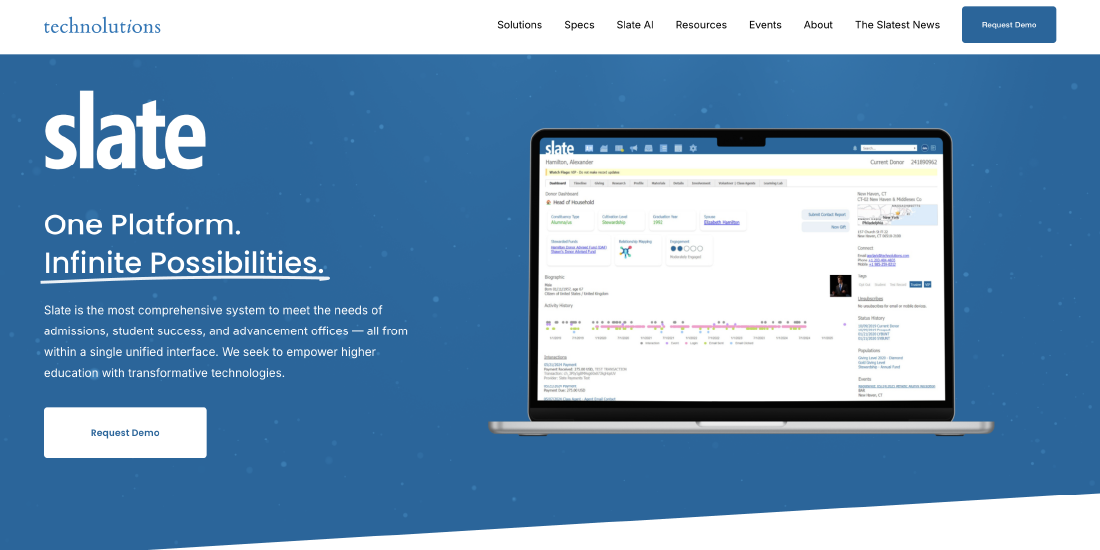
Slate has been a staple in higher education admissions for years and is often considered the benchmark for admission CRM platforms . Developed specifically for colleges and universities, it combines CRM, application management, communications, event management, and reporting into a single platform. Its greatest strength lies in its flexibility, allowing institutions to build highly customized admissions workflows that reflect their unique processes.
Primarily built for:
- Institutions with complex admissions and enrollment workflows
- Universities that require extensive customization
- Teams with dedicated CRM or technical administrators
- Mid-sized to large institutions managing multiple admissions processes
Benefits:
- Highly configurable workflows and business rules
- Comprehensive admissions and enrollment management capabilities
- Strong reporting and data management features
- Large user community and extensive higher education adoption
- Supports complex institutional requirements without relying on multiple systems
Why universities prefer it:
- Offers unmatched flexibility for institutions with unique admissions processes
- Can be tailored to support nearly every stage of the student lifecycle
- Proven platform with a long track record in higher education
- Enables institutions to centralize recruitment, admissions, and communications
Element451
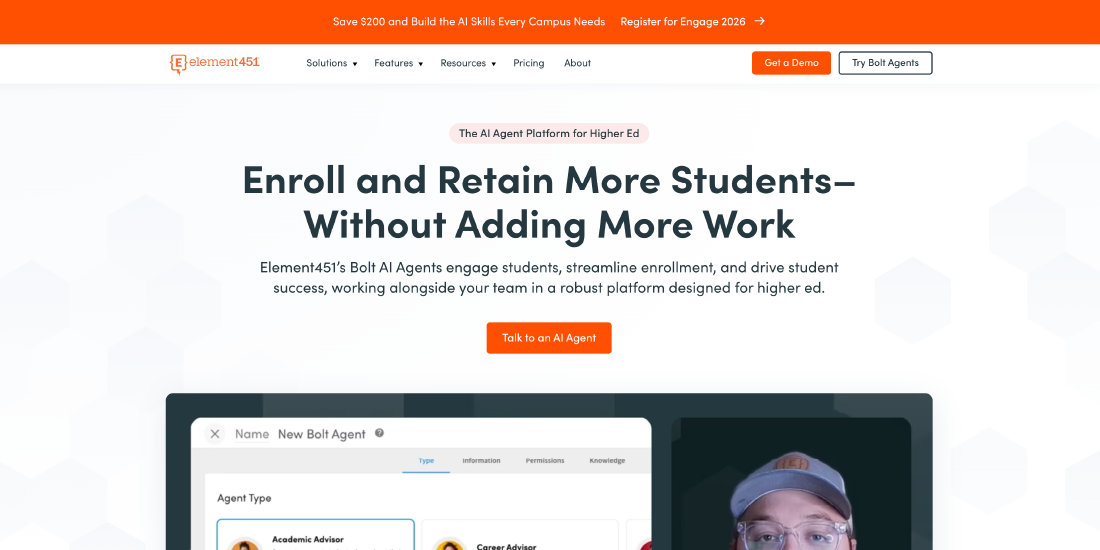
Element451 approaches admissions from a more modern, AI-first perspective. While it also offers CRM and enrollment management capabilities, its focus is on helping admissions teams automate repetitive work, engage students across multiple channels, and respond faster throughout the enrollment journey. The platform emphasizes ease of use, conversational AI, and automation that allows teams to accomplish more with fewer manual tasks.
Primarily built for:
- Institutions looking to modernize recruitment and admissions
- Universities adopting AI and workflow automation
- Lean admissions teams seeking operational efficiency
- Schools focused on improving student engagement and communication
Benefits:
- Built-in AI assistants and automation tools
- Omnichannel communication through email, SMS, chat, and web
- Faster implementation compared to heavily customized platforms
- User-friendly interface with minimal learning curve
- Helps reduce manual administrative work
Why universities prefer it:
- Accelerates student engagement through AI-powered conversations
- Makes automation accessible without extensive technical expertise
- Supports personalized communication at scale
- Enables admissions teams to focus more on relationship-building than administrative tasks
Core CRM Features for Admissions Workflows
When it comes to core CRM capabilities for admissions, Slate and Element451 both cover the essentials, but they reflect very different design philosophies. Slate is built for institutions that need deep control over every part of the admissions lifecycle, from highly customized application forms and review workflows to detailed decision rules and structured communication paths. It excels in environments where complexity is the norm and where teams want to design processes that mirror internal policies with precision.
Element451, in contrast, focuses on simplifying and accelerating those same workflows through automation and AI-driven assistance. Rather than requiring teams to manually configure every step, it helps streamline admissions processes with pre-built intelligence, guided workflows, and conversational tools that reduce operational effort. In short, Slate prioritizes configurability and control, while Element451 emphasizes speed, automation, and ease of execution.
Admissions Workflows and Configuration
Slate has built its reputation on one thing above all else: control. If your admissions process has layers like multiple schools, custom review stages, department-specific rules, or complex decision logic, Slate gives you the tools to model all of it. You can design workflows almost like building blocks, which is why many large or highly structured institutions lean on it. The trade-off is that this level of control often requires time and technical comfort to set up properly.
Element451 takes a different route. Instead of asking teams to design everything from scratch, it leans into guided automation. Workflows are still configurable, but the emphasis is on speed and simplicity, getting journeys live without needing deep technical configuration. It is especially effective for institutions that want to modernize quickly without over-engineering the setup.
Suggestion: If your admissions process is already complex and you need deep structural control, Slate gives you that precision. If you want to simplify operations and move faster, Element451 keeps things more intuitive.
AI, Automation, and Agents
This is where the philosophical difference between the two platforms really shows.
Slate supports automation through rules, triggers, and scheduled actions. It is powerful, but largely logic-driven. You define what happens and when. Over time, institutions can build highly sophisticated automation layers, but it requires intentional setup and ongoing management.
Element451, on the other hand, is built around AI as a first-class capability. Instead of just automating steps, it tries to understand intent. Its AI agents can respond to student inquiries, surface next best actions, and handle parts of the engagement journey in real time. Think less “if this then that” and more “what should happen next for this student.”
Suggestion: Slate works well if you want deterministic, rules-based automation. Element451 is better suited if you are ready to let AI actively participate in student engagement and decision support.
Multi-Channel Engagement
Slate gives you strong foundational communication tools like email campaigns, scheduled messaging, event outreach, and structured communication tracking. For many institutions, this is enough, especially if email remains the primary engagement channel.
Element451 expands the conversation beyond email. It brings SMS, chat, web messaging, and AI-driven conversational interfaces into a single experience. Instead of treating communication as campaigns, it treats it as ongoing dialogue. Students can ask questions, get answers instantly, and continue interactions without friction across channels.
Suggestion: If your recruitment strategy is campaign-heavy and email-centric, Slate fits well. If you are moving toward real-time, conversational engagement, Element451 feels more aligned with modern student behavior.
Integrations and Speed to Value
Slate is highly integrative and sits comfortably within complex higher education ecosystems. It connects well with SIS platforms, financial aid systems, and third-party tools. But because of its flexibility, implementation can be involved. Institutions often invest significant time upfront to design the system properly.
Element451 prioritizes speed. It integrates with key systems but reduces setup complexity by offering more out-of-the-box functionality. Many teams find they can launch core engagement and automation features much faster compared to traditional CRM implementations.
Suggestion: If your institution has a strong IT or CRM operations team and needs deep system integration, Slate is a strong fit. If speed to launch matters more than deep configuration, Element451 wins on agility.
User Experience and Adoption
Slate is powerful, but that power comes with a learning curve. Once teams are trained, it becomes an extremely capable system. However, new users often need structured onboarding to feel comfortable navigating workflows and configurations.
Element451 focuses heavily on usability. The interface is more modern and designed for admissions staff who may not be technical experts. AI features are embedded directly into workflows, reducing the need to learn the system before seeing value.
Suggestion: Slate rewards investment in training and admin expertise. Element451 reduces dependency on technical users and encourages broader team adoption.
Analytics and Actionable Insights
Slate provides deep reporting capabilities. You can slice data across almost any dimension including funnels, yield stages, application behavior, and operational metrics. For data teams, this level of granularity is extremely valuable.
Element451 takes a slightly different approach. Along with standard reporting, it surfaces AI-driven insights that highlight engagement trends, identify at-risk students, and suggest actions based on behavior patterns. It is less about building reports and more about getting answers quickly.
Suggestion: If your team is analytics-heavy and wants full control over reporting structures, Slate is stronger. If you want insights that are immediately actionable without heavy report building, Element451 is more intuitive.
Pricing and Total Cost of Ownership
On paper, both platforms are enterprise investments, but the real cost story goes beyond licensing.
With Slate, the investment often includes implementation effort, internal admin time, and ongoing configuration. Institutions typically need dedicated staff to fully manage and optimize the system.
Element451 can reduce some of that operational overhead by embedding automation and AI into daily workflows. However, the trade-off is dependency on the platform’s built-in structure rather than fully custom builds.
Suggestion: Do not just compare pricing. Compare operational lift. Slate may require more internal ownership. Element451 may reduce staffing pressure in day-to-day operations.
Student Engagement Tools and Communication Personalization
Slate allows highly structured personalization. You can segment audiences, build targeted campaigns, and trigger communications based on behavior or milestones. It is precise and highly controllable, which works well for planned recruitment cycles.
Element451 pushes personalization further into real-time interaction. Instead of just sending the right message at the right time, it can respond dynamically to student questions, adapt messaging based on intent, and maintain ongoing conversational engagement.
Suggestion: If personalization for you means segmentation and campaign control, Slate excels. If it means continuous, adaptive conversations with students, Element451 offers a more modern approach.
Do’s and Don’ts in Slate and Element451
If you’re trying to choose between Slate and Element451, it helps to think less about “features” and more about how each platform is meant to be used in real admissions work. Both are powerful, but they work best when used the right way. Here’s a simple, practical guide.
Slate
Do’s
Do spend time planning before you build anything
Slate works best when you already know how your admissions process should flow. Think of it like building a custom system, you’ll get better results if you design the blueprint first.
Do take advantage of its flexibility
You can customize almost everything in Slate, from forms to workflows to decision rules. If your process is complex, this is where Slate really shines.
Do have trained users managing it
Slate isn’t difficult once you know it, but it does need people who understand how it works. A trained admin makes a big difference.
Do use it as your central admissions hub
Try to keep applications, communication, and decisions inside Slate so everything stays organized in one place.
Do build reports that actually help your team
Use its reporting tools to track things like application progress, yield, and funnel performance so decisions are data-driven.
Don’ts
Don’t expect it to be plug-and-play
Slate takes time to set up properly. If you rush it, you’ll miss out on its full value.
Don’t overbuild your workflows
It’s tempting to create super-detailed processes, but too much complexity can slow your team down.
Don’t leave it unmanaged
Without clear ownership, things can become inconsistent across departments.
Element451
Do’s
Do lean into automation and AI early
Element451 is built to save time. The sooner you start using automation and AI tools, the more value you’ll see.
Do use multiple communication channels
Students don’t just check email anymore. Use SMS, chat, and messaging tools together to stay connected.
Do start simple and improve over time
You don’t need to build everything at once. Get started quickly, then refine as you learn what works.
Do let your admissions team use it directly
It’s designed for non-technical users, so your counselors and recruiters can use it without heavy training.
Do focus on engagement, not just setup
Look at how students are interacting and responding, not just whether workflows are configured.
Don’ts
Don’t expect unlimited customization
It’s flexible, but not designed for highly complex, deeply layered institutional workflows like Slate.
Don’t ignore the AI features
A big part of Element451’s value comes from its AI tools. If you don’t use them, you’re not using the platform fully.
Don’t overcomplicate your setup early on
Keep things simple at the start. The platform is designed to evolve with you.
Don’t rely only on traditional reports
Instead of building heavy reports, focus on the insights and recommendations it surfaces.
Slate vs. Element451 – Comparison Table
| Functionality | Slate | Element451 |
| Core CRM & Admissions Management | A highly flexible CRM that lets universities design admissions almost exactly how they want it. Great for complex setups, but takes effort to configure. | A modern CRM built for speed and simplicity, with AI and automation baked in to reduce manual work. |
| Admissions Workflows & Configuration | Very powerful workflow builder that can handle complex rules, stages, and exceptions. Best when you have a team that can manage setup and maintenance. | Easier, more guided workflow setup. You can get processes running quickly, but with less deep customization than Slate. |
| AI, Automation & Agents | Strong rule-based automation. You define the logic, and it executes reliably, but AI is not the core driver. | AI-first approach with conversational assistants, automated responses, and smart routing built into everyday workflows. |
| Multi-Channel Engagement | Strong focus on email campaigns, events, and structured communication flows. | True omnichannel experience with email, SMS, chat, and AI-driven conversations working together. |
| Integrations & Ecosystem | Very extensive integrations across higher-ed systems, with lots of customization options for complex environments. | Solid integrations with common systems, designed to be quicker to set up and maintain. |
| User Experience & Adoption | Powerful but can feel complex at first. Works best when teams are trained and experienced. | Clean, modern interface that’s easier for admissions teams to pick up and use quickly. |
| Analytics & Reporting | Deep, highly customizable reporting for teams that want detailed control over data. | More focused on ready-to-use insights and AI-driven suggestions rather than building complex reports. |
| Pricing & Total Cost of Ownership | Often comes with higher internal effort due to setup, customization, and ongoing admin needs. | Typically lower operational overhead thanks to automation and faster deployment, depending on usage depth. |
| Student Engagement & Personalization | Strong rule-based segmentation and campaign control for structured outreach. | More dynamic personalization with real-time, AI-powered student interactions. |
Conclusion: Choosing the Right Solution for Your Institution
Both Slate and Element451 are strong platforms, but they solve the admissions challenge in different ways. Slate is often the better fit for institutions that need deep control, complex workflow design, and a highly customizable system that can adapt to unique admissions structures. It works especially well for teams that have the technical capacity and internal resources to manage and optimize a powerful, configuration-heavy platform.
Element451, on the other hand, is built for speed, simplicity, and modern engagement. With AI at its core, it helps admissions teams reduce manual work, automate communication, and engage students across multiple channels in a more conversational way. It is particularly appealing to institutions looking to modernize quickly and improve efficiency without adding operational complexity.
Ultimately, the right choice comes down to what your institution values more: control and customization or speed and automation. Many universities find themselves somewhere in between, which is why the decision should align closely with your team structure, enrollment goals, and long-term digital strategy.
Frequently Asked Questions
Ques 1. How much does Slate CRM cost?
Ques 2. What is Element451?
Ques 3. What is the best CRM for Higher education?
Ques 4. How to Choose Your CRM?
Written By


You May Also Like
 AI in Education

 AI in Education
 AI in Education

No comments yet. Be the first to comment!
Leave a Comment