
Table Of Contents
Introduction
In today’s competitive higher education landscape, attracting prospective students is only half the battle. Many institutions experience significant admission funnel leakage, where interested students drop out before completing their applications or enrolling.
Funnel leakage typically happens due to slow responses, confusing eligibility rules, complex application processes, and a lack of personalized communication. Understanding these critical drop-off points allows admissions teams to implement practical solutions, such as automated follow-ups, simplified forms, and data-driven engagement strategies, to guide students smoothly from inquiry to enrollment.
Stages Where Leads Typically Drop Off Between Inquiry and Application
In the student admission journey, many prospective applicants show initial interest but fail to complete their application. This “funnel leakage” often occurs due to gaps in communication, unclear processes, or friction in the application experience. Understanding where and why leads drop off can help institutions improve conversions and create a smoother applicant journey.
Slow First Response Time: When Interest Fades Quickly
One of the most critical drop-off points occurs immediately after a student inquiry. In today’s fast-paced digital environment, intent declines rapidly if responses are delayed. Prospective students often explore multiple institutions simultaneously. If your response takes hours instead of minutes, they are likely to engage with competitors who respond faster. Research by the Sinorbis International Student Survey (SISS) highlights the impact of this issue, revealing that nearly 33% of international students abandon their applications due to poor communication alone.
Key Improvements:
- Define a response SLA (Service Level Agreement) of under 30 minutes for high-intent channels like web forms and live chat.
- Use automated responses to acknowledge inquiries instantly and share next steps.
- Implement lead routing to connect inquiries with the right counsellors quickly.
- Track and review response times regularly through dashboards to ensure accountability.
Lack of Follow-Up Structure: One Touchpoint Isn’t Enough
Admissions is not a one-step conversion process. Relying on a single call or email often results in lost opportunities. Students typically need multiple interactions, emails, calls, and reminders before making a decision. Without a structured follow-up system, even interested leads may disengage.
Key Improvements:
- Create a standardized follow-up cadence (e.g., Day 1 acknowledgment, Day 2 email, Day 5 SMS, Day 10 call).
- Track all interactions in a centralized system to avoid losing leads.
- Use templates to ensure consistency while allowing personalization.
- Test and optimize follow-up strategies through A/B testing.
Confusing Eligibility Criteria: Clarity Drives Conversions
Unclear or inconsistent eligibility requirements can quickly erode trust. When students receive conflicting information across channels, they often abandon the process. Additionally, applying without proper eligibility clarity can lead to rejection, discouraging future engagement.
Key Improvements:
- Publish simple, clear eligibility checklists on program pages.
- Provide self-assessment tools or decision trees during inquiry.
- Maintain a centralized knowledge base for counsellors to ensure consistent communication.
- Introduce early eligibility screening to guide students toward suitable programs.
Document Submission Friction: Where Applications Stall
The document upload stage is one of the biggest drop-off points in the application process. Complicated requirements, unclear instructions, and technical issues especially on mobile lead to abandonment. Many students face difficulties with file formats, scanning documents, or completing forms on their phones. In fact, 35% of applicants identify completing admission and aid applications as the most challenging part of their experience, underscoring how overwhelming the process itself can be.
Key Improvements:
- Design mobile-friendly forms with simple navigation.
- Allow document uploads via photos instead of only PDFs.
- Provide clear instructions and examples for file formats and quality.
- Enable “save and continue later” functionality.
- Offer real-time validation and feedback on uploads.
Lack of Automation and Visibility: Missed Opportunities to Re-Engage
Without the right systems in place, institutions often struggle to track and re-engage stalled leads effectively. Relying on manual processes can lead to delayed follow-ups, inconsistent communication, and missed opportunities to convert interested students. Implementing automation not only ensures timely engagement but also allows admissions teams to focus on high-value interactions.
Key Improvements:
- Use stage tagging (e.g., Inquiry, Application Started) to track progress.
- Set automated triggers for inactivity (e.g., no response in 48 hours).
- Implement multi-channel communication (email, SMS, notifications).
- Use dashboards to monitor conversion rates by channel, program, and counsellor.
- Identify drop-off patterns and continuously optimize the process.
EDMO Advisor Copilot addresses this challenge by seamlessly supporting applicants throughout their enrollment journey. It provides 24/7 automated student support, instantly answering queries across channels, and enables personalized outreach based on lead behavior. With lead scoring and prioritization, admissions teams can focus on high-value interactions while the system ensures timely engagement, higher student satisfaction, and operational efficiency. Real-time dashboards allow tracking of conversion rates, identifying drop-off patterns, and continuously optimizing the admissions process.
Strategies to Minimize Enrollment Funnel Leakage
Enrollment funnel leakage refers to the significant drop-off of prospective students between initial inquiry and final enrollment. This leakage is typically driven by slow response times, complex application processes, and ineffective communication, especially at mid-funnel stages. To improve conversions, institutions must adopt targeted strategies that address these gaps.
Optimize the Inquiry-to-Application Stage
The largest drop-off usually occurs when students move from inquiry to application. Complicated forms, unclear instructions, or a lack of guidance often discourage them from proceeding.
Strategies to Fix:
- Simplify application forms to reduce friction and confusion.
- Use AI-powered chatbots or live chat for real-time assistance.
- Provide step-by-step guidance and clear CTAs on application portals.
- Ensure mobile-friendly design to match student behavior.
Improve Speed to Lead
Delayed responses are one of the primary reasons leads lose interest. In a highly competitive environment, prospective students are more likely to engage with institutions that respond first. Studies show that chatbot response times longer than 30 seconds can lower lead qualification rates by up to 25%.
Strategies to Fix:
- Implement automated responses within minutes of inquiry.
- Use tools like WhatsApp, email automation, or SMS for instant engagement.
- Set internal SLAs to ensure quick follow-ups by counsellors.
- Prioritize high-intent leads through smart routing systems.
Strengthen Application-to-Enrollment Conversion
Even after starting an application, many students drop off due to confusion around requirements, deadlines, or next steps.
Strategies to Fix:
- Use CRM insights to track where applicants get stuck.
- Send timely reminders for incomplete applications or missing documents.
- Offer personalized support through counsellors at critical stages.
- Provide clear timelines, checklists, and progress indicators.
Deliver Personalized Communication
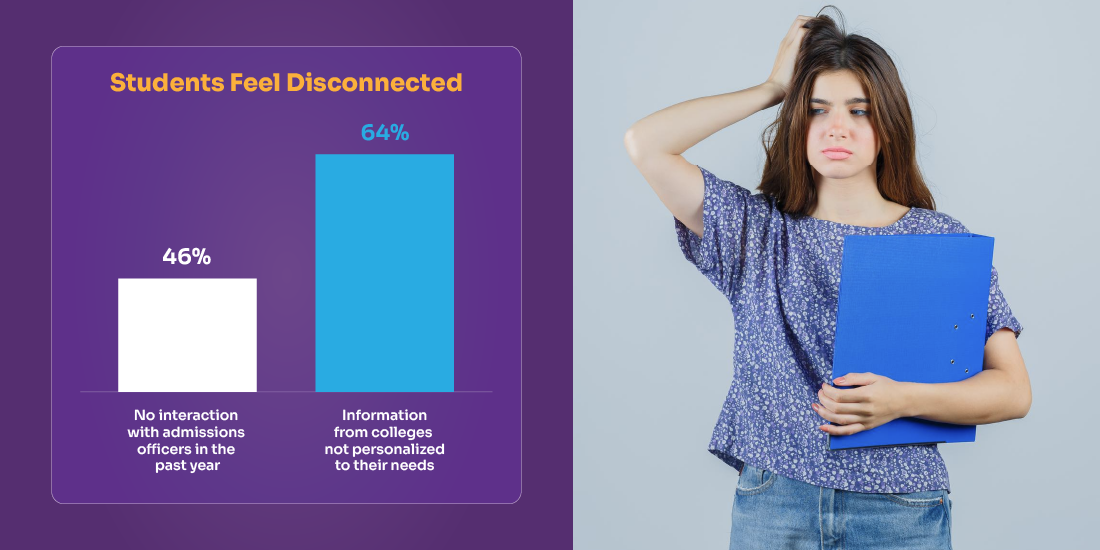
Generic messaging no longer resonates with today’s students. A one-size-fits-all approach often results in disengagement and missed opportunities. In fact, 46% of students reported having no interaction with admissions officers in the past year, while 64% feel that the information they receive from colleges is not personalized to their needs.
Strategies to Fix:
- Map the student journey and identify key touchpoints.
- Segment leads based on interests, location, and program preferences.
- Send personalized emails, messages, and recommendations.
- Use behavioral data to tailor communication dynamically.
EDMO Student Copilot takes student engagement to the next level with omnichannel communication, 24/7 assistance, and personalized guidance. It connects students with admission officers across voice calls, SMS, and WhatsApp, ensuring every student is reachable on their preferred platform. With consistent messaging across channels, students always receive accurate and timely updates, creating a finer, seamless experience where the right guidance reaches them exactly when they need it.
Leverage Data and CRM Systems Effectively
Without proper tracking, institutions cannot identify where or why leads drop off. Data visibility is essential for continuous improvement.
Strategies to Fix:
- Monitor conversion rates at each stage
- Use a centralized CRM to manage leads, automate workflows, and segment audiences.
- Analyze trends to identify bottlenecks and optimize processes.
- Build dashboards to track performance across channels and teams.
Simplify and Streamline the Application Experience
A complicated or time-consuming application process can discourage even highly interested students.
Strategies to Fix:
- Reduce unnecessary fields and steps in forms.
- Enable “save and continue later” functionality.
- Provide real-time validation and clear error messages.
- Allow easy document uploads (including mobile-friendly options).
Minimizing enrollment funnel leakage is not about increasing the number of leads but about maximizing conversions from existing ones. By focusing on speed, simplicity, personalization, and data-driven decision-making, institutions can significantly improve their enrollment outcomes and create a more seamless student experience.
Conclusion
Admission funnel leakage can significantly impact enrollment numbers, but it is highly preventable with the right approach. By addressing slow response times, reducing application friction, and personalizing communication, institutions can retain more leads and increase conversion rates.
Leveraging CRM systems, automation tools, and data tracking helps identify where students are dropping off and allows teams to intervene at the right time. With continuous monitoring and strategic improvements, higher education teams can not only increase enrollments but also provide a seamless, student-friendly experience that builds trust and encourages long-term engagement.
Frequently Asked Questions
Question 1. What are the main stages in the admissions funnel?
Question 2. What does an enrollment solution do in the enrollment funnel?
Question 3. Which stages of the student funnel need the most improvement?
Question 4. Why do students drop off before completing their application?
Question 5. What are the common causes of a leaky admission funnel?
Question 6. How to fix admission funnel drop-offs?
Question 7. How can higher ed teams prevent enrollment funnel leakage?
Written By






No comments yet. Be the first to comment!
Leave a Comment