


Table Of Contents
- 1Introduction
- 2What Is an Articulation Agreement?
- 3 How Do Articulation Agreements Work?
- 4What Is the Purpose of Articulation Agreements for Transfer Students?
- 5What Are the Key Components of an Articulation Agreement?
- 6Articulation Agreement vs. Transfer Agreement: What’s the Difference?
- 7Examples of Articulation Agreement
- 8Examples of Articulation Agreement
- 9What Are the Benefits of Articulation Agreements?
- 10What Challenges Do Colleges Face When Managing Articulation Agreements?
- 11How do colleges establish and keep articulation agreements?
- 12Types of Articulation Agreements
- 13How Technology Can Simplify Articulation Agreement and Transfer Credit Management
- 14Conclusion
Introduction
Articulation agreements are important in enabling students to change colleges or universities without having to lose any of their academic progress. They are formal arrangements that specify how the courses, credits, and programs completed at one college or university will be transferred to another, thus providing students with clearer routes to earning a degree. For colleges and universities, properly designed articulation agreements can also help to increase transfer enrollment, enhance student mobility, and lessen the uncertainty associated with credit evaluation.
Since transfer enrollment is still having a major impact on the way institutions plan their enrollment, it has become more and more important for members of the admissions, registrar, transfer, and academic departments to understand how articulation agreements function. The following guide outlines what articulation agreements are, how they work, the various types that institutions make use of, and the main points that colleges and universities should take into account when setting up and managing them.
What Is an Articulation Agreement?
An articulation agreement is a formal arrangement between two or more colleges or universities that specifies the way in which academic credits, courses, or qualifications obtained at one school will be transferred to another. Such agreements usually state which courses satisfy certain degree requirements, how many credits can be transferred, and if students are allowed to enter a particular program with advanced standing. For admissions and transfer staff, articulation agreements offer a standard framework for assessing transfer courses, enabling the institutions to make their credit decisions in a more consistent manner and at the same time giving students a clearer route for completing their degrees.
How Do Articulation Agreements Work?
Articulation agreements are the result of a systematic collaboration between institutions rather than being prepared for individual students. Colleges and universities jointly assess academic programs, determine course equivalencies, set out transfer rules and maintain the agreement over time. The aim is to establish a consistent and transparent transfer route that both institutions can use whenever a qualifying student transfers.
Institutions identify a transfer partnership
The process starts when two institutions decide to establish a formal transfer pathway, usually because they have a large number of transfer students or wish to increase their enrollment opportunities. The leadership, admissions offices, registrars, and academic departments then decide which programs the agreement will include.
Academic programs and courses are evaluated
The faculty and academic staff compare the course content, learning outcomes, credit hours, and curriculum requirements to determine which courses are academically equivalent. Carrying out this review guarantees that the transferred coursework complies with the receiving institution’s academic standards.
Transfer policies and eligibility requirements are defined
When the course equivalencies have been set up, both institutions agree on the rules concerning the transfer. These rules usually involve minimum grade requirements, GPA limits, the maximum amount of credit that can be transferred, the prerequisite courses that are required, and whether or not students get guaranteed admission or advanced standing.
The agreement is formalized and implemented
Once both organizations have approved the terms, the articulation agreement is recorded and distributed to the admissions, registrar, advising, and transfer offices. The staff then use the agreement as a standard reference when dealing with eligible transfer students.
Student transfers are evaluated using the agreement
When a student submits a transfer application, the admissions and registrar teams verify that the student has met the requirements set out in the agreement. Rather than conducting a fully manual evaluation, staff members can use the course equivalencies and transfer rules previously defined in the agreement.
The agreement is reviewed and updated
Articulation agreements are not fixed; when curricula, degree requirements, and academic policies change, partner institutions regularly review and update their course mappings and transfer rules to ensure the agreement remains accurate and appropriate.
What Is the Purpose of Articulation Agreements for Transfer Students?
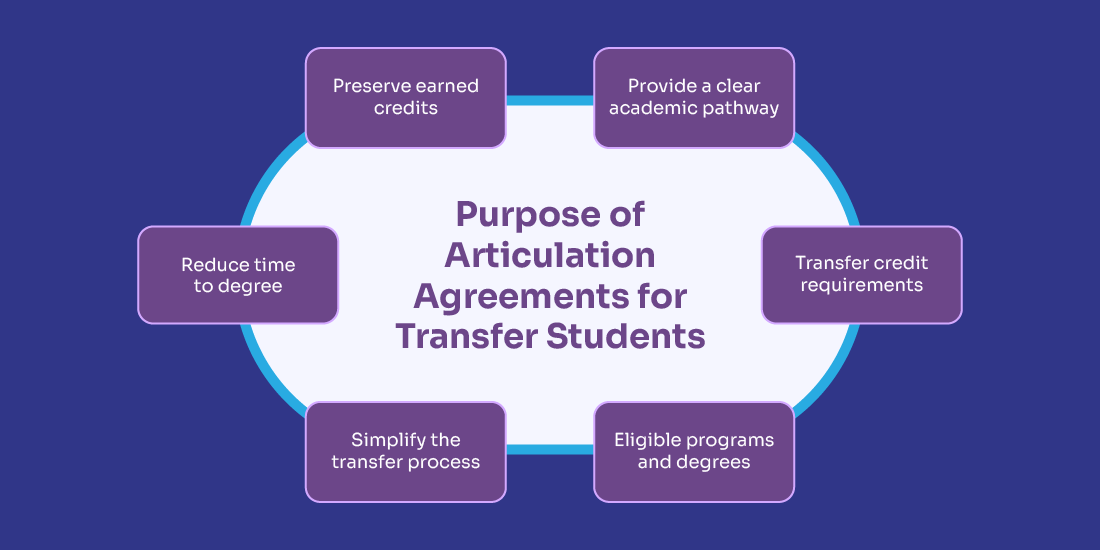
Articulation agreements make the transfer process more predictable and transparent for students moving between colleges and universities. Instead of uncertainty about which credits count toward a degree, students can follow a defined transfer pathway showing how their coursework applies at the receiving institution. This reduces administrative complexity and supports faster progress toward graduation.
Preserve earned credits
A primary purpose of an articulation agreement is to help students receive credit for coursework they completed. By establishing approved course equivalencies in advance, institutions reduce the chance students will have to repeat classes after transferring.
Provide a clear academic pathway
Articulation agreements outline which courses students should complete before transferring and how those courses fit into a bachelor’s or advanced degree program. This helps students plan their academic journey with greater confidence.
Reduce time to degree
When transferable credits are applied as intended, students can enter their new institution with completed requirements already recognized. This can shorten the time needed to finish a degree and help students avoid unnecessary coursework.
Lower the cost of completing a degree
Fewer repeated courses often mean lower tuition and reduced educational expenses. Students may also spend less time enrolled before graduating, further reducing the overall cost of earning a degree.
Simplify the transfer process
Instead of relying on case-by-case credit evaluations, students benefit from a standardized framework that makes transfer decisions more consistent and easier to understand. This reduces confusion during admissions and advising.
Increase confidence in transfer decisions
Knowing an established agreement exists between institutions gives students greater certainty about how their academic work will be recognized. This can make transferring feel like a planned progression rather than an uncertain transition.
What Are the Key Components of an Articulation Agreement?
An articulation agreement has several main parts that help both schools use the same transfer policies. Instead of making informal decisions about credit transfers, these agreements clearly explain how coursework, eligibility, and responsibilities will be managed. This clear structure helps transfer students and the colleges work together smoothly.
Participating institutions
Each articulation agreement starts by naming the schools involved. It states which colleges or universities are part of the partnership and explains if the agreement covers the whole school, certain campuses, or specific departments.
Eligible programs and degrees
Not all academic programs are included in an articulation agreement. The agreement lists which degrees, majors, certificates, or transfer paths are covered so students know if their program is eligible.
Course equivalencies
Course equivalencies are a key part of the agreement. Faculty and departments decide which courses at the first school match courses or requirements at the second school, making credit transfers more consistent.
Transfer credit requirements
The agreement explains what academic standards students need to meet for their credits to transfer. These usually include minimum grades, GPA requirements, certain courses, time spent at the school, and limits on how many credits can transfer.
Admission provisions
Some articulation agreements include guaranteed admission for students who meet specific academic criteria, while others simply provide a structured transfer process without guaranteeing acceptance. The agreement explains exactly what admissions benefits, if any, students receive.
Credit application rules
An articulation agreement does more than approve transfer credits. It specifies how those credits will apply toward a student’s degree, whether they fulfill general education requirements, major requirements, elective credits, or other graduation requirements.
Student eligibility criteria
The agreement states which students can use the transfer option. Eligibility might depend on finishing an associate degree, joining a certain program, meeting GPA standards, or transferring within a set time.
Institutional responsibilities
Both institutions have defined responsibilities for making the agreement work effectively. Admissions teams, registrars, academic advisors, and faculty collaborate to communicate transfer policies, evaluate transcripts, maintain course equivalencies, and support students throughout the transfer process.
Review and renewal process
Since academic programs change over time, articulation agreements need regular review. Partner schools update course lists, eligibility rules, and transfer policies to keep the agreement accurate and up to date.
Effective dates and duration
Each articulation agreement says when it starts, how long it lasts, and how changes or ending the agreement will be handled. This helps schools and students know which version applies to their transfer group.
Articulation Agreement vs. Transfer Agreement: What’s the Difference?
The terms articulation agreement and transfer agreement are often used interchangeably, but they are not always the same. A transfer agreement is a broad arrangement that allows students to transfer from one institution to another, while an articulation agreement is a more detailed framework that specifies exactly how courses, credits, and degree requirements will transfer. In practice, an articulation agreement is often a type of transfer agreement with clearly documented course equivalencies and academic pathways.
| Aspect | Articulation Agreement | Transfer Agreement |
| Purpose | Defines exactly how courses and credits transfer between institutions. | Establishes that students can transfer between institutions under agreed conditions. |
| Level of detail | Highly detailed with course equivalencies and degree pathways. | Generally broader and may not include course-by-course mappings. |
| Course equivalencies | Yes, specific courses are matched to receiving institution requirements. | May not specify individual course equivalencies. |
| Degree pathways | Often outlines a structured path toward completing a specific degree. | May simply facilitate admission or credit transfer without a defined pathway. |
| Admission benefits | May include guaranteed admission or advanced standing for eligible students. | May include transfer admission provisions but not always guaranteed admission. |
| Credit application | Explains how credits apply to general education, major, or elective requirements. | May confirm transferable credits without specifying how they fulfill degree requirements. |
| Primary users | Admissions teams, registrars, academic advisors, faculty, and transfer offices. | Admissions and transfer offices primarily manage the broader transfer relationship. |
| Best suited for | Institutions creating predictable, program-specific transfer pathways. | Institutions establishing a general transfer relationship between campuses. |
Examples of Articulation Agreement
Midwestern University and University of Iowa
A good example is the partnership between Midwestern University and the University of Iowa. Their 2026 agreement gives qualifying University of Iowa students a direct pathway into several graduate health sciences programs. Students who meet the required academic criteria can receive guaranteed interviews or guaranteed admission to programs such as medicine, dentistry, pharmacy, optometry, and veterinary medicine.
Central Methodist University and Labette Community College
Another example comes from Central Methodist University and Labette Community College. Their agreement creates a clear pathway for Exercise Science students. Instead of wondering how their credits will transfer, students can bring over their completed coursework, finish a bachelor’s degree in one year, and then continue into a master’s program in athletic training.
Examples of Articulation Agreement
Alma College and Montcalm Community College
Alma College’s expanded partnership with Montcalm Community College is a good example. The institutions introduced a new chemistry transfer pathway that helps students understand how their coursework at MCC fits into Alma’s chemistry degree, making the transition more predictable and reducing the risk of taking unnecessary classes.
Muskegon Community College and Cornerstone University
Muskegon Community College and Cornerstone University took a broader approach with their updated transfer agreement. The partnership opens pathways into more than 65 bachelor’s degree programs, helping students transfer more credits, streamline the admissions process, and continue their education across fields ranging from business and nursing to psychology and information technology.
What Are the Benefits of Articulation Agreements?
In many higher education systems, institutions maintain an umbrella transfer agreement that governs the overall partnership while using multiple articulation agreements to define transfer pathways for specific programs or departments.
Articulation agreements bring benefits to both transfer students and the institutions that serve them. They give students clearer information regarding the credit given to their previously completed courses. For colleges and universities, the agreements make the transfer process more consistent, enhance ties between institutions, and help achieve enrollment objectives. If well designed, they assist in reducing administrative difficulties while at the same time improving the overall transfer experience.
Benefits for Students
Greater certainty about transfer credits
Students are aware beforehand which of their courses will transfer, thus reducing their uncertainty regarding the recognition of their previous academic work.
Faster path to graduation
Students will be able to fulfill their degree requirements by using their approved credits, thus avoiding the need to repeat courses and possibly finishing their degrees earlier.
Lower education costs
When students have their accepted credits transferred, they usually end up paying for fewer duplicate courses, which in turn helps to lower their tuition fees and the total cost of obtaining their degree.
Easier academic planning
Well-defined transfer pathways enable students to select the correct courses before they transfer, which in turn makes it easier for them to plan their studies with confidence.
Smoother transfer experience
Standard transfer rules help to reduce confusion when it comes to admissions and advising, which in turn makes the process of moving from one institution to another easier.
Benefits for Colleges and Universities
More consistent credit evaluations
Instead of carrying out each evaluation from scratch, the admissions and registrar teams can use the established course equivalencies, which in turn leads to greater consistency in transfer decisions.
Improved operational efficiency
Standard transfer rules mean that admissions, registrar, and advising staff have less manual work and can therefore deal with transfer applications more efficiently.
Stronger institutional partnerships
Articulation agreements promote long-term cooperation among community colleges, universities, and other partner institutions, which in turn results in more effective transfer networks.
Increased transfer enrollment
Well-defined pathways for transfer students can increase an institution’s appeal and thus promote enrollment growth and recruitment.
Better student success outcomes
If a student transfers in with recognized credits and a clear academic pathway, the institution can improve retention, progression, and degree completion for that group of transfer students.
What Challenges Do Colleges Face When Managing Articulation Agreements?
While articulation agreements create smoother transfer pathways, managing them becomes more complex as institutions expand partnerships and academic offerings. Colleges and universities often maintain dozens or hundreds of agreements across departments, each with its own course mappings, eligibility requirements, and renewal timelines. Keeping these agreements accurate, consistent, and aligned with changing curricula requires ongoing coordination among admissions, registrar offices, faculty, and academic leadership.
Keeping course equivalencies up to date
Curricula evolve regularly as courses are revised, renamed, or replaced. Institutions must continually review and update course equivalencies to ensure transfer credits remain accurate and aligned with current academic standards.
Managing multiple institutional partnerships
Many colleges have articulation agreements with numerous community colleges, universities, and international institutions. Tracking different requirements, policies, and program-specific agreements across partners can become difficult as the number of agreements grows.
Handling manual credit evaluations
Even with established agreements, admissions and registrar teams often spend significant time verifying transcripts, checking eligibility requirements, and confirming course matches. Manual processes can slow transfer decisions and create additional administrative workload.
Coordinating across departments
Effective articulation agreements require collaboration between faculty, registrars, admissions teams, academic advisors, and institutional leadership. Keeping every stakeholder aligned on policy changes and curriculum updates can be challenging.
Ensuring policy compliance
Transfer policies must remain consistent with institutional regulations, accreditation requirements, and state or system-wide transfer policies. Maintaining compliance while updating agreements requires careful oversight.
Communicating changes to students and staff
When articulation agreements are updated, institutions must ensure advisors, admissions staff, and students have the latest information. Outdated guidance can cause confusion about which courses transfer and how credits apply to degree requirements.
Scaling agreement management
As institutions expand transfer partnerships, maintaining hundreds of course mappings, renewal dates, and program-specific rules becomes difficult without standardized workflows or centralized systems.
How do colleges establish and keep articulation agreements?
The establishment of an articulation agreement is a joint effort that brings together academic, administrative, and enrollment staff from both colleges. The work doesn’t end when the agreement is signed, since curricula, degree requirements, and transfer rules are subject to change over time; therefore, the colleges have to constantly review and update their agreements to ensure they remain accurate and useful for students. By following a structured process, the institutions are able to develop reliable transfer routes and reduce inconsistencies in credit assessment.
Identify a transfer partnership
The process starts by finding a partner institution that has the same transfer objectives. Colleges usually enter into agreements with community colleges, regional universities, or overseas institutions that frequently send or receive transfer students.
Evaluate academic programs and courses
Faculty and academic departments compare course content, learning outcomes, credit hours, and program requirements. They do this to decide which courses the receiving institution can count as equivalent.
Define transfer policies and eligibility
The two institutions agree on the rules that will regulate the transfer pathway; these usually comprise minimum grade requirements, GPA limits, the number of transferable credits, prerequisite courses, and any admission guarantees.
Document and approve the agreement
When the terms have been finalized, the agreement is officially documented and then subjected to institutional approval procedures, with academic leadership, the registrar’s office, and the legal or administrative teams all having the opportunity to participate before it is signed.
Implement the transfer pathway
Once it has been approved, the admissions offices, registrars, and academic advisors begin using the agreement when working with eligible transfer students. The institutions also use their advising services, transfer guides, and other materials for students to communicate the pathway.
Monitor student outcomes
A number of institutions keep records of the performance of transfer students after they have entered into an articulation agreement. By examining enrollment trends, credit transfer outcomes, retention figures, and graduation rates, colleges can determine whether the agreement is meeting its intended objectives.
Review and update regularly
Since course offerings, degree programs, and institutional policies change over time, articulation agreements need to be continually maintained. Carrying out regular reviews helps ensure that the course equivalencies remain accurate, that the eligibility requirements are up to date, and that students continue to have clear and reliable transfer routes.
Types of Articulation Agreements
There is no single articulation agreement that fits all situations. The type of agreement used by colleges and universities varies depending on the transfer pathway, the academic programs involved, and the level of commitment between the institutions. Certain agreements extend to the entire degree pathway, whereas others apply only to individual courses or specific academic programs. By understanding these models, institutions can establish transfer partnerships that satisfy both student and institutional requirements.
Course-to-Course Articulation Agreements
This kind of agreement relates individual courses at one university to the corresponding courses at another. It is usually employed in the case of students who transfer before finishing their degree or who need certain courses to meet the requirements of their program.
Program-to-Program Articulation Agreements
Program-to-program agreements establish a transfer pathway between full academic programs, for example, from an associate degree to a bachelor’s degree. They offer a more structured approach by acknowledging a number of completed courses rather than assessing them individually.
Statewide Articulation Agreements
Statewide agreements are created at either the state or system level in order to establish standard transfer routes among the public colleges and universities. These agreements enable students to transfer within the state’s higher education system more consistently and with fewer credit-transfer obstacles.
Bilateral Articulation Agreements
A bilateral agreement is established between two institutions, with the two colleges collaborating to set up course equivalencies, eligibility requirements, and transfer policies suited to their common programs and student groups.
Multilateral Articulation Agreements
Multilateral agreements differ from bilateral ones in that they involve several institutions participating under a common transfer system. They are frequently used in university systems or regional education networks to facilitate transfers between campuses.
Guaranteed Admission Agreements
Certain articulation agreements provide guaranteed admission to students who fulfill certain academic criteria, for example by obtaining an associate degree or by keeping a minimum GPA. Even if admission is guaranteed, students might still be required to meet additional requirements to gain a place in competitive programs.
International Articulation Agreements
International articulation agreements set up pathways for transfer between universities in different countries. They specify how international coursework, credits, and qualifications will be recognized, making it more predictable for students pursuing global education pathways.
How Technology Can Simplify Articulation Agreement and Transfer Credit Management
As colleges and universities add more transfer partners and academic programs, managing articulation agreements gets harder. Schools often have dozens or even hundreds of agreements, each with its own course matches, eligibility rules, and renewal dates. If these are tracked with spreadsheets, PDFs, and manual transcript checks, even minor curriculum changes can lead to inconsistent transfer decisions.
Modern transfer credit technology lets schools keep all agreements in one place, automate routine tasks, and make credit evaluations more consistent. These tools do not replace academic judgment. Instead, they help admissions, registrar, and transfer teams apply approved policies more easily and at a larger scale.
Centralize articulation agreements
Rather than storing agreements across multiple documents and departments, institutions can maintain course equivalencies, transfer rules, and program pathways in a single system. This gives admissions officers, registrars, and advisors access to the same up-to-date information.
Automate transfer credit evaluations
Technology can compare incoming transcripts against approved articulation rules and existing course equivalencies, reducing the manual work required for routine transfer evaluations and allowing staff to focus on exceptions.
Keep course mappings current
When academic programs change, centralized systems make it easier to update course equivalencies across multiple agreements. This helps institutions avoid outdated transfer rules that can create confusion for both staff and students.
Improve consistency across departments
A shared platform ensures admissions teams, registrars, faculty reviewers, and academic advisors are working from the same transfer policies, reducing inconsistent credit decisions across different offices.
Speed up transfer decisions
Automating document processing and applying predefined transfer rules can significantly shorten evaluation timelines, allowing students to receive transfer decisions sooner and plan their next academic steps with greater confidence.
Generate insights from transfer data
Digital systems can also help institutions track transfer volumes, approval rates, credit acceptance patterns, and agreement performance. These insights make it easier to identify bottlenecks, strengthen high-performing partnerships, and make more informed enrollment decisions.
Scale without increasing administrative workload
As institutions add new partner colleges and expand transfer pathways, technology enables them to manage a growing portfolio of articulation agreements without a proportional increase in manual administrative work.
Conclusion
One of the most effective methods for colleges and universities to establish clearer transfer routes for students is to make credit assessments more consistent through the use of articulation agreements. By setting out course equivalencies, eligibility requirements, and degree pathways in advance, students become more confident about the transfer process, and the institutions are able to avoid unnecessary administrative complexity.
It is necessary to carry on working together among the admissions office, the registrar’s office, the faculty, and the various academic departments in order to keep these agreements in place. As transfer partnerships develop and the curricula change, technology can assist the institutions in keeping the agreements up to date, simplify the assessment of transfer credits, and expand transfer operations without having to rely completely on manual processes. The outcome is a transfer experience that is more transparent, efficient, and focused on the student.
Frequently Asked Questions
Ques 1: Will articulation agreements ensure that all credits are transferred?
Ques 2: How frequently should colleges revise their articulation agreements?
Ques 3: How do colleges review transfer credits under an articulation agreement?
Ques 4: Can articulation agreements lapse or alter?
Written By








No comments yet. Be the first to comment!
Leave a Comment