

Table Of Contents
- 1Introduction
- 2The Definition of Student Identity Verification
- 3What Does the Student Verification Process Look Like?
- 4Why is Student Identity Verification Important?
- 5Manual Student Verification – Problem Areas (Manual vs Automated Verification)
- 6Automation in Student ID Verification
- 7Different Types of Student Identity Verification Measures
- 8How Universities Can Use Identity Verification at Different Stages
- 9How Big a Problem is Fraud in Education and E-Learning?
- 10Finding a Trusted ID Verification Partner to Verify Your Students
- 11Student Identity Verification Use Cases
- 12Summary
Introduction
As universities race to keep admissions fast, secure, and fraud-free, one thing is clear: student identity verification is no longer optional, it’s mission-critical. With digital admissions exploding and global applicants surging, institutions need smarter tools that verify students in seconds, not weeks. Fraud is not hypothetical: one report found that in some US community colleges, almost one in three applications were flagged as fraudulent, with over US $13 million in financial aid diverted in just one state in a year. Moreover, only about half of institutions say they currently use digital identity verification for critical functions like enrollment or admissions. On the student side, demand for digital convenience is high, with about 70% of students reporting that carrying a physical student ID is frustrating, fueling the shift to mobile/digital verification. Against this backdrop, automated student ID verification tools encompassing document authenticity checks, biometric selfies, liveness detection, and real-time cross-checks offer a dual benefit: they help institutions prevent fraud and streamline the applicant experience. For example, such tools enable remote verification of international students, reducing bottlenecks in global admissions while preserving academic integrity.
The Definition of Student Identity Verification
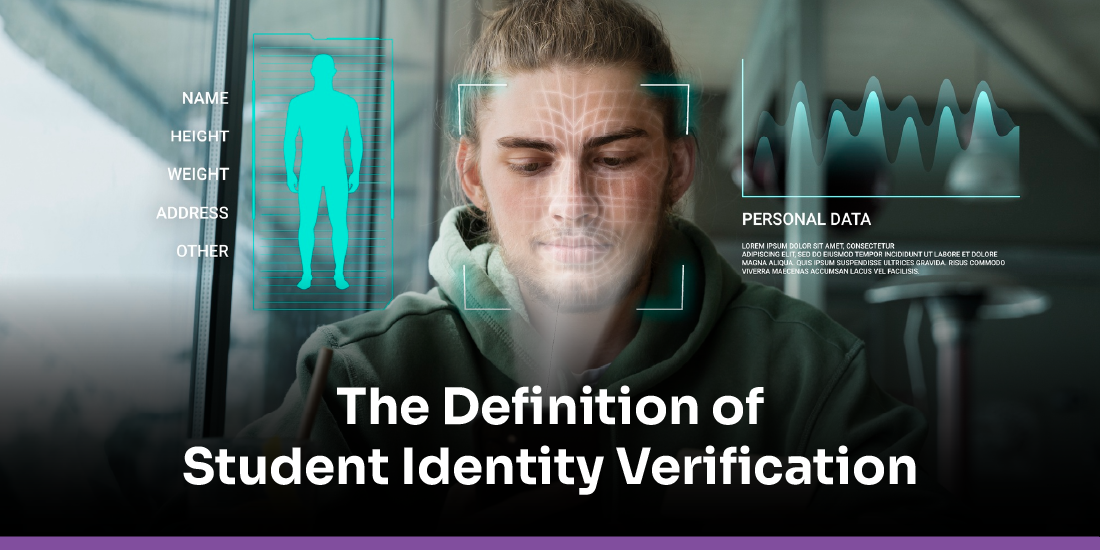
Student identity verification is the process universities use to verify that an applicant is a legitimate individual before granting access to admissions, enrollment, or campus services. It relies on secure methods such as document checks, biometric matching, and real-time validation to prevent fraud, protect institutional integrity, and streamline the student journey.
Here are key pointers to keep in mind:
- Confirms that the applicant’s identity documents (passport, national ID, driver’s license) are genuine.
- Uses biometric tools such as facial recognition or liveness detection to match the applicant to their documents.
- Cross-checks information with authoritative databases or verification systems.
- Prevents impersonation, duplicate accounts, and fraudulent applications.
- Ensures regulatory compliance for admissions, financial aid, and international enrollment.
- Strengthens institutional trust and protects against identity-related risks.
- Speeds up admissions by replacing slow, manual verification steps.
What Does the Student Verification Process Look Like?
The student verification process is designed to confirm a student’s identity and ensure that the person applying, enrolling, or accessing campus services is genuinely who they claim to be. Universities follow a combination of physical and digital checks to prevent impersonation, document fraud, and unauthorised access throughout the student lifecycle.
In-Person Identity Check
Universities traditionally verify identity by asking students to present a government-issued ID at the campus. Staff manually compare the face with the identification document and validate basic details.
Why it matters: This step prevents impersonation but is slow, manual, and prone to human error, especially during peak admissions.
Online (Remote) Verification
With remote learning and online admissions, many institutions now verify identity digitally. Students upload their government ID, take a selfie, and complete liveness checks.
Why it matters: This allows universities to authenticate students from anywhere, reducing queues and enabling a seamless digital admissions experience.
Document Scanning & Data Extraction
Systems scan the ID using OCR (Optical Character Recognition) to extract the name, DOB, ID number, and expiration details.
Why it matters: This removes manual data entry, reduces typos, and ensures that all applicant information is accurately captured.
Face Match & Liveness Detection
The student’s selfie is compared with the ID photo using AI-powered facial recognition. A liveness test ensures the student is physically present and not using printed images or videos.
Why it matters: Prevents high-risk fraud, such as deepfakes, impostors, and fake documents.
Institutional Account Verification
Students may be asked to verify their university email account or portal login credentials to confirm ownership.
Why it matters: Adds another layer of security, ensuring that only validated users gain access to academic portals and resources.
Periodic Re-Verification
Universities may require students to re-verify if their ID expires, their personal details change, or there’s prolonged inactivity in their accounts.
Why it matters: Protects against account takeovers and ensures continuous security across the student journey.
Final Confirmation & System Update
Once all checks are complete, the system updates the student’s profile as “verified,” granting access to learning platforms, exams, and campus services.
Why it matters: Creates a secure, authenticated environment and ensures every system (CRM, SIS, LMS) stays aligned.
Why is Student Identity Verification Important?
Student identity verification matters because universities must balance fast, modern admissions with strict security and compliance. As application fraud, impersonation attempts, and online enrollment rise, verifying each student’s identity protects institutional integrity, financial resources, and the overall student experience. It ensures that only genuine applicants enter the system, reducing risks and improving trust.
Here are some key pointers to prevent the challenges:
Prevents Fraud
Without verification, it’s surprisingly easy for someone to apply using a fake name, stolen identity, or multiple identities. Verification tools catch forged documents, mismatched faces, and duplicate profiles, shutting down Fraud before it enters the admissions pipeline.
Protects Financial Aid
Financial aid Fraud is a real problem. Fake or “ghost” students often attempt to secure grants or scholarships intended for genuine learners. Identity verification ensures only eligible applicants receive funding, helping institutions avoid massive financial losses.
Strengthens Compliance
Universities must follow strict rules — from national education laws to KYC requirements for international students. Proper verification helps institutions remain compliant with SEVIS, immigration guidelines, financial aid audits, and accreditation standards.
Enhances Security
When identity checks are weak, universities risk unauthorised access to portals, personal data, and campus services. Verification tools create a secure digital perimeter, protecting both student records and institutional systems from misuse.
Builds Trust
Students and parents feel safer knowing the university takes identity protection seriously. It also strengthens the confidence of auditors, government bodies, and partner institutions who rely on accurate identity data.
Improves Efficiency
Manual verification takes days — sometimes weeks. Automated systems validate documents, match faces, and detect fraud instantly, speeding up admissions and dramatically reducing staff workload.
Supports Global Admissions
International applicants can be verified remotely without mailing physical documents or visiting campuses. This makes global enrollment smoother, faster, and more accessible for thousands of students.
Ensures Fairness
A secure identity process ensures all applicants are treated equally. No student gets an unfair advantage through impersonation or loopholes, and the admissions decision is made on real merit.
Manual Student Verification – Problem Areas (Manual vs Automated Verification)
Manual student verification often slows down admissions, increases errors, and exposes universities to fraud risks. With growing application volumes and global enrollments, relying on staff to manually inspect documents or validate identity is no longer sustainable. Automated verification eliminates these bottlenecks, offering faster, more accurate, and more secure identity checks.
| Problem Area | Manual Verification | Automated Verification |
| Slow Turnaround Time | Staff manually review IDs, compare photos, and verify details — often causing multi-day delays, especially during peak periods. | AI completes ID, biometric, and liveness checks within seconds, speeding up admissions significantly. |
| Higher Error Rates | Human review is inconsistent and can miss issues due to fatigue or unfamiliarity with different ID formats. | Automated tools apply standardized checks across thousands of ID types for consistent, high-accuracy results. |
| Greater Fraud Exposure | Forged documents, manipulated images, and impersonation attempts can slip through manual inspection. | AI flags tampering, mismatched faces, and duplicate identities instantly, reducing fraud risk. |
| Heavy Admin Workload | Staff handle sorting, matching, and entering data, adding hours of repetitive work. | Automated systems extract data and verify documents end-to-end with minimal human involvement. |
| Low Scalability | Verification slows down when applications spike, requiring more manpower and overtime. | Automated verification scales effortlessly, managing thousands of checks without performance drops. |
| Weak Student Experience | Applicants face long waits, unclear instructions, and multiple document re-submissions. | Real-time, mobile-friendly verification creates a smoother, faster experience for students. |
| Compliance Limitations | Inconsistent processes and missing records can cause issues during audits. | Automated workflows maintain complete logs and consistent verification standards for compliance. |
Automation in Student ID Verification
Student ID verification automation uses AI-driven technologies to quickly, accurately, and securely authenticate a student’s identity. Instead of relying on manual document checks, automated systems verify IDs, biometrics, and data in real time, reducing fraud, speeding up admissions, and creating a smoother experience for both applicants and staff. As universities scale online and global programs, automated identity verification has become essential for efficiency, security, and compliance.
Real-Time Document Authentication
Automatically scans and validates passports, national IDs, and driver’s licenses using AI to detect tampering, forgery, or manipulation.
Biometric & Liveness Detection
Uses selfie or video-based facial matching to confirm the applicant is a real, live person—not a photo, mask, or spoof.
Instant Data Extraction (OCR)
Pulls key data (name, DOB, ID number) from uploaded documents and auto-fills records, reducing manual entry errors.
Automated Fraud Checks
Flags mismatched information, duplicate identities, or suspicious activity using fraud-detection algorithms.
Seamless Integration with CRMs/SIS
Syncs verification results directly into systems like Slate, Salesforce, Banner, or PeopleSoft for smoother workflows.
Scalable Processing
Handles thousands of verifications simultaneously without requiring additional staff or overtime.
24/7 Verification Capability
Allows applicants worldwide to verify their identity anytime, accelerating global admissions and reducing wait times.
Compliance Support
Automatically maintains logs, audit trails, and verification records to help institutions meet regulatory requirements.
Different Types of Student Identity Verification Measures
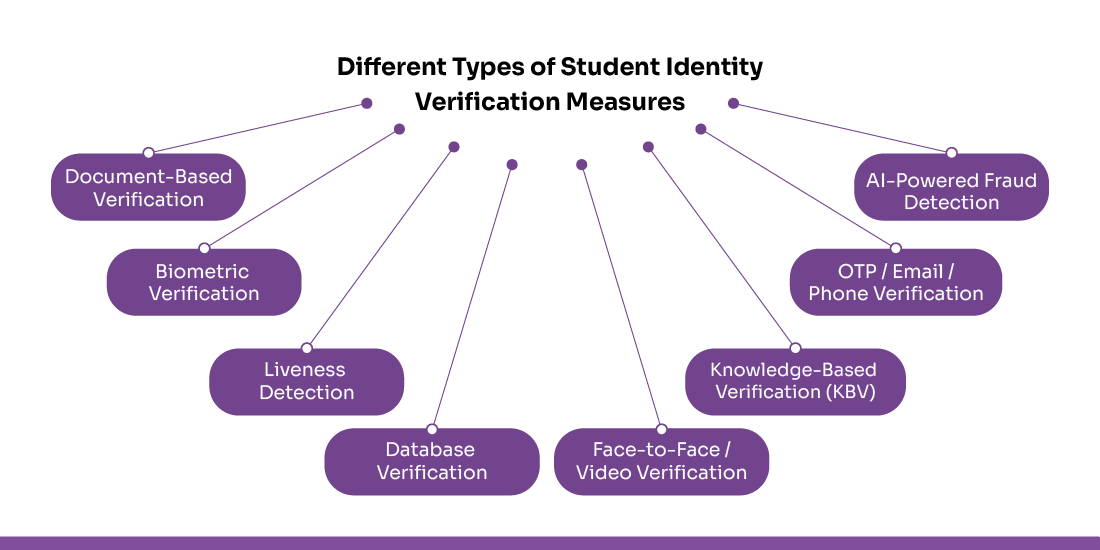
Universities use multiple layers of identity verification to ensure every applicant is genuine, protect against fraud, and maintain secure admissions workflows. These measures combine document checks, biometric technologies, database validation, and real-time authentication to confirm a student’s identity with accuracy and speed. Using a mix of these methods helps institutions reduce impersonation risks, meet compliance requirements, and build trust with students.
Document-Based Verification
Students upload government-issued IDs like passports, driver’s licenses, or national ID cards. The system checks for authenticity, security features, and signs of tampering.
Biometric Verification
Uses facial recognition, fingerprint scans, or iris matching to confirm the student’s identity. Face-matching against the ID photo is the most common method.
Liveness Detection
Ensures the person verifying is real and physically present by detecting movements, blinking, and natural facial depth—not a photo, video, or mask.
Database Verification
Cross-checks student details against trusted databases such as government registries, academic records, or third-party identity services.
Knowledge-Based Verification (KBV)
Asks challenge questions based on personal history or application details to validate authenticity (less used today but still relevant in some regions).
OTP / Email / Phone Verification
Confirms ownership of contact information through one-time passwords or secure links sent to the applicant’s email or mobile number.
AI-Powered Fraud Detection
Uses machine learning to identify duplicate profiles, suspicious patterns, manipulated documents, or potential identity theft attempts.
Face-to-Face / Video Verification
A live video call with an admissions officer or an automated video-verification tool to validate identity when higher assurance is needed.
How Universities Can Use Identity Verification at Different Stages
Universities can integrate identity verification across the entire student journey from first inquiry to final enrollment to prevent fraud, streamline processes, and ensure every applicant is legitimate. Using automated verification at key touchpoints helps institutions improve accuracy, speed up admissions decisions, and create a secure, trustworthy experience for both domestic and international students.
Let’s go through the different stages:
At the Inquiry Stage
- Verify basic contact details (email, phone, OTP verification).
- Filter out bots, fake leads, and duplicate inquiries early.
During Application Submission
- Require students to upload official government IDs.
- Automatically check document authenticity and flag suspicious files.
- Prevent fraudulent or incomplete applications from entering the pipeline.
Personal Profile & Document Upload Stage
- Extract student data (name, DOB, ID number) using OCR.
- Match the applicant’s profile with their identity document.
Before Reviewing Applications
- Conduct biometric face matching to ensure the applicant matches the ID.
- Use liveness checks to confirm the person is real and present.
During Financial Aid & Scholarship Processing
- Verify identity to prevent “ghost student” financial-aid fraud.
- Confirm the student’s eligibility before approving funds.
For International Students (Visa & Compliance)
- Validate passport information and cross-check with required immigration data.
- Maintain accurate records for compliance and reporting.
Pre-Enrollment & Onboarding
- Verify identity again before issuing student email, campus access, or digital IDs.
- Ensure only verified students get access to university systems and resources.
Exam & Assessment Integrity
- Authenticate student identity before online or remote exams.
- Reduce cheating, impersonation, or unauthorized access.
Campus Services & Housing
- Confirm identity for housing applications, ID cards, and service access.
- Prevent misuse of campus resources by unverified individuals.
How Big a Problem is Fraud in Education and E-Learning?
Fraud in education and e-learning has become a primary global concern as online admissions, remote learning, and digital assessments grow. Identity fraud, fake applications, “ghost students,” and cheating rings are costing institutions millions while damaging academic integrity. With rising digital enrollment, universities must adopt strong identity verification measures to protect their systems, students, and reputation. Let’s go through it in more detail:
Massive Financial Losses
Fraud rings have cost institutions millions. For example, U.S. colleges reported over $13 million in financial aid fraud in a single year, driven by fake or stolen identities.
Rise of ‘Ghost Students’
Fraudsters create fake student profiles to access grants, scholarships, or online coursework, often undetected due to insufficient ID verification.
Fake Applications Increasing
Community colleges and online programs have seen up to 20–30% of applications flagged as suspicious or fraudulent.
Cheating in Online Exams
Remote learning led to widespread impersonation, shared logins, and test-taking fraud, challenging academic integrity across e-learning platforms.
Document Forgery Growing
Fake transcripts, manipulated PDFs, and forged passports/IDs are becoming more sophisticated, making manual detection nearly impossible.
Threat to Accreditation & Compliance
Fraud incidents can lead to failed audits, compliance penalties, and risks to federal funding for institutions.
International Admissions Vulnerabilities
With rising overseas applications, identity fraud through fake passports or mismatched credentials is becoming more common.
Reputation Damage
Institutions hit by fraud often suffer loss of trust from students, parents, and partners, harming long-term credibility.
Finding a Trusted ID Verification Partner to Verify Your Students
Choosing the right identity verification partner is becoming a mission-critical decision for universities. With rising global enrollment and sophisticated fraud attempts, institutions need a partner that delivers accuracy, speed, and airtight security, without disrupting the student experience. A trusted provider not only strengthens admissions integrity but also modernizes how universities operate.
What Should You Look For in a Reliable Verification Partner?
Proven Accuracy & Fraud Detection
Opt for a partner with strong AI, biometric matching, and liveness detection to catch forged IDs and impersonation attempts with high precision.
Supports Global Document Types
Ensure the provider can verify passports and national IDs from multiple countries to streamline international admissions.
Fast, Automated Verification
Choose solutions that process verifications in seconds, reducing delays and admission backlogs.
Robust Compliance Standards
Look for certifications like GDPR, FERPA, SOC 2, or ISO 27001 to safeguard student data.
Seamless CRM/SIS Integrations
The system should connect easily with Slate, Salesforce, Banner, PeopleSoft, and other university platforms.
Scalable for Peak Seasons
A strong partner handles large volumes smoothly without requiring extra staff.
Smooth Student Experience
Mobile-friendly flows, clear steps, and fast results help reduce student drop-offs.
Transparent Reports & Audit Trails
Ensure they provide detailed logs, timestamps, and downloadable verification records for compliance.
Strong Customer Support
Look for onboarding assistance, training, and responsive technical support.
Higher-Ed Industry Experience
A partner who already works with universities will understand academic workflows and compliance needs.
Student Identity Verification Use Cases
Student identity verification plays a crucial role across every stage of the academic journey. As universities expand digital services, remote learning, and global admissions, strong verification measures help institutions stay secure, compliant, and efficient while delivering a seamless experience to students. Let’s see where Student Identity Verification make the most significant impact?
Admissions & Application Screening
A verified identity ensures the applicant is a real person using genuine documents. Universities can instantly detect forged passports, manipulated PDFs, and duplicate identities before the application even enters the review process, drastically reducing fraud and administrative load.
Financial Aid & Scholarship Processing
Identity checks prevent “ghost students” or fraud rings from accessing grants, loans, or scholarships. Automated verification ensures that only eligible, legitimate applicants receive aid, protecting institutional funds and improving compliance during audits.
International Student Enrollment
Universities can quickly and accurately validate passports, visas, and other immigration documents. This ensures compliance with immigration authorities and allows institutions to track legitimate international students through verified records.
Remote & Online Exam Authentication
Biometric and liveness checks confirm that the correct student is taking the exam. This reduces impersonation, shared accounts, and cheating, key challenges in online learning environments.
Preventing Fake Accounts in Online Programs
Identity verification blocks bots, fraudulent profiles, and multiple fake student accounts from enrolling in hybrid or fully online courses, ensuring academic integrity and protecting the value of the course.
Access to University Systems
Before issuing student emails, LMS logins, or portal access, universities verify identity to ensure sensitive information and resources are only accessed by legitimate students.
Onboarding & Campus Services
Verification is used during housing applications, ID card issuance, event access, meal plans, and other services. This prevents unauthorized access to campus resources and improves campus-wide safety.
Internship, Placement & Career Services
Before sharing resumes with employers or confirming participation in placement drives, universities ensure that students are who they claim to be, protecting corporate partners and the institution’s credibility.
Alumni Identity Verification
Former students requesting transcripts, certificates, or alumni benefits must be authenticated to avoid identity theft or misuse of institutional documents.
Summary
Student identity verification has become essential as universities handle more digital applications and face rising fraud risks. Fake documents, duplicate profiles, and “ghost students” misusing financial aid have made manual checks too slow and unreliable. Automated verification tools now help institutions confirm identities through document scanning, biometrics, and real-time fraud detection—making the process faster, safer, and far more accurate. Students can verify themselves from anywhere, improving global enrollment and reducing delays. For universities, it lightens staff workload, strengthens compliance, and protects institutional integrity. Overall, identity verification ensures that only genuine students access admissions, exams, campus systems, and key services.
Frequently Asked Questions
Ques 1. When is Identity Verification Typically Required in Education?
Ques 2. What Challenges Do Institutions Face With Student Identity Verification?
Ques 3. Are There Specific Technologies Used in Online Student Verification?
Ques 4. How Do Institutions Benefit From Using Third-Party Verification Services?
Ques 5. Is Online Identity Verification Secure?
Ques 6. What Should Students Do If They Encounter Issues During Verification?
Written By






No comments yet. Be the first to comment!
Leave a Comment