

Table Of Contents
Introduction
Higher education is evolving rapidly, and universities are under growing pressure to enhance student outcomes, streamline operations, and stay competitive. Traditional approaches to teaching and administration often fall short in meeting these demands. This is where big data and analytics come in.
By collecting and analyzing vast amounts of student and institutional data, universities can uncover patterns, predict trends, and make informed decisions. From personalizing learning experiences to improving retention and optimizing resources, big data is transforming both teaching and administrative processes, helping institutions operate more efficiently while supporting student success.
The Role of Big Data in Higher Education Institutions
Big data refers to large volumes of digital information that universities collect and analyze to identify patterns, trends, and connections. This data can include numerical records, databases, text, images, and other digital formats.
In higher education, big data helps institutions improve decision-making, enhance student experiences, and optimize academic and administrative processes. By analyzing data from learning platforms, admissions systems, and student records, universities can better understand student behavior and improve educational outcomes.
Supporting Data-Driven Decision Making
Big data enables university leaders to make more informed and strategic decisions. By analyzing institutional data, administrators can identify trends in enrollment, academic performance, and resource usage. These insights help institutions develop effective policies and long-term strategies. As a result, decision-making becomes more accurate and aligned with institutional goals.
Improving Student Experience
Data analytics helps institutions understand how students interact with academic systems and campus services. By examining engagement patterns, universities can identify areas where students may face difficulties. This information allows institutions to improve support services and campus resources. Ultimately, it helps create a more positive and supportive learning experience for students.
Enhancing Academic Programs and Course Design
Data analytics allows universities to evaluate the effectiveness of their academic programs. By analyzing course outcomes, assignment results, and student feedback, institutions can identify areas where improvements are needed. Educators can use these insights to revise curriculum content and teaching strategies. This ensures that academic programs remain relevant and effective.
Monitoring Student Performance and Progress
Big data analytics enables universities to continuously monitor student performance and academic progress throughout their learning journey. By analyzing data such as grades, attendance, and assignment submissions, institutions can quickly identify students who may be struggling. This allows educators to provide timely support and early interventions to improve outcomes.
For example, Western Washington University has implemented a comprehensive data system to enhance both daily operations and long-term planning. By using aggregated data insights, the university has improved resource allocation, identified inefficiencies, and better predicted enrollment trends.
Improving Institutional Operations
Big data analytics helps universities streamline operations by identifying inefficiencies in admissions, enrollment management, and resource allocation. Insights from operational data enable administrators to simplify workflows and improve service delivery. Montclair State University, for example, integrated an AI agent into its enrollment marketing dashboard for targeted outreach.
Tools like EDMO Application Evaluator further speed up application processing and accelerate enrollments. Its AI-powered document analysis reviews SOPs, LORs, transcripts, and resumes with enhanced accuracy and provides insightful reports. This enables universities to make smarter, fairer admission decisions while minimizing human error.
Supporting Student Retention and Success
One of the most valuable roles of big data is identifying students who may be at risk of dropping out. By analyzing academic performance, engagement levels, and financial factors, institutions can predict potential challenges students may face. Universities can then provide targeted support such as tutoring, counseling, or financial aid. This proactive approach helps improve student retention and overall success.
Challenges Faced by Universities Without Big Data Analytics in Higher Education
Higher education institutions are currently facing several operational and academic challenges. Without the support of big data analytics, it becomes difficult for universities to identify trends, understand student behavior, and make strategic decisions. As a result, institutions often struggle to remain competitive, manage resources effectively, and improve student outcomes.
Below are some key challenges universities may face when they lack data-driven insights.
Declining Student Enrollment
Many colleges and universities have been facing a steady decline in student enrollment in recent years. While numbers are gradually recovering, attracting new students remains a major challenge for many institutions.
Without the use of data analytics to understand application trends and student preferences, universities may struggle to develop effective recruitment strategies. This highlights the growing importance of data-driven insights in improving enrollment planning and outreach efforts. According to recent data, new international student enrollment at U.S. colleges declined by 17% between fall 2024 and 2025, reflecting the ongoing enrollment challenges.
Low Student Retention and Completion Rates
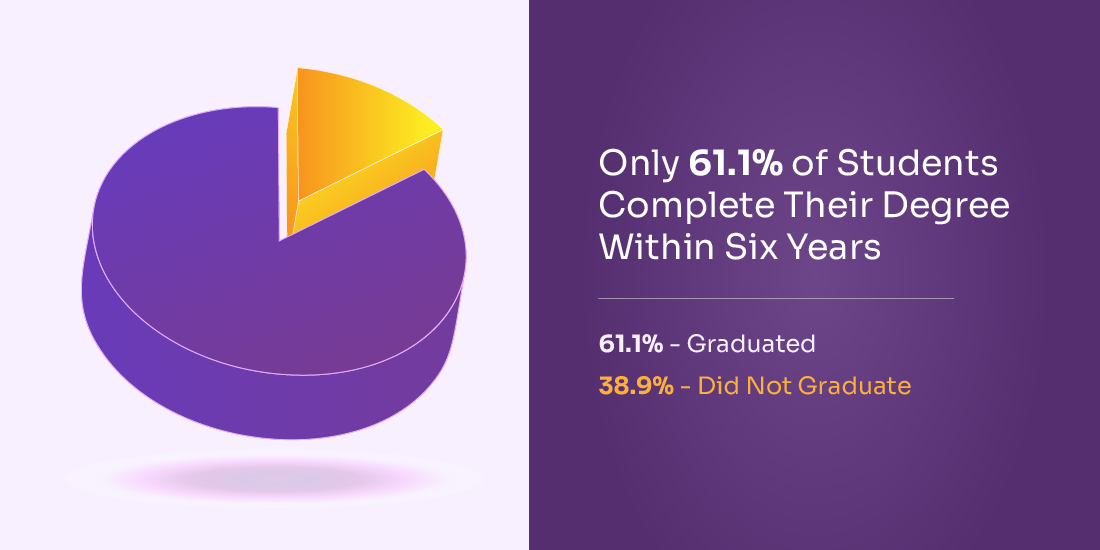
Student retention continues to be a significant challenge for higher education institutions. Many students either transfer to other colleges or discontinue their studies, particularly after the first year. This leads to lower completion rates and affects overall institutional performance. When students leave before graduating, universities face financial losses due to reduced tuition revenue and limited resources. Current data shows that only 61.1% of students complete their degree within six years, highlighting ongoing challenges in student retention and completion.
Rising Costs of Higher Education
The rising cost of higher education continues to place financial pressure on both students and universities. Institutions must balance operational expenses, maintain infrastructure, and provide quality academic services, often with limited funding. Without data-driven insights, efficiently allocating resources and controlling costs becomes challenging.
For example, tuition rates at private National Universities increased by 5.6% between the 2024–2025 and 2025–2026 academic years. Similarly, in-state and out-of-state tuition and fees at public National Universities rose by 4% and 4.7%, respectively, highlighting the growing financial demands on higher education.
Budget Constraints and Administrative Challenges
Many universities face budget reductions and administrative limitations. Reduced funding can affect faculty hiring, research initiatives, student services, and campus development. Without proper data analysis, it becomes difficult for institutions to prioritize spending and identify areas where resources should be allocated for maximum impact.
Increasing Competition from Alternative Education Options
Higher education institutions are also facing growing competition from alternative learning pathways such as vocational training, apprenticeships, certification programs, and trade schools. These options often provide faster and more affordable career opportunities, which can attract students who might otherwise pursue traditional university degrees.
5 Ways Big Data Can Enhance Higher Education
Big data analytics is transforming how universities manage academic programs, student services, and institutional operations. By analyzing large datasets generated from learning systems and student interactions, institutions can gain insights that improve both educational outcomes and operational efficiency.
Below are five important ways big data can enhance higher education.
Personalizing Learning Experiences
The traditional one-size-fits-all approach in education is becoming less effective as students’ learning needs and abilities vary widely. Big data empowers universities to create personalized learning experiences by analyzing academic performance, engagement patterns, and learning behaviors. AI-driven learning tools can assess student responses in real time and adjust lessons to provide the right level of challenge and support. Research shows that personalized learning platforms can improve student performance by up to 30% while significantly increasing engagement.
Key benefits include:
- Identifying individual student learning patterns and preferences.
- Providing personalized course materials and assignments.
- Offering additional support for students who struggle academically.
- Challenging advanced learners with more complex tasks.

Improving Educational Content Through Data Insights
Big data analytics helps educators understand how students interact with course materials such as lectures, videos, assignments, and assessments. By studying these interactions, universities can identify which teaching methods are effective and which topics students find difficult to understand.
Key benefits include:
- Analyzing how students engage with learning materials.
- Identifying topics or subjects that require better explanation.
- Improving course design and instructional strategies.
- Creating more engaging and accessible educational content.
Supporting Collaborative Learning and Student Engagement
Collaborative learning is essential for developing students’ communication, teamwork, and problem-solving skills. Big data analytics enables universities to create digital platforms that promote collaboration among students with shared interests or compatible learning styles.
By analyzing engagement data, institutions can form effective learning communities that foster peer interaction and knowledge sharing. This data-driven approach helps tailor group activities and projects to student preferences, improving participation and outcomes. Studies show that around 70% of students report higher satisfaction when their learning experiences are aligned with their interests through such insights.
Key benefits include:
- Creating digital platforms that support peer collaboration.
- Grouping students based on interests, skills, or learning styles.
- Encouraging knowledge sharing and teamwork.
- Increasing overall student engagement and participation.
Enhancing the Online Learning Experience
The growth of online education has increased the importance of data analytics in higher education. Universities now collect large amounts of data from online learning platforms to understand how students interact with digital courses. By analyzing this data, institutions can identify patterns in student engagement, track academic progress, and determine where learners may need additional support.
Key benefits include:
- Monitoring student engagement in online courses.
- Identifying areas where students may need additional help.
- Improving the design and delivery of digital learning content.
- Enhancing the overall online learning experience.
Improving Student Retention and Academic Success
Big data analytics enables universities to identify students who may be at risk of dropping out by examining academic performance, attendance, and engagement levels. Using predictive analytics, institutions can take proactive steps to support these students before challenges escalate. Interventions may include academic advising, tutoring, or financial assistance to help students stay enrolled and complete their degrees.
By analyzing patterns in grades, campus participation, and payment behavior, universities can target at-risk students early and provide timely support. Tools like EDMO Advisor Copilot complement these efforts by automating 24/7 student support and delivering personalized outreach to engage students throughout their enrollment journey. Its features include instant query resolution, lead scoring, and prioritization, helping universities respond faster, maintain higher engagement, and free admissions staff to focus on high-value tasks.
Key benefits include:
- Identifying students who may be at risk of leaving their programs.
- Providing early academic and financial support.
- Developing strategies to improve student retention.
- Increasing graduation rates and overall academic success.
Conclusion
Big data is reshaping higher education by providing actionable insights that benefit students, faculty, and administrators alike. From personalizing learning experiences and improving course content to enhancing online education, supporting collaboration, and boosting student retention, analytics is driving meaningful change across campuses. As universities continue to adopt data-driven strategies, they can make more informed decisions, optimize resources, and create learning environments that are smarter, more adaptive, and better aligned with the needs of modern students.
Frequently Asked Questions
Question 1. What is big data in higher education?
Question 2. How does big data improve student learning experiences?
Question 3. What kind of data helps universities predict enrollment trends?
Question 4. How can analytics support better financial planning in higher education?
Question 5. How does big data help improve student retention?
Written By


You May Also Like
 AI in Education

 AI in Education
 AI in Education
No comments yet. Be the first to comment!
Leave a Comment