

Table Of Contents
Introduction
While the ongoing debate over the inclusion of AI tools in teaching & learning elicits mixed reactions, higher education institutions are deploying them in enrollment operations to improve outcomes and meet student expectations.
As application volumes rise and expectations for personalized engagement increase, AI-powered enrollment tools have become essential for admissions staff. These advanced tools integrate data from websites, ad campaigns, emails, chat, and call centers to provide a comprehensive view of each prospective student.
Leveraging machine learning, they predict applicant intent, prioritize high-potential candidates, automate follow-ups, evaluate documents, and deliver real-time insights to support faster, more informed decisions. By automating repetitive tasks, enrollment teams can dedicate more time to meaningful interactions and strategic outreach. Rather than replacing admissions teams, AI bolsters their capabilities, enabling greater personalization, efficiency, and improved enrollment outcomes.
AI Chatbots: A 24/7 Admissions Frontline for Students
Students from different countries and geographies who are taking admission in colleges cannot be expected to adhere to office hours for resolving queries or addressing doubts. They are residing in different time zones, often researching programs late at night, comparing schools, and wanting quick answers. If schools are relying on manual processes, they may lose interested applicants to competitors that are automating these processes.
AI chatbots help by giving instant, accurate answers to questions about admissions, document requirements, financial aid, deadlines, programs, and campus life. Unlike traditional systems, they can handle thousands of questions at once, so no student has to wait during busy times, ultimately boosting application completion rates.
There are many types of platforms , from large enterprise tools to solutions made just for college admissions teams, such as EDMO. With no-code AI builders, schools can train chatbots using their own websites, catalogs, and policy documents. This cuts response times from hours to seconds and lets schools streamline their enrollment ecosystem.
Why Universities Should Deploy AI-Powered Chatbots?
However, it’s a common misconception that AI chat tools can only answer basic questions. The best platforms like EDMO’s Advisor & Student Copilot now offer features made for colleges and universities, such as:
Authentic Source-based responses: Advanced systems give answers based on official university documents. This helps prevent misinformation from spreading and builds trust.
No-code deployment: Admissions teams can set up and update AI assistants on their own, without IT support. The EDMO team can help you set up quickly
Centralized knowledge management: When universities train AI using their websites, PDFs, handbooks, and policy documents, they create one searchable place for all information. EDMO’s Knowledge Source is the best AI-driven repository for student documents.
Built-in lead analysis: Chatbots can reach out to visitors, collect their contact details, and connect with CRMs. This helps turn chats into real leads.
Complex Query Escalation: If a question is too complex, AI can quickly send the conversation to admissions staff through live chat, email, or ticketing systems. This keeps a good balance between automation and personal help.
Enterprise-level compliance and security: With data privacy rules like GDPR, top solutions focus on keeping applicant information safe and secure.
Admissions CRMs with AI-Powered Guidance
Contemporary admissions teams are reliant on Customer Relationship Management (CRM) systems to streamline recruitment processes, manage applicant data, and enhance communication throughout the student enrollment lifecycle.
Modern CRMs also have AI-powered plugins that centralize interactions from initial inquiry through enrollment, automate repetitive workflows, and enable institutions to deliver personalized, data-driven engagement that improves application completion rates and overall conversion outcomes.
Slate by Technolutions
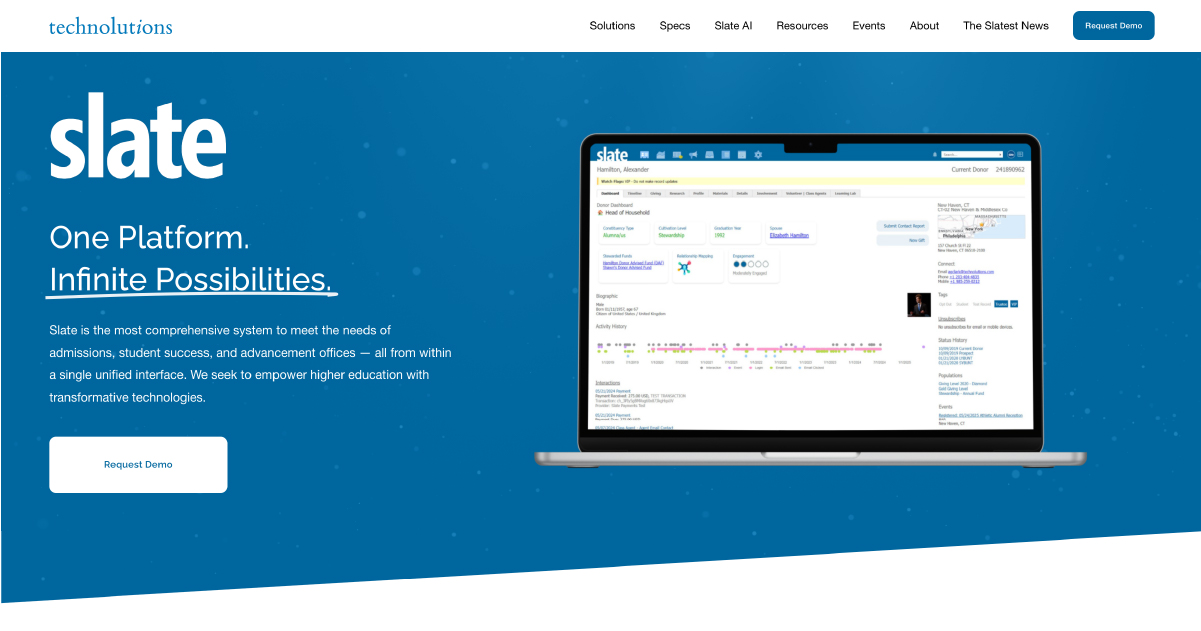
Slate is among the most widely adopted CRM platforms designed specifically for higher education admissions and enrollment management. It integrates application processing, communication tools, and analytics within a unified system, facilitating management of each stage of the student journey. Flexible workflows and customizable reporting enable institutions to tailor recruitment strategies to their specific requirements. Additionally, Slate supports integration with AI-powered tools and plugins that further automate and optimize admissions operations.
Benefits:
- Comprehensive admissions management: Handles application lifecycle from inquiry to decision.
- Strong data and analytics: Provides insights to optimize enrollment strategies.
- Custom workflows: Allows teams to configure processes based on institutional priorities.
Element451
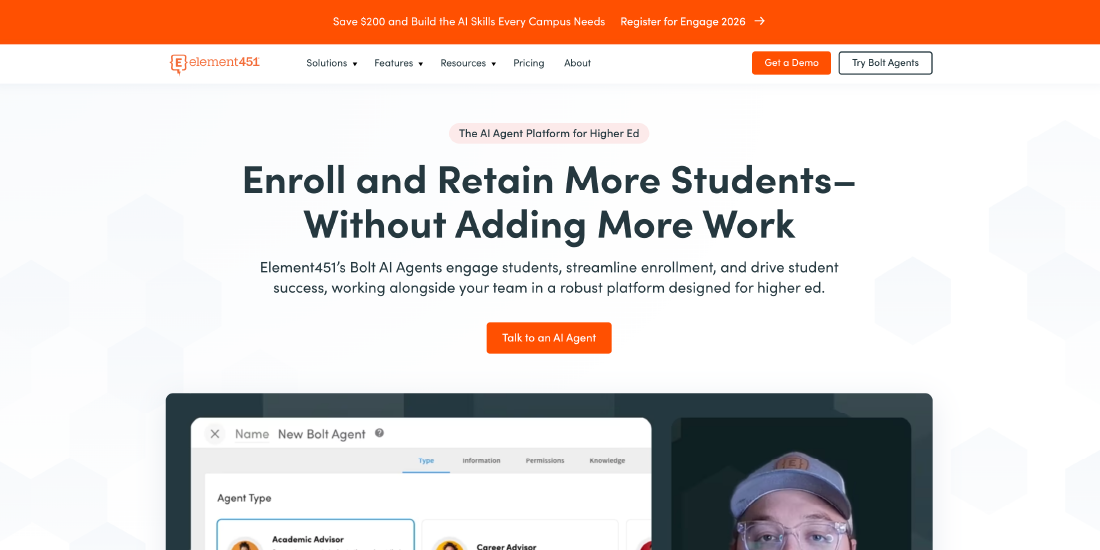
Element451 is a contemporary CRM platform focused on higher education, emphasizing engagement and automation. It assists admissions and marketing teams in attracting and nurturing qualified leads through advanced segmentation and automated, personalized outreach. AI-driven tools support communication campaigns and enable institutions to maintain timely connections with prospective students. Element451 also permits integration of AI modules that enhance predictive modeling, lead scoring, and personalized engagement workflows. engagement workflows.
Benefits:
- Automated communication plugins: Streamline outreach through personalized messaging.
- Data-driven engagement: Uses analytics to identify trends and improve interaction strategies.
- Student lifecycle visibility: Offers a 360° view of prospects through enrollment.
Salesforce Education Cloud
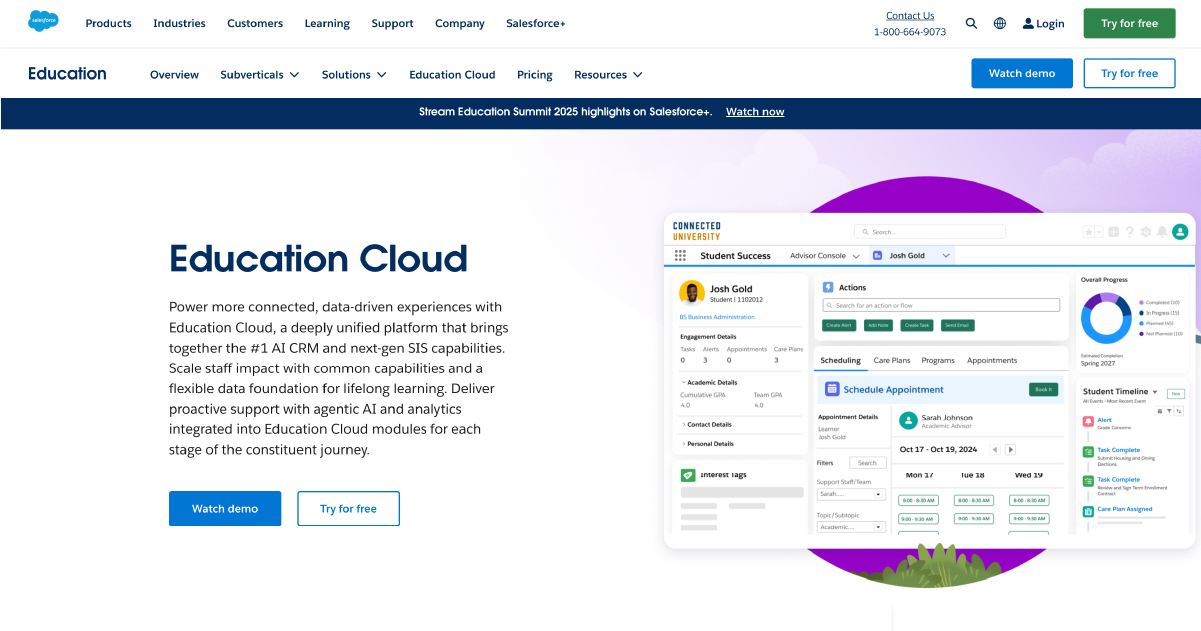
Salesforce Education Cloud is an enterprise-grade CRM platform that adapts Salesforce’s robust capabilities for the higher education sector. It supports recruitment, admissions, student engagement, and alumni relations within a single solution, and includes advanced AI and automation plugins. This cloud-based system enables institutions to unify data across departments, facilitating personalized interactions and improved decision-making. With integrated Salesforce Einstein AI and compatibility with third-party AI plugins, Education Cloud enables refined enrollment forecasting, personalized outreach, and automated lead prioritization.
Benefits:
- Unified data platform: Centralizes student and prospect data across the institution.
- AI and automation plugins: Drives personalized engagement and predictive insights.
- Scalability: Fits large universities and complex organizational needs.
HubSpot CRM
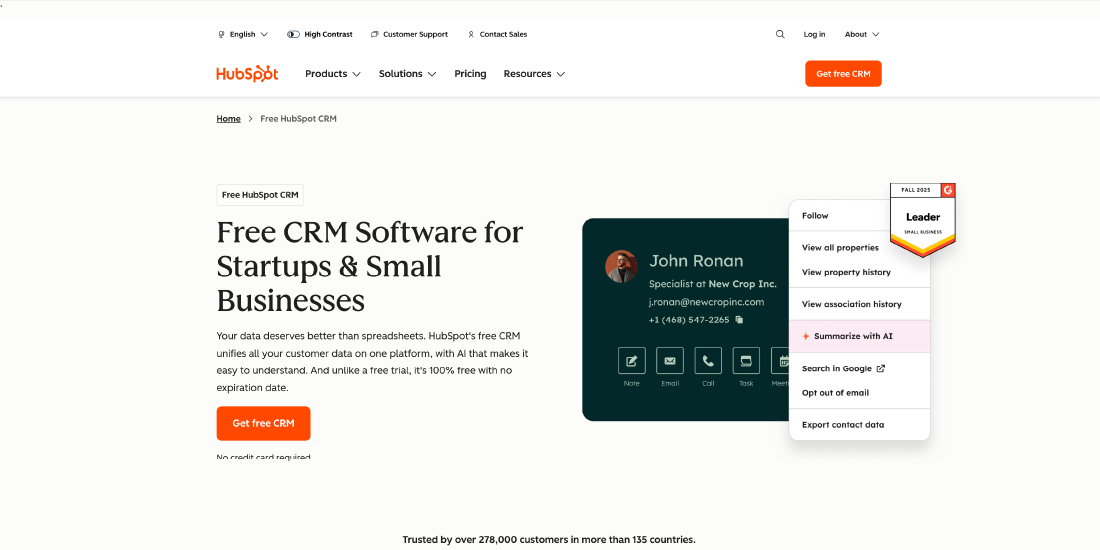
Although it’s not exclusively for education, HubSpot CRM is popular among smaller colleges and departments, all thanks to its intuitive interface and marketing automation capabilities. It supports admissions teams in nurturing applicants through automated workflows, email campaigns, and engagement metric tracking. The availability of a free tier makes it a cost-effective option for institutions initiating CRM adoption. HubSpot’s ecosystem also accommodates AI-powered add-ons and plugins that enhance predictive lead scoring, conversational bots, and intelligent segmentation to improve enrollment operations.
Benefits:
- Ease of use: User-friendly dashboard and quick onboarding.
- Marketing automation: Enables personalized applicant nurturing efficiently.
- Affordable entry: Offers a free CRM option with upgrade paths.
Predictive Analytics Platforms for Enrollment Forecasting
Accurately forecasting student enrollment is a significant challenge for admissions teams. Schools admit thousands of applicants each year, yet it remains difficult to predict who will enroll. This uncertainty complicates planning for budgets, staffing, housing, and course offerings. Overestimating enrollment can lead to overcrowded facilities, while underestimating may result in under-enrolled programs. Predictive analytics tools now enable schools to use data-driven methods rather than guesswork to improve enrollment forecasts.
Key Benefits:
Enrollment Probability Scoring – Calculates enrollment likelihood using demographics, engagement, academic history, and behavioral data.
Targeted Yield Campaigns – Identifies undecided admits, enabling teams to focus outreach, scholarships, and follow-ups where they have the greatest impact.
Reduced Summer Melt – Engages admitted students proactively with AI to keep them informed and committed before the term begins.
Smarter Lead Prioritization – Platforms such as EDMO’s Advisor Copilot analyze intent and engagement data to prioritize high-potential students and personalize outreach for improved conversion rates.
AI Analytics Dashboards for Recruitment Strategy
AI analytics dashboards provide admissions and enrollment teams with real-time, data-driven insights into the effectiveness of their recruitment strategies. It stops enrollment teams from relying on historical trends, unverified assumptions & empirical data. These dashboards aggregate and analyze data from website activity, chatbot interactions, email engagement, CRM usage, and campaign performance.
This approach identifies which channels, messages, and audiences generate the strongest results. For higher education institutions, the dashboards offer greater visibility into high-performing regions, responsive demographic segments, and common applicant challenges. Teams can then refine messaging, allocate marketing budgets more efficiently, and intervene earlier in the recruitment funnel.
As enrollment competition increases, AI-powered dashboards have become essential for strategic enrollment management, supporting continuous optimization through live insights instead of delayed, post-cycle reporting.
Key Platforms
- EDMO
- Google Analytics
- HubSpot
- Salesforce Education Cloud
- Full Fabric
Marketing Automation Platforms for Hyper-Personalization
AI-powered marketing tools are changing how schools connect with future students by replacing one-size-fits-all messages with personal, behavior-based communication. These tools look at things like browsing habits, stated interests, email activity, student records, and chatbot conversations to automatically send content that fits each student, such as information about programs, campus events, scholarships, and reminders to apply.
For admissions and enrollment teams, this means better engagement, more meaningful conversations, and steady support during the decision process. In a competitive market where students want personal experiences, highly personalized automation not only gets more students to open and reply to messages but also helps them feel understood and supported, which can influence their decision to enroll.
Key Platforms:
- HubSpot
- Marketo
- Salesforce Marketing Cloud
- Full Fabric
AI Scheduling Assistants
AI scheduling assistants simplify one of the most time-consuming admissions tasks: coordinating interviews, campus tours, and advising sessions. These tools integrate with staff calendars and scheduling platforms to show real-time availability and allow instant booking, eliminating the need for back-and-forth emails and manual checks.
For admissions and enrollment teams, this reduces administrative workload, minimizes scheduling errors, and enhances the applicant experience. By embedding scheduling into chat conversations or inquiry workflows and sending automated reminders, AI assistants save time, improve attendance rates, and keep prospective students engaged throughout recruitment.
Key Platforms
- EDMO’s Interview Analyzer
- Calendly
- Acuity Scheduling
- HubSpot Meeting Scheduler
- Wonderchat
Immersive Virtual Reality (VR) Tour Platforms
AI-powered virtual reality (VR) tour platforms are changing how schools show their campuses to future students, especially those from other countries or who cannot visit in person. Instead of just using still photos or simple 360-degree views, these new platforms offer interactive, AI-guided tours that change based on what each student likes and does during the tour.
For example, a student interested in engineering might see robotics labs and places where new ideas are developed, while an arts student might visit studios and places for performances. AI helpers give extra information and answer questions right away. By watching how users interact in the virtual tour, these platforms make the experience more personal without making it too much, helping schools connect with students early and reach more people around the world.
Popular VR Tour Platforms:
- YouVisit
- EAB (through YouVisit)
- StudentBridge
- CampusTours
AI-Powered Program Recommendation Engines
AI-powered recommendation tools help students find academic paths that match their interests, strengths, and career goals. Many applicants choose familiar majors without knowing about the wide range of specialized or new programs available.
These systems use algorithms like those in streaming or shopping platforms to look at academic history, browsing habits, stated interests, and chatbot questions. They then suggest majors, minors, certificates, or dual-degree options that fit each student. For admissions and enrollment teams, this means students get more personalized advice, and lesser-known programs with strong career prospects get more attention. This helps balance enrollment and supports steady program growth.
Key Platforms:
- Salesforce Education Cloud
- Slate
- Element451
- HubSpot
AI Knowledge Platforms: A Single Source of Truth
Admissions information is often spread out across websites, PDFs, internal drives, and departmental documents. This can cause inconsistent answers, extra work, and frustration for both applicants and staff. AI knowledge platforms help by bringing all this information together in one searchable place. These systems support both public chatbots and internal AI search tools.
Prospective students can get quick, accurate answers, and admissions teams can easily find verified policy or procedure details using natural language questions. With a single source of truth, institutions keep answers consistent, whether they come from an AI assistant or a human advisor. This reduces misinformation, saves time, and builds trust.
Key Platforms:
- EDMO’s Knowledge Source
- Glean
- Coveo
- Wonderchat
- Algolia
Generative AI Tools for Marketing Content
Producing high-quality, personalized marketing content for different groups of applicants, such as domestic undergraduates and international graduate students, takes a lot of time and creativity. Generative AI tools now help admissions marketing teams create more content without losing the personal touch.
By using data from CRM systems, chatbot conversations, and how applicants interact with content, these tools can generate custom email campaigns, landing page text, social media posts, and ads for specific programs, regions, or student interests. This helps teams work faster, try out different messages, and send relevant information throughout the recruitment process. In a competitive environment, generative AI lets institutions keep their outreach consistent and high-quality while saving time and focusing on strategy.
Key Platforms:
- Jasper
- Copy.ai
- ChatGPT
- Gemini
The Future of Admissions is AI-Powered Enrollment
This is not a prediction but an emerging reality. As application volumes increase, student expectations rise, and global competition intensifies, traditional manual processes are no longer sufficient. AI is already transforming admissions through predictive enrollment forecasting, personalized communication, automated document verification, and real-time student support. Institutions adopting AI-powered enrollment strategies gain measurable advantages in speed, accuracy, and student experience. Those who delay risk falling behind. AI is becoming the foundational infrastructure that will shape modern enrollment management in the years ahead.
Conclusion
AI is no longer just a future consideration for admissions. It is becoming the core engine driving smarter, faster, and more student-centric enrollment strategies. Institutions that embrace AI-powered tools today will be better positioned to improve efficiency, enhance applicant experiences, and compete effectively in an increasingly complex higher education landscape.
Frequently Asked Questions
Ques 1. How does AI help university admissions teams?
Ques 2. How can AI make the application process easier for students?
Ques 3. Can AI replace the human touch in admissions?
Ques 4. Is it complicated to set up an AI system for an admissions office?
Written By


You May Also Like
 AI in Education

 AI in Education
 AI in Education
No comments yet. Be the first to comment!
Leave a Comment