

Table Of Contents
- 1Introduction
- 2What is Higher Education Procurement?
- 3Examples of Procurement in Education
- 4The 3 Ps of Procurement in Higher Education
- 5The Four Key Types of Procurement in Education
- 6How the University Procurement Process Functions
- 7Why Higher Education Institutions Rely on Procurement Solutions
- 8Key Benefits of Procurement in Educational Institutions
- 9Key Participants in the Educational Procurement Process
- 10Practical Steps for Effective Procurement in Educational Institutions
- 11Effective Procurement Practices for Educational Institutions
- 12Key Challenges in Educational Procurement
- 13How Technology Improves Education Procurement
- 14Key Performance Metrics for Education Procurement Success
- 15Evaluating Procurement Performance in Educational Institutions
- 16Conclusion
Introduction
Procurement in higher education plays a critical role in ensuring that universities operate efficiently, remain financially accountable, and deliver high-quality academic experiences. From sourcing classroom technology and research equipment to managing administrative services and campus infrastructure, procurement supports nearly every function within an institution.
Unlike traditional purchasing, higher education procurement involves strategic planning, regulatory compliance, vendor evaluation, and long-term financial management. Understanding how procurement works in universities provides valuable insight into how institutions transform financial resources into educational impact.
What is Higher Education Procurement?
Higher education procurement is a strategic approach that guides how colleges and universities acquire goods, services, and resources. Unlike simple purchasing, which involves the actual buying of items, procurement encompasses a broader framework that includes sourcing, negotiating, contracting, and ensuring compliance with institutional goals and policies.
The primary aim of higher education procurement is to maximize efficiency, reduce costs, and align spending with academic and operational priorities. By taking a strategic approach, institutions can ensure that every purchase supports their overall mission while delivering value for money.
Examples of Procurement in Education
Procurement in educational institutions involves sourcing goods, services, and technologies that support academic programs, campus operations, and administrative efficiency. It extends beyond traditional purchasing to include modern tools that enhance learning, streamline processes, and improve student experiences. Key examples include:
Classroom Supplies and Learning Materials
- Textbooks, workbooks, and teaching aids
- Laboratory and scientific equipment
- Art supplies, musical instruments, and educational kits
Technology and IT Services
- Computers, laptops, tablets, and projectors
- Software licenses, learning management systems, and e-learning platforms
- Network infrastructure, cybersecurity solutions, and cloud-based services
Administrative and Digital Solutions
- AI-powered application evaluators to support admissions and academic assessments
- Chatbots for student inquiries, enrollment guidance, and administrative support
- Workflow automation tools for finance, HR, and student management
- Document management and e-signature systems for faster approvals and compliance
Facilities and Infrastructure
- Classroom, office, and library furniture
- Campus renovation materials and construction services
- Maintenance services for HVAC, electrical, and plumbing systems
The 3 Ps of Procurement in Higher Education
Successful procurement in colleges and universities relies on three core components: People, Process, and Paperwork. These elements work together to ensure efficiency, compliance, and value in every purchase.
People
This refers to the individuals involved in every stage of the procurement and purchasing cycle. From faculty and administrative staff identifying needs to procurement officers managing sourcing, negotiation, and vendor relationships, having skilled and informed personnel is essential for smooth operations.
Process
The process encompasses the workflows, rules, and strategies that guide procurement activities. Clear procedures for requisitions, approvals, bidding, and contract management ensure that purchases are efficient, transparent, and aligned with institutional goals.
Paperwork
Paperwork involves managing all documentation related to procurement, including purchase orders, contracts, invoices, and audit trails. Efficient recordkeeping supports compliance, accountability, and accurate tracking of spending across the institution.
By effectively integrating these three Ps, higher education institutions can create a streamlined, transparent, and strategic procurement system that delivers value, reduces risk, and supports the institution’s mission.
The Four Key Types of Procurement in Education
Educational institutions manage procurement across different categories to meet academic, operational, and strategic needs. Understanding these types helps schools and universities optimize spending, improve efficiency, and support institutional goals.
Direct Procurement
Direct procurement involves acquiring goods and services that are directly tied to the institution’s core educational mission. Examples include classroom supplies, laboratory equipment, educational software, and learning resources. These purchases have a direct impact on student learning and overall institutional performance.
Indirect Procurement
Indirect procurement covers goods and services that support the institution’s operations but are not directly linked to teaching and learning. This includes maintenance supplies, janitorial services, office equipment, utilities, and administrative resources. While less visible, these purchases are essential for maintaining a functional and efficient educational environment.
Strategic Procurement
Strategic procurement emphasizes long-term planning and informed decision-making rather than routine, transactional purchasing. It focuses on building strong vendor relationships, securing favorable contract terms, and aligning procurement activities with the institution’s overall strategic objectives.
Sustainable Procurement
Sustainable procurement focuses on making purchasing decisions that are environmentally responsible and socially ethical. It evaluates the full lifecycle impact of products and services, from sourcing and production to usage and disposal. This approach supports an institution’s commitment to sustainability, environmental stewardship, and corporate social responsibility. Notably, 81% of procurement leaders now consider sustainability a top priority, reflecting its increasing importance in modern procurement strategies.

How the University Procurement Process Functions
University procurement is a structured and strategic process designed to ensure transparency, cost efficiency, compliance, and value for money. Institutions follow defined methods to manage purchasing activities effectively while maintaining accountability. Below are the key components of how procurement works in a university:
Tendering:
To conduct structured and competitive bidding processes such as RFPs (Request for Proposals), RFQs (Request for Quotations), and auctions. Through eProcurement systems, universities can streamline bid solicitation, evaluate supplier responses, award contracts fairly, and manage vendor performance more efficiently.
Strategic Sourcing:
To identify, evaluate, and onboard qualified suppliers while maintaining a reliable vendor database. This process also involves analyzing spending patterns and procurement categories to negotiate better contracts and improve long-term sourcing strategies.
Invoicing Automation:
To digitize the exchange of invoices between the university and suppliers. eProcurement systems automate invoice approvals, reduce paperwork, minimize errors, speed up payments, and lower administrative costs.
Contract Management:
To securely store, monitor, and manage supplier contracts throughout their lifecycle. Automated tracking ensures timely renewals, compliance monitoring, and better visibility into contractual obligations.
Catalog Management:
To create and maintain approved catalogs of goods and services from contracted suppliers. This helps departments purchase standardized items at negotiated rates while maintaining policy compliance.
Purchasing Operations:
To facilitate the efficient purchase of goods and services. eProcurement platforms simplify ordering through integrated supplier portals (punchouts), ensuring purchases align with pre-negotiated contract terms and institutional policies.
Why Higher Education Institutions Rely on Procurement Solutions
Higher education institutions use structured procurement processes to manage the purchase of goods and services efficiently while ensuring accountability, cost-effectiveness, and compliance. The key reasons universities and colleges implement robust procurement practices include:
Supporting Scalable Admissions Processes
As application volumes rise, universities rely on digital solutions like AI-powered application evaluators, CRM platforms, and automated document verification to handle workloads efficiently. Procurement solutions help source and implement these tools cost-effectively. In fact, universities that adopt automated admissions and enrollment systems can cut application processing time by more than 50%. Tools like the EDMO Application Evaluator enhance this process through AI-powered document analysis, seamless bulk processing, and insightful analytics. It quickly reviews SOPs, LORs, transcripts, and resumes to highlight applicant strengths, minimize human error, and support faster, smarter, and more data-driven admissions decisions.
Managing Infrastructure and Learning Resources
Growing enrollment directly impacts classroom capacity, housing, IT infrastructure, and digital learning platforms. Procurement solutions ensure institutions acquire the right resources, such as learning management systems, hybrid classroom technologies, and student support software, while staying within budget constraints.
Improving Financial Planning and Budget Control
Enrollment fluctuations significantly affect tuition revenue and funding allocations. Procurement systems provide real-time visibility into spending, helping institutions adjust investments based on projected enrollment numbers and maintain financial sustainability.
Ensuring Compliance and Risk Management
Admissions and enrollment processes involve sensitive student data and regulatory compliance requirements. Procurement solutions help institutions select secure, compliant technologies that protect data privacy and meet accreditation standards. As AI tools proliferate on campuses, nearly 38 % of institutions are increasing data governance processes to handle risks related to AI adoption and student data security.
Enhanced Transparency and Accountability
Centralized procurement systems improve reporting and tracking, enabling leadership to monitor spending patterns and ensure responsible resource allocation.
Key Benefits of Procurement in Educational Institutions
Implementing Procurement systems in schools and universities creates a more efficient, transparent, and cost-effective procurement process. These solutions offer multiple advantages that improve overall operations:
Increased Process Efficiency
To streamline purchasing workflows, Procurement improves speed, accuracy, and compliance. Digital systems provide real-time tracking of orders, budgets, and approvals. Built-in workflows ensure that purchases follow institutional policies and approval requirements.
Cost Savings on Purchases
Procurement systems help institutions reduce expenses by consolidating spending, encouraging competitive bidding, securing rebates, and minimizing non-compliant purchases while eliminating paperwork and postage costs. As a result, schools can typically achieve cost reductions of 8–12%. Organizations that adopt data-driven procurement strategies report average annual savings of 15–20%, often surpassing industry benchmarks by more than 10%.
Improved Spend Visibility
To gain a clear overview of all purchases, centralized procurement systems track spending against budgets and forecasts. This visibility helps flag potential budget issues and enables informed decision-making.
Enhanced Oversight and Governance
To strengthen financial control, Procurement centralizes purchasing data and digitizes approval processes. Every transaction purpose, approver, date, and amount is recorded in an automated audit trail.
Policy controls can limit purchases by category, vendor, or dollar value, ensuring compliance with institutional and Department of Education guidelines.
Better Vendor Management
To manage suppliers effectively, Procurement standardizes vendor data and centralizes contact information. Institutions can quickly identify preferred vendors, compare pricing, and maintain digital records of communications and transactions, fostering stronger supplier relationships.
Key Participants in the Educational Procurement Process
Understanding the procurement process in educational institutions requires knowing the main stakeholders and their roles. Each plays a critical part in ensuring that purchasing is efficient, compliant, and aligned with institutional goals:
Educational Institutions
To define procurement needs, set budgets, and ensure that all purchases support the institution’s academic, administrative, and operational objectives. Schools and universities are ultimately responsible for aligning procurement with their strategic goals.
Procurement Officers
To manage the end-to-end purchasing process, including negotiating contracts, evaluating suppliers, processing orders, and ensuring compliance with institutional policies and regulations. They act as the central coordinators of all procurement activities.
Teachers and Administrators
To provide input on essential resources, such as classroom materials, technology, or operational tools, to help prioritize purchases that directly support teaching, learning, and administrative efficiency.
Suppliers and Vendors
To deliver quality goods and services on time, maintain transparent communication, and collaborate with institutions to meet contractual obligations. Strong supplier relationships ensure reliability and long-term value.
Government and Regulatory Authorities
To establish procurement guidelines, funding policies, and compliance requirements. These bodies help maintain transparency, fairness, and accountability in educational procurement processes.
Practical Steps for Effective Procurement in Educational Institutions
Implementing efficient procurement practices in schools, colleges, and universities ensures value for money, compliance, and alignment with institutional goals. The following steps provide a clear framework for successful procurement:
Assess Institutional Needs and Define Goals
The foundation of effective procurement is clearly identifying institutional requirements and aligning them with strategic objectives. Whether purchasing classroom materials, technology, or infrastructure, collaboration with stakeholders is essential.
Key actions:
- Engage teachers, administrators, and staff to identify priority needs.
- Define clear product or service specifications suitable for educational use.
- Align procurement needs with the institution’s mission and long-term goals.
When procurement decisions support broader institutional objectives, they deliver greater impact and value.
Plan and Allocate the Budget Strategically
Sound budgeting ensures procurement decisions remain financially sustainable while meeting both immediate and long-term needs.
Key actions:
- Review available funds and allocate them based on priority requirements.
- Balance short-term procurement demands with long-term financial planning.
- Ensure compliance with funding rules, grant conditions, or regulatory guidelines.
Careful budget planning reduces financial risk and supports responsible spending.
Select the Right Vendors
Choosing reliable and qualified suppliers is critical to achieving procurement goals. A structured vendor selection process ensures quality, value, and fairness.
Key actions:
- Conduct market research to identify reputable suppliers.
- Issue Requests for Proposals (RFPs) or Requests for Quotations (RFQs) to encourage competitive bidding.
- Evaluate vendor proposals based on pricing, quality, compliance, and alignment with requirements.
Using supplier sourcing tools or procurement software can streamline vendor evaluation and improve decision-making efficiency.
Negotiate and Finalize Contracts
After selecting vendors, contract negotiation ensures clear expectations and protects institutional interests.
Key actions:
- Finalize terms covering pricing, delivery timelines, warranties, and service guarantees.
- Ensure contracts comply with legal and institutional procurement policies.
- Obtain all required internal approvals before formalizing agreements.
Effective contract negotiation strengthens accountability and reduces future disputes.
Monitor Performance and Evaluate Outcomes
Procurement does not end with contract signing. Continuous monitoring ensures that suppliers meet expectations and that institutional goals are achieved.
Key actions:
- Verify timely delivery and quality of goods or services.
- Evaluate supplier performance against contract terms and service standards.
- Document lessons learned to improve future procurement cycles.
Establishing performance metrics and KPIs helps institutions track progress and drive continuous improvement.
Effective Procurement Practices for Educational Institutions
Maximizing the benefits of procurement in schools, colleges, and universities requires applying consistent best practices across all departments. Implementing these strategies helps increase efficiency, standardization, and cost-effectiveness:
Centralize Procurement
To ensure consistency and control, centralize procurement under a dedicated office. While individual departments may request purchases, procurement professionals can manage spending policies, contract oversight, and approvals, ensuring all purchases align with institutional goals.
Consolidate Vendors and Maintain Clean Records
To improve efficiency and secure better pricing, institutions should reduce the number of suppliers within common spending categories. Regular contract reviews help eliminate duplicate vendors, correct data inaccuracies, and standardize supplier information. Maintaining clean and centralized records streamlines procurement management and minimizes purchasing errors.
Establish Clear eProcurement Policies
To promote compliance and standardization, create well-documented procurement policies covering purchase requisitions, approvals, purchase orders, and workflows. Clearly define what can be purchased under contracts versus items requiring competitive bidding, ensuring all transactions follow institutional rules.
Train Staff on Policies and Procedures
To encourage compliance and stakeholder support, provide regular training on procurement processes and policies. Educating staff on the benefits of using preferred suppliers and optimizing spend reduces non-compliant purchases and positions procurement teams as helpful advisors rather than gatekeepers.
Leverage Data Analysis
To make informed decisions, analyze procurement and spending data against benchmarks. Insights from data analysis can identify opportunities for consolidation, contract optimization, and process improvements. Reporting functions also track compliance with initiatives such as environmental, social, and governance (ESG) criteria and supplier diversity goals.
Utilize Cooperative Buying Programs
To access better pricing and supplier options, participate in cooperative procurement programs like E&I Cooperative Services, which aggregates purchasing across thousands of institutions.
Cooperative contracts provide pre-negotiated terms, reduce administrative effort, and allow institutions to quickly adopt cost-effective solutions without running full RFPs.
Manage Supplier Relationships
To ensure quality and reliability, thoroughly vet suppliers, define expectations in contracts, and monitor ongoing performance. Strong vendor relationships improve fulfillment, accountability, and service levels.
Achieve Cost Savings
Institutions can significantly reduce purchasing costs by leveraging bulk-buying power through cooperative procurement programs. By combining purchases across multiple institutions, they can secure discounts that are often unavailable to individual organizations while also reducing the time spent on sourcing, vetting, and negotiating suppliers.
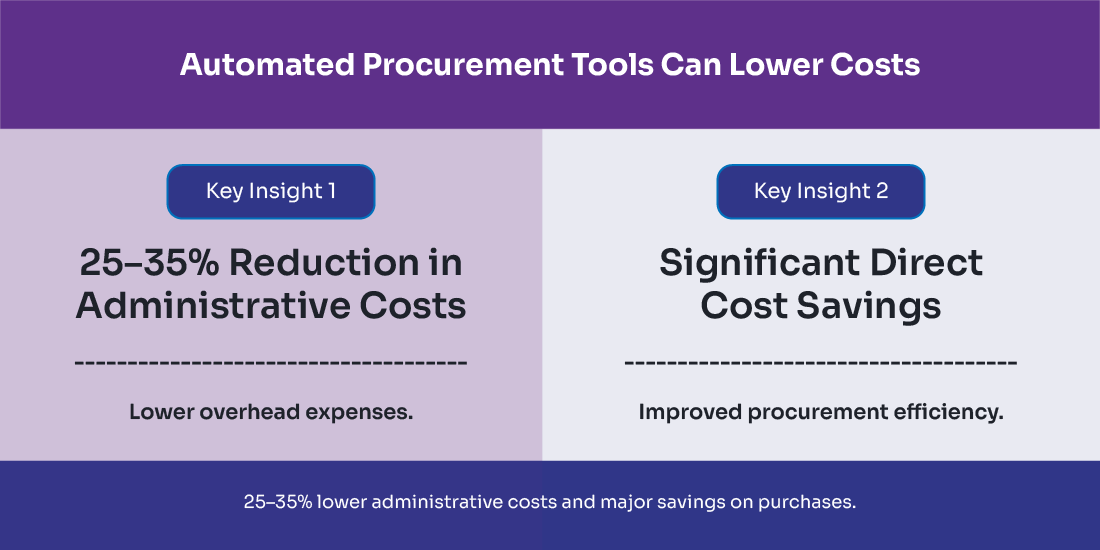
This collaborative approach streamlines administrative processes and improves overall efficiency. Additionally, data indicates that automated procurement tools can lower administrative costs by 25–35% while generating substantial direct cost savings.
Key Challenges in Educational Procurement
Educational institutions face several distinct challenges when managing procurement due to financial, regulatory, and technological factors.
Financial Constraints: Managing Limited Budgets
Schools and universities often operate under tight financial conditions, with limited funding sources, rising operational costs, and competing institutional priorities. Budget scrutiny from stakeholders adds additional pressure.
Institutions typically need to:
- Upgrade technology infrastructure
- Maintain aging facilities
- Procure educational resources
- Support faculty and staff development
All of this must be managed within static or even shrinking budgets.
Strategies to address financial constraints:
- Explore creative funding options and grant opportunities
- Implement zero-based budgeting for more efficient spending
- Prioritize essential investments
- Develop cost-sharing or partnership models
Regulatory Complexity: Ensuring Compliance
Educational procurement is subject to a complex web of regulations, including federal and state guidelines, local institutional policies, funding-specific rules, and ethical standards.
Institutions must:
- Follow all legal requirements rigorously
- Maintain transparency in procurement activities
- Document transactions accurately
- Mitigate audit risks
- Adapt to frequently changing regulations
Strategies to manage Regulatory Challenges:
- Provide ongoing compliance training for staff
- Develop detailed documentation and record-keeping systems
- Conduct regular internal audits
- Utilize specialized procurement compliance software
- Foster a culture of awareness around regulatory requirements
Technological Challenges: Keeping Pace with Rapid Change
Technology in education is evolving rapidly, with new learning tools, digital infrastructure, cybersecurity requirements, and changing pedagogical needs. Institutions must:
- Anticipate future technology trends
- Balance innovative solutions with budget limitations
- Ensure compatibility across systems
- Support smooth integration and lifecycle management of technology
Strategies to address technological disruption:
- Develop multi-year technology roadmaps
- Establish flexible procurement frameworks and approval timelines
- Form technology evaluation committees
- Build scalable and modular infrastructure
- Prioritize upgradable solutions that adapt to evolving needs
How Technology Improves Education Procurement
Modern procurement technology transforms traditional, paper-based systems into efficient, data-driven workflows. By implementing the right procurement automation strategy, educational institutions can streamline operations, strengthen compliance, and gain better control over spending.
Workflow Automation
Procurement software minimizes manual intervention by automating routine tasks such as requisition processing, purchase order creation, and invoice matching. This accelerates procurement cycles and frees staff to focus on higher-value responsibilities like vendor negotiations and strategic sourcing.
Improved Compliance Management
Technology helps ensure that procurement activities consistently align with institutional policies and regulatory requirements. Features such as automated compliance checks, structured approval hierarchies, and comprehensive audit trails significantly reduce the risk of non-compliance while simplifying audit preparation. In fact, approximately 67% of procurement teams use e-procurement or automated systems to strengthen policy compliance and improve governance oversight.
Faster and More Transparent Approvals
Digital workflows automatically route requisitions to the appropriate stakeholders, reducing delays. Mobile-enabled systems allow approvals from anywhere, while self-service portals empower faculty and staff to submit and track requests independently.
Supplier Performance Monitoring
Procurement systems help institutions systematically evaluate vendor performance based on delivery timelines, product quality, and pricing agreements. This data-driven evaluation strengthens supplier relationships and improves accountability.
Cost Reduction and Strategic Savings
By supporting competitive bidding, contract management, spend analytics, and automated invoice reconciliation, procurement software helps institutions identify cost-saving opportunities and eliminate unnecessary expenses.
Key Performance Metrics for Education Procurement Success
Measuring procurement performance in educational institutions requires tracking the right Key Performance Indicators (KPIs). These metrics help identify inefficiencies, improve decision-making, reduce risks, and demonstrate the overall value procurement brings to the institution. Below are the essential procurement metrics institutions should monitor:
Cost Management KPIs
To evaluate financial efficiency and spending control. Important metrics include cost savings achieved, cost avoidance, purchase price variance (PPV), and cost per transaction. These indicators help assess whether procurement strategies are delivering measurable financial benefits.
Vendor Performance KPIs
To measure supplier reliability and service quality. Key metrics include on-time delivery rates, product or service quality ratings, defect rates, and vendor responsiveness. Monitoring these ensures suppliers consistently meet institutional standards and contractual obligations.
Process Efficiency KPIs
To assess how smoothly procurement workflows operate. Metrics such as purchase order (PO) cycle time, overall procurement cycle time, approval delays, and the rate of emergency purchases help identify bottlenecks and areas needing improvement.
Compliance and Risk KPIs
To ensure adherence to policies and minimize risk exposure. These include contract compliance rates, maverick spending levels (off-contract purchases), vendor concentration risk, and audit findings. Tracking these metrics strengthens governance and reduces financial and operational risks.
Evaluating Procurement Performance in Educational Institutions
Measuring procurement effectiveness in schools, colleges, and universities requires a structured approach using relevant performance indicators. Below are the key performance indicators (KPIs) that help assess procurement effectiveness in education:
Cost Savings Percentage
Procurement success is not only about reducing expenses but about achieving value for money. Institutions should measure total cost of ownership (TCO) and compare actual spending against baseline budgets, historical data, and market benchmarks. This helps determine whether procurement strategies are delivering meaningful financial benefits.
Vendor Performance Metrics
Monitoring supplier performance ensures reliability and quality. Key indicators include on-time delivery rates, consistency in product or service quality, responsiveness to institutional needs, innovation capabilities, effectiveness of technical support, and pricing competitiveness.
Contract Compliance Rates
To maintain transparency and accountability, institutions must track adherence to procurement policies and legal guidelines. This includes reviewing documentation completeness, regulatory compliance, ethical procurement standards, financial transparency, and overall risk management effectiveness.
Resource Utilization Efficiency
Procurement effectiveness also depends on how well purchased resources are used. Institutions should analyze technology adoption rates, actual utilization levels, operational productivity improvements, educational impact, and return on investment (ROI) for specific acquisitions.
Stakeholder Satisfaction Surveys
Beyond quantitative metrics, qualitative feedback is essential. Surveys should assess satisfaction with resource quality, usability, perceived educational impact, alignment with institutional goals, and suggestions for improvement.
Conclusion
Procurement in higher education is a structured, multi-stage process designed to balance cost efficiency, compliance, quality, and institutional goals. From identifying needs and securing budget approvals to issuing RFPs, evaluating vendors, and finalizing contracts, each stage plays a vital role in ensuring responsible use of institutional funds.
As universities increasingly adopt digital procurement systems, AI-powered tools, and automated workflows, procurement is becoming more transparent, data-driven, and strategically aligned with enrollment growth and academic success.
Frequently Asked Questions
Question 1. What Is Procurement in Education?
Question 2. What Are the Types of Procurement Activity in Higher Education?
Question 3. How Can Vendors Enter the Higher Education Procurement Market?
Question 4. What Are the Main Challenges of Procurement in Higher Education?
Written By




No comments yet. Be the first to comment!
Leave a Comment