

Table Of Contents
- 1Introduction
- 2What is the 2026 Enrollment Cliff?
- 3What Caused the Enrollment Cliff?
- 4Strategies Colleges Are Using to Handle the Enrollment Decline
- 5Regional and Demographic Impact Variations on Institutions Amid the Enrollment Cliff
- 6How Different Institutions Are Affected by the Enrollment Cliff?
- 7 Institutions Likely to Be More Resilient
- 8Conclusion
Introduction
The 2026 enrollment cliff is a significant shift in higher education, marked by declining numbers of traditional college-aged students. Colleges and universities across the country are facing increased competition for a smaller pool of applicants, while demographic changes, rising tuition costs, and alternative education pathways are reshaping student choices. Understanding the causes, timeline, and potential impacts of the enrollment cliff is essential for institutions, students, and communities alike.
What is the 2026 Enrollment Cliff?
The 2026 enrollment cliff refers to the sharp decline in the number of college-age students expected to continue through 2026 and beyond. This trend is reshaping higher education, affecting both domestic and international student populations, and creating significant challenges for colleges and universities that rely heavily on tuition revenue.
Declining Domestic High School Graduates
- The Western Interstate Commission for Higher Education (WICHE) projects that the number of U.S. high school graduates peaked at 3.8–3.9 million in 2025 and is now in a steady decline as we move through 2026.
- By 2041, high school graduates are expected to decrease by 13%, which would mean roughly 576,000 fewer students over a typical four-year period.
- This reduction represents a major structural shift for colleges, particularly those dependent on tuition revenue.
Declining International Student Enrollment
- The Institute of International Education (IIE) reported that overall international student enrollment in U.S. colleges fell by 1% in fall 2025, the first decrease after four consecutive years of growth.
- Undergraduate international enrollment increased slightly by 2%, but graduate and non-degree students dropped by 12% and 17%, respectively.
- According to NAFSA, this decline in new international students resulted in an estimated $1.1 billion in lost revenue and around 23,000 fewer jobs.
The term “demographic cliff” highlights how sudden and steep this decline will be compared to previous years of relatively stable enrollments.

What Caused the Enrollment Cliff?
The enrollment cliff is mainly the result of demographic changes and shifting student preferences. Colleges are facing a smaller pool of traditional college-aged students, along with changing attitudes toward higher education. Below are the key factors explained in simple terms:
Declining Birth Rates
Lower birth rates in the early 2000s mean fewer students are graduating from high school today. As a result, there are simply fewer young people available to enroll in colleges and universities. This decline is now directly affecting freshman enrollment numbers.
Decreasing College Enrollment Rates:
Not all high school graduates are choosing college anymore. Around 9% of graduates are opting out of higher education and pursuing jobs, skill-based training, or alternative career paths instead. At the same time, many smaller and mid-tier U.S. colleges are struggling with falling enrollment and reduced tuition revenue. The decline in international student numbers has also led to revenue losses nearing $7 billion, increasing the risk of program cuts and even campus closures.
Rising Costs and Skepticism
Rising tuition fees and increasing student debt have made many families question whether a college degree is worth the financial investment. Concerns about return on investment, job outcomes, and long-term debt are influencing enrollment decisions. According to the Ellucian Student Voice Report, 53% of high school students who do not plan to attend college say affordability and financial concerns are the primary reason.
Alternative Education Pathways
Students today have more options beyond a traditional four-year degree. Vocational programs, technical certifications, online courses, and short-term credentials offer faster and often more affordable routes to employment. For example, vocational enrollment increased by about 11.7% in spring 2025, compared to only 2.1% growth for bachelor’s programs, showing a clear shift in student preferences.
Colleges and universities must rethink recruitment strategies, broaden their focus beyond traditional student demographics, and adapt to an increasingly competitive and uncertain landscape to maintain enrollment stability.
Strategies Colleges Are Using to Handle the Enrollment Decline
As the enrollment cliff gets closer, colleges and universities need to act early and make smart, data-based decisions. They must focus on maintaining student enrollment, protecting their financial stability, and continuing to deliver quality education. Below are some key strategies that many institutions are using to address these challenges.
Expanded and Data-Driven Recruitment Strategies
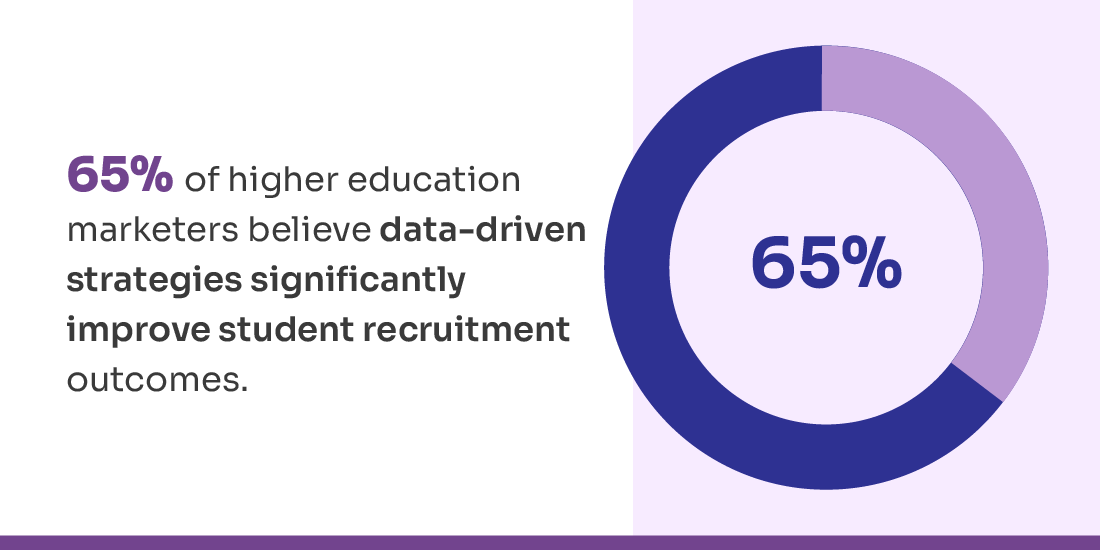
Colleges are expanding their recruitment efforts beyond traditional local and regional markets to reach a wider audience. They are using digital marketing, predictive analytics, and personalized communication to connect with prospective students more effectively. With a smaller number of high school graduates available, institutions are becoming more strategic in how they identify and engage potential applicants. In fact, 65% of higher education marketers believe data-driven strategies significantly improve student recruitment outcomes.
Engaging Adult and Alternative Learner Populations
As the number of traditional college-age students declines, institutions are increasingly focusing on adult learners, returning students, and working professionals. A large group of individuals with “some college, no degree” offers a valuable opportunity for colleges to boost enrollment through re-engagement efforts. In fact, about 37.6 million Americans aged 18–64 have attended college but did not complete a credential, representing a significant untapped market. To attract this segment, colleges are offering flexible class schedules, online and hybrid formats, and credit-for-prior-learning options.
Leveraging AI and Automation for Enrollment Growth
Technology is transforming how colleges recruit and engage students, with AI playing a key role in improving efficiency. AI solutions streamline communication, automate routine responses, and enhance student engagement. For example, Point Park University in Downtown Pittsburgh introduced a 24/7 AI chatbot to support high school students anytime. The chatbot delivers instant answers, ensures timely information, and reduces admissions staff workload. EDMO Student Copilot enhances this by offering omnichannel communication across calls, SMS, and WhatsApp, delivering consistent messaging and timely guidance. It ensures every student is reachable, receives the right updates, and enjoys a smoother, more responsive experience.
Academic Program Redesign and Innovation
To stay competitive, colleges and universities are updating their academic programs to match current workforce trends and student needs. Many institutions are introducing stackable credentials, flexible degree pathways, and competency-based education models. They are also expanding online and hybrid learning formats to improve accessibility for a wider range of students. In fact, 83% of public four-year institutions report increasing online competition, which has pushed them to strengthen student support services and improve overall program quality.
Strengthening Global Recruitment Efforts
As domestic student numbers decline, many universities are increasing their focus on recruiting international students. However, this strategy has become more challenging due to policy changes and stronger global competition. In the U.S., new international student enrollments fell by 17% in fall 2025, mainly because of visa restrictions and shifting mobility trends. Although overall international enrollment remains relatively strong, fewer new students are arriving each year. To maintain diversity and financial stability, institutions must adopt more focused and strategic global recruitment efforts.
Building Stronger School Partnerships and Early Pathways
Colleges are working more closely with K–12 schools to connect with students earlier in their academic journey. Expanding dual enrollment programs allows high school students to earn college credits before graduation. These partnerships help improve college readiness and create smoother transitions into higher education.
Collaborative Models and Shared Operational Services
To handle financial pressure, many institutions are partnering with other colleges to share resources and services. This includes sharing academic programs, technology systems, and administrative operations. Collaborative models help reduce operational costs while maintaining educational quality. According to a 2025 sector report, shared service arrangements can lower institutional expenses by around 6–10%, which leaders consider a meaningful savings. These strategies are especially helpful for smaller institutions facing budget challenges.
Optimizing Transfer Student Recruitment and Support
Transfer students are becoming an important source of enrollment growth, so colleges are making the transfer process easier and faster. They are improving credit transfer, offering advising, and simplifying evaluations to reduce delays and confusion. For example, Stony Brook University uses AI to review transcripts and summarize essays and recommendation letters, helping admissions teams make quicker, smarter decisions. Tools like EDMO’s Transfer Credit Evaluator further support this process by automating transcript analysis, instantly mapping credits to course equivalents, and clearing backlogs in minutes for accurate and fast credit evaluations.
Regional and Demographic Impact Variations on Institutions Amid the Enrollment Cliff
The enrollment cliff is not impacting all institutions in the same way across the country. Its effects vary depending on geographic location and the demographic makeup of the student population. Some regions are expected to see sharper declines in high school graduates, while others may experience slower changes or even modest growth.
Regional Impact on Institutional Stability
According to projections from the Western Interstate Commission for Higher Education, demographic changes will not affect every state equally. Around 38 states are expected to experience declines in high school graduates, while only 12 states and the District of Columbia are projected to see growth. These uneven trends will create very different challenges for institutions depending on their location.
Regions Facing Significant Declines
- West: Approximately 20% projected decline in high school graduates.
- Northeast: Around 17% projected decline.
- Midwest: Nearly 16% projected decline.
Colleges in these regions will likely face increased competition for a shrinking pool of traditional-age students. This may lead to more aggressive recruitment strategies, tuition discounting, program restructuring, and tighter budget management.
Regions Experiencing Growth
- South: Expected modest growth of about 3%, making it the only region with overall net increases.
- Texas and parts of the Mountain West: Some states may see growth exceeding 7% in high school graduate populations.
Institutions in these growing regions may experience higher demand and potential capacity pressures. They may need to expand infrastructure, student support services, and flexible program options to serve a more diverse and increasing student population effectively.
Demographic Shifts Reshaping Institutional Profiles
In addition to regional differences, changing demographics will significantly transform the composition of future student populations. While the total number of high school graduates is projected to decline nationally, the diversity of students is expected to increase.
Projected demographic changes include:
- White students: 26% decline
- Black students: 22% decline
- Asian/Pacific Islander students: 10% decline
- Hispanic students: 16% increase
- Multiracial students: 68% increase
These trends indicate that although fewer students overall may graduate from high school, campuses will serve a more diverse mix of learners than in previous decades.
Institutional Impact
- As traditional enrollment pipelines shrink, colleges that have historically relied on less diverse student populations will need to adjust their strategies. Recruitment approaches, financial aid models, advising structures, and campus engagement efforts must evolve to reflect changing demographics.
- Institutions will also need to strengthen culturally responsive student support services, inclusive academic programs, and targeted outreach initiatives.
Failure to adapt recruitment and retention strategies to these demographic realities could lead to enrollment gaps and long-term sustainability challenges.
How Different Institutions Are Affected by the Enrollment Cliff?
The enrollment cliff will not impact all colleges and universities in the same way. Some institutions may face serious financial pressure or even the risk of closure, while others may experience only minor disruption or new growth opportunities. The level of impact largely depends on factors such as the type of institution, financial health, academic programs, and overall reputation.
Small, Tuition-Dependent Private Colleges
Small private colleges that rely primarily on tuition revenue face significant vulnerability.
Key Challenges:
- Limited endowments and financial reserves.
- Heavy dependence on student tuition for operating budgets.
- Lack of strong national brand recognition or highly distinctive programs.
- Thin financial margins make them sensitive to even small enrollment declines.
Even a modest drop in student numbers can create serious budget shortfalls. This financial pressure is evident in recent trends, with at least 16 nonprofit colleges announcing closures in 2025 due largely to ongoing financial strain and declining enrollments.
Community Colleges and Regional Public Universities
Community colleges and regional public institutions are also highly exposed to demographic shifts.
Key Challenges:
- Dependence on local or regional student populations.
- Limited ability to recruit nationally or internationally to offset local declines.
- Enrollment losses during the pandemic that many institutions have not fully recovered from.
As high school graduate numbers decline in many regions, these institutions face increased competition and financial uncertainty. Continued demographic changes may further complicate efforts to stabilize enrollment and maintain long-term sustainability.
Institutions Likely to Be More Resilient
While some colleges face significant risk, others are better positioned to manage the challenges of the enrollment cliff. Institutions with strong financial foundations, clear value propositions, and distinctive academic offerings are more likely to remain stable.
Well-Established and Financially Strong Institutions
Colleges and universities with strong national reputations and recognizable brands are generally more resilient.
Key Strengths:
- Substantial endowments and diversified revenue sources.
- National or international recruitment reach.
- Strong brand recognition and competitive applicant pools.
These advantages allow them to maintain steady applications and enrollment levels, even as the overall number of college-aged students declines.
Institutions with Specialized and Career-Focused Programs
Colleges offering specialized academic programs or distinctive educational models also tend to be more resilient.
Key Strengths:
- Programs aligned with workforce demand.
- Strong graduate employment outcomes.
- Unique learning models, such as experiential or competency-based education.
As students become more selective and focused on return on investment, institutions that clearly communicate career outcomes and long-term value are more likely to sustain enrollment and maintain competitiveness.
Economic and Community Implications
The enrollment cliff not only affects colleges and universities, but it also has broader economic consequences for surrounding communities. As institutions experience declining student numbers, the financial impact often extends beyond campus boundaries.
Local Economies at Risk
Falling enrollment can reduce economic activity in college towns and surrounding areas.
Key Impacts:
- Lower spending by students on housing, food, and local services.
- Weakening housing markets in areas heavily dependent on student renters.
- Reduced local tax revenues and business income.
Communities that rely on colleges and universities as major employers and economic anchors are particularly vulnerable. When institutions struggle financially, the ripple effects can impact jobs, small businesses, and regional economic stability.
Closures and Institutional Consolidations
Demographic declines are increasingly linked to college closures and mergers.
Key Trends:
- In 2024, several U.S. colleges closed due to financial instability tied to declining enrollment.
- Research from the Federal Reserve suggests closure rates could rise significantly, with up to an 8.1% annual increase in moderate decline scenarios.
- In more severe scenarios, as many as 80 institutional closures could occur by 2029.
These closures often occur among smaller, tuition‑dependent institutions and represent a loss of educational access, particularly in rural or underserved areas where alternatives are limited.
Conclusion
The 2026 enrollment cliff presents both challenges and opportunities for higher education. Institutions must adapt through innovative recruitment strategies, strategic partnerships, and programs that meet evolving student needs. While some colleges may face financial pressure or closures, those with strong brands, specialized programs, and diverse student engagement strategies are better positioned to remain resilient. By understanding the trends and preparing proactively, higher education can navigate this period of change while continuing to provide value to students and communities.
Frequently Asked Questions
Question 1. When does the enrollment cliff begin?
Question 2. Will public universities be affected the same way as private colleges?
Question 3. What role will financial aid play?
Question 4. Are demographic trends the only factor?
Written By








No comments yet. Be the first to comment!
Leave a Comment