

Table Of Contents
- 1Introduction
- 2How does Automated Nudging help complete college admissions?
- 3Smart SMS Nudging Strategies
- 4AI Chatbots as Digital Front Desks
- 5Dedicated Application Trackers: Importance in Higher Ed Enrollment Processes
- 6Enrollment Stages and Application Tracking Overview
- 7Early Warning & Predictive Analytics: How Automated Nudging Helps in Admissions
- 8Conclusion
Introduction
Higher education leaders face a persistent challenge (which remains an albatross around their necks): many students begin college applications but do not finish them or press the apply button. While some students are non-committal, operational bottlenecks also contribute to incomplete applications and enrollment funnel drop-offs.
More than institutions are willing to accept, but students often lose interest midway through the application process because follow-ups are inconsistent, documentation requirements are confusing, next steps are unclear, or they cannot reach someone when they need help.
Slow communication is a major buzzkill. Missed emails, slow replies, and scattered outreach make the process more complicated than it should be.
According to the Common App report, 962,284 first-year applicants had sent in 4,716,352 applications by November 1. This marks a 5% increase in applicants and a 10% rise in total applications compared to the same time last year. On average, students applied to 4.90 colleges, up a bit from 4.68, underscoring that application numbers and reach continue to grow.
As more applications come in and teams stay small, it becomes harder to maintain timely, personal engagement at scale. This negatively impacts enrollment numbers, the speed of admissions, and the overall student experience.
Automated nudges and AI chatbots can help solve this problem in a scalable way. Automated nudges send reminders, deadline alerts, and personalized next steps based on where each applicant is in the process. This keeps students moving forward without adding extra work for admissions staff. AI chatbots add even more support by giving real-time, round-the-clock answers through chat, SMS, and email. They can answer common questions, explain requirements, point out missing documents, and connect students to human advisors for more complicated issues.
For enrollment counselors, this leads to fewer repeated questions, less manual follow-up, and better insight into how applicants are engaging.
Rather than spending time tracking down incomplete files, teams can focus on students who are most interested and have more meaningful conversations that help them arrive at well-thought-out decisions. This creates a more responsive, student-focused admissions process that blends human expertise with smart automation to reduce drop-offs and improve enrollment results.
How does Automated Nudging help complete college admissions?
Automated nudging helps colleges bolster their admission processes. At a time when stiff competition has kicked in with students being inundated with too many options, sending timely, personalized reminders and guidance to applicants can actually help institutions grow their enrollment numbers.
Automated nudging enables universities to help students stay on track throughout the enrollment process. On the other hand, manual follow-ups are not only hurting institutions but are also burdensome for enrollment teams, forcing them to rely on static processes that can simply be automated.
In case of automated reminders, institutions can send targeted messages based on each student’s application status, such as missing transcripts, incomplete forms, upcoming deadlines, or pending financial aid documents.
These nudges help reduce confusion, prevent procrastination, and re-engage students whose application processes are in limbo. By reaching applicants with the right message at the right time, automated nudging helps reduce drop-offs, speeds up document submission, and makes it more likely that prospective students finish their applications.
- Increases Application Completion Rates: Automated systems help more applicants finish their applications by noticing when someone starts but does not complete the process. They then send personalized reminders to encourage people to finish.
- Bolsters Personalized Communication: AI can review how applicants interact with the website or if they submit only part of an application. It then sends messages that are specific and relevant to each person, instead of using generic follow-ups. This makes the process feel more supportive.
- Provides 24/7 Instant Support: AI-powered chatbots are available around the clock to answer common questions about deadlines, requirements, and document submissions. This lets students complete steps whenever they want, without having to wait for help from a person.
- Streamlined Operational Efficiency: When routine tasks like follow-ups & reminders are automated, admissions staff have more time to focus on helping students who have unique or complex backgrounds, especially international students.
Smart SMS Nudging Strategies
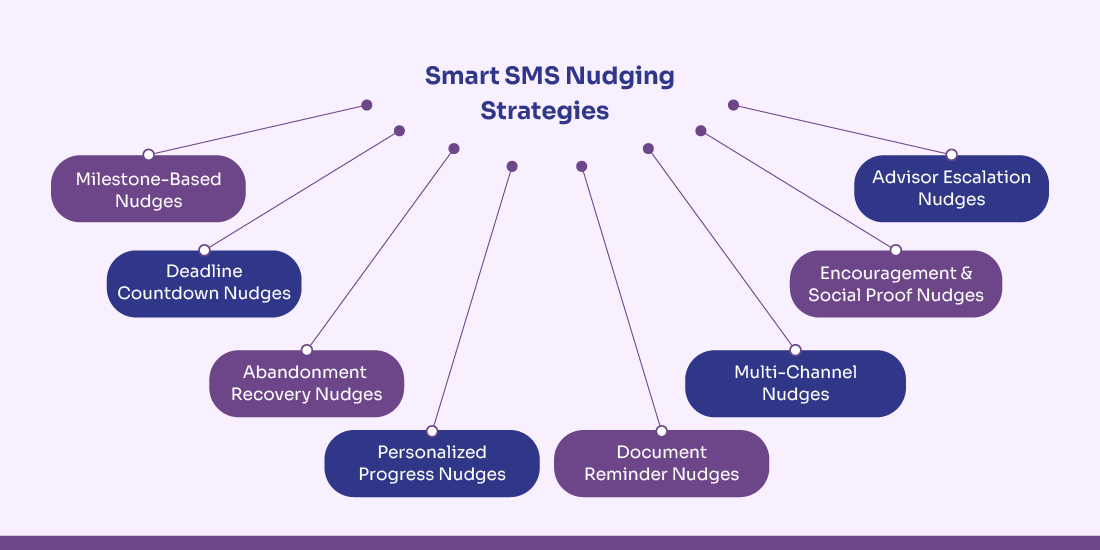
Many prospective students find the college application process overwhelming and even dreary, especially with deadlines, paperwork, and several steps to manage. Even studious applicants sometimes pause or give up because of a muzzled process, missed reminders, or a lack of help when they need it.
Smart nudging strategies help by sending clear, personalized prompts at key points in the process. When schools use behavioral insights, automation, and timely communication, they can guide students through each step. This approach makes the process smoother, reduces drop-offs, and helps more students finish their applications.
Milestone-Based Nudges
Send reminders at key points in the application, such as when someone has started but not finished, has documents missing, or is almost done. Each message should highlight one clear next step to help students avoid feeling overwhelmed.
Appropriate Time: Best sent right after a student stops making progress at a milestone, usually 48 to 72 hours after they pause.
Deadline Countdown Nudges
Use gentle countdown reminders to create a sense of urgency. Clearly explain what is still needed and how to finish. Combine this with a reassuring message and a direct link to take action.
Appropriate Time: Send these reminders 7 days before the deadline, again 3 days before, and once more 24 hours before the application closes.
Abandonment Recovery Nudges
If a student leaves in the middle of their application, send a quick message to encourage them to return. Include a link so they can easily continue from where they stopped.
Appropriate Time: Send this message within 24 hours after the student leaves their application unfinished.
Personalized Progress Nudges
Help students keep going by showing them how much they have finished and what steps remain. Seeing their progress can motivate them and lower the chance they stop.
Appropriate Time: Share these updates after each major section is completed.
Document Reminder Nudges
Send simple reminders if transcripts, recommendation letters, or financial aid forms are missing. Add instructions or a link to FAQs to make uploading easier.
Appropriate Time: Send these reminders 2 to 3 days after you notice something is missing.
Multi-Channel Nudges
Choose the best way to reach students: use SMS for urgent needs, email for detailed steps, and chat for real-time help. Match the channel to how quickly they need to act.
Appropriate Time: Pick the timing based on urgency. Use SMS as deadlines approach, and email earlier in the process.
Encouragement & Social Proof Nudges
Use encouraging words to let students know they are making good progress and are not alone. Positive feedback helps more students finish.
Appropriate Time: Share these messages when a student has finished between half and most of their application.
Advisor Escalation Nudges
If students do not respond to automated reminders, have an advisor reach out to offer personal support and answer any questions.
Appropriate Time: Do this after two or three reminders go unanswered, or if there has been no activity for five to seven days.
AI Chatbots as Digital Front Desks
AI chatbots are becoming the digital front desk or virtual assistant of modern campuses, providing instant, 24/7 support at key student touchpoints. By centralizing inquiries and delivering real-time, personalized guidance, they snap out operational friction, accelerate response times, and empower enrollment counsellors to focus on high-impact interactions. The following outlines how chatbots streamline essential campus functions:
Enrollment and Admissions
Admissions can be mentally, emotionally, & financially challenging, especially for first-generation and international students. AI chatbots offer step-by-step guidance on application requirements, deadlines, document uploads, and next steps. They proactively remind students about incomplete forms, answer FAQs instantly, and escalate complex cases to admissions officers as and when needed.
Benefits:
- 24/7 instant responses across chat, SMS, and web
- Reduced email and call center volume
- Lower application drop-offs due to timely reminders
- Multilingual support for global applicants
- Personalized guidance based on applicant status
Financial Aid
Financial aid is often a complex and crucial part of the student enrollment experience. Instead of engaging human support in answering routine scholarship queries and requirements, AI chatbots simplify the process by answering questions about eligibility, FAFSA requirements, scholarships, deadlines, and document submissions. They also provide real-time status updates and reminders for pending forms.
Benefits:
- Immediate clarification on complex aid processes
- Fewer missed financial aid deadlines
- Reduced phone queues and in-person traffic
- Improved transparency into award timelines
- Better support during peak aid seasons
Academic Advising
AI chatbots help students with course selection, SOP, LOR, and resume requirements, prerequisite clarification, degree progress tracking, and registration timelines. Integrated with institutional data, they provide personalized recommendations and flag risks such as missed credits or upcoming deadlines.
Benefits:
- Faster responses to routine advising queries
- Improved on-time course registration
- Early identification of academic risk signals
- Reduced administrative burden on advisors
- More time for advisors to focus on complex student needs
Mental Health and Wellness
AI chatbots can serve as an accessible first point of contact for students facing stress or emotional challenges. While not a substitute for professional care, they offer coping strategies, wellness resources, crisis hotline information, and can escalate urgent cases to human counselors when needed.
Benefits:
- Early intervention through guided self-help prompts
- Faster routing to appropriate campus services
- Increased awareness of available mental health resources
- Continuous support outside office hours
Dedicated Application Trackers: Importance in Higher Ed Enrollment Processes
Dedicated application trackers are real-time dashboards that show a prospective student’s progress through the admissions process. They bring together data from CRM, SIS, document management, and communication tools in one place. This gives students and enrollment teams a clear view of each application’s status, what is still needed, and what steps come next.
For students, application trackers make the process less confusing by showing which steps are done, what documents are missing, and when deadlines are coming up. For enrollment teams, these trackers serve as command centers, highlighting bottlenecks, helping focus on interested applicants, and prompting timely follow-ups.
Enrollment Stages and Application Tracking Overview
Inquiry & Lead Capture
Keeps track of initial form submissions, event sign-ups, and early signs of interest. This helps teams spot interested prospects and organize outreach efforts from the start.
Application Started
Shows when a student has started an application but hasn’t finished it yet. This lets teams send reminders or have advisors follow up to help students finish their applications.
Application Submission
Confirms when an application is submitted and records the time. This helps teams organize application reviews and track how quickly they respond.
Document Collection
Keeps track of transcripts, recommendation letters, test scores, ID checks, and other needed documents. This helps teams quickly spot missing documents and avoid delays.
Eligibility Review / Evaluation
Tracks academic reviews, GPA calculations, transfer credit checks, and prerequisite requirements. This helps teams manage workloads and focus on applications that are almost complete.
Financial Aid Pro
Keeps track of FAFSA submissions, verification steps, scholarship eligibility, and award offers. This helps teams make sure financial aid is ready in time for admission decisions.
Admission Decision
Records whether a student is accepted, waitlisted, or denied. It helps teams trigger next-step communications automatically.
Enrollment Confirmation
Keeps track of deposit payments, signed enrollment agreements, and completed registrations. This helps teams predict enrollment numbers and spot students who might not enroll.
Matriculation & Onboarding
Tracks orientation sign-ups, course enrollments, and any required compliance steps. This helps teams make sure students move smoothly from being admitted to becoming active students.
Early Warning & Predictive Analytics: How Automated Nudging Helps in Admissions
Early warning and predictive analytics are vital for higher education institutions because they enable proactive student support. By deploying AI-powered chatbots, universities can use data analytics to monitor student performance, engagement, attendance, and behavior.
These assets help identify those students at risk and assist them at any stage required. This timely identification incentivizes enrollment advisors to intervene with targeted resources, such as tutoring, personalized outreach, or academic planning, encouraging students to remain on track and complete their enrollment journey.
Predictive analytics further enhances support by analyzing large datasets to identify students at risk of disengagement or dropout. By detecting patterns such as declining participation, missed deadlines, or consistently low performance, institutions can modify support based on individual needs and allocate resources efficiently. These insights improve student retention and graduation rates and help create data-driven pathways for student success, fostering a personalized and inclusive learning environment where barriers are addressed early.
Early Identification of At-Risk Students
Predictive systems identify students who show early signs of struggle, such as low engagement, missed assignments, or declining performance, before these issues become serious.
Proactive Intervention
When risks are detected early, advisors and support teams can step in with targeted help, such as tutoring, academic counseling, or wellness resources. This increases the chances that students will stay enrolled.
Personalized Support Strategies
Predictive insights allow schools to customize support for each student instead of relying on a one-size-fits-all approach.
Data-Driven Decision Making
Analytics offer useful information about large groups of students, helping schools use their resources wisely and focus support where it is needed most.
Improved Retention & Graduation Rates
When challenges are addressed early and efficiently, predictive analytics helps more students stay in school, make academic progress, and graduate.
Enhanced Student Experience
Students get timely and relevant support that meets their needs, leading to greater satisfaction and confidence in their academic journey.
Conclusion
In today’s competitive enrollment landscape, supporting students is no longer optional in the enrollment journey; it has become one of the most fundamental tasks of admissions teams. As friendly and warm as an institution is during the enrollment process, the chances of enrolling students are higher because they feel seen, heard, and supported. They are not despondent but excited about the whole journey, asking questions rather than expressing resignation.
Automated nudging shifts admissions from a static, archaic process to a proactive, student-centered experience. Timely reminders, personalized next steps, and real-time assistance help institutions reduce friction, prevent drop-offs, and keep applicants progressing with confidence.
Importantly, nudging does not replace the human touch; it enhances it. Automation manages routine follow-ups and status-based reminders, allowing enrollment teams to focus on meaningful conversations with high-intent or at-risk students. This creates a smarter admissions ecosystem that is responsive, data-driven, and focused on student success from the first interaction.
As higher education evolves, institutions that integrate behavioral insights with intelligent automation will be best positioned to improve completion rates, strengthen yield, and create a seamless path from inquiry to enrollment.
Frequently Asked Questions
Ques 1. What is automated application completion nudging in higher education?
Ques 2 How does automated nudging reduce application drop-offs?
Ques 3: Does automated nudging replace admissions counselors?
Written By


You May Also Like
 AI in Education

 AI in Education
 AI in Education
No comments yet. Be the first to comment!
Leave a Comment