

Table Of Contents
Introduction
AI in admissions is no longer an experimental concept—it has become an operational necessity. Recent studies show that 86–92% of students now use AI tools in their academic lives, many of them daily or weekly. At the same time, 93% of prospective students say personalized outreach increases their likelihood of considering an institution, yet nearly two-thirds report that they seldom receive communication that feels truly individualized. On the institutional side, momentum is accelerating, 57% of higher-education leaders now identify AI as a strategic priority, and adoption of AI in marketing and enrollment operations has risen from 40% to 65% in just one year.
In short, students are already AI-native, while many admissions offices are still adapting. Preparing for AI integration is fundamentally about closing this gap responsibly so institutions can scale personalization, reduce administrative workload, and reinforce human-centered decision-making throughout the admissions process.
Key points to prepare for AI integration in Admissions
Start with strategy, not tools
AI only works when it solves an actual admissions problem—not when it’s added because “everyone else is doing it.”
- Tie AI to clear outcomes: Decide what you’re solving first: faster response times, higher yield, better support for first-gen students, reduced counselor burnout, etc.
- Prioritize a few high-impact metrics: For example, inquiry response time, application completion rate, event show-up rate, or staff hours saved per week.
- Create a simple AI roadmap: Break it into 3 horizons, quick wins (FAQ/chatbot, nudging), mid-term (lead scoring, workflow automation), long-term (predictive modelling, end-to-end orchestration).
Audit your data and tech stack
If your CRM, SIS, and email data are fragmented, AI can’t deliver accurate insights or personalization.
- Map where your data lives: CRM, SIS, email platform, application portal, event system, spreadsheets—AI is only as good as the data it can access.
- Check data quality: Fix duplicate records, inconsistent fields (e.g., programs/majors named differently), and missing contact info before you plug AI into it.
- Plan for integration: Prioritize AI tools that connect cleanly to your CRM/SIS via APIs or native connectors; avoid “AI islands” that create yet another silo.
Put governance, ethics, and compliance in place
A strong governance structure ensures trust, fairness, and institutional credibility.
- Form an AI steering group: Include admissions, IT, legal/compliance, financial aid, DEI, and student representatives. Their job: guardrails, not micromanagement.
- Define responsible-use guidelines: Clarify what AI can and cannot decide on (e.g., “supportive,” not “final admit/deny”), how bias will be monitored, and how humans stay in the loop.
- Address privacy and regulatory requirements: Review vendor data retention practices, train models on your data, assess FERPA/GDPR implications, and ensure accessibility standards.
Choose a small set of concrete use cases
Instead of “AI everywhere,” start with a few specific, testable workflows, such as:
- Inquiry & FAQ automation: AI chatbot or voicebot that answers common questions 24/7 and routes complex ones to counselors with full context.
- Application-stage nudging: Automated, personalized reminders based on where a student is stuck (missing transcript, incomplete essay, no FAFSA, etc.).
- Intelligent lead scoring: Rank prospects based on engagement signals (email opens, event attendance, portal logins) to focus counselor outreach.
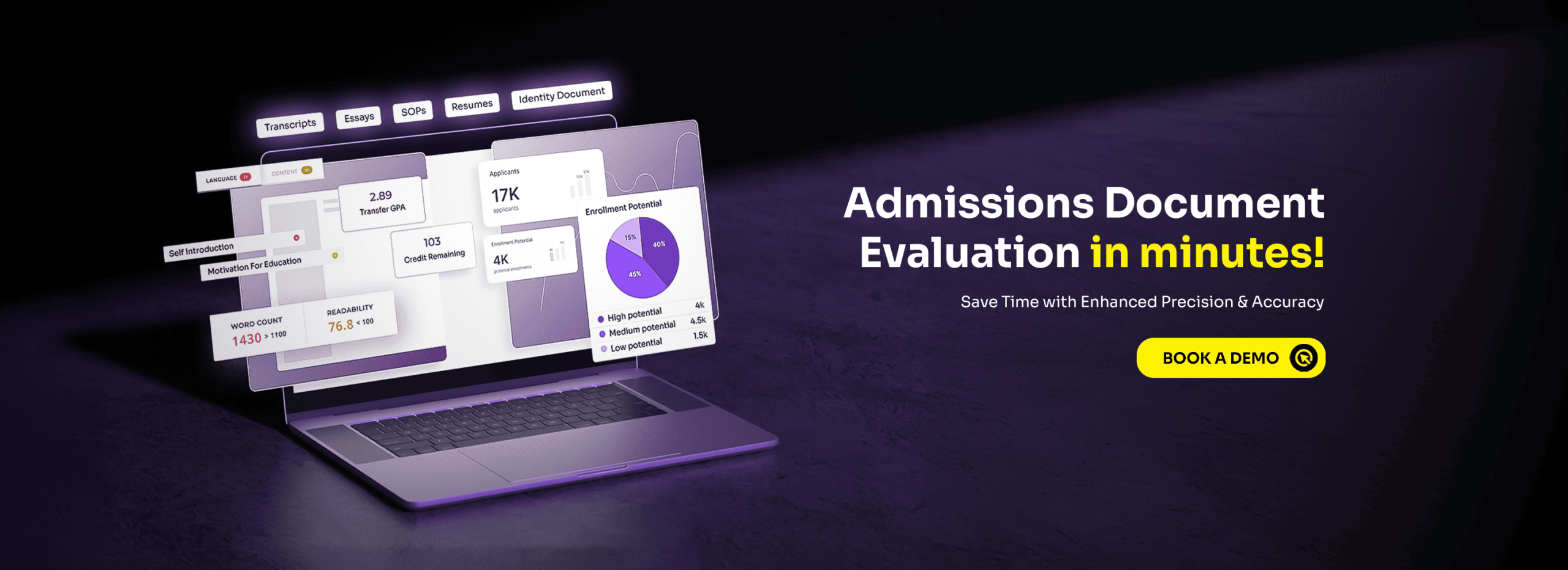
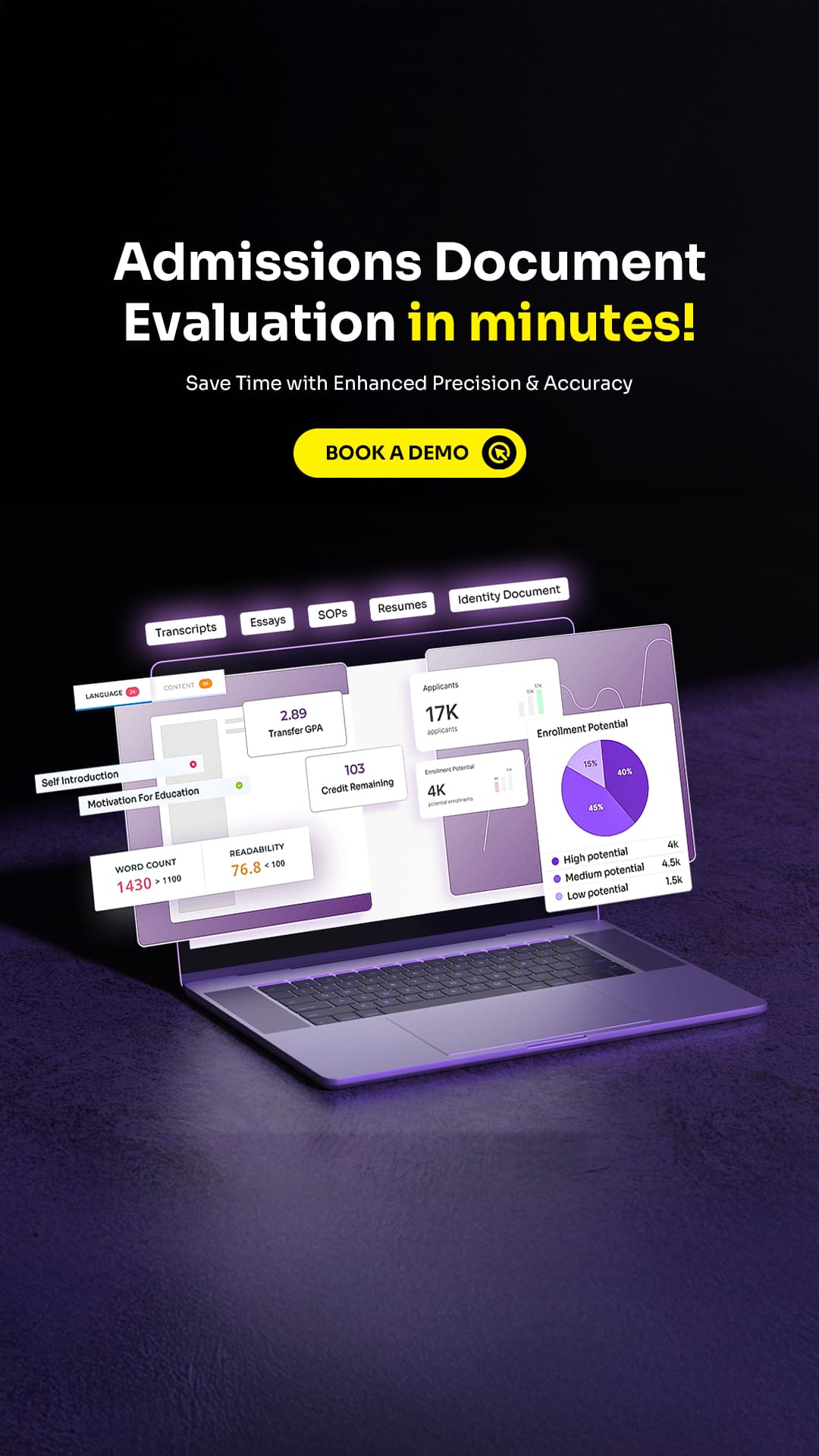
- Document & data processing: Use AI to extract data from transcripts, test scores, essays or financial documents into your CRM to reduce manual data entry.
Get your people ready (change management)
Counselors and ops staff must see AI as a support system, not a threat.
- Create AI champions inside admissions: Train a small group of counselors and operations staff who can pilot tools, share feedback, and coach colleagues.
- Offer practical, hands-on training: Short sessions on “How AI supports your daily work” are far more effective than abstract lectures about machine learning.
- Address fears openly: Emphasize that AI is there to remove low-value tasks (copy-pasting, chasing documents), not to replace the relational work counselors do best.
Evaluate vendors with a higher-ed lens
Choose partners that align with your CRM, workflow, and compliance requirements.
- Check for higher-ed experience: Ask for case studies in admissions/enrollment, not just generic marketing automation.
- Insist on interoperability: Verify support for your CRM (Salesforce, Slate, Ellucian, etc.), authentication (SSO), and data standards.
- Probe transparency and control: Can you see why the model made a prediction (e.g., lead score)? Can you adjust rules, segments, and thresholds without writing code?
- Run a time-boxed pilot: 60–90 days with a limited audience or program can show whether the tool actually moves your metrics.
Design a student-centric experience
The goal is to simplify the student journey without losing the human warmth.
- Keep the “human lane” obvious: Make it easy to escalate from bot to counselor (live chat, call scheduling, or ticket) when emotions or complexity are high.
- Match channels to student preferences: Pair AI with email, SMS, portal notifications, and social DMs based on what your audience responds to, not what’s convenient for you.
- Test for tone and equity: Review AI-generated communication for clarity, warmth, and inclusivity—especially for first-gen, adult, and international students.
Measure, learn, and iterate
Continuous refinement is where the real gains happen.
- Define baseline numbers first: Capture current response times, counselor caseloads, yield rates, and no-show rates before going live.
- Monitor both numbers and stories: Track metrics (e.g., 24/7 bot conversations, completed applications) and also collect qualitative feedback from staff and students.
- Iterate in small loops: Adjust prompts, workflows, and routing rules monthly or by term rather than waiting for a big annual “version 2.0.”
How EDMO’s System Intelligence can help you with integration in Admissions

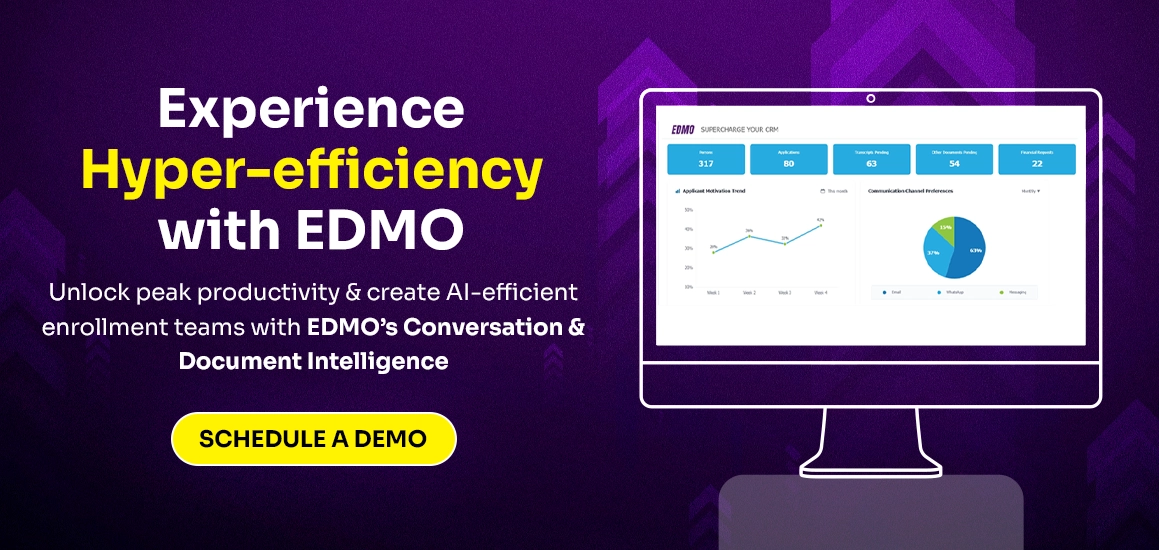
EDMO’s System Intelligence makes AI adoption in admissions simple, practical, and immediately worthwhile. Instead of forcing universities to change their systems or rebuild workflows, it acts as a plug-and-play layer that connects with your existing CRM, SIS, and communication tools. It helps teams reduce manual work, personalize communication at scale, and improve visibility across the entire student journey. Most importantly, it blends automation with human expertise—so institutions get the efficiency of AI without losing the human touch that students rely on.
Below is how System Intelligence supports a smooth and effective AI integration in admissions:
Plug-and-Play Integration With Your Existing Systems
No need to replace your CRM or tech stack. System Intelligence connects directly with tools like Salesforce, Slate, Banner, and Colleague, allowing admissions teams to start using AI immediately.
- Syncs data automatically across platforms
- Reduces manual entry and duplicate records
- Ensures every department sees the same, accurate student information
Automates Day-to-Day Admissions Workflows
AI takes over repetitive tasks so staff can focus on students. The system manages tasks that typically slow down counselors and operations teams.
- Sends automated reminders and follow-ups
- Tracks missing documents and incomplete applications
- Prioritizes cases based on urgency
- Reduces turnaround time for application processing
Personalizes Student Communication at Scale
Every student receives timely, relevant updates, automatically. Using AI-driven nudges and context-aware messaging, students get guidance that feels personal, not generic.
- Real-time reminders based on application stage
- Answers common questions instantly
- Supports first-gen, adult, and international students more consistently
Provides Intelligent Insights and Lead Scoring
Helps admissions teams focus their outreach where it matters most. The system analyzes student engagement such as opens, clicks, portal activity, and more to highlight high-intent prospects.
- Identifies students likely to enroll
- Flags applicants who may need support
- Helps counselors prioritize outreach strategically
Ensures Human Support Stays at the Center
AI assists, humans decide. System Intelligence blends automation with expert human oversight.
- AI handles repetitive workflows
- Human enrollment specialists intervene when judgment is needed
- Ensures accuracy, compliance, and institutional integrity
Delivers Complete Transparency and Operational Visibility
Admissions leaders gain clarity across the entire pipeline. From one dashboard, teams can see:
- Tasks in progress
- Bottlenecks slowing applications
- Counselor workload
- Communication history
- Real-time application status
Improves Yield and Student Experience
Students feel guided, supported, and informed throughout the journey.
This leads to:
- Faster application completion
- Higher engagement
- Reduced melt
- Better conversion from inquiry to enrollment
Summary
AI is rapidly becoming a core part of the admissions process because students already use it every day and expect faster, more personalized communication from institutions. To prepare, colleges need a clear strategy, cleaner data systems, strong governance, and a few well-chosen AI use cases that genuinely solve operational challenges. Teams also need training, the right vendor partners, and a student-first approach to communication and support. EDMO’s System Intelligence makes this transition easier by integrating smoothly with existing systems, automating manual work, personalizing outreach at scale, and highlighting high-intent students, all while keeping human judgment at the center of admissions.
Frequently Asked Questions
Question 1. Should colleges and universities be more transparent about their use of AI in the admissions process?
Question 2. What are the roles of AI in enhancing the transparency and fairness of college admissions processes?
Question 3. How can AI improve student engagement during the admissions journey?
Question 4. Does AI replace human judgment in college admissions?
Question 5. How does AI help reduce administrative workload for admissions teams?
Written By



No comments yet. Be the first to comment!
Leave a Comment