


Table Of Contents
- 1Introduction
- 2AI in Higher Education: Transforming Institutional Operations
- 3The Importance of AI in College Administration
- 4Challenges of Implementing AI in Colleges and Universities
- 5Benefits of Streamlining College Operations with AI
- 6AI Usage in Higher Education Administration: Where Is It Needed Most?
- 7AI for Admissions and Records Management
- 8The Evolving Role of AI in Academic Administration
- 9Conclusion
Introduction
Artificial intelligence (AI) is transforming higher education administration by making processes faster, more efficient, and more data-driven. From managing student records and applications to streamlining communication and decision-making, AI-driven tools help universities handle complex administrative tasks with greater accuracy and speed.
By adopting these tools, higher education institutions can reduce manual workloads, improve operational efficiency, and focus on delivering a better experience for students, faculty, and staff.
AI in Higher Education: Transforming Institutional Operations
Adopting AI in university administration is more than just implementing new technology it represents a major shift in how institutions manage operations, make informed decisions, and plan for the future. Rather than replacing existing systems, AI enhances administrative processes by enabling smarter, data-driven approaches. Colleges and universities that integrate AI across their administrative functions experience several key benefits:
- Improved Decision-Making: Predictive analytics help leaders anticipate trends, assess risks, and make informed strategic choices.
- Streamlined Workflows: AI enables smoother collaboration between departments by automating routine tasks and reducing manual handoffs.
- Data-Driven Student Strategies: Institutions can leverage AI-generated insights to enhance their admissions processes and boost student retention and success. According to UPCEA, nearly 48% of higher education institutions reported that integrating AI had a positive effect on their enrollment funnel.
The Importance of AI in College Administration
Efficient administration is the backbone of any college or university. Without strong administrative systems, even high-quality academic programs can face significant challenges. Many institutions still rely on manual processes, which can create several inefficiencies, including:
- Delayed admission processing: Manual handling of applications increases processing times, affecting student enrollment and satisfaction.
- Ineffective inter-departmental communication: Lack of streamlined communication leads to misalignment between academic, administrative, and support teams.
- Scheduling conflicts: Managing class timetables, exams, and events manually can result in overlaps and logistical issues.
- Limited data-driven insights: Traditional systems often fail to provide actionable analytics, making strategic planning difficult.
By integrating AI into administrative processes, colleges can overcome these challenges. AI technologies offer:
- Automation of routine tasks: AI reduces repetitive work, allowing staff to focus on strategic initiatives and student-centered activities. According to UPCEA, in 2025, 34% of respondents stated that their institution’s approach to AI influenced their decision to remain at that institution.
- Predictive analytics: Helps anticipate trends in admissions, resource allocation, and student performance.
- Real-time support and decision-making: AI improves accuracy in scheduling, communication, and reporting.
The adoption of AI not only enhances operational efficiency but also improves the overall student experience, enabling institutions to make smarter decisions, optimize resources, and maintain high standards of education.

Challenges of Implementing AI in Colleges and Universities
While the adoption of AI in colleges and universities offers significant operational and academic advantages, institutions also face several challenges that must be addressed for successful implementation.
- High initial investment: Implementing AI systems requires significant upfront costs for technology infrastructure, software, and staff training, which can be a major hurdle for many institutions. According to surveys in higher education, around 76% of respondents cited budget constraints as a barrier, with many institutions lacking dedicated funds for AI initiatives.

Source: Educationdynamics
- Data privacy and security concerns: AI relies on large volumes of sensitive student and institutional data, raising important issues around data protection, compliance, and ethical use. Many administrators view this as a key challenge nearly 60% agree that AI poses potential risks to student and faculty data privacy and security.
- Resistance to change: Faculty and administrative staff may be hesitant to adopt AI due to unfamiliarity, fear of job displacement, or lack of trust in automated systems.
- Shortage of skilled professionals: Managing and maintaining AI tools requires specialized technical expertise, which many institutions currently lack.
Benefits of Streamlining College Operations with AI
Streamlining administrative operations with AI delivers value that extends beyond basic efficiency. When implemented effectively, AI helps colleges and universities improve service quality, optimize resources, and support data-driven decision-making.
- Enhanced student experience: AI enables faster service delivery, timely responses, and personalized interactions, improving overall student satisfaction.
- Increased staff productivity: By automating routine and repetitive tasks, AI reduces administrative workload and allows staff to focus on strategic and student-centric activities.
- Lower operational costs: By automating routine tasks and reducing errors, AI helps lower administrative expenses and optimizes the use of institutional resources. Surveys show that 71% of administrators believe AI will result in direct cost savings, while approximately 78% feel it supports institutions in achieving their financial and strategic objectives.
- Actionable data insights: AI-powered dashboards provide real-time visibility into operations, enabling informed and timely decision-making.
By adopting AI-driven processes, colleges can modernize their operations, improve institutional effectiveness, and better prepare for evolving educational and administrative demands.
AI Usage in Higher Education Administration: Where Is It Needed Most?
Artificial Intelligence (AI), especially generative AI, is rapidly gaining ground in higher education, even though the sector has been slower to adopt new technologies. Colleges and universities are using AI in teaching, learning, and administrative tasks while carefully addressing ethical and academic integrity concerns.
White papers like “AI, Academic Integrity, and Authentic Assessment: An Ethical Path Forward for Education” by Anthology emphasize the importance of responsible AI use. Even at this early stage, AI is proving to be a practical tool for tackling a variety of operational and academic challenges.
Key areas where AI is making an impact include:
- Automating student communications: AI chatbots and messaging systems can manage routine inquiries and notifications, allowing staff to focus on more meaningful and high-impact interactions. For example, 58% of universities now use chatbots to respond to student queries.
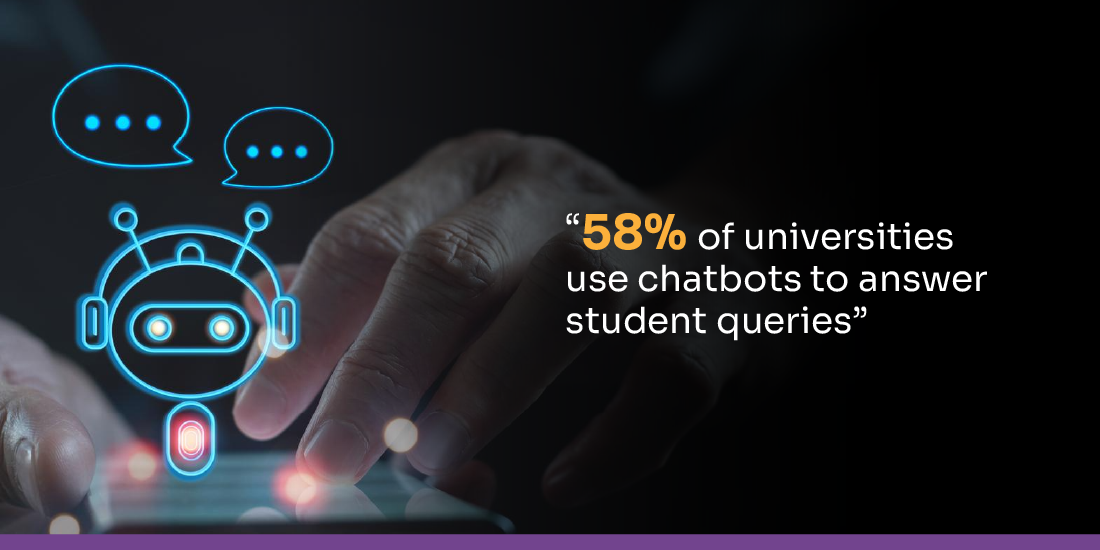
Source: Wifitalents
- Supporting student learning: Automated tutoring and educational assistance tools help students engage with challenging material and reinforce understanding outside the classroom.
- Assisting faculty and instructional design: AI can aid in generating and refining teaching materials, enabling instructors to enhance curriculum quality and save preparation time.
- Streamlining administrative and business processes: AI-driven automation reduces manual labor, making operations more efficient and enabling staff to concentrate on strategic priorities.
- Providing real-time data access and insights: AI analytics support institutional decision-making by offering dashboards and predictive insights that inform planning, enrollment forecasting, and student success initiatives.
AI for Admissions and Records Management
Admissions and student records are among the most critical administrative functions in higher education, yet they often require significant time and manual effort.
- Application Screening: AI systems can review and sort thousands of applications, quickly identifying eligible and high-potential candidates.
- Fraud Detection: Advanced algorithms help detect fake or suspicious documents, reducing errors and compliance risks.
- Student Records Management: AI automatically maintains and updates digital student profiles, ensuring data consistency across departments.
- Data Security: AI-driven tools enhance the protection of sensitive student information through intelligent monitoring and threat detection.
The impact of AI is already evident in real-world applications. For example, Virginia Tech uses AI to analyze admissions essays and process transcripts more quickly, allowing the university to make admissions decisions up to a month earlier than in previous cycles.
The Evolving Role of AI in Academic Administration
The future of AI in academic administration is set to redefine how educational institutions operate and serve students. As AI technologies continue to mature, they will play a central role in improving efficiency, accessibility, and long-term planning across campuses.
Key trends shaping the next phase of academic administration include:
- Voice-Enabled Assistants: AI-powered voice tools will allow staff and students to access academic and administrative information quickly and hands-free.
- AI-Driven Chatbots: Intelligent chatbots will manage routine admissions and student queries, providing instant responses and reducing pressure on administrative teams. Platforms like EDMO Conversation Intelligence enhance this capability by centralizing student communication, personalizing responses, and ensuring consistent engagement across multiple channels.
- Blockchain-Based Record Management: The integration of blockchain with AI will ensure secure, tamper-proof storage and verification of student records and credentials.
- Advanced Predictive Analytics: AI-powered analytics help institutions anticipate enrollment trends, identify emerging skill demands, and forecast future educational needs, allowing for proactive decision-making. For example, Western Governors University used predictive models to identify and support at-risk students, resulting in a five-percentage-point increase in graduation rates.
Institutions that adopt these emerging technologies early will be better positioned to deliver high-quality education, improve administrative efficiency, and meet the evolving expectations of students and stakeholders.
Conclusion
AI-driven tools are transforming higher education administration by streamlining processes, improving decision-making, and enhancing communication across institutions. From automating routine administrative tasks to delivering real-time insights for enrollment, student services, and resource planning, AI enables administrative teams to operate more efficiently and strategically. As adoption continues to grow, institutions that effectively integrate AI into their administrative workflows will be better positioned to reduce operational burdens, improve stakeholder experiences, and support sustainable institutional growth.
Frequently Asked Questions
Question 1. How can AI drive operational efficiency in higher education institutions?
Question 2. In what ways can AI support student learning?
Question 3. How does AI assist faculty and instructional design?
Question 4. What role does AI play in student communication?
Question 5. How can AI enhance decision-making and institutional planning?
Written By



No comments yet. Be the first to comment!
Leave a Comment