

Table Of Contents
- 1Introduction
- 2What Is Admissions Automation?
- 3Key Benefits of Automation in Admissions
- 4Core Functional Areas of Admission Automation
- 5How Automation Transforms Admissions: Comparisons between Manual & Automated Process
- 6AI Helps Select Bright Candidates: How?
- 7Real Use Cases of AI in Admissions
- 8The Role of AI in Academic Enrollment Strategy
- 9Conclusion
Introduction
During peak admission seasons, higher education institutions often feel overwhelmed. Inboxes fill up with repetitive questions, counselors handle hundreds of follow-ups, and spreadsheets make it hard to track application statuses. To make matters worse, delayed responses also frustrate prospective students.
Missed emails, misplaced documents, and slow turnaround times may leave applicants feeling ignored or undervalued. These challenges not only put pressure on admissions teams but can also dampen conversion rates and the institution’s reputation. This is where admissions automation can help.
With AI-powered tools, schools can automate routine communication, streamline document verification, send timely reminders, and organize applicant data in one place. Instead of constantly reacting to problems, teams can follow clear workflows, process applications faster, and see real-time updates on the enrollment process. This turns admission season into a more organized and proactive experience.
What Is Admissions Automation?
Admission automation is the systematic transition from manual processes to the use of software, AI, and digital workflows to streamline & finetune the student enrollment process. It starts with the initial inquiry and ends with the final enrollment.
By replacing manual, repetitive tasks with intelligent systems, institutions reduce errors, speed up decision-making, improve transparency, and enhance both the applicant experience and operational efficiency.
Key Functions & Stages of Admission Automation:
- Inquiry Management: Captures and centralizes prospect data from websites, events, and campaigns.
- Lead Nurturing: Sends automated personalized emails, reminders, and engagement messages.
- Application Processing: Handles online forms, document uploads, fee payments, and application status tracking.
- Document Verification: Automates transcript parsing, validation, and compliance checks.
- Evaluation and Decision-Making: Supports structured review processes and eligibility screening.
- Enrollment and Registration: Sends offer letters, tracks acceptances, and initiates onboarding steps.
Key Benefits of Automation in Admissions
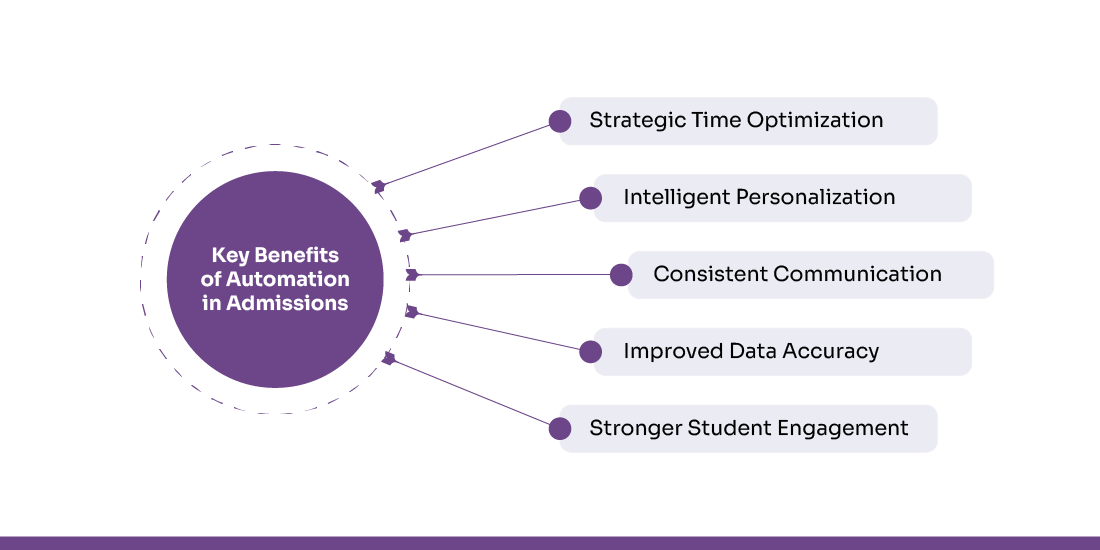
Automation in admissions is changing how institutions handle increasing applicant volumes while maintaining quality engagement. Traditional manual processes often cause delays, inconsistent follow-ups, and staff overload, particularly during peak enrollment periods.
Integrating automation throughout the admissions process enables greater precision, speed, and personalization. This leads to a more efficient team, an improved applicant experience, and stronger enrollment results.
Strategic Time Optimization
Automation in admissions delivers immediate time savings by handling repetitive administrative tasks such as tracking inquiries, sending follow-ups, and updating records. This allows admissions teams to focus on strategic planning, relationship-building, and personalized student counseling.
Intelligent Personalization
Automation enables targeted communication without adding to the workload. Messages can be tailored to a student’s interests, location, engagement, or application stage, ensuring applicants receive relevant information and improving both their experience and conversion rates.
Consistent Communication
Missed follow-ups can result in lost enrollments. Automated workflows ensure confirmations, reminders, invitations, and updates are sent consistently and on time. This structured approach prevents prospects from being overlooked and builds trust through reliable engagement.
Improved Data Accuracy
Manual data entry increases the risk of errors and outdated records. Automation synchronizes applicant information in real time, validates input, and keeps CRM systems up to date. Accurate data improves reporting, forecasting, and compliance management.
Stronger Student Engagement
Automation keeps institutions visible and responsive throughout the student journey, from initial inquiry to enrollment and onboarding. Regular, meaningful touchpoints help applicants feel supported and informed, strengthening their connection with the institution and increasing enrollment success.
Core Functional Areas of Admission Automation
An effective admissions funnel is not just a straight path. It is a structured journey that leads prospects from curiosity to commitment. Each stage needs its own communication approach, level of engagement, and operational focus.
Automation is important throughout the funnel because it ensures timely interactions, personalized messages, and real-time tracking. When used well, it helps schools nurture interest, reduce drop-offs, and turn admitted students into enrolled learners.
Top of the Enrollment Funnel: Building Applicant Interest & Awareness
At this stage, prospective students are exploring their options. They might have downloaded a brochure, signed up for a newsletter, or joined a virtual event, but they are still comparing schools.
Admission Automation tools help keep them engaged with well-timed, relevant messages instead of too many emails.
Key Functions:
- Thank-you emails with requested resources
- Personalized invitations to open days or info sessions
- Alumni testimonials and success stories
- Financial aid guidance and FAQs
- CRM status updates and alerts for highly engaged prospects
This approach helps admissions teams consistently nurture prospects and gauge early signs of interest.
Middle of the Enrollment Funnel: Guiding Applicants & Nudging Them to Move Forward
At this stage, students have started their applications but may be juggling several deadlines and school choices. Clear guidance and support are especially important now. Automation makes things easier by guiding applicants step by step and helping them finish their applications.
Key Functions:
- Section-specific completion tips
- Invitations to live Q&A sessions
- Friendly deadline reminders
- Alerts for partially completed or stalled applications
Automated tracking shows where applicants stop in the process, so counselors can step in and help at the right time.
Bottom of the Enrollment Funnel: Conversion & Enrollment Enablement
An admission offer does not guarantee enrollment. Admitted students are weighing multiple options, making this stage critical for reinforcement and reassurance. Automation helps institutions remain visible and supportive during decision-making.
Key Functions:
- Admission confirmation emails with welcome messages or videos
- Visa, accommodation, and onboarding guidance
- Campus life highlights and student community stories
- Enrollment checklists and key date reminders
- Internal alerts for students who have not confirmed acceptance
How Automation Transforms Admissions: Comparisons between Manual & Automated Process
Admissions automation helps institutions move from manual, primitive processes to more proactive, data-driven operations. Rather than using spreadsheets, scattered emails, and time-consuming follow-ups, automated systems streamline communications, track engagement as it happens, and kickstart smart workflows at each stage of the admissions process.
This change makes things faster, more accurate, and easier to see, while also improving the applicant experience. It also lets admissions teams spend more time on strategic enrollment growth instead of getting caught up in routine administrative tasks.
Manual vs. Automated Admissions Processes
| Key Functions | Manual Process | Automation into Picture |
| Inquiry Response Time | Delayed replies; dependent on staff availability | Instant 24/7 responses via AI chatbots and automated emails |
| Lead Tracking | Managed through spreadsheets or disconnected systems | Centralized CRM with real-time tracking, updates, & segmentation |
| Follow-Ups | Manual reminders; slow follow-ups, risk of missed communication | Trigger-based automated follow-ups and deadline alerts |
| Application Processing | Paper-based or semi-digital; prone to bottlenecks & tiresome delays | AI tools streamlining document verification & processing, error-free, preserving human oversight |
| Document Verification | Manual checking and data entry; incessant delays | Automated parsing, validation, and error detection; fast-tracks admission processes |
| Personalization | Limited personalization due to time constraints | Scalable, behavior-based personalized communication |
| Data Accuracy | Higher risk of duplication, inaccurate info, and human error | Real-time synchronization and validation |
| Team Workload | Massive administrative burden | Reduced repetitive tasks; focus on strategy building |
| Decision-Making | Lacks foresight; limited predictive insights | Data-driven forecasting and lead scoring; strengthens decision-making |
| Student Experience | Inconsistent communication and delays | Seamless, transparent, and timely engagement |
Admissions automation is not a cosmetic operational upgrade; it is now a strategic upper hand in a highly competitive enrollment landscape. Institutions that adopt intelligent, automated workflows can respond more quickly, engage more effectively, and enroll more strategically.
AI Helps Select Bright Candidates: How?
Choosing the right candidates is one of the most important KRAs for admissions teams. In today’s day & age, traditional methods have proven to be obsolete, often focusing just on grades and test scores.
Only focusing on students’ grades does not always reflect a student’s full potential, resilience, or fit for a program. AI is changing this process by enabling a more comprehensive, data-driven review of each applicant. Rather than replacing human judgment, AI supports it by revealing deeper insights, finding patterns in past success, and helping schools see which students are likely to do well both academically and socially.
Here are some key ways AI helps with candidate selection:
- Holistic Student Profile Analysis: Looks at academics, extracurricular activities, leadership roles, essays, SOPs, LORs, and recommendations to give a wholesome picture of each applicant.
- Essay & Statement Insights: Uses natural language processing to check writing quality, main themes, motivation, and authenticity.
- Historical Data Analysis: Finds traits and behaviors that are common among students who have succeeded in certain programs.
- Program Fit Scoring: Matches each applicant’s strengths, interests, and career goals with what the program offers and expects.er evaluations by applying consistent criteria and flagging potential inconsistencies in review patterns.
- Predictive Success Modeling: Estimates how likely a student is to perform well, stay in school, and graduate by looking at many different factors.
By combining data insights with human experience, AI helps universities make smarter, more balanced, and more strategic admissions decisions.
Real Use Cases of AI in Admissions
Rising application volume and evolving student expectations are powerful catalysts in motivating universities to actively implement AI across their admissions workflows. Real use cases of AI admissions automation actually show a real picture of how institutions can reduce inefficiencies, improve responsiveness, and make smarter enrollment decisions. It empowers enrollment teams acting as a force multiplier, handling repetitive tasks, surfacing actionable insights, and ensuring consistent engagement across the student journey.
What are AI admissions automation use cases?
Use cases are defined as descriptive and practical examples of how AI tools help solve real admissions challenges, such as managing inquiries, evaluating applications, predicting enrollment, and personalizing communication.
How AI helps in real-world admissions scenarios:
- 24/7 Inquiry Handling: AI chatbots answer FAQs, guide prospects through eligibility requirements, and schedule appointments instantly, reducing response delays.
- Application Completion Nudges: Automated reminders and smart prompts help students finish incomplete applications, lowering abandonment rates.
- Document Processing & Verification: AI extracts and validates data from transcripts and uploaded files, accelerating review timelines.
- Lead Scoring & Prioritization: Predictive models identify high-intent prospects so counselors can focus outreach efforts strategically.
- Personalized Communication Campaigns: AI segments audiences and tailors messages based on interests, location, and engagement behavior.
- Enrollment Forecasting: Data analytics predict yield rates and help institutions plan recruitment and capacity more accurately.
These examples show how AI automation can make daily admissions work more organized, scalable, and data-driven. This helps institutions run more efficiently and improves the experience for applicants.
The Role of AI in Academic Enrollment Strategy
Artificial intelligence (AI) is increasingly recognized as a strategic pillar in academic enrollment planning, augmenting a viable shift from impulsive decision-making to well-informed forecasting.
In addition to streamlining application processing, AI enables universities to anticipate enrollment trends, optimize resource allocation, and assemble well-balanced incoming cohorts. By integrating historical data with real-time behavioral insights, AI supports leadership teams in making informed plans, reducing uncertainty, and achieving stronger academic outcomes.
Key roles of AI in academic enrollment strategy
- Enrollment Forecasting: Predicts acceptance rates, yield, deferrals, and melt to enhance planning accuracy.
- Resource Optimization: Guides faculty allocation, class sizes, housing, and budget distribution.
- Retentionand& Risk Prediction: Identifies students at risk of dropping out or transferring.
- Diversity & Cohort Planning: Supports data-driven strategies to build balanced, inclusive, and high-performing classes.
Conclusion
Admissions automation is redefining efficiency in university enrollment by replacing fragmented, manual workflows with intelligent, streamlined systems. From faster response times and improved data accuracy to personalized engagement and predictive decision-making, AI-driven tools empower admissions teams to operate with greater precision and agility. Ultimately, institutions that embrace automation reduce operational strain and create a more responsive, student-centric admissions experience. This positions them for sustainable enrollment growth in a competitive landscape.
Frequently Asked Questions
Ques 1. Which processes in university admissions can be automated?
Ques 2. How does automation increase efficiency?
Ques 3. Does admissions automation replace human staff?
Written By






No comments yet. Be the first to comment!
Leave a Comment