

Table Of Contents
- 1Introduction
- 2What Is AI Document Analysis?
- 3The Need for AI Document Analysis
- 4Key Benefits of AI-Powered Document Analysis
- 5How AI-Powered Document Analysis Works
- 6Key Use Cases of AI-Powered Document Analysis
- 7Core Evaluation Criteria for AI-Powered Document Review
- 8Governance and Responsible AI in Ethical Document Review
- 9Security and Data Privacy in AI-Driven Document Review
- 10Best Practices for Implementing AI Solutions in Higher Education
- 11Conclusion
Introduction
Universities and colleges handle enormous volumes of student and administrative documents every day, from applications, transcripts, and letters of recommendation to financial records and compliance forms. Managing these documents manually is time-consuming, prone to errors, and can slow critical processes like admissions and enrollment. An AI tool for document analysis can automate the extraction, classification, and processing of key information, improving accuracy and efficiency.
By integrating seamlessly with existing student information systems and workflows, these tools help higher-education institutions make faster, data-driven decisions and enhance the overall student experience.
What Is AI Document Analysis?
AI document analysis refers to the use of artificial intelligence technologies, such as large language models (LLMs) and natural language processing (NLP), to automatically extract, classify, and analyze data from a wide range of documents. These can include purchase orders, invoices, contracts, emails, sales orders, reports, and more. By leveraging AI, organizations can process large volumes of documents, both digital and physical, much faster than manual methods, while achieving higher accuracy and reducing errors.
For instance, procurement teams manage countless POs, invoices, and contracts daily. Manually reviewing and inputting this information is time-consuming, resource-intensive, and prone to mistakes, which can cause delays and inefficiencies. AI document analysis tools can automatically extract key details such as item descriptions, quantities, and delivery dates, classify documents by type, and populate relevant systems. The outcome is a more efficient, accurate, and streamlined workflow, saving time, reducing errors, and improving overall operational productivity.
The Need for AI Document Analysis
Manual document handling is no longer sustainable in today’s data-driven environment. Organizations are dealing with growing volumes of information, increasing complexity, and rising compliance requirements, making traditional, manual processes inefficient and risky.
Data Overload
The rapid increase in both physical and digital documents has made manual management extremely challenging. From financial records and contracts to customer and operational files, the sheer volume of documents can overwhelm teams.
Error-Prone Manual Processes
Human involvement in document handling inevitably leads to mistakes. Typographical errors, misclassification, misplaced files, and overlooked details are common in manual review processes. These errors can result in inaccurate data, compliance issues, and costly operational consequences, especially in environments that require high accuracy.
Slow and Inefficient Workflows
Manual document review and processing significantly slow business operations. According to industry studies, teams still spend hours per day on basic administrative tasks like document handling, with McKinsey reporting that employees spend an average 1.8–2.5 hours daily just searching for needed information in poorly managed document repositories.
Inconsistent Data Management
Without standardized document handling, departments often categorize, store, and process information differently. This leads to fragmented data, slow retrieval, and higher compliance risks. EDMO’s Email Doc Extractor solves this by scanning emails, syncing student documents, and automatically classifying them, providing enrollment teams with accurate, organized, and easily accessible information.
Given these challenges, the need for AI-powered document analysis has become more urgent than ever. By automating document processing, classification, and data extraction, AI reduces errors, accelerates workflows, ensures consistency, and enables organizations to manage information more efficiently and accurately.

Key Benefits of AI-Powered Document Analysis
AI-powered document analysis offers significant advantages that enhance efficiency, accuracy, and cost-effectiveness across document management processes. Below are six key benefits:
Higher Accuracy and Data Reliability
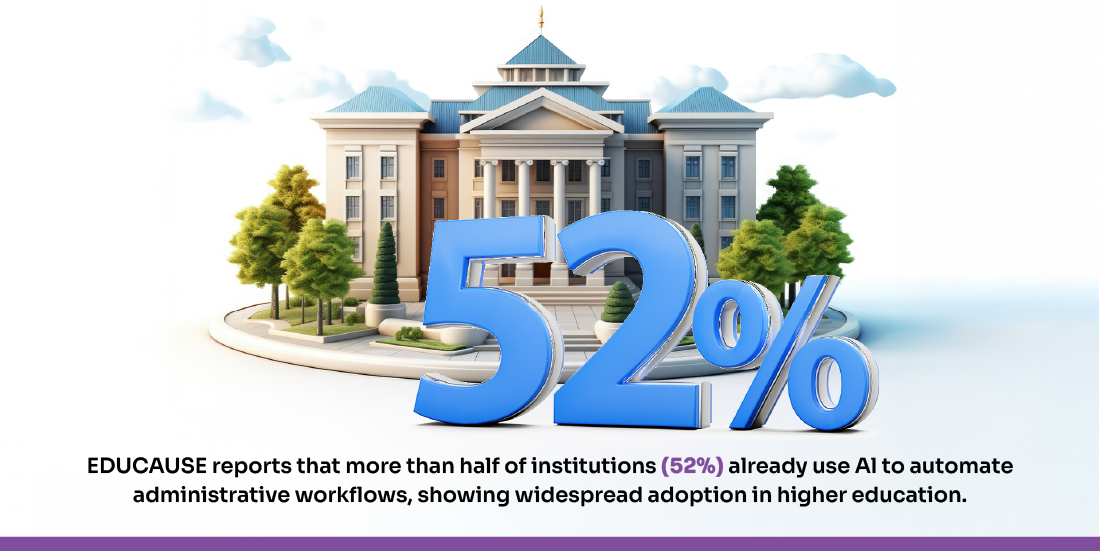
AI reduces the need for manual data entry, cutting down errors such as misclassification, omissions, or incorrect extraction. Machine learning continuously improves as it processes new data, enhancing accuracy over time. EDUCAUSE reports that more than half of institutions (52%) already use AI to automate administrative workflows, showing widespread adoption in higher education. This ensures more reliable information for better decision-making and compliance with regulations.
Time and Cost Efficiency
Manual document handling consumes large amounts of staff time across admissions, registrar, and finance departments. AI-based automation reduces repetitive tasks, allowing teams to focus on higher-value work. For example, Purdue University saved over 17,000 staff hours using AI-enabled document and workflow automation, improving efficiency and reducing operational costs. With EDMO’s GPA Calculator, universities can quickly compute and standardize student GPAs from diverse international transcripts. This not only saves time but also helps admissions teams identify the best-fit candidates and make faster, more accurate enrollment decisions.
Seamless Scalability
AI document analysis systems can process large volumes of documents ranging from thousands to millions without compromising performance. As organizations grow and document volumes increase, AI solutions scale effortlessly without the need for additional staff or infrastructure, ensuring consistent efficiency.
Strengthened Compliance and Reduced Risk
AI helps organizations maintain compliance by embedding regulatory rules directly into document workflows. Automated monitoring, validation, and alert systems reduce the risk of missing critical information and ensure consistent adherence to legal and regulatory requirements. This minimizes exposure to compliance violations and costly penalties. Organizations that integrate AI can cut time spent on audit and compliance tasks by over 40%, enabling teams to detect and address risks faster than with traditional manual processes.
Faster and Better Decision-Making
AI enables real-time access to structured document data, allowing decision-makers to retrieve critical information instantly. Tasks that once took hours or days, like evaluating course equivalencies across institutions, can now be completed in minutes. With accurate and up-to-date data, universities can make consistent, fair, and timely credit decisions. EDMO’s Transfer Credit Evaluator takes this a step further by clearing transcript backlogs in minutes, extracting course and grade details, mapping credits precisely to degree requirements, and identifying top candidates quickly.
Optimized Resource Utilization
Automating document analysis frees employees from repetitive administrative work, allowing them to focus on strategic projects and complex problem-solving. Teams can use their skills more effectively, improving productivity and operational efficiency. According to IDC, organizations that successfully integrate AI into workflows improve data utilization by 40%. This not only enhances output but also boosts employee satisfaction by reducing mundane workloads.
By improving accuracy, scalability, compliance, and decision-making, AI transforms document management into a strategic asset enhancing overall organizational performance and information value.
How AI-Powered Document Analysis Works
AI-powered document analysis combines machine learning (ML) and natural language processing (NLP) to automate how organizations capture, understand, and use information from documents. The primary objective is to extract key data from both structured and unstructured documents, accurately classify the information, and seamlessly integrate it into business workflows while minimizing human involvement. Below is an overview of how AI document analysis solutions typically function:
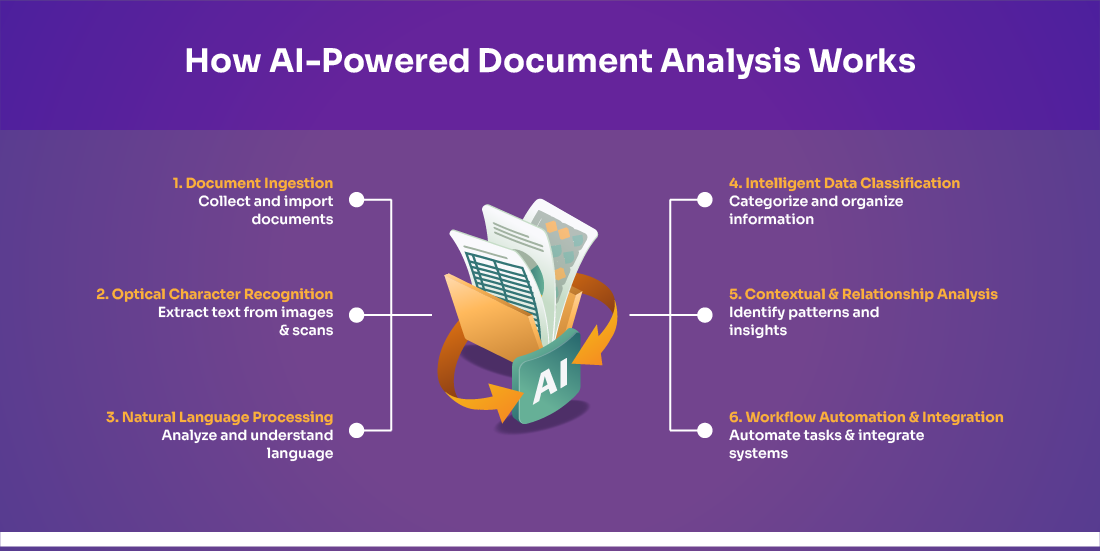
Document Ingestion
The process begins with ingesting documents in multiple formats, including scanned paper files, PDFs, images, and digital documents. AI systems are designed to handle a wide variety of formats, allowing organizations to centralize all document types within a single platform or repository for easier management and access.
Optical Character Recognition (OCR)
For documents that are not machine-readable, such as scanned images or image-based PDFs, AI applies OCR technology to convert visual content into editable and searchable text. This step enables the system to “read” printed text accurately and prepare it for further analysis.
Natural Language Processing (NLP)
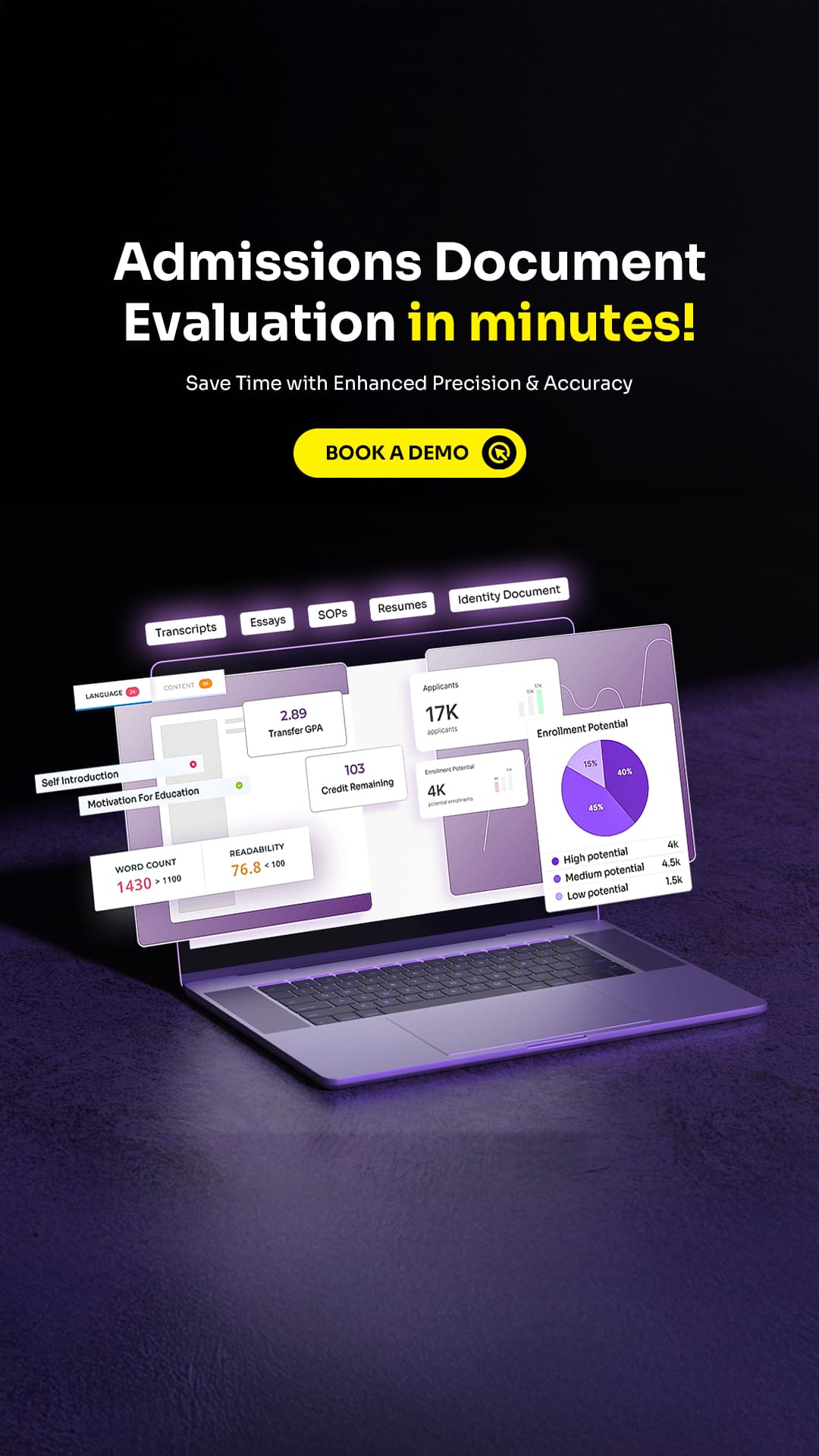
Natural Language Processing (NLP) enables AI systems to read, understand, and interpret human language within documents. Instead of relying on basic keyword searches, NLP analyzes context, sentence structure, and meaning to accurately identify important information such as names, dates, scores, amounts, and contractual clauses even when presented in varied formats. NLP-based systems can process application-related content up to 80% faster than manual review, improving speed, consistency, and accuracy when working with unstructured text. With EDMO’s Application Evaluator, universities can analyze SOPs, LORs, and transcripts instantly, generating actionable insights that support smarter and faster enrollment decisions.
Intelligent Data Classification
Once information is extracted, AI automatically categorizes documents based on predefined rules or learned patterns. This may include sorting invoices, contracts, academic records, legal documents, or application forms into appropriate categories. Automated classification ensures consistency and reduces the risk of misplaced or misfiled documents.
Contextual and Relationship Analysis
Advanced AI systems go beyond extraction and classification by understanding the relationships between different pieces of information. For example, in a contract, AI can associate specific clauses with relevant obligations or identify terms that affect a particular agreement, enabling deeper document insight.
Workflow Automation and Integration
AI-driven document analysis enables seamless integration with existing digital workflows after documents are processed. For example, invoices can be automatically routed to accounts payable for approval, while contracts are forwarded to legal or compliance teams for review. This automation reduces manual handoffs, speeds up processing, and improves overall operational efficiency. Studies show that around 50% of institutions are expanding access to AI tools to streamline internal processes, including automated routing and workflow integration, reflecting a growing investment in AI-powered administrative capabilities.
AI-powered document analysis fundamentally transforms traditional document processing. By automating ingestion, interpretation, classification, and workflow integration, AI enables faster, more accurate, and more scalable document management turning documents into actionable data.
Key Use Cases of AI-Powered Document Analysis
AI-powered document analysis is a versatile technology that helps organizations across industries automate, streamline, and optimize document management tasks. By extracting key information, classifying documents, and integrating data into workflows, AI enables faster, more accurate, and more efficient operations. Below are some common applications:
Invoice Processing
AI can automatically extract critical details from invoices, including invoice numbers, vendor names, line items, and payment amounts. Processed invoices can then be routed digitally for approval, reducing manual data entry, accelerating payment cycles, minimizing errors, and helping prevent fraud.
Contract Review and Management
AI can review contracts, extract key terms, deadlines, and conditions, and compare them against existing benchmarks or compliance requirements. This accelerates contract review processes, making it easier for legal teams to manage multiple agreements simultaneously while reducing the risk of oversight.
Customer Onboarding
In regulated industries like banking, insurance, and finance, AI simplifies the onboarding process by automatically verifying customer documents such as IDs, proof of address, and application forms. This ensures faster, more accurate verification while reducing manual workloads and potential errors.
Legal Document Review
Law firms and legal departments can use AI to process large volumes of legal documents, identify relevant clauses, and flag inconsistencies or risks. This significantly reduces the time spent on manual review, allowing legal professionals to focus on higher-value tasks and strategic work.
Healthcare Records Management
In healthcare environments, AI-powered document analysis helps process medical records by accurately extracting patient information and organizing documents for easy access. This ensures clinicians and staff can quickly retrieve critical data, improving patient care and clinical decision-making. Automating document handling also reduces administrative workload and supports compliance with healthcare regulations. In large healthcare systems, automation can save up to 15,000 employee hours per month, cut document turnaround times by 40–50%, and achieve accuracy levels close to 99.5%.
Compliance Monitoring and Risk Management
AI can automatically monitor documents for adherence to industry regulations. By identifying relevant data and comparing it against regulatory requirements, AI can flag potential risks, highlight non-compliant documents, and help organizations maintain legal and regulatory compliance.
Document Processing
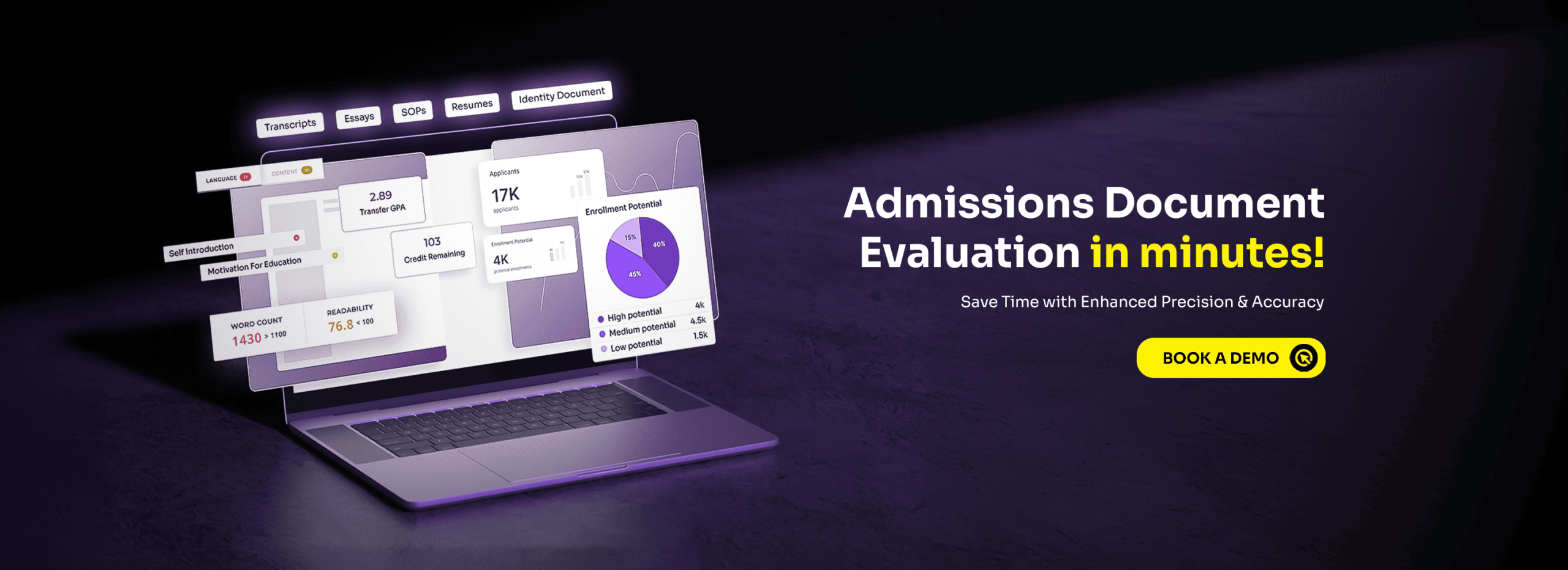
Universities and colleges can use AI to analyze student applications, transcripts, letters of recommendation, and enrollment forms. AI tools can evaluate transfer credits, standardize GPAs from international transcripts, and flag missing or inconsistent information, speeding up admissions decisions and improving staff efficiency.
AI-powered document analysis is a multi-purpose solution that transforms traditional document workflows across industries.
Core Evaluation Criteria for AI-Powered Document Review
Selecting the right AI solution for document review requires a clear understanding of both your organization’s needs and the limitations of traditional manual review. Not all AI systems perform equally, so it’s essential to evaluate potential solutions based on key criteria:
Accuracy and Domain-Specific Training
The most effective document review AI delivers high accuracy within your specific domain. Systems trained on domain-specific datasets can interpret specialized terminology, contextual nuances, and industry-specific rules that generic AI models may miss. For example, in contract analysis, benchmark accuracy rates for key clause identification should typically exceed 90% to ensure reliable insights and minimize errors.
Integration Capabilities
AI document review solutions rarely operate in isolation. The best systems integrate seamlessly with existing document management platforms, communication tools, and workflow applications. Look for vendors that offer robust APIs, pre-built connectors, and compatibility with your technology stack to enable smooth adoption without disrupting current operations.
Security and Compliance
Document review processes often involve sensitive and regulated information, making security a critical requirement when adopting AI solutions. Institutions should ensure their AI vendors comply with recognized standards such as ISO 27001 and SOC 2 Type II, and follow transparent data handling and privacy practices. Secure deployment options whether on-premises or cloud-based along with strong data residency and access controls help protect confidential information. Reflecting this priority, concerns around data privacy and security among higher-education administrators have risen from 50% to 59% year over year, highlighting the growing focus on secure and responsible AI deployment.
Total Cost of Ownership (TCO)
Evaluating cost goes beyond the initial license fee. Consider implementation expenses, employee training, and ongoing maintenance requirements. The most cost-effective solution may not have the lowest upfront price but delivers higher long-term ROI by reducing manual review workloads, improving accuracy, and minimizing operational risks.
Scalability and Performance
Document volumes can vary with seasonal workloads, regulatory deadlines, or business cycles. A high-performing AI system maintains consistent speed and accuracy under peak loads. Test potential solutions with your typical document volumes and diversity to ensure they can scale effectively without compromising performance.
Governance and Responsible AI in Ethical Document Review
AI-powered document review tools bring speed and efficiency, but their success depends on how responsibly they are used. Strong governance is necessary to ensure ethical use, reduce risks, and build trust. Below are the key governance pillars for responsible AI-based document review:
Bias Detection and Mitigation
AI systems can unintentionally reflect or amplify biases present in their training data, which may affect decision-making outcomes. To reduce this risk, organizations implement structured bias-testing frameworks aligned with standards such as the NIST AI Risk Management Framework. These evaluations assess AI outputs across different document types to identify inconsistencies, unfair patterns, or skewed results. Corrective actions are then applied to improve fairness and reliability. As of spring 2025, fewer than 40% of colleges and universities have formal AI acceptable-use policies, leaving bias and equity risks insufficiently governed across many campuses.
Transparency and Explainability
For AI to be trusted in document review, its decision-making process must be understandable. Effective solutions provide explainability features such as confidence scores for extracted data and clear reasoning behind classifications. Maintaining detailed audit logs of AI actions, system decisions, and human interventions further enhances accountability and regulatory compliance.
Human Oversight and Control
Responsible use of AI requires people to stay involved in the document review process. Documents with high risk or low AI confidence should be flagged for manual review. Effective workflows include clear review checkpoints based on document sensitivity and confidence scores, ensuring experts verify important decisions before approval.
Security and Data Privacy in AI-Driven Document Review
Responsible AI governance goes beyond ethical considerations and extends to strong security and privacy protections. When AI systems handle highly sensitive documents such as academic records, admissions files, financial data, or compliance documents the underlying security architecture is just as critical as the AI’s analytical performance. Below are the key security and privacy considerations organizations should evaluate:
Secure Data Protection Models
Modern AI document review platforms offer flexible deployment models to meet varying security and compliance needs. Common approaches include:
- Zero-trust cloud environments with end-to-end encryption to protect data at rest and in transit
- Private cloud deployments hosted in specific geographic regions to meet data residency and regulatory requirements
- On-premises solutions for institutions that require complete control over their data and infrastructure
These options allow organizations to align AI adoption with their internal security policies and compliance standards.
Platform Security and Infrastructure
Security in AI-driven document processing must go beyond basic compliance certifications. Organizations should evaluate a provider’s overall security framework, including access controls, continuous monitoring, and incident response capabilities. While adoption is growing, security readiness still lags behind. A 2025 report found that 87% of organizations use cloud-based AI services, yet 31% cite a lack of AI security expertise as a major concern, highlighting the gap between adoption and secure implementation.
Data Usage and Privacy Commitments
It is essential to understand how vendors handle customer data. Institutions should confirm whether uploaded documents are ever used for AI model training. Leading AI providers now offer clear contractual assurances that customer data remains private and is not used to train or improve their models, ensuring confidentiality and regulatory compliance.
Best Practices for Implementing AI Solutions in Higher Education
Implementing AI in higher education requires strategic planning, ethical oversight, and continuous support to maximize benefits while protecting sensitive data. Here are five best practices institutions should follow:
Align AI Strategy with Institutional Goals
AI initiatives should be aligned with an institution’s mission and long-term priorities, such as improving learning outcomes, streamlining administrative processes, or enhancing student experiences. Clear alignment ensures AI is adopted responsibly and delivers measurable impact rather than being implemented in isolation. Research shows that 81% of institutions view AI as a strategic focus, yet only a small number have formal AI strategies in place. This gap highlights the need for intentional planning to effectively integrate AI into institutional decision-making and operations.
Establish Comprehensive AI Governance
Form a cross-functional governance committee to oversee AI implementation, address ethical considerations, manage risks, and evaluate outcomes. This framework promotes transparency, accountability, and consistent decision-making across departments.
Provide Training and Support for Staff
Institutions should offer both foundational and role-specific AI training for faculty, administrators, and support staff. Equipping users with knowledge helps them use AI tools effectively, promotes adoption, and reduces errors or misuse. Research shows that among institutions aiming to strengthen workforce AI skills, 69% focus on upskilling or reskilling existing staff and faculty. Providing continuous guidance and support ensures that AI initiatives are used responsibly and deliver maximum benefit across the campus.
Prioritize Privacy and Data Security
AI solutions should integrate privacy-by-design principles, including data anonymization, encryption, and secure access controls. Protecting sensitive student and institutional information is essential for maintaining trust and regulatory compliance. A survey found that 67% of respondents identified six or more AI-related risks as “urgent”, with top concerns including misinformation, unauthorized data use, and loss of critical independent thinking skills. Prioritizing security and privacy ensures AI adoption is safe, ethical, and reliable.
Measure Impact and ROI
Institutions should implement tools to track efficiency gains and return on investment (ROI) for AI initiatives. Measuring performance allows better resource allocation, demonstrates the value of AI projects, and guides future adoption decisions. However, only 13% of institutions currently measure ROI for work-related AI tools, highlighting a major opportunity to improve accountability and strategic planning. Monitoring impact ensures AI initiatives deliver tangible benefits and support institutional goals.
Conclusion
Choosing the right AI tool for document analysis is essential for organizations that want to boost efficiency, reduce errors, and ensure compliance. Modern AI solutions can handle multiple document types, automate workflows, and provide actionable insights, allowing staff to focus on higher-value tasks. By leveraging an AI tool, organizations can accelerate operations, enhance data accuracy, and make timely, informed decisions making it a critical strategy in today’s digital and information-heavy environment.
Frequently Asked Questions
Question 1. How accurate are AI document review systems compared to human review?
Question 2. What types of documents work best with AI review?
Question 3. How long does implementation typically take?
Question 4. Do AI review systems require ongoing training?
Question 5. What’s the difference between general AI like ChatGPT and specialized document review AI?
Question 6. Can AI review systems handle multiple languages?
Question 7. Can the AI Document Analyzer handle complex documents?
Question 8. What are the best document analysis tools with support and integration?
Question 9. How does an AI document analysis tool improve efficiency?
Written By






No comments yet. Be the first to comment!
Leave a Comment